
Short answer: Online Quran classes give Muslim families in The Hague access to live, one-on-one Ijazah-certified tutors across Noorani Qaida, Tajweed, Hifz, Tafseer and Quranic Arabic, scheduled around The Hague time with a free trial before any payment. Families searching for online quran classes in the hague will find full pricing, scheduling and trial-class details below.
The Hague’s Muslim community is estimated at close to 15% of the city’s roughly 550,000 residents, among the highest shares in the Netherlands, concentrated in areas including Transvaal, Schilderswijk and Laak.
Why The Hague Families Are Choosing an Online Quran Academy
The Hague’s Muslim community is spread across multiple neighbourhoods, and a well-regarded local tutor in one part of the city isn’t much use to a family living across town. Online classes remove that limit: pick a tutor by teaching style and specialism, and the class happens over video wherever in The Hague you live.
- One-to-one, not group classes: full tutor attention every session, not shared among six or more students.
- Ijazah-certified tutors: a formal chain-of-transmission certificate verifying the tutor’s own recitation.
- Flexible scheduling: weekday evenings, weekends, or a mix, without a fixed classroom timetable.
- A genuine free trial: a real class with the actual tutor, not a sales consultation.
What Online Quran Classes in The Hague Cost in 2026: The Real Range
What it does not say is what that actually costs, or what a family should expect to pay for a proper one-to-one class with a qualified tutor. This section puts numbers on it: what the market charges, what each plan costs per class, and why the cheapest number on a homepage is rarely the cheapest price over a year.
The Range, in Plain Numbers
Start with the range. The named academies on this page charge from $25 to $75 a month for a one-to-one online Quran plan, and the middle of the market, where most families actually buy, sits between $30 and $50 a month for 8 to 16 classes. The point is not that one of these is right and the others are wrong. What one family pays tells you almost nothing about what another should pay, because the number bundles together the course, the tutor, the length of each class, how many classes a week, and who is paying from where. A thirty-minute class is not the same product as an hour class, and $40 a month for 8 classes is $5.00 a class. A $40 a month for 16 classes is $2.50 a class, and the per-class number is the one to watch, not the monthly number. The named academies all charge in US dollars, and the currency matters: QuranlyHub charges in euros, and a family paying in euros from a Dutch account should compare the euro price with the dollar price after conversion, not before. A $40 plan that leaves a Dutch account as €37 is cheaper than a €40 plan, and the difference is small, but it is real.
Why One Number Never Fits Every Family
First is the course: Noorani Qaida is a shorter, simpler course than Tajweed, and Hifz is a longer commitment than either, so the price follows the course, not the other way round. Second is frequency: a child who takes 20 classes a month pays more in total than a child who takes 8, but less per class, because the tutor’s time is bought in bulk. Third is class length: a 60-minute class costs more than a 30-minute class, and a 30-minute class is the standard for a child. Tutor experience comes fourth: a tutor who teaches several recitation styles, or who has taught for many years, may be priced higher than a new tutor.
Online vs In-Person: Where the Money Actually Goes
An online class is usually cheaper than an in-person class for the same thirty minutes, and the reason is simple: there is no room to rent, no travel time, and no printed material to buy. An online class pays for the tutor’s time and nothing else, and the tutor can teach from anywhere, which is why a family can choose from a wider pool than the teachers in their own town. A mosque weekend school can still be the cheapest option of all, because the teaching is often given by volunteers, the class meets once or twice a week, and the fee is a token one — but a weekend school is a group class, and the teacher’s time is shared, so a child who needs one-to-one teaching, at the child’s own pace, with a tutor who knows exactly where that child stopped last time, will not get that from a group. That matters most in the neighbourhoods where the community is concentrated, Transvaal, Schilderswijk and Laak, and just as much in Scheveningen, Segbroek, Escamp, Loosduinen and Leidschenveen-Ypenburg, where a family may live far from the nearest weekend school.
Female Quran Teacher in The Hague
Requests for a female tutor come up often among The Hague families, for daughters and mothers alike. This is available at the standard price with no waiting list. Any of the seven courses can be booked one-to-one by an adult woman, at her own pace.
What Happens in Your Free Trial Class
Every plan on this page starts the same way: with one free 30-minute class, on Zoom, with a real tutor, before you pay anything. No card is taken, and nothing is charged if you decide not to continue. That is the whole of the offer, and it is worth spelling out, because a free trial is only useful if you know what to look for inside it. Here is what actually happens, minute by minute, and what to ask before the class ends.
Inside the Trial: What the Tutor Actually Does
The tutor starts by listening, not by teaching. Your child reads a few lines, usually from wherever they stopped last, and the tutor notes exactly which letters need work: the throat letters, the heavy and light sounds, and how long each madd stretches. That listening takes about five minutes, and it decides everything that follows, because a tutor who has heard your child read can place them at the right level instead of guessing. Then the tutor teaches for about fifteen minutes, at that level, with the child reading and the tutor correcting pronunciation letter by letter. In the last five minutes the tutor tells you plainly what level your child is at, what the next three months would look like, and which plan fits: eight classes a month for a steady start, or sixteen for a child who wants to move faster. Class times are set in The Hague time, CET in winter and CEST in summer, and the tutor in Pakistan is four hours ahead in winter and three hours ahead in summer, so an evening class in The Hague is a late-evening class for the tutor, and that is already built into the schedule.
What Other Academies Offer Before You Pay
A free first class is now the normal way to start, and the other academies all offer something before they ask for payment. Tibyan starts with a free trial class, with no registration fee and no contract. Al-Noor Academy starts with three free classes. Al Noor Islamic Center, a different organisation with a similar name, offers three free trial classes with every plan. Noor Ul Quran offers a three-day free trial with no upfront payment. QuranlyHub’s trial is one free 30-minute class, and the plans that follow it start at €30 a month.
Four Questions to Ask Your Trial Tutor
Ask these four questions before the trial ends, and write the answers down. First, what level is my child at, and what exactly needs fixing? A good tutor names the letters, not just the level. Second, how many new lines will my child learn each day, and how much revision will there be? The answer should be a number, not a promise. Third, who will teach the paid classes, the same tutor or someone else? If the trial tutor is not the class tutor, ask to meet the class tutor before you pay. Fourth, what happens if the tutor is away or my child is ill? The answer should be a makeup class, not a lost class. If a tutor answers all four clearly, you have found a good one. If a tutor cannot answer them, the trial has done its job anyway: it has told you not to pay.
Tajweed Classes in The Hague
Most students in The Hague can already read Arabic script — what’s often missing is correction. Our Tajweed course gives live, one-to-one feedback on makharij and elongation rules that a group class or weekend school rarely has time for. See our full Tajweed course page.
Hifz Course in The Hague
Our online Hifz course follows a structured daily sabaq (new memorisation), sabqi (recent revision) and manzil (long-term revision) cycle, one-to-one with a dedicated Hafiz tutor — the same structure a residential programme would use, without leaving The Hague. See our full Hifz course page.
Quranic Arabic and Tafseer for Students in The Hague
Understanding the text is a common goal among The Hague students, not just reciting it. Our Quranic Arabic course covers the grammar for that directly; our Tafseer classes cover meaning, referencing Ibn Kathir and Al-Jalalayn.
A City Shaped by an International Muslim Community
The Hague’s Muslim community looks a little different from many Dutch cities because of what The Hague itself is: the seat of the Dutch government and home to international bodies including the International Criminal Court and International Court of Justice, which brings a steady flow of diplomatic and international families through the city alongside its long-established Moroccan, Turkish and Surinamese-heritage communities in areas like Transvaal and Schilderswijk. That mix means a lot of Hague families are either relatively new to the city, moving every few years with a posting, or juggling a household where English, Dutch and a home language are all in daily use.
For families who may only be in The Hague for a contract of two or three years, building a relationship with a single local mosque or tutor often doesn’t make sense the way it would for a family settling permanently — and a move partway through a school year shouldn’t mean starting a child’s Qur’an education over with someone new. Online classes solve that specific problem: a tutor who already knows a child’s level, pace and the specific mistakes they’re working on can continue the relationship by video regardless of which city or country the family relocates to next. For The Hague’s more settled families, the same tutor-matching applies in reverse — choosing a teacher by specialism and teaching style rather than whoever happens to be reachable nearby.
Pricing: What Online Quran Classes in The Hague Actually Cost
Tafseer costs €70 a month for 12 classes, three days a week. The following plans cover Noorani Qaida, Tajweed, Advanced Tajweed, Hifz and Quranic Arabic, with four schedules to fit a The Hague week:
| Plan | Classes / Month | Schedule | Price |
|---|---|---|---|
| Weekend Plan | 8 classes | Sat & Sun | €30/month |
| 3 Days a Week | 12 classes | Any 3 weekdays | €35/month |
| 4 Days a Week Most Popular | 16 classes | Any 4 weekdays | €40/month |
| 5 Days a Week | 20 classes | Mon to Fri | €45/month |
All plans include a free trial class, monthly progress reports, and a dedicated Ijazah-certified tutor. Enrolling siblings? Every additional child in the same family gets a 10% discount. See the full pricing page for the Alim & Aalimah scholar track.
What Online Quran Classes in The Hague Cost, in Plain Numbers
Thirty euros a month could mean eight classes or twenty, depending on the plan, so the pricing paragraph on this page needs translating into plain numbers. This section does that: what each plan costs per class, what a second child costs, how the prices compare with other academies, how long each course takes, what it costs over time, and the fine print on payment, refunds and makeup classes.
QuranlyHub’s Four Plans, and What Each Class Costs
The four plans on this page are the whole price list: €30 a month for 8 classes, €35 a month for 12 classes, €40 a month for 16 classes, and €45 a month for 20 classes. Every class is 30 minutes, live and one-to-one on Zoom, with the same teacher each week. The 16-class plan at €40 a month is the most popular, and the arithmetic shows why: the 8-class plan works out at €3.75 a class, the 12-class plan at about €2.92 a class, the 16-class plan at €2.50 a class, and the 20-class plan at €2.25 a class. The more classes you book, the less each one costs, and the 20-class plan is the cheapest per class on the page. A second child in the same family gets a 10 percent discount on the same plans, which works out at €27 a month for 8 classes, €31.50 for 12 classes, €36 for 16 classes, and €40.50 for 20 classes, and the second child gets a different class time, not a shared one. Every plan includes a free trial class first and a monthly progress report, and all classes are one-to-one on Zoom, with the same teacher every week, and each class is 30 minutes long. Tafseer costs €70 a month for 12 classes, three days a week, taught in Urdu or English, and the difference between tarjuma and tafseer is explained in our guide. The Tafseer price is in euros, seventy euros a month, while the four plans above are also in euros, and the Alim and Aalimah scholar track is priced the same way: €80 a month for 8 sessions or €100 a month for 16 sessions, with each session lasting 40 minutes. That is the full price list, and the prices above are the prices you pay. See the full pricing page for every plan in one place.
How do those prices compare? Tibyan charges $30 a month for 4 classes, $35 for 8, $40 for 12 and $50 for 20, with a free trial first and no registration fee. Al-Noor Academy starts at $35 a month. The Al Noor Islamic Center charges $40 a month for 8 classes, $50 for 12, $65 for 16 and $75 for 20. Noor Quran Institute charges $49 a month for standard classes, $59 for Tajweed and Hifz, and $69 for Arabic. Al Noor Tuition charges $9 to $30 an hour, which works out at about $54 to $180 a month for three half-hour lessons a week. Noor Academy charges $32 a month for 8 classes, $38 for 12, $51 for 20 and $44 for its weekend plan, in dollars as published. Noor Ul Quran charges $35 a month for its weekend plan, $48 for its regular plan and $75 for its intensive plan. Every one of those prices is in dollars, as the academy charges it, and none of them has been converted. On the numbers alone, QuranlyHub’s euro table sits in the same range as the dollar prices the named competitors charge, and a family in The Hague pays the euro figure exactly as printed, with no conversion at the bank.
How Long Each Course Takes, and What It Costs Over Time
Noorani Qaida takes 2 to 3 months on the 16-class plan, or 3 to 5 months on the 8-class plan, for a child starting from the alphabet. At the 16-class rate of €40 a month, a Qaida course works out at about €80 to €120 in total, and at the 8-class rate of €30 a month it works out at about €90 to €150. Hifz takes 2 to 2.5 years, at 7 to 8 new lines a day, with daily revision of the new lesson, the recent lessons and the older portion, the sabaq, sabqi and manzil that every Hifz student learns to manage. Children usually finish Juz Amma, the last 37 surahs of the Quran, in 2 to 3 months, and that short section is the best first test of whether a child is ready for full Hifz, which follows our step-by-step Hifz method. At the 16-class rate, two years of Hifz works out at about €960 in monthly fees, and two and a half years at about €1,200, which is why the per-class price matters more than the monthly headline over a long course. Quranic Arabic takes 9 to 12 months. No confirmed duration is published for Tajweed or for Tafseer, and this page does not invent one: a Tajweed student’s timeline depends on how many letters need correcting, and a Tafseer student’s timeline depends on how much of the Quran they want to study. Ramadan in 2027 falls in February and March, when the days are still short, and class times move earlier in the day during the fast, as they do for every family. Homework is set only for Hifz students, never for Qaida, Tajweed or Tafseer, so a parent does not need to police a worksheet every evening.
The Fine Print: Payment, Refunds and Makeup Classes
Fees are paid in advance, by bank transfer, before the month’s classes begin. If a student leaves on their own, the advance fee is not refunded. If the teacher cannot continue, the fee is refunded. If the teacher misses a lesson, the lesson is made up at another time that suits the family. If the student misses a lesson, the lesson is not automatically made up, so tell the tutor as early as you can and ask what can be rearranged. A parent may sit in on any class, and a class may be recorded for the family to watch again, with the tutor’s agreement. The trial class itself is free, and nothing is charged until the family chooses a plan after it.
All 7 Online Quran Courses in The Hague, One Platform
Whichever course your family starts with, the same tutor-matching and free trial process applies across all seven, for every age from Noorani Qaida beginners to the Alim & Aalimah scholar track:





Also Available in the Netherlands
Book Your Free Trial Class
See for yourself before you commit to a plan. Book a free trial class with an Ijazah-certified tutor, matched to your child’s or your own age, level and preferred schedule.
Frequently Asked Questions
Is it safe for my child to learn Quran online in The Hague?
Yes — every class is one-on-one over video with a vetted, Ijazah-certified tutor, and a parent can stay nearby throughout.
Can complete beginners join, or do I need prior knowledge?
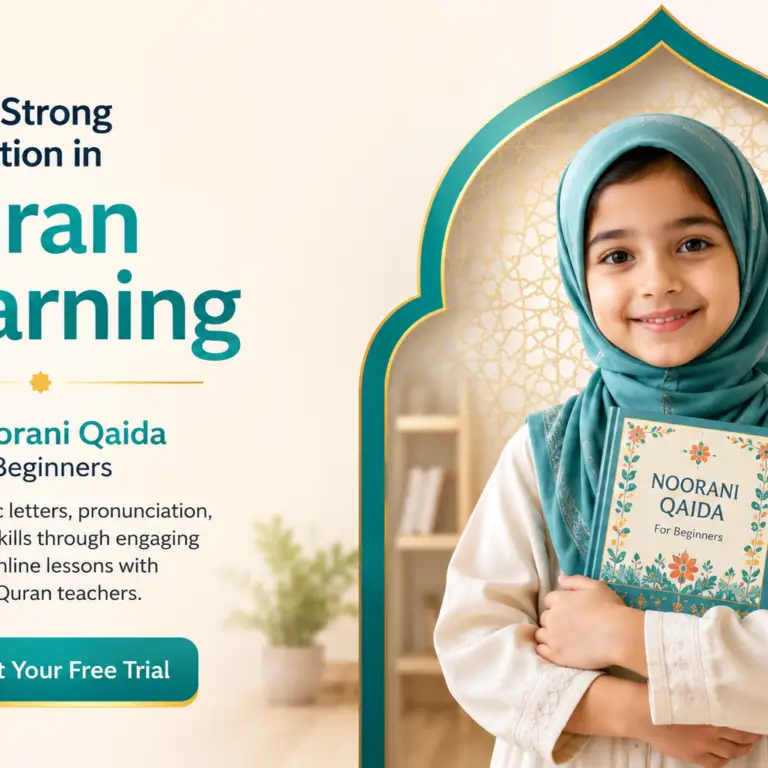
Complete beginners start with Noorani Qaida — letters, joining rules and basic Tajweed — before moving to full Quran reading.
Is a female Quran tutor available in The Hague?
Yes, at no extra cost — mention your preference when booking your free trial.
Can adults join, or is this only for children?
Adults join just as often as children, especially for Tajweed correction, Tafseer, or starting from zero as a new Muslim.
How much do online Quran classes cost in The Hague?
€30/month for 8 classes, up to €45/month for 20 classes, one-on-one, 30 minutes each. Tafseer costs €70 a month for 12 classes, three days a week.
Is there a free trial before I pay?
Yes — every course starts with a free trial class, no card required.
What if my family relocates partway through the course?
Classes continue with the same tutor by video wherever you move to — useful for The Hague’s many diplomatic and internationally mobile families who may only be in the city for a few years.
How We Keep Your Child Safe Online
A parent handing a child to a teacher on a screen is right to ask how that child is kept safe. This page says nothing about safeguarding at all, and this section does not invent a certificate to fill that gap. It states plainly what checks exist, what checks do not exist, and the four things a parent should do before the first paid class.
What No Online Tutor Can Show You
Every tutor at QuranlyHub is Ijazah-certified, which means a named teacher granted that tutor’s Ijazah and can be asked about it. That is a teaching certificate, not a safeguarding certificate, and the two should not be confused. In the Netherlands, a person who works with children holds a VOG, a Verklaring Omtrent het Gedrag, a certificate of good conduct issued by the Dutch authorities. In Britain, the equivalent is an Enhanced DBS check. In Canada, it is a vulnerable sector check. In Australia, it is a working with children check. None of those checks exists for an overseas online tutor, because each one is issued by one country for people working with children in that country, and a tutor teaching from Pakistan cannot hold a Dutch, British, Canadian or Australian certificate. In the United States the position is the same, only messier: there is no single national scheme at all, and background checks for people working with children are set state by state, so no federal certificate exists that an overseas online tutor can hold either. So no honest academy can show you a safeguarding certificate for an online tutor, and any academy that claims one is not telling the truth. What QuranlyHub can show you is the tutor’s identity, verified and reference-checked, the tutor’s Ijazah and the teacher who granted it, and a safeguarding contact, Adeel Ahmad, who answers for every class. If a parent wants a check beyond that, the honest answer is that the check does not exist, and the parent should judge the academy on the four checks below instead.
Four Checks Before the First Paid Class
First, sit in on the trial class, and stay for the whole 30 minutes. You will hear how the tutor speaks to your child, and your child will tell you afterwards whether they liked the lesson. Second, ask for the tutor’s full name and Ijazah details, and check that the tutor on the trial is the same teacher who will teach the paid classes. Third, ask who the safeguarding contact is and how to reach them: at QuranlyHub it is Adeel Ahmad, and the contact is given to every family before the first paid class. Fourth, agree the practical rules before you pay: the camera stays on for the child, the class is held on Zoom and not on a private call, a recording of the class is available to the family, and no lesson happens without a parent knowing the time. Those four checks cost nothing, take one trial class to run, and tell you more about an academy than any certificate on a website.
A Female Teacher for Your Daughter, at No Extra Cost
Girls and daughters learn only with a female teacher, and that should not cost extra. At QuranlyHub a female teacher is available at no extra cost, for every course on this page, from Noorani Qaida to Tafseer. The female teacher is a Hafiza, a woman who has memorised the whole Quran. A female teacher costs nothing extra, and the trial itself can be taken with that teacher, so the family meets the real tutor before paying. Our guide to finding a female Quran teacher online explains what to look for and what to ask, and it is linked here for any parent who wants to read it before booking.