Montenegro’s Muslim population, close to a fifth of the country, is concentrated in and around Rožaje and Plav near the border with Serbia’s Sandžak region, a cultural and family tie that runs deeper than the modern border. Short answer: QuranlyHub serves families there and in Podgorica with a one-to-one, Ijazah-certified tutor for Noorani Qaida, Tajweed, Hifz, Tafseer or Quranic Arabic, on a CET-friendly schedule, with a free trial class before any payment.
Montenegro is home to an estimated 118,000-130,000 Muslims – around one-fifth of the population, per the 2011 census, anchored by community hubs such as mosques across Rožaje, Plav and the capital Podgorica. Even in a country with a large or long-established Muslim population, finding a specific tutor gender, teaching pace or evening time slot can still mean a wait. Online Quran classes in Montenegro solve that directly – your family is matched with an Ijazah-certified tutor and a schedule built around your own week. This guide covers how it works, alongside our full pricing page, Learn Quran Online overview, and comparison of local vs online Quran classes.
Montenegro’s Muslim Community: What’s Actually Known
Montenegro is home to an estimated 118,000-130,000 Muslims – around one-fifth of the population, per the 2011 census. The community is organised around mosques and centres including mosques across Rožaje, Plav and the capital Podgorica, with families spread across Podgorica, Rožaje and Plav.
Montenegro’s Two Muslim Regions: The Northeast and the Coast
The 2023 census counted 124,668 Muslims in Montenegro, almost exactly one in five people in the country. That is the headline number, and it hides the real story. Montenegro’s Muslims do not live in one place, and they are not one community. They live in two clusters, a day’s drive apart, with different histories, different home languages, and different mosques. Online Quran classes in Montenegro work because they reach both clusters the same way, and a family in either one gets the same teacher, the same timetable, and the same choice of courses.
Rožaje, Plav and the Sandžak Northeast
The northeast is where most of Montenegro’s Muslims live. Rožaje, a town of about 23,000 people in the 2023 census, was almost 95 percent Muslim in the 2011 census, the highest share of any municipality in the country. Plav sits beside it, and Bijelo Polje, Petnjica and Gusinje fill out the same corner of the map, all of them part of the Sandžak region that runs across the border into Serbia. The families here are mostly Bosniak, and the ties across that border are family ties, not just geography. Cousins live on both sides of it. The Sultan Murat Mosque in Rožaje has stood there since the 1400s, and it is still the centre of the town’s religious life.
A small town has a small choice of teachers. That is the plain truth of it. A family in Rožaje or Plav who wants a female teacher for a daughter, or a Hifz teacher who follows sabaq, sabqi and manzil properly, or an evening slot that fits around school, will usually find one option locally, or none. Online, the choice opens up. The same teacher who teaches a student in Podgorica teaches a student in Rožaje, on the same Zoom setup, for the same 30 minutes. If your child is finding a page hard, our guide on how to memorize the Quran step by step walks through the same method step by step, so you can see what the teacher is doing and why.
Ulcinj, Tuzi and Bar: The Albanian Coast
The second cluster sits on the southern coast, and it speaks Albanian at home. Ulcinj is the centre of it. Albanians were 30,978 people in the 2023 census, about 5 percent of the country, and nearly three quarters of Ulcinj’s population is Albanian. The town was about 72 percent Muslim in the 2011 census. Tuzi, just outside Podgorica, is close behind at nearly 63 percent Albanian. The Namazgjahu Mosque in Ulcinj dates from 1728, and the Sailors’ Mosque stands a short walk from the old town walls. Bar, twenty minutes up the coast, has a smaller but long-settled Muslim community of its own.
Coastal life runs on a different clock. A lot of families here work in tourism, which means the summer is busy and the winter is quiet, and a child’s timetable changes with the season. A fixed classroom time does not bend around that. An online class does. Lessons are taught in English, with Urdu where it helps, and the teacher is matched to the student’s level, not to whoever happens to teach in the nearest town. That is the whole point of doing it online. The mosque is still where the family prays on Friday. The class is where the child learns to read.
Podgorica: The Capital’s Smaller Community
Podgorica is the odd one out. It is the capital and the biggest city, with about 180,000 people in the municipality in the 2023 census, but only about 11 percent of them were Muslim in the 2011 census. The community is real but scattered, and its mosques, the Starodoganjska Mosque in the old town and the Osmanagića Mosque, sit among neighbourhoods where most families are not Muslim. The Islamic Cultural Centre in Podgorica is the hub for the city’s Muslims, and the Islamic Community of Montenegro runs thirteen councils across the country, from Bar and Ulcinj on the coast to Plav and Rožaje in the northeast.
That scattered pattern is exactly why the capital is the hardest place in Montenegro to find a structured children’s Quran class. A family in Rožaje lives five minutes from the mosque school. A family in Podgorica may live twenty minutes from the nearest one, and the class there runs at one fixed time for a room full of children. Online, the distance disappears. The same applies in reverse, too. A student in Podgorica who wants Tafseer, or Quranic Arabic, or the Alim track, gets the same teacher as a student in Ulcinj, because the teacher is not in either town. The teacher is on the call.
Why Families in Montenegro Choose an Online Quran Academy
Families in Podgorica are often further from an established mosque school than those in Rožaje or Plav, which leaves the capital comparatively underserved for structured children’s Quran classes. Online tutoring flips that: a family in Podgorica gets the same access to a chosen, Ijazah-certified teacher as one in Rožaje, with lessons scheduled around Montenegrin school hours rather than a single class in one town.
- One-to-one, not group classes: full tutor attention every session, not shared among 6-8 students.
- Ijazah-certified tutors: a formal chain-of-transmission certificate verifying the tutor’s own recitation.
- Flexible scheduling: weekday evenings, weekends, or a mix, without a fixed classroom timetable.
- A genuine free trial: a real class with the actual tutor, not a sales consultation.
Quran Classes for Ladies and a Female Quran Teacher in Montenegro
Finding a female tutor locally in Montenegro can mean a real wait – online, it doesn’t. Any of the seven courses is available one-to-one with a female tutor, at the standard price, for daughters or for adult women themselves.
The Safety Question: What a Parent in Montenegro Can Actually Check
A free trial tells you what a class feels like. It does not tell you who is teaching it, or whether anyone has actually checked that person. For a child in Montenegro, that is the question to settle first. Montenegro has child-protection law, and a parent should know what it says, what it can show, and where it stops. Online Quran classes in Montenegro are only as safe as the teacher on the other end of the call, and a badge on a website is not a check.
What Montenegro’s System Does and Doesn’t Give You
Montenegro’s child protection sits under the Law on Social and Child Protection, and the Protector of Human Rights and Freedoms, the Ombudsman, has a deputy who deals with children’s rights. Those are real institutions, and a parent should know they exist. A family with a concern about a child has somewhere to go, and that matters.
Here is the honest limit. None of those laws gives a parent a certificate to ask for. There is no background-check certificate an online Quran tutor in Montenegro can hold, and no academy can show one, because the laws set duties and a complaints route, not a check a family can demand from a teacher on a video call. The same is true everywhere else in Europe. No DBS, no VSC and no WWCC exists for an overseas tutor, because those checks belong to one country’s system. What a parent can check instead is the part the academy controls. Teachers at QuranlyHub are identity-verified and reference-checked before they take a class, and the academy names a safeguarding contact, Adeel Ahmad, so a family always knows who to write to. Ask, too, who granted the teacher’s Ijazah and in which subject, because a named teacher with a named chain is the oldest check in this tradition. That is the check that actually exists. Anything beyond it, a parent should ask to see.
Four Checks Before the First Lesson
The trial class is the real test, and a parent should treat it that way. Sit in on it, or ask a family member to. Watch how the teacher handles a hard question, whether they admit what they do not know, and whether the child looks forward to the next one. Ask for the lesson to be recorded, because a recording lets the family hear it later, and a teacher who welcomes a recording has nothing to hide. Check that the only contact between the teacher and the student is the official channel. There is no private messaging, no personal number, and no side arrangement. If any of those appear, stop the class and write to the safeguarding contact.
Four things, then, before you commit to anything. Sit in on the trial. Ask for a recording. Confirm there is no private contact outside the official channel. Know the name of the safeguarding contact. At QuranlyHub that contact is Adeel Ahmad, who answers families directly. None of these takes more than an hour, and together they tell you more about an academy than any claim on its website. And one thing no academy should claim: no Montenegrin certificate, no DBS, no VSC and no WWCC exists for an online tutor. A good academy says that plainly instead of printing a badge.
Daughters and Sisters: A Female Teacher Throughout
Girls and daughters in Montenegro learn only with a female teacher, and that should not cost extra. At QuranlyHub a female teacher is available at no extra cost, and the rule holds for every course, from Qaida to the Alim track. The female teacher is a Hafiza, and she teaches the same courses as the male teachers, so a daughter is not offered a thinner version of the timetable. The class runs the same way, on the same Zoom setup, for the same 30 minutes.
The camera is optional for adult sisters, and the student decides how the class looks. What matters is that the family controls the setup from the start, not that the academy decides it for them. If you are weighing this choice, our guide to finding a female Quran teacher online sets out the same questions from the family’s side, so you can see what a good answer looks like before you book. A student who has already asked these questions before the trial will not need to ask them again after it.
Tajweed Classes in Montenegro: Correcting Recitation One-to-One
Montenegro families get the same live-correction Tajweed format online as in person: makharij, elongation, the details self-study misses. A tutor watching over video picks up what an in-person class would, with no local seat needed.
Hifz Course in Montenegro: Structured Memorization From Home
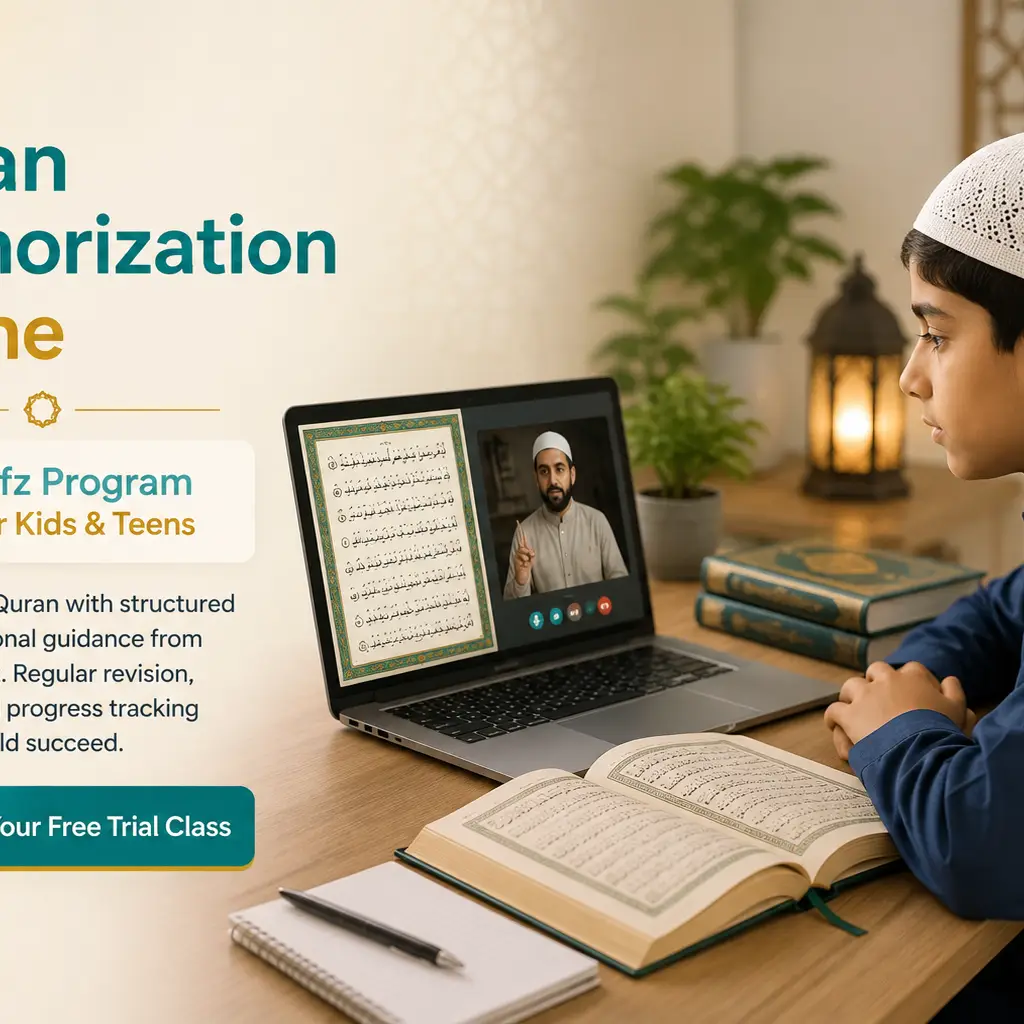
There’s no need to send a Montenegro child abroad for Hifz. The online course follows the same sabaq, sabqi and manzil cycle, tracked class by class, fitted around school hours instead of competing with them.
Quranic Arabic and Tafseer for Students in Montenegro
Plenty of Montenegro students want to actually understand the Quran, not just recite it correctly. A Quranic Arabic course builds that grammar directly; Tafseer covers meaning through commentary like Ibn Kathir and Al-Jalalayn – one-to-one, for a student in Podgorica, Rožaje or Plav.
The Montenegro Clock and the School Year: When Classes Actually Happen
Two clocks run at once for a family in Montenegro. There is the school clock, which decides when children are free, and the prayer clock, which decides when the evening opens up. Then there is a third clock, the one in Pakistan, where the teacher sits. A class booked at the wrong hour puts the teacher up at midnight or the child up past bedtime, so the slot has to work for both sides. Online Quran classes in Montenegro fit around the school day, not against it, and here is how the three clocks line up.
CET, CEST and the Pakistan Gap
Montenegro runs on Central European Time, UTC plus 1, in the winter, and Central European Summer Time, UTC plus 2, in the summer. The clocks go forward on the last Sunday in March and back on the last Sunday in October. In 2026 that means summer time from 29 March to 25 October, and in 2027 from 28 March to 31 October. Pakistan runs on Pakistan Standard Time, UTC plus 5, all year, with no daylight saving at all. So the gap is four hours in the winter and three hours in the summer, and it changes twice a year whether anyone remembers or not.
Do the maths once and the timetable makes sense. A 5 pm class in Podgorica is 9 pm in Pakistan in the winter and 8 pm in the summer. A 4 pm class is 8 pm in the winter and 7 pm in the summer. The after-school window, roughly 4 to 6 pm in Podgorica, lands in the early evening in Pakistan, which is when teachers are free and children are home. Weekend mornings work the same way. A Saturday class at 10 am in Podgorica is 2 pm in Pakistan in the winter and 1 pm in the summer, right in the middle of the teacher’s day. Book the slot first, then check it against the school calendar, not the other way round.
Prayer Times and the Evening Window
In mid-November the Podgorica day is short, and the prayer times show it. On 18 November 2026 Fajr was about 4:59 am, Dhuhr about 11:28 am, Asr about 1:59 pm, Maghrib about 4:20 pm, and Isha about 5:51 pm, on the Muslim World League method. Every source agrees within a few minutes, so treat these as about, not exact. What they mean for a family is simple. Maghrib falls just after 4 pm in November, so the evening is free early, and a class after Maghrib does not cut into the school day or the family dinner.
That early Maghrib is the reason the evening window works so well in the winter. A child home from school at 2:30 pm can pray Asr, rest, pray Maghrib, and then take a 5 pm class and still be done long before bedtime. In the summer the pattern flips. Maghrib falls closer to 8:30 pm, the day is long, and a late-afternoon class fits better than an evening one. The academy keeps the timing flexible, with classes moved earlier or later on request, because the prayer clock moves through the year and a fixed slot does not. If a slot ever feels wrong after the clocks change, ask, and it gets moved.
The School Year: September to June, and Ramadan
Montenegro’s school year usually starts at the start of September and runs to the middle of June, with a winter break around the New Year, a short break around Easter, and a long summer break from mid-June to the end of August. The public holidays inside that year are New Year on 1 and 2 January, Independence Day on 21 and 22 May, Statehood Day on 13 and 14 July, and Njegoš Day on 13 and 14 November. A family that books around those dates will not be caught out by them. A family that assumes another country’s dates will.
Ramadan in 2027 is expected to start on Monday 8 February, and it falls in the middle of the school term, not across a break. That is the week to plan for, not to cancel. Children are fasting, the days are short, and a class moved earlier in the day fits around fasting without a fight. The academy keeps the timing flexible in Ramadan, with classes moved earlier on request, and Eid al-Fitr is expected around 10 March 2027. A student should not cancel for Ramadan. They should ask for a different slot instead. And the summer break, the long one, is the best time to add a class, not drop one, because a child with no school has the mornings free and the revision sticks better when it is daily.
Online Quran Classes in Montenegro: What You Actually Pay
Tafseer costs €60 a month for 8 classes or €100 for 16. The following plans cover Noorani Qaida, Tajweed, Advanced Tajweed, Hifz and Quranic Arabic, with four schedules to fit around a work and school week in Montenegro:
| Plan | Classes / Month | Schedule | Price |
|---|---|---|---|
| Weekend Plan | 8 classes | Sat & Sun | €30/month |
| 3 Days a Week | 12 classes | Any 3 weekdays | €35/month |
| 4 Days a Week Most Popular | 16 classes | Any 4 weekdays | €40/month |
| 5 Days a Week | 20 classes | Mon to Fri | €45/month |
All plans include a free trial class monthly progress reports, and a dedicated Ijazah-certified tutor. Enrolling siblings? Every additional child in the same family gets a 10% discount. See the full pricing page for the Alim & Aalimah scholar track.
What Online Quran Classes Cost in Montenegro, and What the Fee Should Buy
A cheap headline number means little on its own. What matters is what a month actually buys: how many classes, how long each one runs, who teaches them, and what happens when a lesson is missed. Families in Montenegro pay in euros, and the market quotes in euros, so a price in dollars can hide a lot when the bank converts it. Here is what online Quran classes in Montenegro cost as published in 2026, and then what the price should include.
The Market in Euros: What Other Academies Publish
The euro-billed providers publish in euros, and the range is wide. Quran Ilm Academy charges €40 a month for 8 classes, €45 for 12, €55 for 16, and €60 for 20, with a 10 percent family discount for each extra sibling. AlQuranClassesOnline charges €30 a month for 8 classes, €39 for 12, €45 for 16, and €49 for 20, and its Hifz programme runs higher at €55, €65 and €85 a month for 2, 3 and 5 classes a week. 92 Campus charges €30 a month for three days a week and €40 for five days a week, in euros, for 30-minute one-to-one lessons. Quran In Depth quotes €32 to €85 a month across its Europe plans, billed in euros.
One price needs a second look. Tarbiyatul Quran Academy charges $35 a month, about €30, for its standard plan, which sounds cheaper than the rest until you read the small print: every class is a full hour, not 30 minutes. An hour-long class at $35 is a different product from a 30-minute class at the same money, and a family comparing the two is comparing a lesson twice as long. If you want the same decision made on price grounds instead of learning grounds, our guide on how much online Quran classes cost sets out the same questions from the price side. The plans on this page, €30 to €45 a month for 8 to 20 classes, sit at or below the low end of that market, and they are 30-minute one-to-one lessons, so the comparison is like with like.
What the Fee Should Buy: 30 Minutes, One-to-One, With the Same Teacher
A month should buy live, one-to-one teaching in 30-minute sessions, with the same teacher each week and a monthly progress report that shows where the student stands. That is the whole price. There is no extra charge for a female teacher, and the second child in a family gets a 10 percent discount. The trial class is free, with no card needed to book it. The plans above run from eight classes a month to twenty, on weekends, three days a week, four days a week, or five days a week, so a family picks the pace that fits the school week. The standalone Tafseer course costs €60 a month for 8 classes or €100 for 16. The Alim and Aalimah scholar track is a different plan because it covers several subjects at once, in longer sessions: €80 a month for two classes a week, or €100 a month for four classes a week, each session 40 minutes. If you want to know what a good Tafseer course covers before you choose one, our best Quran Tafseer guide sets out the same questions from the student’s side. The figure to compare is not the monthly price. It is what a month actually contains.
Ask four questions before you pay anything. How long is each class, and is it one to one or a group? Who is the teacher, and does the same teacher return every week? What happens when the teacher misses a lesson, and what happens when the student does? And is the trial class free, with no card needed? Any academy that answers all four plainly is worth the trial. Any academy that cannot answer them is not worth the money, whatever the price.
The Fine Print That Matters More Than the Price
The price is only half the story. Fees are paid in advance by bank transfer, and the class runs for the month that has been paid for. If a student leaves, there is no refund for the month, and a family should know that before they pay. If the teacher cannot continue, the fees are refunded, because that is the academy’s side of the same promise. If the teacher misses a lesson, a makeup class is arranged. If the student misses one, it is not made up, and the month is not extended. A student can stop at the end of any month.
None of this is hidden in a terms page. It is written here because a family who knows the fine print before the first lesson will never have to argue about it after the tenth. Ask any academy these four questions before you pay: how do I pay, what happens if we leave, what happens if the teacher leaves, and what happens if a lesson is missed. The answers should take one minute, and they should match what is written on the page.
All 7 Quran Courses in Montenegro, One Platform
Whichever course your family starts with, the same tutor-matching and free trial process applies across all seven, for every age from Noorani Qaida beginners to the Alim & Aalimah scholar track:



Book Your Free Trial Quran Class in Montenegro
See for yourself before you commit to a plan. Book a free trial class with an Ijazah-certified tutor, matched to your child’s or your own age, level and preferred schedule.
Explore Our Other Courses
Also Available in Other European Countries
Related Guides
Frequently Asked Questions
Is a female Quran teacher in Montenegro available online?
Yes. You can request a female tutor for daughters or for women’s classes at no extra cost when you book your free trial – no waitlist, since scheduling isn’t limited to whoever teaches locally.
What times work for Montenegro’s time zone?
Classes are scheduled around Central European Time, including evening and weekend slots, so lessons fit around school and work.
Can my child join a Hifz course in Montenegro online?
Yes. An online Hifz course follows the same sabaq-sabqi-manzil revision structure as an in-person programme, with a dedicated Ijazah-certified Hifz tutor tracking memorisation one-to-one.
Are there online Islamic courses for ladies in Montenegro, not just children’s classes?
Yes. Adult women can book any of the seven courses one-to-one with a female tutor, at a pace and time that suits their own schedule.
How much do online Quran classes in Montenegro cost?
Plans range from €30/month (8 classes, weekends only) up to €45/month (20 classes, Monday to Friday), 30 minutes each. The 4-days-a-week plan at €40/month is the most popular. Families enrolling more than one child get a 10% discount.
Is there a free trial before I pay?
Yes, every course starts with a free trial class with a real tutor, so you can judge fit before choosing a plan.