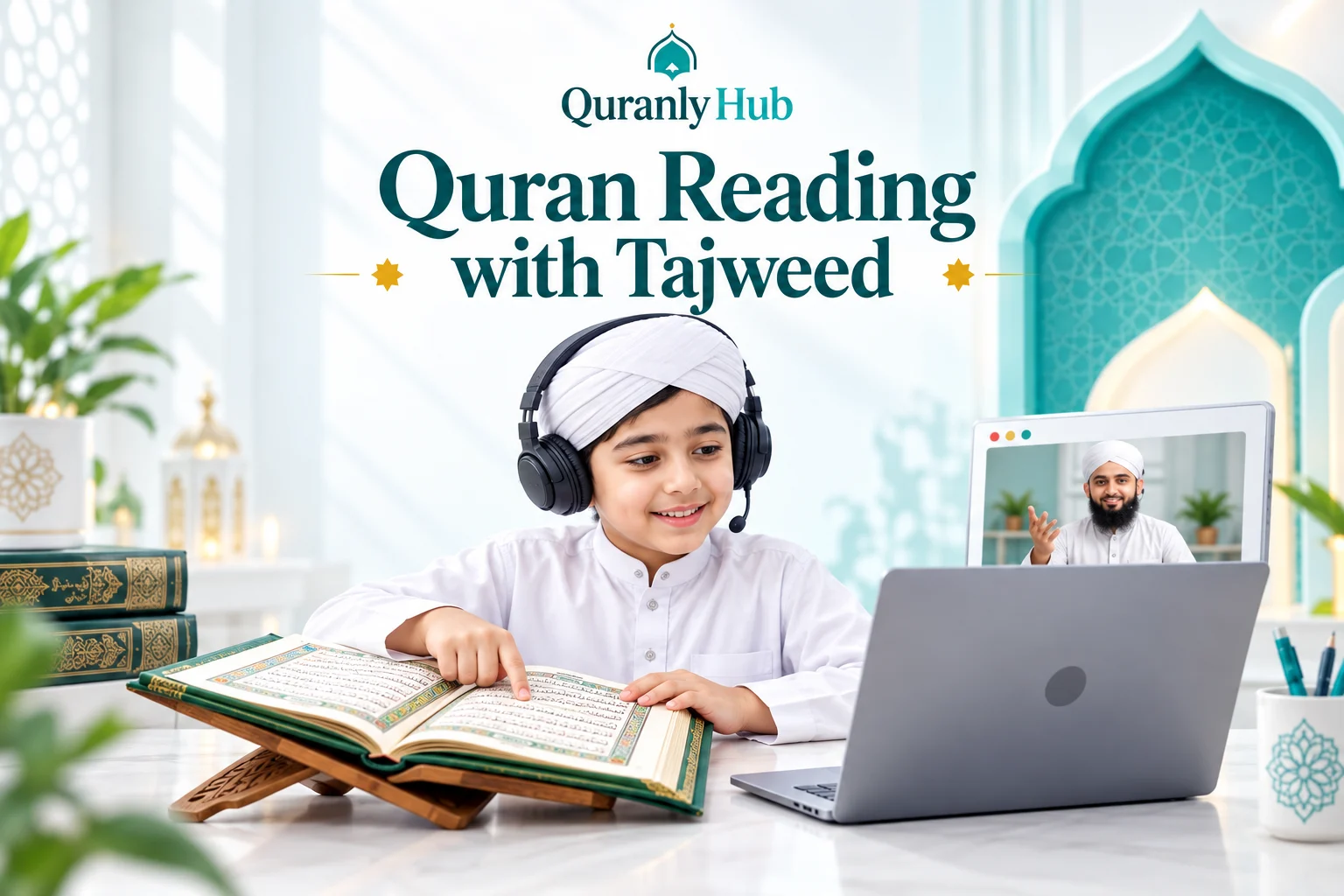
Online Quran classes in Tunisia: a child learning with a QuranlyHub tutor on a live video call

Online Quran Courses in Tunisia: Noorani Qaida, Tajweed and Tafseer, Which to Start With

Online Quran classes in Tunisia: a child learning with a QuranlyHub tutor on a live video call

Short answer: if you are in Tunisia and wondering which online Quran course to take, start with Noorani Qaida if you cannot yet read Arabic letters, Quran Reading with Tajweed once you can, Advanced Tajweed when your reading is correct and you want it precise, and Tafseer whenever you want to understand the meaning. All four are taught one-to-one by certified Quran teachers, with a free trial class first.

Families often ask for “a Quran course” without knowing that there are several, each for a different stage. This guide puts them in order so you can see where you or your child fits, and what comes next. For the full overview of how our classes work in the country, see online Quran classes in Tunisia.

Book a Free Trial Class in Tunisia

One-to-one · Ijazah-certified tutors · No card required

Which Course Is Right for You? A Quick Guide

  • Cannot read Arabic letters yet: start with Noorani Qaida.
  • Can read slowly and want to read correctly: Quran Reading with Tajweed.
  • Read well already and want precision: Advanced Tajweed.
  • Want to understand the meaning: Tafseer, alongside any of the above.

Learning Quran in Tunisia: A Country That Already Knows the Quran

Tunisia is not a country where the Quran feels foreign. Around 99 percent of Tunisians are Muslim, Arabic is the official language, and the call to prayer is part of daily life in every town. Tunis is home to the Zitouna Mosque, founded in 732 CE, which grew into one of the oldest Islamic universities in the world. Scholars such as Ibn Khaldun studied and taught there. When a Tunisian family starts Quran classes, they are joining a tradition their own country helped build, not importing something new.

That background helps, and it also sets a trap. Because Arabic is spoken at home, many parents assume their child can already read the Quran. Speaking a language and reading its script are two different skills. Tunisian Arabic, the Derja spoken in everyday life, is not the same as the classical Arabic of the Mushaf, and a child who chats fluently in Derja may still stumble over joined letters and vowel marks. That is normal, and it is exactly what Noorani Qaida is for.

French plays a big part in Tunisian life too. It is the language of much of schooling and business, even though it has no official status. Some children in Tunisia read French better than they read Arabic, which can make Quran lessons feel harder than they are. A good teacher does not fight that. The lessons stay in Arabic, because the Quran is in Arabic, and each new rule is explained step by step before the student is asked to read it.

Adults start too, and they start at every age. Some are parents who want to learn alongside their children. Some grew up hearing the Quran at home but never learned to read it themselves. Some can read but want to understand what they are reading, so they start Tafseer while their children start Qaida. There is no age limit and no separate adult track. The same one-to-one lessons, the same free trial class, and the same teacher carrying you from one stage to the next.

Noorani Qaida: The Starting Point for Kids and Beginners

Our certified teachers introduce students to the Quran from the very beginning: first recognising each Arabic letter, then how letters join, then the short and long vowels, until the student can read real Quran words alone. Each step is repeated until it is secure. Children usually start around five or six, and adult beginners are welcome too. The full lesson list is in our guide Noorani Qaida: all 17 lessons and rules, and the course itself is on the Noorani Qaida course page.

Quran Reading and Recitation with Tajweed

This is the stage where a student who can join letters learns to read and recite correctly. A teacher listens live and corrects the right sounds, madd and stops. Read one short surah aloud and ask yourself:

  • Do heavy letters (such as ص and ط) sound clearly different from their light partners (س and ت)?
  • Do you hold the nasal sound (ghunnah) on a noon or meem with shaddah for the full count?
  • Do your madd letters stretch to a steady length?
  • Do you bounce the five echo letters (ق ط ب ج د) when they carry a sukoon?
  • Do you stop at the end of a verse without adding a vowel?

If two or more are a maybe, this course will help quickly. Details are on the Tajweed classes online page, and our guide to common Tajweed mistakes shows what teachers fix most often. Female teachers are available for sisters: see classes for sisters and ladies.

Advanced Tajweed: From Correct to Precise

Basic Tajweed makes recitation correct. Advanced Tajweed makes it precise: exact makharij, the characteristics of each letter (sifaat), the less common madd cases, and where to stop and start. It is for students who already recite correctly, including those refining memorisation or preparing to lead prayer. See the Advanced Tajweed course and our guide on how to know you are ready.

Tafseer: Understanding the Meaning

Tafseer classes take one passage at a time: the meaning of the words, the background of the verses and the lesson for daily life. It is taught in English or Urdu, one-to-one, at a weekly time that suits your work, including weekends. To compare well-known commentaries, read Ibn Kathir, Al-Jalalayn and Al-Tabari, and see the Quran Tafseer classes page.

A Simple Learning Path

  1. Noorani Qaida: recognise and join letters.
  2. Quran Reading with Tajweed: read correctly with live correction.
  3. Advanced Tajweed: refine to precision.
  4. Tafseer: understand what you recite, at any stage.

The same teacher can carry a student from one stage to the next, so nobody starts over.

What Your First Month Looks Like

In Noorani Qaida, the first month is about letters and joining. Your child learns to recognise each Arabic letter on its own, then how letters change shape when they join, then the short vowels that turn letters into words. Nothing is rushed. Each step is repeated until it is secure, and the teacher only moves on when the sounds are right. By the end of the first month, most beginners can read simple joined words on their own, and that small win matters more than it looks.

In Quran Reading with Tajweed, the first month is a check-up. The teacher listens to how you read now and finds the sounds that need work, usually the heavy letters, the nasal ghunnah, and the madd lengths. Then the lessons work through those sounds one at a time, with live correction in every session. Students are often surprised at how fast their recitation cleans up once someone is listening closely and correcting in the moment.

In Advanced Tajweed, the first month goes deeper into the rules you already know. The teacher checks your makharij letter by letter, works on the characteristics of each letter, and practices the less common madd cases and the places where you should stop and start. It is detailed work, and it suits students who already recite correctly and want their recitation to be precise, whether they are refining memorisation or preparing to lead prayer.

In Tafseer, the first month is one passage at a time. The teacher takes a short surah or a few verses, explains the meaning of the words, the background of the verses, and the lesson for daily life. There is no race through the Quran. A student who understands ten verses properly has learned more than one who skimmed a whole Juz without taking anything in.

Timing in Tunisia

Tunisia stays on Central European Time all year, so a weekly slot after school or work stays the same through the year. The teacher arranges the time with you directly, and you can reach QuranlyHub on WhatsApp at any time.

The time difference is easy to work with. Tunisia stays on Central European Time all year, which is four hours behind Pakistan, so a 6 pm lesson in Tunis is a 10 pm start for the tutor. Evening slots after school or work are the most popular, and weekend mornings work well for families who prefer them. Because Tunisia does not change its clocks, a weekly slot stays the same through the whole year.

How to Start

  1. Use the form above or message us on WhatsApp and tell us the student’s age and current level.
  2. Take a free trial class so the teacher can place you at the right stage.
  3. Choose a plan on the pricing page and fix a weekly slot.

Frequently Asked Questions

Which online Quran course should I start with?

If you cannot yet read Arabic letters, start with Noorani Qaida. If you can read, take Quran Reading with Tajweed. The free trial class places you at the right stage.

Can adults take these courses too?

Yes. Adult beginners are welcome in every course.

Is Tafseer taught in English?

Yes, Tafseer is taught in English or Urdu.

Are female teachers available?

Yes, female teachers are available for sisters and for mothers learning alongside their children.

Is there a free trial class?

Yes. Every student starts with a free trial class and no card is needed.

Noorani Qaida course

Online Quran Tarjuma & Tafseer Course in Pakistan

Short answer: Haan — QuranlyHub Pakistan mein live, one-on-one online Quran Tarjuma aur Tafseer course offer karta hai, Ijazah-certified tutors ke saath, Urdu ya English mein, free trial class ke saath. Fees USD 70/month mein 12 classes (3 per week) hain.

Bohat se log sirf Quran parhna (recite karna) seekhte hain, lekin tarjuma aur tafseer ke baghair ye pata nahi chalta ke jo parha ja raha hai uska matlab kya hai. Pakistan mein log “quran tafseer course online”, “online quran tarjuma tafseer course”, ya “tafseer classes” jaise terms search karte hain — ye guide bilkul wahi cover karta hai: online tarjuma aur tafseer course kaise kaam karta hai, kya seekhaya jata hai, aur enroll kaise karein.

Book a Free Trial Tafseer Class

One-to-one · Urdu ya English · No card required

Quran Tarjuma aur Tafseer Mein Kya Farq Hai?

Tarjuma (translation) Quran ke Arabic alfaz ka seedha, word-for-word ya sentence-by-sentence tarjuma hai — jaise Urdu ya English mein. Tafseer is se aik qadam aage jata hai: aayat ka context, asbab-e-nuzul (revelation ki wajah), aur scholars ki tashreeh (explanation) shamil hoti hai. Sirf tarjuma parhne se aksar sawal reh jate hain jo tafseer clear karti hai — isi liye zyada tar students dono saath saath seekhna chahte hain, ek hi tutor ke saath, live class mein.

Misaal ke taur par, agar koi Surah Al-Asr ka sirf tarjuma parhe to usay pata chalega ke Allah waqt ki qasam kha raha hai aur insan ghate mein hai siwaye un logon ke jo iman laaye, naik amal karein, aur haq aur sabr ki talqeen karein. Lekin tafseer ye batati hai ke mufasireen ne “asr” (waqt) ko kis tarah samjha hai, kyun sirf char sifaat (iman, amal, haq, sabr) kafi hain, aur ye surah pehli, choti surahon mein kyun shamil ki gayi — yehi tafseer ki gehrai hai jo sirf alfaz ke tarjuma se nahi milti.

Pakistan Mein Online Quran Tarjuma Tafseer Course Ki Fees: Asal Range Kya Hai

Is page par short answer mein Tafseer ki fees likhi hai: USD 70 a month mein 12 classes. Lekin aik family ke liye ye aik number kafi nahi hota: market mein aur academies kya leti hain, aur har class ki asal qeemat kya banti hai? Ye post dollar mein price karti hai, is liye is section ke figures bhi dollar, euro ya pound mein hain, jaisi har academy khud publish karti hai. Pakistan mein payment ke waqt bank dollar ko rupees mein convert karta hai, apne rate par. Don’t judge a plan by its monthly number alone, kyun ke USD 30 a month ka matlab 8 classes bhi ho sakta hai aur 20 classes bhi.

Market Mein Kya Chal Raha Hai

Pehle range dekh lein. Tibyan USD 30 se USD 50 a month leta hai, 4 se 20 classes ke liye, pehli trial class free, na registration fee, na contract. eQuranSchool Europe mein 20 lessons ke EUR 56 a month leta hai, aur doosre sibling ke EUR 45. eQuranCoaching USD 45 a month leta hai 8 classes ke liye aur USD 135 tak 20 classes ke liye. E-Quran Academy USD 50 a month leta hai Starter plan ke liye aur USD 90 tak Premium ke liye. E Quran Institute GBP 25 a month leta hai Start Up plan ke liye aur GBP 50 tak Elite Hifz plan ke liye, beech mein GBP 28, GBP 32, GBP 38 aur GBP 42 wale plans ke saath. Elbayan USD 40 a month leta hai 8 classes ke liye aur USD 80 16 classes ke liye, jo USD 5 per class banta hai. Quran In Depth EUR 35 a month leta hai 2 classes per week ke liye aur EUR 85 tak 5 classes ke liye, beech mein EUR 50 aur EUR 68 wale plans ke saath. Al Tahoor USD 44.99 a month leta hai 8 classes ke liye aur USD 74.99 tak 20 classes ke liye, beech mein USD 49.99 weekend-only aur USD 54.99 12 classes ke liye. AlhudaQuranTutor EUR 45 a month leta hai 12 classes ke liye aur EUR 60 tak 20 classes ke liye. My Online Quran Tutor EUR 28 a month se shuru hota hai 8 classes ke liye. Online Quran Live EUR 40 a month se shuru hota hai. Murouj Academy EUR 6 per 30-minute lesson se shuru hoti hai. TarteeleQuran USD 39 a month leta hai 2 classes per week ke liye. 92 Campus EUR 30 a month leta hai 3 days per week ke liye aur EUR 40 5 days ke liye, aur doosre ya teesre bachay par 20 percent sibling discount deta hai. Teen academies koi price publish nahi kartin: Kanzulilm WhatsApp par customised monthly plan deta hai, International Quran Academy koi price nahi batata, aur Madani Islamic Academy bhi koi figure nahi deta. Al-Noor Academy USD 35 a month leta hai 8 classes ke liye aur USD 60 tak 20 classes ke liye.

Ab har class ki qeemat nikal lein: USD 30 mein 8 classes hon to har class USD 3.75 banti hai; USD 35 mein 12 classes hon to har class USD 2.92; USD 40 mein 16 classes hon to har class USD 2.50; USD 45 mein 20 classes hon to har class USD 2.25. Elbayan ka USD 5 per class aur Murouj ka EUR 6 per lesson is list ke mehnge tareen single lessons hain. Tafseer ki USD 70 wali plan mein har class USD 5.83 banti hai, jo aik reading course se zyada hai, kyun ke Tafseer mein tutor ko har lesson se pehle lambi tayari karni hoti hai.

Price Ko Kya Cheezain Upar Neeche Karti Hain

Char cheezain price ko hilati hain. Pehli, format: one-to-one class group class se mehngi hoti hai, kyun ke tutor ka waqt sirf aik student ka hota hai. Doosri, frequency: 8 classes a month ka total 20 classes se kam hota hai, lekin har class ki qeemat zyada banti hai. Teesri, course: Noorani Qaida aur basic Tajweed aam tor par aik hi price par hote hain, jab ke Hifz aur Tafseer mehnge ho sakte hain, kyun ke Hifz mein roz revision chahiye hoti hai aur Tafseer mein tutor ko lambi tayari karni hoti hai. Chauthi, tutor ka tajurba: jo tutor kai saal se parha raha ho, us ki fees aik naye tutor se zyada ho sakti hai. Do academies ko compare karte waqt aik hi format, aik hi frequency aur aik hi course ko compare karein, warna comparison ka koi matlab nahi.

Pakistan mein aik aur cheez bhi hai: school ka waqt. Punjab mein school subah 8 baje se dopahar 1:30 baje tak hota hai, aur bohat se bachay school se wapas aa kar dopahar ya shaam ko free hote hain. Aik tutor jo dopahar aur shaam dono waqt parha sake, us ki qeemat us plan se zyada hoti hai jo sirf aik waqt deta hai. Bijli aur internet ka bhi khayal rakhein: load shedding ya slow internet aik online class ko rok sakta hai, is liye agar teacher ki taraf se class miss ho to makeup class ka sawal pehle se pooch lena chahiye.

Online Class, Masjid Ya Home Tutor: Paisa Kahan Jata Hai

Online class aam tor par home tutor se sasti hoti hai, aur wajah quality nahi, kharcha hai: home tutor ko aane jaane ka waqt aur kiraya lagta hai, jab ke online class mein sirf tutor ka waqt kharch hota hai. It’s the tutor’s time you pay for, not the room. Masjid ki class aksar muft ya bohat sasti hoti hai, lekin woh group mein hoti hai aur fixed waqt par hoti hai, is liye aik bachay ko woh tawajjo nahi milti jo one-to-one class mein milti hai. Sasti class woh nahi jis ka monthly number sab se kam ho, balkay woh hai jis mein bachay ne utne waqt mein sab se zyada seekha ho.

Karachi, Lahore ya Islamabad mein aik acha home tutor dhoondna mushkil bhi ho sakta hai aur mehnga bhi, jab ke online class mein family apni pasand ka tutor chun sakti hai, chahe family Karachi mein ho, Lahore mein, Islamabad mein, ya aik chote sheher mein jaise Gujranwala ya Sialkot mein. Rawalpindi, Faisalabad, Multan, Peshawar, Quetta aur Hyderabad mein bhi wohi masla hai: achi Tafseer ki class har gali mein nahi milti. Online class is kami ko poora karti hai, aur masjid woh community deti hai jo screen nahi de sakti.

Online Quran Tarjuma Tafseer Course Mein Kya Shamil Hai

  • Aayat-by-aayat tarjuma — Urdu ya English mein, aapki pasand ke mutabiq
  • Tafseer ki tashreeh — classical sources (Ibn Kathir, Al-Jalalayn) se, asaan zaban mein
  • Live sawal-jawab — tutor se seedha poochne ka mauka, na ke sirf ek recorded lecture sunna
  • Aapki raftar ke mutabiq — aap khud choose karte hain kaun si surah ya para se shuru karna hai

Free Trial Class Mein Kya Hota Hai

QuranlyHub ka har course aik free trial class se shuru hota hai, aur us ke liye koi card nahi liya jata. Is section mein bataya gaya hai ke us trial mein kya hota hai, aur doosri academies pehle kya deti hain.

Trial Mein Tutor Kya Karta Hai

Tutor pehle sunta hai, parhata nahi. Shuru mein tutor student se kuch ayaat parhne ko kehta hai, ya aik surah sunne ko kehta hai jo student ko pehle se yaad ho, aur sunta hai ke parhai kahan theek hai aur kahan atak rahi hai. Usi se level tay hota hai, pehle se lagaye gaye andaze se nahi. Phir tutor usi level par aik asal lesson parhata hai: Qaida ke beginner ko kuch naye haroof, Tajweed ke student ko makharij ki islaah, ya Tafseer ke student ko aik ayat ka tarjuma aur us ki tashreeh. Class Urdu ya English mein hoti hai, jo zaban student ko asaan lage. Parent bhi class mein baith sakta hai, aur aakhir mein tutor batata hai ke student kis level par hai aur kaun sa plan theek rahega. Aakhir mein parent apne sawal pooch sakta hai. Class ka waqt Pakistan time (PKT) par tay hota hai, aur Pakistan mein daylight saving nahi hoti, is liye waqt saal bhar aik hi rehta hai. Jo parent trial mein baithta hai, woh ye bhi dekh sakta hai ke tutor bachay se sabr se baat karta hai ya jaldi mein.

Doosri Academies Pehle Kya Deti Hain

Free shuruaat har academy mein aik jaisi nahi hoti. Tibyan, eQuranSchool, Al Tahoor aur Murouj aik free trial class ya session se shuru hote hain. Quran In Depth aik free trial evaluation deta hai, bina card ke. TarteeleQuran free trial classes deta hai. International Quran Academy teen free trial classes deta hai. Madani Islamic Academy 2 din ki free trial deta hai. Al-Noor Academy teen free classes se shuru hota hai aur card nahi leta. Quran Focus aik hafte ki free trial deta hai. Elbayan ki pehli class free hoti hai. Kanzulilm aik free 30-minute class se shuru hota hai. Free classes ke baad monthly price ko bhi saath parhna chahiye, kyun ke mehnge plan par free shuruaat aik saal mein saste plan par aik free class se zyada mehngi par sakti hai.

Trial Tutor Se Poochne Wale 4 Sawal

Pehla, mere bachay ya mera level kya hai, aur pehle mahine mein kya parhaya jaye ga? Jo tutor agle paanch lessons ke naam bata sake, us ke paas plan hai. Doosra, roz kitna naya tarjuma ya kitni nayi hifz set karein ge, aur revision kaise hogi? Hifz ke liye jawab mein nayi lines ki tadaad aur rozana sabaq, sabqi aur manzil ka zikr hona chahiye. Teesra, kya mera bachay ka teacher har hafte wohi rahe ga? QuranlyHub ka jawab haan hai, aur kisi bhi academy se payment se pehle yehi jawab sunna chahiye. Chautha, agar teacher beemar ho ya chutti par ho to kya hoga? Imaandari se jawab ye hai ke makeup class mile gi, ya aik substitute teacher mile ga jis se family pehle mil le. Ye charon sawal trial mein pooch lein, aur jawab likh lein, kyun ke trial free hai aur pehla mahina free nahi.

Online vs. Free PDF ya Recorded Lecture

Bohat se log pehle “quran tafseer pdf” ya “tafseer video” dhoondte hain, lekin ek recorded lecture mein sawal poochne ka mauka nahi milta, aur khud padhne mein context samajhna mushkil ho sakta hai. Hamare live, one-on-one classes mein aap seedha tutor se poochte hain jab tak baat samajh na aa jaye — ye farq khaas taur par un logon ke liye important hai jo sirf tarjuma parh kar tafseer bhi samajhna chahte hain, na ke sirf alfaz ka matlab.

Ye Online Quran Tafseer Course Kin Logon Ke Liye Hai

Zyada tar students jo humaray online quran tafseer classes join karte hain, inmein teen tarah ke log shamil hain: (1) wo adults jinhon ne bachpan mein Quran parhna seekh liya tha lekin kabhi matlab nahi samjha, (2) wo huffaz (jinhon ne Quran hifz kiya hai) jo ab un ayaat ka matlab samajhna chahte hain jo unhein zubani yaad hain, aur (3) wo parents jo chahte hain unke bachay sirf tilawat na karein balke samjh kar parhein. Agar aap in teenon mein se kisi bhi category mein aate hain, to ye quran tafseer course aap hi ke liye banaya gaya hai.

Live Tafseer Class Mein Typical Session Kaisi Hoti Hai

Pehle tutor aik ya do ayaat tilawat karta hai aur aap ke sath tarjuma line-by-line parhta hai. Phir tafseer ka hissa shuru hota hai — tutor batata hai ke is ayat ka asbab-e-nuzul (nazil hone ki wajah) kya tha, mufasireen (jaise Ibn Kathir, Al-Jalalayn) ne is ka kya matlab bataya hai, aur ye ayat baqi Quran ya Hadees se kaise mil ti hai. Aakhir mein aap sawal pooch sakte hain — yehi woh hissa hai jo ek recorded lecture ya tafseer pdf mein possible nahi hota.

Noorani Qaida course

Noorani Qaida

Start from the very first letter with a structured, one-on-one Qaida foundation.

Learn More
Tajweed course

Tajweed

Learn correct Quran recitation rules with a certified Tajweed tutor.

Learn More
Advanced Tajweed course

Advanced Tajweed

Refine your recitation with advanced makharij and qirat practice.

Learn More
Hifz (Memorization) course

Hifz (Memorization)

Memorize the Quran with a structured daily revision plan.

Learn More
Tafseer course

Tafseer

Understand the meaning and context behind the verses you recite.

Learn More
Quranic Arabic course

Quranic Arabic

Learn the Arabic grammar and vocabulary needed to understand the Quran directly.

Learn More
Alim & Aalimah Course course

Alim & Aalimah Course

A structured Islamic scholarship track for young men and women.

Learn More

Fees — Online Quran Tarjuma Tafseer Course in Pakistan

PlanFrequencyPrice
Tafseer12 classes/month, 3x / week, 30 minUSD 70/month

QuranlyHub Ki Fees, Saaf Alfaz Mein

USD 70 a month ka matlab tab tak kuch nahi jab tak family ko ye na pata ho ke kitni classes milti hain aur har class one-to-one hai ya group mein. Is section mein QuranlyHub ki Pakistan fees poori tarah likhi hain, har plan ke saath har class ki qeemat.

Tafseer Aur Baqi Courses Ke Plans

Tafseer course ki fees USD 70 a month hai, 12 classes ke liye, hafte mein 3 din. Har class one-to-one hoti hai, Urdu ya English mein, aur tarjuma Tafseer ke andar hi parhaya jata hai. Tarjuma aur tafseer mein kya farq hai, ye samajhne ke liye tarjuma vs tafseer wali guide parhein. Tafseer ki har class USD 5.83 banti hai. Baqi courses ke standard plans ye hain: 8 classes a month USD 30, jo USD 3.75 per class banta hai; 12 classes a month USD 35, jo USD 2.92 per class banta hai; 16 classes a month USD 40, jo USD 2.50 per class banta hai; aur 20 classes a month USD 45, jo USD 2.25 per class banta hai. Har plan aik free trial class se shuru hota hai aur us mein monthly progress reports shamil hain. Aik hi family ke doosre bachay par 10 percent discount milta hai. Alim aur Aalimah scholar track alag se price hota hai: USD 80 a month 8 sessions ke liye aur USD 100 a month 16 sessions ke liye, har session 40 minute ka. Poori pricing aik jagah dekhne ke liye full pricing page kholein.

Market ke hisab se ye table theek baithti hai: sab se sasta headline monthly price Tibyan ka USD 30 a month hai 4 classes ke liye, aur sab se mehnga single lesson Murouj ka EUR 6 per lesson hai.

Har Course Kitne Arse Mein Mukammal Hota Hai

Monthly price sirf aadha sawal hai. Doosra aadha ye hai ke course kitne mahine chalega. Is section mein sirf woh durations likhi hain jo QuranlyHub ne confirm ki hain. Noorani Qaida 16-class plan par 2 se 3 mahine mein mukammal hoti hai aur 8-class plan par 3 se 5 mahine mein, jo 16-class plan par USD 80 se USD 120 aur 8-class plan par USD 90 se USD 150 banta hai. Hifz 2 se 2.5 saal leta hai, roz 7 se 8 nayi lines ke saath, aur rozana sabaq, sabqi aur manzil ke cycle ke saath, aur har hafte Hifz ka test hota hai. 16-class plan ke USD 40 a month ke hisab se 2 saal ka Hifz USD 960 aur 2.5 saal ka USD 1,200 banta hai, mahina ba mahina, poora course aik saath advance mein nahi. Quranic Arabic 9 se 12 mahine leta hai. Tajweed ya Tafseer ki koi confirmed duration nahi hai, is liye yahan koi duration nahi likhi. Jo academy Hifz ki finish date mahinon mein pakki kar ke bataye, us se hoshiyar rahein, kyun ke hifz bachay ki raftar se hota hai. Hifz ka tareeqa tafseel se samajhne ke liye Hifz course wali guide parhein.

Pakistan ke school calendar ko bhi zehen mein rakhna chahiye: Sindh mein naya academic year 1 April 2026 se shuru hua, Punjab mein schools 24 August 2026 ko dobara khule, winter break December ke aakhir mein hoti hai, annual exams March 2027 mein hote hain, aur summer vacation May se August 2027 tak hoti hai. Shuru karne ke do behtareen waqt hain: school year ke shuru mein, aur winter break mein, jab bachay ke paas waqt zyada hota hai. Ramadan 2027 school term ke andar aata hai: pehla roza 8 ya 9 February 2027 ko expected hai, aur Eid al-Fitr 10 March 2027 ko expected hai, chand dekhne par final date Ruet-e-Hilal Committee announce karti hai. Roze mein class ka waqt Iftar se pehle ya Taraweeh ke baad rakha ja sakta hai. Homework sirf Hifz ke students ko milta hai, kyun ke sirf Hifz mein roz ghar par revision chahiye hoti hai; baqi courses ki practice class mein hi ho jati hai.

Payment, Refund Aur Makeup Class Ki Sharaait

Fees advance mein bank transfer se pay ki jati hain. Agar student apni marzi se course chhor de to refund nahi milta, aur agar teacher course jari na rakh sake to refund milta hai. Makeup class sirf us waqt milti hai jab teacher class miss kare, is liye family ko wohi waqt chunna chahiye jo woh nibha sake. Parent kisi bhi class mein baith sakta hai, aur class ko tutor ki razamandi se record bhi kiya ja sakta hai. Trial free hai, koi card nahi liya jata, aur pehle mahine ki fees trial ke baad hi pay ki jati hai.

Enroll Kaise Karein

  1. WhatsApp par message karein apni current level aur preferred din/waqt batate hue.
  2. Free trial class lein — koi payment nahi, koi obligation nahi.
  3. Apna plan confirm karein aur regular weekly classes shuru karein.

Related Guides

Frequently Asked Questions

Kya QuranlyHub par online Quran Tarjuma aur Tafseer course hai?

Ji haan. Hamara online Quran Tafseer course Quran ke tarjuma (translation) aur tafseer (detailed explanation) dono ko cover karta hai, ek qualified tutor ke saath one-on-one live classes mein, aapki choice ki zaban (Urdu ya English) mein.

Online Quran Tafseer course ki fees kitni hai Pakistan mein?

One-on-one, 30 minute session: USD 70/month mein 12 classes (3x/week). Har plan free trial class ke saath shuru hota hai.

Kya Tafseer class Urdu mein hoti hai?

Ji haan, hamare tutors Tafseer Urdu mein bhi parhate hain aur English mein bhi — jo zaban aapko samajhne mein asaan lage, wahi chunein.

Kya free trial class sach mein free hai?

Ji haan, bilkul free, koi obligation nahi. Ek real class hoti hai qualified tutor ke saath, taake aap dekh sakein ke teaching style aapke liye sahi hai ya nahi.

Kya Noorani Qaida se pehle Tafseer seekhna zaroori hai?

Nahi. Tafseer samajhne ke liye Quran ko fluently parhna zaroori nahi — tarjuma aur tafseer ka maqsad hi meaning samajhna hai, chahe aap abhi Qaida ya Tajweed bhi seekh rahe hon. Dono courses saath chal sakte hain.

Kya female tutor mil sakti hai Tafseer ke liye?

Ji haan, request karne par female tutor di jati hai, bila kisi extra charge ke.

Kaun se tafseer source se parhaya jata hai?

Hamare tutors classical, widely-accepted tafseer sources (jaise Tafsir Ibn Kathir, Tafsir Al-Jalalayn) se refer karte hain, na ke sirf ek tutor ki zaati raye se.

Kya adults bhi is course mein enroll ho sakte hain?

Ji haan, ye course khaas taur par un adults ke liye bana hai jo Quran recite to karte hain lekin meaning samajhna chahte hain — saath hi teenagers bhi enroll kar sakte hain.

Konsi Surah ya Para se Shuru Karna Chahiye?

Zyada tar naye students chote, mashhoor surahon se shuru karte hain jaise Surah Al-Fatiha, Al-Asr, ya Al-Ikhlas, taake tarjuma-tafseer ka tareeqa samajh ayen. Lekin agar aap kisi khaas para ya surah ka tafseer samajhna chahte hain (masalan jo aap hifz kar chuke hain), to tutor wahin se shuru kar sakta hai — course bilkul aapki pasand ke mutabiq flexible hai.

Kya Hifz ke Sath Tarjuma aur Tafseer Bhi Sath Mein Le Sakte Hain?

Ji haan, bohat se students apna Hifz course jari rakhte hue sath mein Tarjuma-Tafseer classes bhi lete hain — dono alag sessions hote hain, is liye schedule mein koi mushkil nahi hoti, aur ulta ye faida hota hai ke jo ayaat aap hifz kar rahe hain unka matlab bhi sath sath samajh aata hai.

Apne Bachay Ki Online Hifazat Kaise Karein

Jab aik parent apne bachay ko screen par aik tutor ke hawale karta hai, to woh aik ajnabi par bharosa kar raha hota hai. Is section mein likha hai ke QuranlyHub kya karta hai, kya nahi dikha sakta, aur parent pehli paid class se pehle kya check kar sakta hai.

Koi Online Tutor DBS Ya VSC Jaisa Certificate Kyun Nahi Dikha Sakta

Ijazah aik teaching certificate hai. Ye batata hai ke tutor ki apni qirat check ki gayi thi, aur kis ustad ne check ki thi. Ye nahi batata ke woh tutor video call par bachay ko akela parhane ke liye safe hai ya nahi. UK mein parents jis check ko jante hain woh Enhanced DBS hai, Canada mein vulnerable sector check hai, Australia mein working with children check hai, aur Netherlands mein VOG hai. Ye sab checks aik mulk ke andar kaam karne walon ke liye hote hain. Doosre mulk se online parhane wale tutor ke liye koi mulk aisa certificate nahi deta, is liye koi imaandaar academy bhi aisa certificate nahi dikha sakti. To QuranlyHub kya dikha sakta hai? Har tutor identity-verified aur reference-checked hota hai, aur har tutor ki Ijazah par us ustad ka naam hota hai jis ne Ijazah di thi. Safeguarding contact Adeel Ahmad hain, aur parent un se seedha rabta kar sakta hai.

Pehli Paid Class Se Pehle 4 Checks

Char checks mein das minute lagte hain. Pehla, tutor ki Ijazah aur us ustad ka naam maangein jis ne Ijazah di thi. Doosra, free trial class mein baith kar dekhein ke tutor aap ke bachay se kaise baat karta hai. Teesra, poochein ke safeguarding contact kaun hai aur un se kaise rabta karein: jawab mein aik naam aur aik number hona chahiye, sirf aik form nahi. Chautha, poochein ke agar teacher beemar ho ya chutti par ho to kya hoga. Jo family ye charon checks kar le, us ne kisi bhi certificate se zyada kar liya hota hai, kyun ke certificate tutor ke salook ke baray mein kuch nahi batata, aur trial ye dikha deta hai.

Beti Ke Liye Female Teacher, Bila Extra Charge

Beti ya walda ke liye female teacher mil sakti hai, bila kisi extra charge ke, aur saaton courses mein se koi bhi course one-to-one us ke saath parha ja sakta hai. Adult sister ke liye camera optional hai, aur class sirf voice par bhi chal sakti hai. Jo parent female teacher chahta ho, woh free trial book karte waqt bata de, aur academy bachay ko female teacher se match kar de gi. Female teacher kaise kaam karti hai, ye janne ke liye female Quran teachers online wali guide parhein.

Best Online Quran Classes in Saudi Arabia: Academy, Tajweed, Hifz & Tafseer Courses Explained

Short answer: The best online Quran academy for families in Saudi Arabia delivers live, one-on-one classes with Ijazah-certified tutors – Tajweed, Hifz, Tafseer, Noorani Qaida and Quranic Arabic – scheduled around Riyadh time, with a female tutor option and a free trial before you pay. QuranlyHub runs exactly this, with standard courses from SAR 112.50 a month. Tafseer costs SAR 262.50 a month for 12 classes, three days a week.

Saudi Arabia’s cities have no shortage of mosque classes and weekend Islamic schools, but most run as shared group sessions on a fixed timetable, and can feel like a mismatch in cities that are themselves centres of Islamic scholarship. Families searching for a quran academy in saudi arabia that actually fits a working week – and gives a child or adult a tutor’s full attention – usually end up looking online instead. Here’s what to check, course by course.

Book a Free Trial Class in Saudi Arabia

One-to-one · Ijazah-certified tutors · No card required

Best Online Quran Classes in Saudi Arabia: What to Look for in an Academy

Quran Teaching in Saudi Arabia: What “Best” Actually Means

“Best” is a word academies give themselves. What a parent can check is the quran teaching itself: who teaches, how the lesson runs, and what it costs in riyals. Here it means learning the Quran with a teacher, one to one, live on a screen, not a recorded course and not a hall full of children. Every class starts with one free 30-minute trial, and every tutor is Ijazah-certified.

The reading path runs from Qaida to Qirat. A child starts with Noorani Qaida, learns the letters and the joins, then reads the whole Quran through with a teacher listening. That is Nazra. Qirat is the step after that: reading beautifully as well as correctly, with the letters from their right places and the madd held for its full length. For younger children, Islamic Studies for kids runs alongside the Quran courses, so the child learns the faith and the reading together.

Judge any academy by four checks: a live one-to-one trial with the real tutor, a price printed in riyals, the same teacher every week, and a monthly progress report that names what was learned. An academy that answers all four plainly is worth paying. One that cannot has told you what you need to know.

  • Live, one-on-one classes – not a recorded course or a shared group session.
  • Ijazah-certified tutors – a verified chain of transmission, not just a claimed qualification.
  • A genuine free trial – a real class with the actual tutor before you commit to a plan.
  • Scheduling around Saudi time (AST) – evening and weekend slots that fit a Saudi work or school week.
  • A female tutor option – available on request, at no extra cost.

The Safety Question: Child Protection Law M/14 and What Saudi Parents Can Actually Check

Before any Saudi family sorts out a timetable, most parents ask the same question first, and it is not about the slot. It is about the teacher. Who is teaching my child, what checks have actually been done, and what can I check myself? Saudi Arabia has a real child protection law, and it is worth knowing what it does and does not do. The best online Quran classes in Saudi Arabia answer plain questions with plain answers. A loud safety badge on a website is not an answer. Here is what to ask, and what an honest answer sounds like.

Saudi Arabia Has a Child Protection Law, but No Saudi Certificate for an Overseas Tutor

Saudi Arabia takes child protection seriously in law. The Child Protection Law, Royal Decree M/14 of 2014, defines a child as anyone under eighteen and puts a duty on anyone who learns of abuse to report it promptly. The national Child Support Line is 116111, and the Ministry of Human Resources and Social Development runs a reporting line on 1919. A new General Education Law, approved in July 2026, takes effect in January 2027. Schools and nurseries inside the Kingdom work under these rules every day, and a parent in Riyadh or Jeddah is right to expect the same care from anyone who teaches their child.

None of that gives a parent a certificate to ask for. Those laws govern schools and carers inside Saudi Arabia, and an online tutor teaching from Pakistan cannot hold a Saudi background-check certificate, because no such certificate exists for an overseas tutor. So when an academy tells a Saudi family that all its tutors are “background-checked in Saudi Arabia”, the parent should ask what that actually means. A badge on a website is not a check. What a parent can check is a real person, a real qualification and a real class.

Girls Learn Only With a Female Teacher

For daughters, the teacher question has a second half. A girl should learn with a female teacher, and that should not cost extra. At QuranlyHub a female teacher is available at no extra cost, and girls learn only with a female teacher. That is a rule of the academy, not a request a parent has to make. The female teacher is a Hafiza, and she teaches the same courses as the male teachers, so a daughter is not offered a thinner version of the timetable. Parents can ask for her by name when they book, and the class runs the same way, on the same Zoom setup, for the same 30 minutes.

The camera is optional for adult sisters, and for younger girls the parent decides how the class looks. What matters is that the family controls the setup from the start, not that the academy decides it for them. If you are weighing this choice, our guide to finding a female Quran teacher online sets out the same questions from the family’s side, so you can see what a good answer looks like before you book. A parent who has already asked these questions before the trial will not need to ask them again after it.

Four Things a Parent Can Check in the First Week

The trial class is the real test, and a parent should treat it that way. Sit in on it. Watch how the teacher corrects a letter, how they handle a tired child, and whether the child looks forward to the next one. Ask for the lesson to be recorded, because a recording lets both parents hear it later, and a teacher who welcomes a recording has nothing to hide. Check that the only contact between the teacher and the child is the official channel. There is no private messaging, no personal number, and no side arrangement. If any of those appear, stop the class and write to the safeguarding contact.

Four things, then, before you commit to anything. Sit in on the trial. Ask for a recording. Confirm there is no private contact outside the official channel. Know the name of the safeguarding contact. At QuranlyHub that contact is Adeel Ahmad, who answers families directly. None of these takes more than an hour, and together they tell you more about an academy than any claim on its website. A good academy will welcome all four, because each one is easy to pass when the setup is honest.

Online Tajweed Classes in Saudi Arabia: Correction for Readers Who Already Read

Most students in Saudi Arabia already read Arabic script by the time they look for Tajweed – what they actually need is correction. Our Tajweed course gives live, one-to-one feedback on makharij and elongation rules a group class rarely has time for.

Online Hifz Classes in Saudi Arabia

Our online Hifz course runs the sabaq-sabqi-manzil revision cycle one-on-one with a dedicated Hafiz tutor, timed around Saudi evenings and weekends.

Online Tafseer Classes in Saudi Arabia

Our Tafseer classes go beyond recitation into meaning and context, drawing on Ibn Kathir and Al-Jalalayn, in English or Urdu.

Noorani Qaida and Quranic Arabic in Saudi Arabia

Complete beginners start with Noorani Qaida – letters, joining rules and basic Tajweed. Once reading is fluent, Quranic Arabic teaches the vocabulary and grammar to understand the text directly.

From Qaida to Hifz: Which Course Fits Which Student in Saudi Arabia

The course order matters more than the timetable, because each course asks for something different from the week. Most students in Saudi Arabia already read Arabic script by the time they look for a teacher, so the path here starts in a different place than it does for a family starting from zero. The best online Quran classes in Saudi Arabia put a student on the right course first. Selling the longest plan is a different job. Here is that order, with the time each step actually takes.

Noorani Qaida: Two to Five Months, Then Real Reading

Complete beginners start with Noorani Qaida. It teaches the letters, the joins, and the first rules of reading, and a child who finishes it properly can open the Quran and read. That takes two to three months on the 16-class plan, or three to five months on the 8-class plan. Children start from age four, and the sessions are 30 minutes, one to one, live on Zoom. The reason the shorter plan takes longer is simple: a child who meets the teacher twice a week needs more weeks than a child who meets the teacher four times a week. Either way, the plan is finished when the child can read, not when a date arrives.

Parents get a monthly progress report, so they can see which letters are secure and which still need work. If a child struggles with a particular sound, the teacher stays on it instead of moving on. That is the whole point of one-to-one teaching. A child who is pushed through Qaida too fast will carry the gaps into everything after it, and fixing them later takes longer than learning them properly the first time.

Tajweed and Quranic Arabic: For Students Who Already Read

Most students in Saudi Arabia already read Arabic script, so for them the starting point is Tajweed, not Qaida. Tajweed is correction: where each letter comes from, how long to hold a madd, when to hide a noon and when to say it clearly. A group class rarely has time for that kind of correction, because the teacher cannot listen to every student. One to one, the teacher hears every letter, and the student hears the difference at once. There is no fixed finish date for Tajweed, because the goal is not a certificate. The goal is a student who can open the Quran and read it right.

Quranic Arabic sits next to Tajweed. It teaches the vocabulary and grammar a reader needs to follow the text without a translation, and most students need nine to twelve months to get there. It is the course for the student who can already read and now wants to understand what they are reading. Together, Tajweed and Quranic Arabic are the two courses that turn a reader into someone who understands the Quran in its own words.

Hifz and Tafseer: The Long Steps

Hifz is the longest step, and it should be planned in years, not months. It takes two to two and a half years at seven to eight new lines a day, and that pace is the one a family should hold the academy to. The method is old and simple: sabaq is the new lesson, sabqi is the recent revision, and manzil is the old revision that keeps the earlier Juz strong. A child who learns ten lines today and forgets them tomorrow has not memorised anything. A child who learns seven lines and still has them next month is building something real.

Homework is Hifz-only. No other course sets homework, because reading does not need it, and Hifz cannot be done without it. The daily practice is the lesson, and the lesson is where the teacher checks it. If your child is finding a page hard, our guide on how to memorize a page of the Quran when it is hard walks through the same method step by step, so you can see what the teacher is doing and why.

Online Quran Academy Fees in Saudi Arabia: What SAR 112.50 and SAR 150.00 Buy

One-to-one, 30 minutes per session: SAR 112.50 a month for 8 classes (2 a week), or SAR 150.00 a month for 16 classes (4 a week). A 10% family discount applies for more than one enrolment. Every plan starts with a free trial class. See the full pricing breakdown.

What Quran Classes Cost in Saudi Arabia, and What the Price Should Include

The first question a Saudi family asks is what it costs. The second question, and the one that actually matters, is what the price includes. A cheap plan that charges for every extra lesson, or that only offers group classes, can cost more by the end of the month than a dearer plan that includes everything. The best online Quran classes in Saudi Arabia state their price plainly, in a currency the family can check. A cheap headline number means little on its own. Here is the market as it is published in 2026, and then what QuranlyHub charges.

The Market in 2026: What Other Academies Publish

Academies that teach Saudi families publish their prices in riyals, in dollars, or in both, and the range is wide enough to mean something. Quran In Depth lists classes from SAR 130 a month, with a range of SAR 130 to SAR 360 a month, and hourly rates of SAR 32 to SAR 55 in Riyadh. Alhuda Quran Tutor charges SAR 190 a month for 12 classes, SAR 225 for 16 classes, and SAR 260 for 20 classes, all 30 minutes each. EQuran School charges SAR 120 a month for 8 classes, SAR 160 for 12, SAR 200 for 16, and SAR 240 for 20, with a second student at SAR 96, SAR 128, SAR 160 and SAR 192 on the same plans. My Online Quran Tutor charges SAR 113 a month for 8 classes, SAR 150 for 12, SAR 169 for 16, and SAR 188 for 20, with a 10 percent family discount for two children and 15 percent for more than two.

The dollar-priced academies are just as plain about it. Tibyan Quran Academy charges $30 a month for 4 classes, $35 for 8, $40 for 12, and $50 for 20, every class 30 minutes and one to one. Learn Quran Better starts at $35 a month for two 30-minute one-to-one classes a week, with the first three classes free. Wanoyasserka Academy charges SAR 250 a month for its Foundation package of 8 lessons, SAR 350 for Mastery, SAR 500 for Elite, and SAR 1,000 for Completion. Every one of these pages offers a free trial before any payment. If you want the same decision made on price grounds instead of learning grounds, our guide on how much online Quran classes cost sets out the same questions from the price side.

What SAR 112.50 and SAR 150.00 Actually Buy at QuranlyHub

QuranlyHub charges SAR 112.50 a month for eight classes, or SAR 150.00 a month for sixteen classes. That is the standard price, and it is the whole price. There is no extra charge for a female teacher. Every class is live, one to one, for 30 minutes, on Zoom, with the same teacher each week. The second child in a family gets a 10 percent discount, and the trial class is free, with no card needed to book it. It is stated here so a parent can check it against the market in the section above.

Tafseer is priced separately, at SAR 262.50 a month for twelve classes, three days a week. That is the Tafseer price, and it is the only Tafseer price this post carries. Tafseer lessons run longer than the standard 30-minute class, because a Tafseer lesson has to work through the meaning of the verses, not just the reading of them. There is no confirmed duration for a Tafseer course as a whole, so none is stated here. If Tafseer is what you want, ask for the Tafseer plan by name when you book.

The Fine Print That Matters More Than the Price

The price is only half the story. Fees are paid in advance by bank transfer, and the class runs for the month that has been paid for. If a student leaves, there is no refund for the month, and a parent should know that before they pay. If the teacher cannot continue, the fees are refunded, because that is the academy’s side of the same promise. If the teacher misses a lesson, a makeup class is arranged. If the student misses one, it is not made up, and the month is not extended. A family can stop at the end of any month.

Online Quran Classes in Saudi Arabia by City: Riyadh, Jeddah, Mecca, Medina and Dammam

Every class runs live over video, so your city no longer limits which tutor you’re matched with – but here’s how it applies across Saudi Arabia.

Online Quran Academy in Riyadh and Jeddah

Families searching for an online quran academy in riyadh or in Jeddah get the same pricing, certified-tutor matching and free trial as anywhere else in Saudi Arabia. See our full Riyadh Quran classes guide.

Mecca, Medina, Dammam and Khobar

The same applies across the Kingdom – see our guides for Mecca, Medina, and Dammam and Khobar, where local tutor options for a specific gender or pace are often even thinner.

Scheduling Around the Saudi Work Week, School Calendar and Prayer Times

Saudi Arabia’s work and school week runs Sunday to Thursday, with Friday and Saturday as the weekend – different from the Monday-Friday pattern many expat and diaspora families are used to elsewhere. A tutor who only offers Saturday-Sunday availability does not actually fit a Saudi household’s rhythm. QuranlyHub tutors keep slots open across the full week, including Friday and Saturday, so a family does not have to adjust their actual weekend around the class.

Daily prayer times matter for timing too. Many families in Riyadh, Jeddah and across the Kingdom prefer booking a recurring slot after Asr or after Isha, once the day’s prayers are settled, rather than mid-afternoon when Dhuhr and Asr fall close together. Because classes run from early morning through late evening Arabia Standard Time (AST), a family can set a weekly time that sits comfortably between prayers instead of working around one fixed classroom hour.

The Saudi school calendar also shapes when families want to add or pause classes. The academic year includes a long summer break and shorter mid-year breaks, and weekend Islamic school sessions at local mosques often stop entirely during these periods. An online one-on-one schedule does not have to follow that calendar – families frequently keep their regular weekly slot through the break, or move up to the 16-class plan during school holidays specifically to push faster progress on Hifz, Tajweed or Tafseer while there is less competing homework.

The Saudi Clock and the School Year: When Classes Actually Happen

A class time only works if it fits the Saudi day, and the Saudi day has three clocks running at once: the school clock, the prayer clock, and the time-zone clock. The school clock decides which evenings are free, and it runs Sunday to Thursday, not Monday to Friday. The prayer clock decides when Asr and Maghrib fall, and in Riyadh the gap between them is short. The time-zone clock decides what time it is for the teacher in Pakistan. The best online Quran classes in Saudi Arabia are the ones that fit all three clocks at once, because a slot that fits one and breaks another will not last. Here are the three clocks.

AST and the Two-Hour Gap to Pakistan

Riyadh, Jeddah, Makkah, Madinah, Dammam, Khobar, Taif, Abha. One clock. Arabia Standard Time is UTC+3 all year, in every city, and Saudi Arabia does not change its clocks. There is no daylight saving, so a 5 pm class in October is still a 5 pm class in February. That is also why online academies like teaching here: the schedule agreed in September does not need renegotiating in March.

Your tutor sits in Pakistan, two hours ahead of you. A 7 pm class in Riyadh is 9 pm in Pakistan, and a 5 pm class in Jeddah is 7 pm in Lahore. That is the whole gap. Two hours. It means an evening class in Saudi Arabia is still an evening class for the tutor, not the middle of the night, which is why Saudi families get a wide choice of slots. A 7 pm class in New York is 5 am in Pakistan. Yours is 9 pm. That difference is the reason your tutor is fresh and your child is not the last lesson of a very long night.

Prayer Times and the After-School Window

Prayer times are the second clock, and in Riyadh they sit right inside the after-school window. On 17 November 2026, by the Umm al-Qura method, the official method in Saudi Arabia, Fajr was about 4:49 am, Dhuhr about 11:38 am, Asr about 2:44 pm, Maghrib about 5:05 pm, and Isha about 6:35 pm. That means a child who comes home from school at half past two has about two hours before Maghrib, and the class that works best is usually the one after it. Methods differ slightly, so treat every prayer time on this page as an “about” figure, and check the timetable your own masjid follows. The class should fit around the prayers, not the other way round.

The MoE Calendar and Ramadan 2027

The school year decides when a family can actually attend, and the dates are set by the Ministry of Education. The 2026-27 school year started on Sunday 23 August 2026, except in Makkah, Madinah, Jeddah and Taif, where students went back a week later on Sunday 30 August 2026. The autumn break runs Friday 20 to Saturday 28 November 2026. The first semester ends Thursday 7 January 2027, and the mid-year break runs Friday 8 to Saturday 16 January 2027. The second semester starts Sunday 17 January 2027. The Founding Day break runs Friday 19 to Monday 22 February 2027. The Eid al-Fitr break runs Friday 26 February to Saturday 13 March 2027. The Eid al-Adha break runs Friday 7 to Saturday 22 May 2027, though one source puts the start on 30 April in Makkah, Madinah, Jeddah and Taif. The summer break starts Thursday 24 June 2027, and the new school year starts Sunday 22 August 2027. International schools on British, American, Indian or Pakistani curricula run their own terms and do not follow these dates.

Ramadan 2027 will fall across the school year in a way it has not for years. It is expected to start on Monday 8 February 2027, with Eid al-Fitr expected on 9 or 10 March 2027, though the moon sighting decides both dates. That means Ramadan will overlap with the Founding Day break and the Eid al-Fitr break, and classes can be moved earlier in the day during Ramadan, because the academy keeps the timing flexible in that month. A family should not cancel for Ramadan. They should ask for a different slot instead. If you want the whole picture in one place, our Quran learning tips in Saudi Arabia put the timetable, the courses and the prices together, so you can plan the week instead of guessing it.

How to Enrol in Saudi Arabia

  1. Message us on WhatsApp with your (or your child’s) current level and preferred days.
  2. Take a free trial class – no payment, no obligation.
  3. Confirm your plan and start regular weekly classes.

Frequently Asked Questions

What should I look for in an online Quran academy in Saudi Arabia?

Live one-on-one classes, an Ijazah-certified tutor, a genuine free trial, and scheduling that fits Saudi time (AST).

Which is the best online Quran academy in Saudi Arabia?

One offering all seven core courses one-on-one with a free trial before payment – QuranlyHub runs on exactly this model.

Can I learn Hifz Quran online in Saudi Arabia?

Yes – the sabaq-sabqi-manzil cycle runs one-on-one with a dedicated Hafiz tutor, the same structure a residential programme would use.

Do you offer online Tajweed classes in Saudi Arabia?

Yes – live, one-to-one correction of makharij and elongation rules.

Is a female Quran teacher available in Saudi Arabia?

Yes, as a standard option at no extra cost.

Are online Quran classes available in Riyadh, Jeddah, Mecca, Medina and Dammam specifically?

Yes – coverage is the same across all of Saudi Arabia since classes run live over video.

How much does an online Quran academy cost in Saudi Arabia?

SAR 112.50 a month for 8 classes, or SAR 150.00 a month for 16 classes, one-to-one, 30 minutes each. Tafseer costs SAR 262.50 a month for 12 classes, three days a week.

Is there a free trial before I have to pay?

Yes – every course starts with a free trial class with a real tutor.

Boy wearing a headset attending a live online Quran class on his laptop, with his tutor visible on screen and the QuranlyHub logo

Online Quran Classes in Windsor, Ontario – Quran Classes Near Me for Kids & Adults

LOCATIONS · WINDSOR, ONTARIO, CANADA

Online Quran Classes in Windsor, Ontario – Quran Classes Near Me for Kids & Adults

Short answer: Windsor, Ontario students can take live, one-to-one Quran lessons online with an Ijazah-certified tutor. Children and adults begin with an assessment, using an agreed Eastern Time appointment. A free trial comes before the paid Qaida, Tajweed, Hifz or other standard course.

A child who is nervous about reading aloud needs time to attempt a word, hear a clear correction and try again. Families in Windsor, LaSalle, Tecumseh and nearby Essex County communities can use a private online trial to see how a teacher handles that moment. Tell the tutor what the student already knows and whether earlier lessons made them anxious. For an adult starting again, the same assessment can identify a reading gap without assuming years of confident recitation.

Windsor’s Muslim community is small but long established. The 2021 Census counted 25,740 Muslims in the City of Windsor, 11.4% of the city, and 30,145 across the Windsor area. Muslims have lived in Essex County since the early 20th century: in 1950 the community was 20 families, and by 1963 it numbered over 3,000 Muslims from 19 countries. Today the community is centred on West Windsor and Walkerville, along the Wyandotte Street corridor, and Arabs are the largest visible-minority group in the area. Its landmarks are part of daily life here: the Windsor Mosque on Northwood Street, whose current building was completed in 1993; Masjid Noor-ul-Islam on Lincoln Road in Walkerville, established in Ramadan 1983; and the Rose City Islamic Centre on Empress Street. Yet for many families, a good local Quran teacher is still hard to find. Weekend maktab classes are crowded, weekday classes clash with school, and a child who falls behind in a group has nowhere to catch up. That is the gap this page is about: a live, one-to-one Quran teacher for Windsor families, at a time that fits Windsor, not a timetable set somewhere else.

Boy wearing a headset attending a live online Quran class on his laptop, with his tutor visible on screen and the QuranlyHub logo

Learn Quran Online in Windsor – Online Quran Classes for Adults

Quran classes for adults can start with Arabic letters or focus on a familiar passage that needs correction. Bring an example rather than apologising for reading slowly. A private appointment allows the teacher to hear your actual level and discuss the next skill, whether it is joining letters, pronunciation or a Tajweed rule.

Online Quran Classes for Adults in Windsor – Returning After a Gap

The aim of the first lesson is to find a useful starting point. You do not need to have completed a beginner book before asking for help. Tell the tutor which recitations you know by memory and which written words you can read independently, so those skills are not confused.

Online Hifz Course in Windsor – Quran Memorisation with Sabaq, Sabqi and Manzil

A Quran Hifz online course needs practice instructions that the learner can follow at home. Ask what is new sabaq, what is recent sabqi and what older manzil should be revisited. Parents can help keep the routine, but the tutor needs to explain the exact assignment and hear whether it was retained.

Online Hifz Course in Windsor – Adults and Children

A working adult and a school-age child may have very different practice windows. Agree the amount of new memorisation after discussing those limits. If a break or busy week affects revision, tell the teacher before adding more material. A fixed finish date does not replace a workable learning plan.

Online Quran Classes for Kids in Windsor – Learn from Home

Watch the trial for patient corrections and enough time for the child to respond. Give the teacher any information about attention or confidence that has helped elsewhere. Parents may observe lessons and ask about credentials, identity verification and references. Ask for progress in a specific skill, not only a report that another page was completed.

Female Quran Teacher Near Me in Windsor: Private Online Options

Girls and women can request a female tutor for reading or memorisation lessons. Specify the preferred explanation language and Windsor, Ontario appointment time. Confirm the selected teacher before enrolling. The service is online and does not imply a women’s classroom at a Windsor branch.

Quran Classes Near Me in Windsor – Local or Online?

Searching for learn Quran near me in Windsor can lead to different types of help: a community class, a visiting tutor or an online appointment. QuranlyHub offers private video teaching and has no Windsor premises or home-visit service. If you need a physical group for your child, compare a local provider on those needs alongside the online trial.

Learn Quran Online in Windsor – Online Quran Courses for Beginners

Choose the subject from the learner’s assessment. Each course below has a separate guide explaining its teaching and requirements.

Noorani Qaida course illustration

Beginner

Course

Noorani Qaida Classes Online in Windsor

Practise letters, vowels and joined forms in small steps. A fresh word helps the tutor see independent recognition instead of relying on a familiar page the student can repeat from memory.

30 min · CAD 56.95/month* · 16 lessons
Quran reading with Tajweed course illustration

Intermediate

Course

Tajweed Classes Online in Windsor

Work on articulation and recitation rules in the passage you read. The teacher demonstrates, hears your attempt and helps you repeat the correction with a clear purpose.

30 min · CAD 56.95/month* · 16 lessons
Quran memorization (Hifz) course illustration

Advanced

Course

Online Hifz Course in Windsor – Quran Memorisation

The teacher explains new memorisation and recent and older review. A parent can support a precise assignment more easily than a general instruction to practise Quran for longer.

30 min · CAD 56.95/month* · 16 lessons
Tafseer course illustration

Intermediate

Course

Online Tafseer Course in Windsor

Ask about translation, explanation and context in a passage the learner already recites. The depth and language should match the student’s background and age.

30 min / session · CAD 100/month for 12 classes, 3 days a week
Advanced Tajweed course illustration

Advanced

Course

Online Tajweed Course in Windsor

An assessment identifies detailed sounds and rules for established readers. Advanced study should address those needs rather than restart secure basics or rush past gaps.

30 min · CAD 56.95/month* · 16 lessons
Quranic Arabic course illustration

Beginner

Course

Quranic Arabic Courses Online in Windsor

Study frequent vocabulary, roots and grammar found in Quranic text. This supports understanding without claiming that a reading course alone teaches everyday Arabic conversation.

30 min · CAD 56.95/month* · 16 lessons
Alim and Aalimah course illustration

Scholar Track

Course

Islam Classes for Adults: Alim and Aalimah Study

The scholar track combines several subjects and has separate lesson lengths and fees. Discuss the workload and learning goals before selecting it instead of a single-subject plan.

40 min · CAD 142.39/month* · 16 lessons

Online Quran Classes in Windsor – Choose After Your Free Trial Class

When booking from Windsor, Ontario, tell us what makes reading difficult for the learner. The trial can help find a calm starting point and a practice task the family can follow.

Many Windsor families keep their child in the local maktab as well, and the two work better together than either one alone. If your child attends Noorani Qaida or hifz at the Windsor Mosque or Masjid Noor-ul-Islam, tell us, and their online teacher will work on the same sabaq, the same page, and the same rules, so the child is not pulled in two directions. The group class at the masjid keeps your child part of the local jamaat. The one-to-one class fills the gaps a group cannot, like fixing a makhraj, repeating a lesson until it sticks, or catching up after a missed week. Both together, the masjid and the online teacher, give your child the best of both.

Quran Lessons Online in Windsor – Scheduling That Fits Windsor Time

Boy wearing a headset attending a live online Quran class on his laptop, with his tutor visible on screen and the QuranlyHub logo

Specify Windsor, Ontario, Canada when requesting the trial so the location is clear. Give the student’s age, reading history and available Eastern Time windows. Use a quiet spot, clear audio and the current reading book. Agree the regular appointment, exact practice task and rescheduling arrangements before continuing with paid lessons.

If siblings enrol, explain each child’s needs separately. They have individual lessons and may need different pages or courses. A parent who does not read Arabic can still help with attendance and a small assigned routine while leaving unfamiliar reading rules to the tutor.

Learn Quran Online Free in Windsor – Trial or Programme? Know the Difference

The trial is free, while continuing one-to-one study is paid. If your search is for free online Hifz classes, ask volunteer providers about current programmes and how a teacher hears each learner. QuranlyHub does not describe its paid monthly tuition as a free long-term course.

Pricing Plans

Quran Study Online in Windsor – Class Fees and Pricing

Windsor standard plans cost CAD 42.72 a month for 8 private lessons or CAD 56.95 a month for 16, with 30 minutes per session. Materials are included; scholar-course fees are separate.

Check the current Quran tuition plans and currency guidance.

Starter Quran plan

CAD 42.72 / month*

8 classes / month

*Prices are in Canadian dollars. Standard plans cost CAD 42.72 a month for 8 lessons or CAD 56.95 a month for 16 lessons. Tafseer is CAD 100 a month for 12 classes, 3 days a week. Scholar-course fees are separate.

Tafseer course pricing: CAD 100 per month for 12 classes, 3 days a week.

Your class time is always set in Windsor time. Windsor runs on Eastern Time: EST (UTC-5) in winter and EDT (UTC-4) for daylight saving, from the second Sunday in March to the first Sunday in November. Pakistan stays on UTC+5 all year and does not change its clocks. That means Pakistan is 10 hours ahead of Windsor in winter and 9 hours ahead in summer. A 5 pm class in Windsor is 3 am the next day in Pakistan in winter, and 2 am in summer. You never have to work the difference out yourself. Book the time that suits your family in Windsor, and your teacher adjusts on their side.

Online Quran Classes FAQ: Windsor – Your Questions Answered

Yes, this page is for Windsor, Ontario, Canada and nearby communities such as LaSalle and Tecumseh. The lessons are online, not held at a Windsor branch. Specify the full location and Eastern Time availability when booking.

Yes. Stay for the free trial and tell the teacher what makes the child anxious. Watch how corrections are explained and whether the child gets time to answer again. The trial helps you assess comfort rather than committing from a description alone.

Yes. Explain that you need Arabic letters and joining rather than assuming the teacher knows your level. Adult beginners can study privately. Knowing some surahs by memory is useful, but independent written reading should be assessed separately.

No. The introductory trial is free, followed by paid private tuition. If fully free continuing study is essential, ask community organisations about current volunteer programmes and check individual feedback and revision support.

Ask the tutor for the exact page, lines or revision portion and make time for that small task. You can support the routine and report difficulties without teaching unfamiliar sounds yourself. The tutor remains responsible for explaining reading corrections.

You can request a female tutor and an adult beginner assessment. Confirm the explanation language, available appointment and learning goal before enrolling. The teacher can begin at the alphabet or another suitable point shown by the reading assessment.

Ask for clear new memorisation and recent and older revision portions. The teacher should explain what to repeat and later check recall. Tell them when the workload is not fitting the learner’s school or working week.

Each student has an individual reading level, appointment and monthly plan. Ask about consecutive slots if convenient. Sharing a home does not mean both learners should use the same passage or follow the same correction pace.

If my child's teacher is in Pakistan, what time will the class be in Windsor?

Your class time is always set in Windsor time. A 5 pm class is a 5 pm class in Windsor, whether it is EST in winter or EDT in summer. The teacher adjusts on their side. In winter, when Windsor is on EST (UTC-5), Pakistan is 10 hours ahead, so a 5 pm class in Windsor is 3 am the next day in Pakistan. In summer, when Windsor moves to EDT (UTC-4), Pakistan is 9 hours ahead, so a 5 pm class is 2 am the next day in Pakistan. You never have to work out the difference yourself. Book the time that suits your family in Windsor, and we handle the rest.

Can my child use these classes alongside their local maktab or masjid class?

Yes, and many families in Windsor do exactly that. Tell us what your child is learning at their local maktab, whether it is Noorani Qaida at the Windsor Mosque or a hifz class at Masjid Noor-ul-Islam, and their online teacher will work on the same sabaq, the same page, and the same rules. The one-to-one class fills the gaps the group class cannot, like fixing a makhraj or repeating a lesson until it sticks, while the masjid class keeps your child part of the local jamaat. Both together work better than either one alone.

Start Learning Quran Online from Windsor – Book Your Free Trial Class

When booking from Windsor, Ontario, tell us what makes reading difficult for the learner. The trial can help find a calm starting point and a practice task the family can follow.

Quran Lessons Online Across Canada – Other Cities We Serve

Use the Canada overview for shared service information and fees. Other Canadian city pages answer their own appointment and learner questions.

Learn Al Quran Online – Practice Between Lessons in Windsor

Building a Sustainable Quran Learning Routine
Boy wearing a headset attending a live online Quran class on his laptop, with his tutor visible on screen and the QuranlyHub logo

Online Quran Classes in Vancouver for Adults and Kids

LOCATIONS · VANCOUVER, CANADA

Online Quran Classes in Vancouver – Quran Study Online for Kids & Adults

Short answer: Vancouver families can join live private Quran lessons with an Ijazah-certified tutor, using an appointment confirmed in Vancouver local time. Children and adults begin at their assessed reading level. The introductory trial is free; regular Qaida, Tajweed and Hifz tuition uses paid monthly plans.

A student in Vancouver, Burnaby, Richmond or Surrey can attend a private video lesson without travelling to another community. The useful test is whether that student participates. During the trial, notice how often they read, ask a question or try a correction. Tell the teacher if school already involves a lot of screen time or if your child tends to watch silently. Online convenience is valuable only when the format also gives the learner clear instruction and attention.

Boy wearing a headset attending a live online Quran class on his laptop, with his tutor visible on screen and the QuranlyHub logo

Vancouver’s Muslim community is smaller than Toronto’s or Montreal’s, but it is spread right across the Lower Mainland. The 2021 Census counted 110,645 Muslims in Greater Vancouver, 4.2% of the region, while 2.8% of the City of Vancouver itself is Muslim. Most Muslim families live beyond the city proper, in Surrey, Burnaby and Richmond, with Surrey holding the metro’s largest South Asian concentration. Its landmarks are part of daily life here: Al-Masjid Al-Jamia on West 8th Avenue, established in 1965 as the first mosque in British Columbia; the Richmond Jamia Masjid on Blundell Road, completed in 1983 as the first purpose-built mosque in the province; and the Surrey Jamea Masjid on 72 Avenue. Yet for many families, a good local Quran teacher is still hard to find. Weekend maktab classes are crowded, weekday classes clash with school, and a child who falls behind in a group has nowhere to catch up. That is the gap this page is about: a live, one-to-one Quran teacher for Vancouver families, at a time that fits Vancouver, not a timetable set somewhere else.

Learn Quran Online in Vancouver – Online Quran Classes for Adults

Online Quran classes for adults can address the reading you want to improve now. Bring a passage that makes you hesitate, even if you have recited it for years. A private teacher can distinguish pronunciation or Tajweed work from first-letter reading. Choose a Vancouver local appointment when you can read aloud without also handling a work call.

Online Quran Classes for Adults in Vancouver – Learn at Your Own Pace

An adult beginner can take time over letters and joining without apologising for being slow. An experienced reader can ask why a correction is needed. Tell the tutor whether your main goal is recitation, memorisation or understanding so the appointment has a clear focus.

Online Hifz Course in Vancouver – Quran Memorisation with Sabaq, Sabqi and Manzil

An online Hifz program needs a home-practice routine as well as a live appointment. Ask what new verses will be assigned and how earlier portions will be checked. If a school week becomes busy, discuss the workload before revision is dropped. Hearing a student recite older work is part of learning, not an optional extra after the new page is complete.

Online Hifz Course in Vancouver – Check Reading and Recall Separately

Knowing a familiar surah from listening does not mean the student can read a new written passage. Ask the teacher to assess both. New sabaq, recent sabqi and older manzil can then be discussed around the learner’s actual skills and available practice time, without a promised completion date.

Online Quran Classes for Kids in Vancouver – Learn from Home

For a child, keep the book ready and turn off unrelated notifications before the appointment. A parent can observe without supplying every answer. Tell the tutor how your child responds to mistakes and ask for calm, specific feedback. Use the trial to decide whether the learner works well on video or needs a physical classroom.

Female Quran Teacher Near Me in Vancouver: Private Online Study

A girl or woman can request a female tutor. Confirm the explanation language and Vancouver local availability before joining a plan. If your search for ladies Quran classes near me includes wanting a local women’s circle, private online tuition offers a different setting and should be compared on that basis.

Quran Classes Near Me in Vancouver – Local or Online?

QuranlyHub teaches online and has no Vancouver classroom or home-visit branch. A search for Quran learning center near me may involve wanting a place to attend, peers or supervised group activities. Those are valid reasons to consider a local provider. Our appointment offers individual reading correction and guided study from your device.

Learn Quran Online in Vancouver – Online Quran Courses for Beginners

Choose the subject from the learner’s assessment. Each course below has a separate guide explaining its teaching and requirements.

Noorani Qaida course illustration

Beginner

Course

Noorani Qaida Classes Online in Vancouver

Learn letters, vowels and joins with checks on new examples. The tutor should see what the student can read independently rather than assume a memorised page establishes the skill.

30 min · CAD 56.95/month* · 16 lessons

Quran reading with Tajweed course illustration

Intermediate

Course

Tajweed Classes Online in Vancouver

Read a passage while the teacher listens to your own sounds and rules. A demonstration followed by another attempt helps make the correction practical.

30 min · CAD 56.95/month* · 16 lessons

Quran memorization (Hifz) course illustration

Advanced

Course

Online Hifz Course in Vancouver – Quran Memorisation

The tutor discusses new verses, recent review and older review. Agree a practice routine that fits the school or working week before increasing the memorisation target.

30 min · CAD 56.95/month* · 16 lessons

Tafseer course illustration

Intermediate

Course

Online Tafseer Course in Vancouver

Study a manageable surah with translation, explanation and context. Tell the teacher the learner’s age and background so the discussion is understandable.

30 min / session · CAD 100/month for 12 classes, 3 days a week

Advanced Tajweed course illustration

Advanced

Course

Online Tajweed Course in Vancouver

Experienced readers can work on detailed pronunciation and recitation rules after an assessment. The course should address identified skills rather than simply add a more advanced label.

30 min · CAD 56.95/month* · 16 lessons

Quranic Arabic course illustration

Beginner

Course

Quranic Arabic Courses Online in Vancouver

Study recurring vocabulary, roots and grammar in Quranic text. This supports understanding and has a different purpose from spoken Arabic conversation tuition.

30 min · CAD 56.95/month* · 16 lessons

Alim and Aalimah course illustration

Scholar Track

Course

Islam Classes for Adults: Alim and Aalimah Coursework

Ask about the multi-subject workload and separate fee before choosing scholar studies. It is a broader programme than a single-subject reading or Hifz plan.

40 min · CAD 142.39/month* · 16 lessons

Online Quran Classes in Vancouver – Choose After Your Free Trial Class

Include Vancouver local time and the learner’s reading level when booking the trial. Watch the interaction and ask about the next practice task before deciding whether to continue.

Many Vancouver families keep their child in the local maktab as well, and the two work better together than either one alone. If your child attends Noorani Qaida or hifz at Al-Masjid Al-Jamia or the Richmond Jamia Masjid, tell us, and their online teacher will work on the same sabaq, the same page, and the same rules, so the child is not pulled in two directions. The group class at the masjid keeps your child part of the local jamaat. The one-to-one class fills the gaps a group cannot, like fixing a makhraj, repeating a lesson until it sticks, or catching up after a missed week. Both together, the masjid and the online teacher, give your child the best of both.

Quran Lessons Online in Vancouver – Scheduling on Pacific Time

Boy wearing a headset attending a live online Quran class on his laptop, with his tutor visible on screen and the QuranlyHub logo

Say Vancouver local time when booking, and confirm the appointment with the teacher instead of sending a bare time or assuming US Pacific clock changes apply. British Columbia’s 2026 move to year-round Pacific Time means Vancouver does not turn clocks back on 1 November 2026. The relevant provincial guidance is linked below. Reconfirm appointments with an overseas tutor or a teacher whose location changes clocks.

B.C. government guidance on permanent Pacific Time.

Give the learner’s age, current reading and two realistic local windows. Test microphone audio before the trial and let the student answer independently. Agree the course, practice task and rescheduling arrangements before paying. A quiet, parent-visible space helps make teaching and supervision easier to follow.

Learn Quran Online Free in Vancouver – Understand the Trial

You can book a free trial to meet the tutor and check the online format. Continuing tuition is paid. If you need a free online Hifz course, ask community providers about current volunteer options and the feedback they offer. A video library can support practice but does not provide the same individual correction as a live tutor.

Pricing Plans

Quran Study Online in Vancouver – Class Fees and Pricing

Vancouver standard plans are CAD 42.72 a month for 8 private lessons or CAD 56.95 a month for 16, each 30 minutes. Materials are included; Alim and Aalimah studies are separately priced.

Check the current Quran tuition plans and currency guidance.

Starter Quran plan

CAD 42.72 / month*

8 classes / month

*Prices are in Canadian dollars. Standard plans cost CAD 42.72 a month for 8 lessons or CAD 56.95 a month for 16 lessons. Tafseer is CAD 100 a month for 12 classes, 3 days a week. Scholar-course fees are separate.

Tafseer course pricing: CAD 100 per month for 12 classes, 3 days a week.

Your class time is always set in Vancouver time. Since November 2026, British Columbia no longer changes its clocks: the province stays on Pacific Time (PCT, UTC-7) all year. Pakistan stays on UTC+5 all year and does not change its clocks, so Pakistan is 12 hours ahead of Vancouver in every season. A 5 pm class in Vancouver is 5 am the next day in Pakistan. You never have to work the difference out yourself. Book the time that suits your family in Vancouver, and your teacher adjusts on their side.

Online Quran Classes FAQ: Vancouver – Your Questions Answered

Confirm the local appointment directly with the teacher. Vancouver is covered by British Columbia’s year-round Pacific Time change and does not turn clocks back on 1 November 2026. A teacher elsewhere may follow different clock rules, so do not assume the time difference stays unchanged.

Yes. The service is delivered by video, so students can join from those communities without travelling to a Vancouver branch. Specify the learner’s current reading and Vancouver local availability when requesting a tutor.

Keep the reading text ready, silence unrelated apps and allow the learner to answer first. Watch how much the child reads and whether corrections are checked. The trial helps you judge participation instead of assuming every screen-based lesson suits the child.

Yes. A private tutor can assess letter recognition, joining and pronunciation without requiring you to keep pace with a group. Explain what feels difficult and bring a short passage. Choose the course from the assessment rather than an assumed adult level.

Only the introductory trial is free at QuranlyHub. Ongoing private memorisation teaching is paid. If you need a continuing free programme, ask volunteer providers about current places, revision checks and the amount of individual feedback.

Yes, request a female tutor and confirm the teaching language and local appointment before enrolling. The lesson is private online tuition and does not imply the teacher lives in Vancouver. Use the trial to judge comfort and clarity of explanation.

Yes, discuss the amount of independent practice expected before agreeing the plan. New memorisation and recent and older review all take time. Tell the teacher what fits the learner’s week so the assignment does not depend on practice that cannot happen.

A local centre may offer a physical group, peers and longer supervised study. QuranlyHub provides individual video appointments and has no Vancouver premises. Compare the learner’s attention, supervision and learning needs rather than treating the formats as identical.

If my child's teacher is in Pakistan, what time will the class be in Vancouver?

Your class time is always set in Vancouver time. A 5 pm class is a 5 pm class in Vancouver all year round, because British Columbia stays on Pacific Time (PCT, UTC-7) and no longer changes its clocks. The teacher adjusts on their side. Pakistan stays on UTC+5 all year, so it is 12 hours ahead of Vancouver, and a 5 pm class in Vancouver is 5 am the next day in Pakistan. You never have to work out the difference yourself. Book the time that suits your family in Vancouver, and we handle the rest.

Can my child use these classes alongside their local maktab or masjid class?

Yes, and many families in Vancouver do exactly that. Tell us what your child is learning at their local maktab, whether it is Noorani Qaida at Al-Masjid Al-Jamia or a hifz class at the Richmond Jamia Masjid, and their online teacher will work on the same sabaq, the same page, and the same rules. The one-to-one class fills the gaps the group class cannot, like fixing a makhraj or repeating a lesson until it sticks, while the masjid class keeps your child part of the local jamaat. Both together work better than either one alone.

Start Learning Quran Online from Vancouver – Book Your Free Trial Class

Include Vancouver local time and the learner’s reading level when booking the trial. Watch the interaction and ask about the next practice task before deciding whether to continue.

Quran Lessons Online Across Canada – Other Cities We Serve

Use the Canada overview for shared course and payment information. The other city pages discuss their own local appointments and family-learning questions.

Learn Al Quran Online – Practice Between Lessons in Vancouver

Building a Sustainable Quran Learning Routine
Boy wearing a headset attending a live online Quran class on his laptop, with his tutor visible on screen and the QuranlyHub logo

Online Quran Classes in Marseille

Short answer: Online Quran classes give Muslim families in Marseille access to live, one-on-one Ijazah-certified tutors across Noorani Qaida, Tajweed, Hifz, Tafseer and Quranic Arabic, scheduled around Marseille time with a free trial before any payment. Families searching for online quran classes in marseille will find full pricing, scheduling and trial-class details below.

Marseille has the largest Muslim share of any French city — estimates put it at 20-25% of the city’s roughly 870,000 residents, around 200,000 people, concentrated in areas including the 3rd, 13th, 14th and 15th arrondissements.

Book Your Free Trial in Marseille

One-to-one · Ijazah-certified tutors · No card required

Why Marseille Families Are Choosing an Online Quran Academy

Finding the right local tutor in Marseille often means calling around and joining a waiting list before a single class starts. Online, one-on-one classes remove that step completely — a tutor matched to your family’s needs, not whoever happens to have space nearby.

  • One-to-one, not group classes: full tutor attention every session, not shared among six or more students.
  • Ijazah-certified tutors: a formal chain-of-transmission certificate verifying the tutor’s own recitation.
  • Flexible scheduling: weekday evenings, weekends, or a mix, without a fixed classroom timetable.
  • A genuine free trial: a real class with the actual tutor, not a sales consultation.

Learning the Quran in Marseille: Mosques, Prayer Rooms, and the Waiting List

Most Marseille families start by looking for a Quran teacher at the mosque. That is the natural first step, and it should be. But a mosque class and a one-to-one tutor are different things, and the section before this one already says so. What it doesn’t say is what the local options actually look like, and where they stop. Here is that part.

The Grande Mosquée That Never Got Built

Marseille has been promised a grand mosque since 2001. The project was approved in 2006, a foundation stone was laid in 2010, and the building was meant to hold 7,000 people and become the biggest mosque in France. The lease was cancelled in 2016, and the site is still a car park. That is no small detail. It is the reason Marseille, a city of about 250,000 Muslims, still has only a handful of purpose-built mosques. Two newer mosques did open, the Mosquée des Cèdres in 2019 and the Mosquée Arrahma in 2023, and directories list between 59 and 83 mosques and prayer rooms across the city, depending on what counts as a mosque. Most of them are small prayer rooms, a salle de prières in a rented room or a converted flat, not a building with classrooms. Between 40,000 and 70,000 people actually attend a mosque in the city. The rest pray at home, or not at all, and their children learn the Quran wherever a class has a place.

Why the Waiting List Is So Long

A waiting list does not mean a mosque school is doing something wrong. It means the room is too small for the neighbourhood. A class that meets in a prayer room holds a dozen children, sometimes twenty, and the teacher is often a volunteer with a full-time job of their own. When the class fills up, the next family waits a term, sometimes a year. That wait is longest in the northern quartiers, the 13th, 14th and 15th arrondissements, where the Muslim population is densest and the rooms are smallest. A family that moves to Marseille from Paris or Lyon, or from Morocco or Algeria, joins the same queue as everyone else. And a child who needs individual correction, or a daughter who needs a female teacher, waits longer still, because the class that has a place is not always the class that fits. None of this makes the associative school a bad choice. For many children it is the right start, and it costs little or nothing. But a parent should know what the queue actually looks like before they join it, and the only reliable way to find out is to call the mosque and ask, not to trust a search result.

The 3rd, 13th, 14th and 15th, and Everywhere Else

The lead on this page names the 3rd, 13th, 14th and 15th arrondissements, and those four districts do hold the largest share of Marseille’s Muslim families. But the city’s Muslim families do not live in four districts. They live in Noailles and Belsunce near the Old Port, in Le Panier and Saint-Charles, in La Castellane and La Capelette, and in Aix-en-Provence, Toulon, Avignon and Nîmes just beyond the city line. A family in La Castellane faces a different trip to the Mosquée des Cèdres than a family in Noailles does, and a parent working shifts at the port faces a different week than a parent working office hours. Online classes remove the district from the decision entirely. You choose a tutor by teaching style, by gender, and by specialism, not by which arrondissement you happen to live in. The class comes to your living room, at a time that fits your week, whether that week runs on school hours, shift patterns, or both.

Female Quran Teacher in Marseille

Requests for a female tutor come up often among Marseille families, for daughters and mothers alike. This is available at the standard price with no waiting list. Any of the seven courses can be booked one-to-one by an adult woman, at her own pace.

Tajweed Classes in Marseille

Tajweed correction is hard to get right without someone listening closely in real time. Our online Tajweed course gives Marseille students exactly that: live, one-to-one feedback on makharij and elongation, session by session. See our full Tajweed course page.

Hifz Course in Marseille

For Marseille families considering Hifz, the online course runs the same sabaq, sabqi and manzil revision cycle a residential or mosque-based programme would use, tracked lesson by lesson by a dedicated Hafiz tutor. See our full Hifz course page.

Quranic Arabic and Tafseer for Students in Marseille

Understanding the text is a common goal among Marseille students, not just reciting it. Our Quranic Arabic course covers the grammar for that directly; our Tafseer classes cover meaning, referencing Ibn Kathir and Al-Jalalayn.

The Free Trial in Marseille: One Real Class Before You Pay

This page promises a free trial before any payment, and the FAQ says every course starts with one. Here is what that trial actually is, what other academies offer instead, and the four questions that tell you whether a trial is real.

What Happens in the Free Trial Class

QuranlyHub offers one free class, thirty minutes, live and one-to-one, with the actual tutor your child would keep. No card, no payment details, no commitment. That is the whole free part, and it is labelled as exactly that: one class. The tutor listens to the student recite what they already know, even if that is just a short surah. Then the tutor checks where mistakes creep in, not just during recitation but during memorization, and gives a genuinely honest estimate of pace. Not an inflated one. A child who already knows Juz Amma gets a different plan from a child starting from the first page, and the trial is where that difference shows up. A parent can sit in on the trial, and should. Watch how the teacher handles a hard question, whether they admit what they do not know, and whether the child looks forward to the next one. If the “free class” turns out to be a scripted sales call with no actual recitation involved, that is a sign to look elsewhere. The whole point of a trial is seeing the teaching itself.

One Free Class, Two, or Three: Trial Shapes in the Market

Other academies do it differently. Quran Pak Teacher gives three free trial classes before its monthly plan starts. Online Quran Ilm Academy gives three free trial classes too. Quran In Depth gives one free trial lesson. None of these is a trick. A three-class trial gives you more time to judge the teacher, and a one-class trial gives you less. The honest question is not how many free classes you get. It is what the academy says the free part is, before you book. If the website says “free trial” and the booking form asks for a card, walk away. If it says three classes free and the trial is three real classes with a real teacher, that is a fair offer. And if it says “free” with no end date and no price anywhere, that is usually a free first class followed by a monthly plan that only appears after you have already invested an hour of your time.

Four Questions Before You Book Any Trial

Before you book any trial, ask four things, and ask them in writing if you can. First, how many free classes, exactly, and how long is each one? Second, what happens the day the free part ends: does the plan start automatically, or do you choose? Third, what is the monthly price after the trial, in writing, before the first class? Fourth, is there a registration fee, an admission fee, or any one-time charge on top of the monthly price? An academy that hides its price behind “contact us for pricing” until you are already invested is telling you something about how it will treat you later. The trial is where that gets tested. If you want the same decision made on price grounds instead of learning grounds, our guide on how much online Quran classes cost sets out the same questions from the price side.

Online Classes Alongside Marseille’s Long-Established Qur’an Schools

Marseille has one of France’s longest-standing traditions of community Qur’an education, built up over generations through neighbourhood associations and mosques across the city, where weekend and after-school classes have taught recitation to children of North African heritage for decades. That tradition carries real community value — children learn alongside cousins, neighbours and lifelong family friends — but it shares the same structural limit as any group class: a room of a dozen or more children means a teacher’s correction reaches each child only a few minutes out of the whole session, and a specific tutor, pace or gender isn’t always something a family can simply request and get.

Online one-to-one classes don’t compete with that tradition so much as fill in where it structurally can’t: a dedicated tutor hears every word a child reads and corrects it immediately, every session, rather than periodically across a shared class. The Académie d’Aix-Marseille also sits in France’s Zone B holiday calendar, with its own half-term and summer dates distinct from Lyon’s Zone A or Paris — so a schedule rebuilt each year around Marseille’s actual term dates, rather than an assumed national one, holds up better over a full school year. Many Marseille families use both models side by side: the associative class for community and continuity, online sessions for the individual Tajweed correction and Hifz pacing a group setting has less room for.

What Marseille Families Actually Pay: €30 to €45, and How Long Each Course Takes

A price on its own tells you almost nothing. Thirty euros a month could mean eight classes or twenty. It could mean a group, or one-to-one. It could mean the same teacher every week, or whoever happens to be free. So here is what QuranlyHub’s fee actually buys, in plain numbers, and then how long each course takes, because the price of a month and the length of a course are two different questions. When a family in Marseille searches “online quran classes in marseille”, the number they actually need is the monthly one, in euros, with the class count next to it. Here it is.

The Plans, in Plain Numbers

The plans on this page run from €30 a month for eight classes to €45 a month for twenty, all of them live, one-to-one, thirty minutes each, on Zoom. Eight classes a month means weekends only. Twelve classes means any three weekdays. Sixteen classes means any four weekdays, and that is the most popular plan. Twenty classes means Monday to Friday. The trial class is free, with no card needed, and the second child in a family gets a 10 percent discount. The standalone Tafseer course costs €70 a month for twelve classes, three days a week, taught in Urdu or English. The Alim and Aalimah scholar track is a different plan because it covers several subjects at once, in longer sessions: €80 a month for two classes a week, or €100 a month for four classes a week, each session 40 minutes. If you want to know what a good Tafseer course covers before you choose one, our best Quran Tafseer guide sets out the same questions from the student’s side. Every plan includes a monthly progress report that shows where the student stands, and the same teacher each week, so the teacher knows which page the student is on without having to ask.

The market around Marseille is wide. My Online Quran Tutor charges in euros: €28 a month for eight classes, €37 for twelve, €42 for sixteen and €46 for twenty. Quran In Depth charges from €35 a month, with a published range of €32 to €85. Al-Noor Academy charges $35 a month for its Starter plan of eight classes, $45 for Regular with twelve classes and $60 for Intensive with twenty classes, and takes euros by SEPA transfer. Quran Pak Teacher charges €30 a month in Europe for twenty classes. Online Quran Ilm Academy charges €40, €45, €55 and €60 a month in euros for eight, twelve, sixteen and twenty classes. QuranlyHub’s plans sit at or below the low end of that market, in euros, with the same 30-minute one-to-one format throughout.

How Long Each Course Actually Takes

A parent’s second question, after the price, is how long it takes. Noorani Qaida takes 2 to 3 months on the 16-class plan, or 3 to 5 months on the 8-class plan, and at the end of it a child reads the Quran on their own. Hifz takes 2 to 2.5 years, at 7 to 8 new lines a day, with daily revision of the old lessons, sabaq, sabqi and manzil, and the youngest children finish Juz Amma in 2 to 3 months. Quranic Arabic takes 9 to 12 months. No confirmed duration exists for Tajweed or for Tafseer, and this page does not invent one: Tajweed takes as long as the student’s reading needs, and Tafseer is taught as an ongoing course, not a fixed-length one. Homework is Hifz-only: the student revises what the teacher set, nothing else. If your child is finding a page hard, our guide on how to memorize the Quran step by step walks through sabaq, sabqi and manzil the way the teacher does it, so you can see what the method is and why it works. The point of the durations is not to promise a date. It is to show that the academy has a plan for each course, and that the plan is measured in months and years, not in vague promises.

The Fine Print: Advance Payment, Refunds, and Makeup Classes

The price is only half the story. Fees are paid in advance by bank transfer, and the class runs for the month that has been paid for. If a student leaves, there is no refund for the month, and a family should know that before they pay. If the teacher cannot continue, the fees are refunded, because that is the academy’s side of the same promise. If the teacher misses a lesson, a makeup class is arranged. If the student misses one, it is not made up, and the month is not extended. A student can stop at the end of any month. None of this is hidden in a terms page. It is written here because a family who knows the fine print before the first lesson will never have to argue about it after the tenth. Ask any academy these four questions before you pay: how do I pay, what happens if we leave, what happens if the teacher leaves, and what happens if a lesson is missed. The answers should take one minute, and they should match what is written on the page.

Pricing: What Online Quran Classes in Marseille Actually Cost

Tafseer costs €70 a month for 12 classes, three days a week. The following plans cover Noorani Qaida, Tajweed, Advanced Tajweed, Hifz and Quranic Arabic, with four schedules to fit a Marseille week:

PlanClasses / MonthSchedulePrice
Weekend Plan8 classesSat & Sun€30/month
3 Days a Week12 classesAny 3 weekdays€35/month
5 Days a Week20 classesMon to Fri€45/month

All plans include a free trial class, monthly progress reports, and a dedicated Ijazah-certified tutor. Enrolling siblings? Every additional child in the same family gets a 10% discount. See the full pricing page for the Alim & Aalimah scholar track.

The Safety Question: the Attestation, and What Marseille Parents Can Actually Check

A free trial tells you what a class feels like. It doesn’t tell you who is teaching it, or whether anyone has actually checked that person. For a child learning online, that is the question to settle first, before the price, before the timetable, before anything else. And it is the question most academies answer with a badge on their website, which is the weakest answer of all.

France Has an Attestation, but No French Certificate for an Overseas Tutor

Here is the honest limit, stated plainly. France takes child safety seriously in law. Since 1 October 2025, anyone who works with children in early-childhood care or child protection must hold an attestation d’honorabilité, a certificate of good repute issued through honorabilite.social.gouv.fr. It checks bulletin n°2 of the casier judiciaire and the FIJAISV register, and it must be less than six months old. A parent in the 3rd, 13th, 14th or 15th arrondissement is right to expect the same care from anyone who teaches their child. None of that gives a parent a certificate to ask for. An attestation is a French check for people working with children in France, and an online tutor teaching from Pakistan cannot hold one, because no such certificate exists for an overseas tutor. So when an academy tells a Marseille family that all its tutors are “attestation-checked in France”, the parent should ask what that actually means. A badge on a website is not a check. What a parent can check is a real person, a real qualification and a real class. Ask, too, who granted the teacher’s Ijazah and in which subject, because a named teacher with a named chain is the oldest check in this tradition. What QuranlyHub does instead is say plainly what has been done. Teachers are identity-verified and reference-checked before they take a class, and the academy names a safeguarding contact, Adeel Ahmad, so a family always knows who to write to. And if a family ever worries about a child in France, the national helpline is 119, Allô Enfance en Danger, free and confidential, day and night; in immediate danger, call 112.

Four Checks Before the First Lesson

The trial class is the real test, and a parent should treat it that way. Sit in on it, or ask a family member to. Watch how the teacher handles a hard question, whether they admit what they do not know, and whether the child looks forward to the next one. Ask for the lesson to be recorded, because a recording lets the family hear it later, and a teacher who welcomes a recording has nothing to hide. Check that the only contact between the teacher and the student is the official channel. There is no private messaging, no personal number, and no side arrangement. If any of those appear, stop the class and write to the safeguarding contact. Four things, then, before you commit to anything. Sit in on the trial. Ask for a recording. Confirm there is no private contact outside the official channel. Know the name of the safeguarding contact. At QuranlyHub that contact is Adeel Ahmad, who answers families directly. None of these takes more than an hour, and together they tell you more about an academy than any claim on its website.

Daughters and Sisters: A Female Teacher Throughout

Girls and daughters learn only with a female teacher, and that should not cost extra. At QuranlyHub a female teacher is available at no extra cost, and the rule holds for every course, from Qaida to the Alim track. The female teacher is a Hafiza, and she teaches the same courses as the male teachers, so a daughter is not offered a thinner version of the timetable. The class runs the same way, on the same Zoom setup, for the same 30 minutes. The camera is optional for adult sisters, and the student decides how the class looks. What matters is that the family controls the setup from the start, not that the academy decides it for them. If you are weighing this choice, our guide to finding a female Quran teacher online asks the same questions a family would ask, so you can see what a good answer looks like before you book. A student who has already asked these questions before the trial will not need to ask them again after it.

All 7 Online Quran Courses in Marseille, One Platform

Whichever course your family starts with, the same tutor-matching and free trial process applies across all seven, for every age from Noorani Qaida beginners to the Alim & Aalimah scholar track:

Noorani Qaida course

Beginner

Noorani Qaida

Start from the very first letter with a structured, one-on-one Qaida foundation.

Learn More

Quran Reading with Tajweed course

Intermediate

Quran Reading with Tajweed

Recite the Quran correctly, one-on-one with an Ijazah-certified tutor.

Learn More

Advanced Tajweed course

Advanced

Advanced Tajweed

Refine recitation further with advanced Tajweed rules and correction.

Learn More

Hifz (Quran Memorization) course

Advanced

Hifz (Quran Memorization)

Structured daily revision (sabaq, sabqi, manzil) built around your pace.

Learn More

Tafseer course

Intermediate

Tafseer

Understand the meaning of the Quran directly with a tutor, not just recitation.

Learn More

Quranic Arabic course

Beginner

Quranic Arabic

Understand the Quran’s own language directly, not just recite it.

Learn More

Alim & Aalimah Course course

Scholar Track

Alim & Aalimah Course

A structured path to becoming a certified Islamic scholar: Quran, Fiqh, Hadith and Arabic.

Learn More

Also Available in France

Book Your Free Trial Class

See for yourself before you commit to a plan. Book a free trial class with an Ijazah-certified tutor, matched to your child’s or your own age, level and preferred schedule.

Frequently Asked Questions

With such a large Muslim community in Marseille, why choose online over a local teacher?

A large community doesn’t always mean a spot in the class or teacher you actually want. Online, one-on-one classes give your child a tutor’s full attention every session, without waiting for a place to open up.

Are classes available in French as well as English?

No — classes are taught in English, with Urdu support where it helps. There is no French-medium teaching.

Is a female Quran teacher available in Marseille?

Yes, at no extra cost — mention your preference when booking your free trial.

What does the Hifz course actually involve in Marseille?

The same sabaq-sabqi-manzil memorisation cycle a residential programme would use, one-to-one with a dedicated Hafiz tutor, timed around school hours.

How much do online Quran classes cost in Marseille?

€30/month for 8 classes, up to €45/month for 20 classes, one-on-one, 30 minutes each. Tafseer costs €70 a month for 12 classes, three days a week.

Is there a free trial before I have to pay?

Yes — every course starts with a free trial class, no card required.

Can online classes work alongside an existing associative Quran class in Marseille?

Yes — many families keep their community class for its social side and add one-to-one online sessions specifically for individual Tajweed correction and Hifz pacing.

Boy wearing a headset attending a live online Quran class on his laptop, with his tutor visible on screen and the QuranlyHub logo

Online Quran Classes in Lyon

Short answer: Online Quran classes give Muslim families in Lyon access to live, one-on-one Ijazah-certified tutors across Noorani Qaida, Tajweed, Hifz, Tafseer and Quranic Arabic, scheduled around Lyon time with a free trial before any payment. Families searching for online quran classes in lyon will find full pricing, scheduling and trial-class details below.

Lyon and the wider Rhône-Alpes region are home to a well-established Muslim community — the region is cited as home to around 15% of France’s Muslim population — concentrated in Lyon itself and neighbouring communes like Vénissieux and Vaulx-en-Velin.

Book Your Free Trial in Lyon

One-to-one · Ijazah-certified tutors · No card required

Why Lyon Families Are Choosing an Online Quran Academy

A large local community in Lyon doesn’t always mean an easy match — a specific tutor gender, teaching pace, or evening slot can still mean a real wait. Moving online solves this directly: your family is matched with an Ijazah-certified tutor and a schedule built around your own week, not the other way round.

  • One-to-one, not group classes: full tutor attention every session, not shared among six or more students.
  • Ijazah-certified tutors: a formal chain-of-transmission certificate verifying the tutor’s own recitation.
  • Flexible scheduling: weekday evenings, weekends, or a mix, without a fixed classroom timetable.
  • A genuine free trial: a real class with the actual tutor, not a sales consultation.

Learning the Quran in Lyon: Mosques, Prayer Rooms, and the Waiting List

Most Lyon families start by looking for a Quran teacher at the mosque. That is the natural first step, and it should be. But a mosque class and a one-to-one tutor are different things, and the section before this one already says so. What it doesn’t say is what the local options actually look like, and where they stop. Here is that part.

The Grand Mosque on Boulevard Pinel

Lyon has a grand mosque, and that already sets it apart from Marseille, where a grand mosque was promised and never built. The Grande Mosquée de Lyon was inaugurated on 30 September 1994, on Boulevard Pinel in the 8th arrondissement, about five kilometres east of Presqu’île. It is France’s sixth largest mosque, with a 25-metre minaret, a prayer hall, cultural facilities, a library and a school, and it runs Quran classes of its own. Two other mosques are worth knowing by name. The Mosquée de la Duchère, in the 9th arrondissement, can hold up to 900 worshippers. The El Walid mosque in Givors, just south of the city, was inaugurated in 2013 and is the second largest mosque of the Rhône after the Grand Mosque. But a grand mosque is not the whole picture. France has around 2,300 mosques, and most of them are small prayer rooms, a salle de prières in a rented room or a converted flat, not a building with classrooms. Lyon is no different: alongside the big names, the city has dozens of small prayer rooms spread across the neighbourhoods, and it is in those rooms that most children first meet the Quran.

Why the Waiting List Is So Long

A waiting list does not mean a mosque school is doing something wrong. It means the room is too small for the neighbourhood. A class that meets in a prayer room holds a dozen children, sometimes twenty, and the teacher is often a volunteer with a full-time job of their own. When the class fills up, the next family waits a term, sometimes a year. That wait is longest in Vénissieux and Vaulx-en-Velin, where the Muslim community is densest and the rooms are smallest. A family that moves to Lyon from Paris or Marseille, or from Morocco or Algeria, joins the same queue as everyone else. And a child who needs individual correction, or a daughter who needs a female teacher, waits longer still, because the class that has a place is not always the class that fits. None of this makes the associative school a bad choice. For many children it is the right start, and it costs little or nothing. But a parent should know what the queue actually looks like before they join it, and the only reliable way to find out is to call the mosque and ask, not to trust a search result.

Vénissieux, Vaulx-en-Velin, and Everywhere Else

The lead on this page names Vénissieux and Vaulx-en-Velin, and those two communes do hold the largest share of the Lyon area’s Muslim families. But the city’s Muslim families do not live in two communes. They live in Presqu’île and Croix-Rousse, in Part-Dieu and Fourvière, in La Duchère and Saint-Priest, in Bron, Décines and Givors, and in Villeurbanne just across the Rhône. A family in La Duchère faces a different trip to the Grande Mosquée than a family in Vénissieux does, and a parent working shifts faces a different week than a parent working office hours. Online classes remove the district from the decision entirely. You choose a tutor by teaching style, by gender, and by specialism, not by which commune you happen to live in. The class comes to your living room, at a time that fits your week, whether that week runs on school hours, shift patterns, or both. And when the school holidays come, the class moves with them: Lyon’s schools follow Zone A, so the winter break runs from Saturday 13 February to Monday 1 March 2027 and the spring break from Saturday 10 April to Monday 26 April 2027, and a plan is rebooked around those dates rather than a generic French calendar.

Female Quran Teacher in Lyon

Requests for a female tutor come up often among Lyon families, for daughters and mothers alike. This is available at the standard price with no waiting list. Any of the seven courses can be booked one-to-one by an adult woman, at her own pace.

Tajweed Classes in Lyon

Getting Tajweed rules corrected properly needs a tutor who can hear the difference in real time. Lyon students get that same live correction online that they’d get from an in-person class, without needing a specific tutor to have space nearby. See our full Tajweed course page.

Hifz Course in Lyon

Hifz is a long-term commitment, and it’s exactly the kind of course where an inconsistent teacher does real damage. Our online Hifz course keeps the same dedicated tutor throughout, running the sabaq-sabqi-manzil cycle session by session, timed around a Lyon school week. See our full Hifz course page.

Quranic Arabic and Tafseer for Students in Lyon

Understanding the text is a common goal among Lyon students, not just reciting it. Our Quranic Arabic course covers the grammar for that directly; our Tafseer classes cover meaning, referencing Ibn Kathir and Al-Jalalayn.

The Free Trial in Lyon: One Real Class Before You Pay

This page promises a free trial before any payment, and the FAQ says every course starts with one. Here is what that trial actually is, what other academies offer instead, and the four questions that tell you whether a trial is real.

What Happens in the Free Trial Class

QuranlyHub offers one free class, thirty minutes, live and one-to-one, with the actual tutor your child would keep. No card, no payment details, no commitment. That is the whole free part, and it is labelled as exactly that: one class. The tutor listens to the student recite what they already know, even if that is just a short surah. Then the tutor checks where mistakes creep in, not just during recitation but during memorization, and gives a genuinely honest estimate of pace. Not an inflated one. A child who already knows Juz Amma gets a different plan from a child starting from the first page, and the trial is where that difference shows up. A parent can sit in on the trial, and should. Watch how the teacher handles a hard question, whether they admit what they do not know, and whether the child looks forward to the next one. If the “free class” turns out to be a scripted sales call with no actual recitation involved, that is a sign to look elsewhere. The whole point of a trial is seeing the teaching itself.

One Free Class, Two, or Three: Trial Shapes in the Market

Other academies do it differently. Quran Pak Teacher gives three free trial classes before its monthly plan starts. Online Quran Ilm Academy gives three free trial classes too. Quran In Depth gives one free trial lesson. None of these is a trick. A three-class trial gives you more time to judge the teacher, and a one-class trial gives you less. The honest question is not how many free classes you get. It is what the academy says the free part is, before you book. If the website says “free trial” and the booking form asks for a card, walk away. If it says three classes free and the trial is three real classes with a real teacher, that is a fair offer. And if it says “free” with no end date and no price anywhere, that is usually a free first class followed by a monthly plan that only appears after you have already invested an hour of your time.

Four Questions Before You Book Any Trial

Before you book any trial, ask four things, and ask them in writing if you can. First, how many free classes, exactly, and how long is each one? Second, what happens the day the free part ends: does the plan start automatically, or do you choose? Third, what is the monthly price after the trial, in writing, before the first class? Fourth, is there a registration fee, an admission fee, or any one-time charge on top of the monthly price? An academy that hides its price behind “contact us for pricing” until you are already invested is telling you something about how it will treat you later. The trial is where that gets tested. If you want the same decision made on price grounds instead of learning grounds, our guide on how much online Quran classes cost sets out the same questions from the price side.

Scheduling Around Lyon’s Zone A School Calendar

France splits its school holidays into three zones specifically to stagger demand, and the Académie de Lyon falls in Zone A, meaning Lyon’s half-term and holiday dates often differ by a week or more from Paris, Marseille or other French cities a family might see quoted online. A class schedule built around a generic “French school holidays” assumption can end up a week out of step with what Lyon’s schools are actually doing, which matters when a fixed weekly class doesn’t flex around an unexpected week off.

Online scheduling is built around the family’s actual calendar rather than an assumed one, so a plan is rebooked around Lyon’s real Zone A dates each year rather than drifting out of sync. Many Lyon families, particularly in Vénissieux and Vaulx-en-Velin, already know the weekend associative Qur’an classes (cours de Coran) run through local mosques and community centres — these remain valuable for their community side, but a class of a dozen or more children inevitably limits how much individual correction any one child gets in an hour. Online one-to-one sessions fill that specific gap, hearing and correcting every word a child reads rather than a fraction of them, and can run alongside a weekend associative class rather than replacing it, with sessions set to CET/CEST so timing stays unambiguous across the school year.

What Lyon Families Actually Pay: €30 to €45, and How Long Each Course Takes

A price on its own tells you almost nothing. Thirty euros a month could mean eight classes or twenty. It could mean a group, or one-to-one. It could mean the same teacher every week, or whoever happens to be free. So here is what QuranlyHub’s fee actually buys, in plain numbers, and then how long each course takes, because the price of a month and the length of a course are two different questions. When a family in Lyon searches “online quran classes in lyon”, the number they actually need is the monthly one, in euros, with the class count next to it. Here it is.

The Plans, in Plain Numbers

The plans on this page run from €30 a month for eight classes to €45 a month for twenty, all of them live, one-to-one, thirty minutes each, on Zoom. Eight classes a month means weekends only. Twelve classes means any three weekdays. Sixteen classes means any four weekdays, and that is the most popular plan. Twenty classes means Monday to Friday. The trial class is free, with no card needed, and the second child in a family gets a 10 percent discount. The standalone Tafseer course costs €70 a month for twelve classes, three days a week, taught in Urdu or English. The Alim and Aalimah scholar track is a different plan because it covers several subjects at once, in longer sessions: €80 a month for two classes a week, or €100 a month for four classes a week, each session 40 minutes. If you want to know what a good Tafseer course covers before you choose one, our best Quran Tafseer guide sets out the same questions from the student’s side. Every plan includes a monthly progress report that shows where the student stands, and the same teacher each week, so the teacher knows which page the student is on without having to ask.

The market around Lyon is wide. My Online Quran Tutor charges in euros: €28 a month for eight classes, €37 for twelve, €42 for sixteen and €46 for twenty. Quran In Depth charges from €35 a month, with a published range of €32 to €85. Al-Noor Academy charges $35 a month for its Starter plan of eight classes, $45 for Regular with twelve classes and $60 for Intensive with twenty classes, and takes euros by SEPA transfer. Quran Pak Teacher charges €30 a month in Europe for twenty classes. Online Quran Ilm Academy charges €40, €45, €55 and €60 a month in euros for eight, twelve, sixteen and twenty classes. QuranlyHub’s plans sit at or below the low end of that market, in euros, with the same 30-minute one-to-one format throughout.

How Long Each Course Actually Takes

A parent’s second question, after the price, is how long it takes. Noorani Qaida takes 2 to 3 months on the 16-class plan, or 3 to 5 months on the 8-class plan, and at the end of it a child reads the Quran on their own. Hifz takes 2 to 2.5 years, at 7 to 8 new lines a day, with daily revision of the old lessons, sabaq, sabqi and manzil, and the youngest children finish Juz Amma in 2 to 3 months. Quranic Arabic takes 9 to 12 months. No confirmed duration exists for Tajweed or for Tafseer, and this page does not invent one: Tajweed takes as long as the student’s reading needs, and Tafseer is taught as an ongoing course, not a fixed-length one. Homework is Hifz-only: the student revises what the teacher set, nothing else. If your child is finding a page hard, our guide on how to memorize the Quran step by step walks through sabaq, sabqi and manzil the way the teacher does it, so you can see what the method is and why it works. The point of the durations is not to promise a date. It is to show that the academy has a plan for each course, and that the plan is measured in months and years, not in vague promises.

The Fine Print: Advance Payment, Refunds, and Makeup Classes

The price is only half the story. Fees are paid in advance by bank transfer, and the class runs for the month that has been paid for. If a student leaves, there is no refund for the month, and a family should know that before they pay. If the teacher cannot continue, the fees are refunded, because that is the academy’s side of the same promise. If the teacher misses a lesson, a makeup class is arranged. If the student misses one, it is not made up, and the month is not extended. A student can stop at the end of any month. None of this is hidden in a terms page. It is written here because a family who knows the fine print before the first lesson will never have to argue about it after the tenth. Ask any academy these four questions before you pay: how do I pay, what happens if we leave, what happens if the teacher leaves, and what happens if a lesson is missed. The answers should take one minute, and they should match what is written on the page.

Pricing: What Online Quran Classes in Lyon Actually Cost

Tafseer costs €70 a month for 12 classes, three days a week. The following plans cover Noorani Qaida, Tajweed, Advanced Tajweed, Hifz and Quranic Arabic, with four schedules to fit a Lyon week:

PlanClasses / MonthSchedulePrice
Weekend Plan8 classesSat & Sun€30/month
3 Days a Week12 classesAny 3 weekdays€35/month
5 Days a Week20 classesMon to Fri€45/month

All plans include a free trial class, monthly progress reports, and a dedicated Ijazah-certified tutor. Enrolling siblings? Every additional child in the same family gets a 10% discount. See the full pricing page for the Alim & Aalimah scholar track.

The Safety Question: the Attestation, and What Lyon Parents Can Actually Check

A free trial tells you what a class feels like. It doesn’t tell you who is teaching it, or whether anyone has actually checked that person. For a child learning online, that is the question to settle first, before the price, before the timetable, before anything else. And it is the question most academies answer with a badge on their website, which is the weakest answer of all.

France Has an Attestation, but No French Certificate for an Overseas Tutor

Here is the honest limit, stated plainly. France takes child safety seriously in law. Since 1 October 2025, anyone who works with children in early-childhood care or child protection must hold an attestation d’honorabilité, a certificate of good repute issued through honorabilite.social.gouv.fr. It checks bulletin n°2 of the casier judiciaire and the FIJAISV register, and it must be less than six months old. A parent in Vénissieux or Vaulx-en-Velin is right to expect the same care from anyone who teaches their child. None of that gives a parent a certificate to ask for. An attestation is a French check for people working with children in France, and an online tutor teaching from Pakistan cannot hold one, because no such certificate exists for an overseas tutor. So when an academy tells a Lyon family that all its tutors are “attestation-checked in France”, the parent should ask what that actually means. A badge on a website is not a check. What a parent can check is a real person, a real qualification and a real class. Ask, too, who granted the teacher’s Ijazah and in which subject, because a named teacher with a named chain is the oldest check in this tradition. What QuranlyHub does instead is say plainly what has been done. Teachers are identity-verified and reference-checked before they take a class, and the academy names a safeguarding contact, Adeel Ahmad, so a family always knows who to write to. And if a family ever worries about a child in France, the national helpline is 119, Allô Enfance en Danger, free and confidential, day and night; in immediate danger, call 112.

Four Checks Before the First Lesson

The trial class is the real test, and a parent should treat it that way. Sit in on it, or ask a family member to. Watch how the teacher handles a hard question, whether they admit what they do not know, and whether the child looks forward to the next one. Ask for the lesson to be recorded, because a recording lets the family hear it later, and a teacher who welcomes a recording has nothing to hide. Check that the only contact between the teacher and the student is the official channel. There is no private messaging, no personal number, and no side arrangement. If any of those appear, stop the class and write to the safeguarding contact. Four things, then, before you commit to anything. Sit in on the trial. Ask for a recording. Confirm there is no private contact outside the official channel. Know the name of the safeguarding contact. At QuranlyHub that contact is Adeel Ahmad, who answers families directly. None of these takes more than an hour, and together they tell you more about an academy than any claim on its website.

Daughters and Sisters: A Female Teacher Throughout

Girls and daughters learn only with a female teacher, and that should not cost extra. At QuranlyHub a female teacher is available at no extra cost, and the rule holds for every course, from Qaida to the Alim track. The female teacher is a Hafiza, and she teaches the same courses as the male teachers, so a daughter is not offered a thinner version of the timetable. The class runs the same way, on the same Zoom setup, for the same 30 minutes. The camera is optional for adult sisters, and the student decides how the class looks. What matters is that the family controls the setup from the start, not that the academy decides it for them. If you are weighing this choice, our guide to finding a female Quran teacher online asks the same questions a family would ask, so you can see what a good answer looks like before you book. A student who has already asked these questions before the trial will not need to ask them again after it.

All 7 Online Quran Courses in Lyon, One Platform

Whichever course your family starts with, the same tutor-matching and free trial process applies across all seven, for every age from Noorani Qaida beginners to the Alim & Aalimah scholar track:

Noorani Qaida course

Beginner

Noorani Qaida

Start from the very first letter with a structured, one-on-one Qaida foundation.

Learn More
Quran Reading with Tajweed course

Intermediate

Quran Reading with Tajweed

Recite the Quran correctly, one-on-one with an Ijazah-certified tutor.

Learn More
Advanced Tajweed course

Advanced

Advanced Tajweed

Refine recitation further with advanced Tajweed rules and correction.

Learn More
Hifz (Quran Memorization) course

Advanced

Hifz (Quran Memorization)

Structured daily revision (sabaq, sabqi, manzil) built around your pace.

Learn More
Tafseer course

Intermediate

Tafseer

Understand the meaning of the Quran directly with a tutor, not just recitation.

Learn More
Quranic Arabic course

Beginner

Quranic Arabic

Understand the Quran’s own language directly, not just recite it.

Learn More
Alim & Aalimah Course course

Scholar Track

Alim & Aalimah Course

A structured path to becoming a certified Islamic scholar: Quran, Fiqh, Hadith and Arabic.

Learn More

Also Available in France

Book Your Free Trial Class

See for yourself before you commit to a plan. Book a free trial class with an Ijazah-certified tutor, matched to your child’s or your own age, level and preferred schedule.

Frequently Asked Questions

Do you have teachers based in Lyon?

QuranlyHub is an online service — classes are delivered live over video rather than in person, so we can match you with a suitable tutor no matter where in Lyon or the Rhône-Alpes region you are.

Are classes available in French as well as English?

No — classes are taught in English, with Urdu support where it helps. There is no French-medium teaching.

Is a female Quran teacher available in Lyon?

Yes, at no extra cost and no separate waiting list.

Can my child start with Noorani Qaida if they’ve never read Arabic before?

Yes — Noorani Qaida is the starting point for complete beginners, teaching letters and joining rules before real Quran reading begins.

How much do online Quran classes cost in Lyon?

€30/month for 8 classes, up to €45/month for 20 classes, one-on-one, 30 minutes each. Tafseer costs €70 a month for 12 classes, three days a week.

Is there a free trial before I pay?

Yes, every course starts with a free trial class with a real tutor.

Does the schedule follow Lyon’s Zone A holiday dates specifically?

Yes — your plan is rebooked around Lyon’s actual Zone A term and holiday dates each year, rather than a generic French school calendar.

Boy wearing a headset attending a live online Quran class on his laptop, with his tutor visible on screen and the QuranlyHub logo

Online Quran Classes in Vienna

Short answer: Online Quran classes give Muslim families in Vienna access to live, one-on-one Ijazah-certified tutors across Noorani Qaida, Tajweed, Hifz, Tafseer and Quranic Arabic, scheduled around Vienna time with a free trial before any payment. Families searching for online quran classes in vienna will find full pricing, scheduling and trial-class details below.

Vienna is home to the great majority of Austria’s roughly 800,000 Muslims (about 8.3% of the national population, per Statistics Austria’s 2021 census) — Austria’s Muslim community is heavily concentrated in the capital, across districts including Favoriten, Ottakring and Brigittenau.

Book Your Free Trial in Vienna

One-to-one · Ijazah-certified tutors · No card required

Why Vienna Families Are Choosing an Online Quran Academy

Vienna’s Muslim community is spread across multiple neighbourhoods, and a well-regarded local tutor in one part of the city isn’t much use to a family living across town. Online classes remove that limit: pick a tutor by teaching style and specialism, and the class happens over video wherever in Vienna you live.

  • One-to-one, not group classes: full tutor attention every session, not shared among six or more students.
  • Ijazah-certified tutors: a formal chain-of-transmission certificate verifying the tutor’s own recitation.
  • Flexible scheduling: weekday evenings, weekends, or a mix, without a fixed classroom timetable.
  • A genuine free trial: a real class with the actual tutor, not a sales consultation.

What Online Quran Classes in Vienna Cost in 2026: The Real Range

The short answer on this page says families in Vienna can find a live, one-to-one, Ijazah-certified tutor for every course, and that is true. What it does not say is what that actually costs in euros, or what a family should expect to pay for a proper one-to-one class with a qualified tutor. This section puts numbers on it: what the market charges, what each plan costs per class, and why the cheapest number on a homepage is rarely the cheapest price over a year. Families who reached this page by searching online koran, the German spelling of the same lessons, will find the same euro prices below, because the academies are the same whichever spelling a parent types.

The Range, in Plain Numbers

Start with the range. The academies with a dedicated Austria page charge from $40 to $56 a month for a one-to-one online Quran plan, and the wider market of academies that serve Austria sits between €28 and €85 a month in euros. Tibyan charges $30 to $50 a month for 4 to 20 classes, with a free trial first and no registration fee. Elbayan charges $40 a month for 8 classes and $80 for 16, which works out at $5 a class. eQuranSchool charges €56 a month for 20 classes. My Online Quran Tutor starts at €28 a month for 8 classes. Quran In Depth charges €35 a month for two classes a week, €50 for three, €68 for four and €85 for five. AlhudaQuranTutor charges €45 a month for 12 classes, €50 for 16 and €60 for 20. Online Quran Live charges from €40 a month. Murouj Academy charges from €6 per 30-minute lesson. 92 Campus charges €30 a month for three days a week and €40 for five days a week, with a 20 percent sibling discount for a second or third child. Two academies publish no price at all: Kanzulilm asks families to request a customised monthly plan in euros over WhatsApp, and International Quran Academy says plainly that it will not publish a price it cannot verify. Al Tahoor charges $44.99 a month for 8 classes, $49.99 for a weekend-only plan, $54.99 for 12 and $74.99 for 20. Al-Noor Academy charges $35 a month for 8 classes, $45 for 12 and $60 for 20. TarteeleQuran charges $39 a month for two classes a week. A €28 plan that buys eight classes is €3.50 a class. A €45 plan that buys twelve classes is €3.75 a class. A €56 plan that buys twenty classes is €2.80 a class. A €6 lesson is €6 a class, the dearest single euro lesson in this list. For a family in Vienna, the currency matters: a euro price is the price that leaves the bank account, while a dollar price is converted by the family’s bank at its own rate. QuranlyHub prices its Vienna plans in euros, €30 to €45 a month, so the number on the page is the number a Vienna family pays, with no conversion at the bank.

Why One Number Never Fits Every Family

Four things explain the range, and each one moves the price in a predictable direction. Format comes first: one-to-one costs more per hour than a group class, because the tutor’s time belongs to one student. Frequency comes second: eight classes a month costs less in total than twenty, but more per class, because the tutor’s time is bought in bulk. Course comes third: Noorani Qaida and basic Tajweed are usually priced the same, while Hifz and Tafseer can cost more, because Hifz needs daily revision and Tafseer needs longer preparation. Tutor experience comes fourth: a tutor who has taught for many years may be priced higher than a new tutor. A family comparing two academies should compare the same format, the same frequency and the same course, or the comparison means nothing. In Vienna there is one more factor: the school day. Austrian schools often finish around midday or in the early afternoon, so a 30-minute lesson fits between school and afternoon care, called Nachmittagsbetreuung, which runs in the school or in a Hort, a day home that looks after children after school and helps with homework. A plan that fits a Vienna school day is worth more than a cheaper plan built around another country’s school hours.

Online vs In-Person: Where the Money Actually Goes

An online class is usually cheaper than an in-person class for the same thirty minutes, and the reason is overhead, not quality. An in-person class pays for a room, for travel, and for a fixed hour that cannot move. An online class pays for the tutor’s time and nothing else. The saving has a limit, though: the tutor’s time is still the cost, and a good tutor’s time is not cheap anywhere. A family that finds an online class for a fraction of every other academy’s price should ask what is being left out: the tutor’s qualification, the length of the class, or the number of students sharing it. The cheapest class is not the one with the lowest monthly number. It is the one where the child learns the most in the time paid for. Most mosque weekend schools run on fixed hours and shared classes, so the online class does the part the mosque cannot do on its own: one-to-one teaching, at the child’s own pace, with a tutor who knows exactly where that child stopped last time. Vienna’s mosques serve a community with deep institutional roots: Islam was recognised as a religion here in 1912, under the Islamgesetz, and the community’s representative body, the IGGÖ, oversees religious education in public schools. The largest mosque in Austria is the Vienna Islamic Centre in Floridsdorf, opened in 1979, and ATIB and the Bosniak organisations run the largest mosque networks. Austria has 205 registered mosques. Vienna’s mosques sit across districts including Favoriten, Ottakring and Brigittenau, and just as much in Simmering, Floridsdorf and Donaustadt, where a family may live far from the nearest weekend school. A family that already prays at one of them does not need the online class to replace it: the online class covers the weekday teaching the mosque cannot fit in, and the mosque covers the community the screen cannot give.

Female Quran Teacher in Vienna

Requests for a female tutor come up often among Vienna families, for daughters and mothers alike. This is available at the standard price with no waiting list. Any of the seven courses can be booked one-to-one by an adult woman, at her own pace.

What Happens in Your Free Trial Class

Every QuranlyHub course starts with one free 30-minute class on Zoom, with no card taken. This section walks through that half hour, minute by minute, and then says what other academies offer before a family pays, so the free start can be compared like-for-like.

Inside the Trial: What the Tutor Actually Does

The tutor starts by listening, not by teaching. In the first five minutes the tutor asks the child to read a few lines, or to recite a surah the child already knows, and listens for where the reading is steady and where it breaks. That is the level the plan is built from, not a guess made before the call. In the next fifteen minutes the tutor teaches a real lesson at that level: a few new letters for a Qaida beginner, a correction of makharij for a Tajweed student, or a few new lines for a Hifz student. The tutor teaches in English, with Urdu support where it helps. There is no German-medium teaching, and the trial runs the same way, so a family hears exactly how the lessons will sound before paying. The parent sits in, and at the end of the trial the tutor tells the parent where the child stands and which plan fits: eight classes a month for a slow start, or sixteen for a child who is ready to move faster. The last five minutes are for the parent’s questions: the class time, the same teacher each week, and what happens when the teacher is away. The time is chosen around Vienna, not around the tutor: Vienna runs on CET in winter and CEST in summer, and Pakistan sits 4 hours ahead in winter and 3 hours ahead in summer, so 5 pm in Vienna is 9 pm in Pakistan in winter and 8 pm in summer.

What Other Academies Offer Before You Pay

The free start is not one thing. Tibyan starts with a free trial class. Elbayan’s first class is free. Kanzulilm starts with one free 30-minute class. Quran In Depth offers one free trial evaluation, with no card. Al Tahoor offers a free trial class. TarteeleQuran offers free trial classes. International Quran Academy offers three free trial classes. Murouj Academy offers one free trial class. Madani Islamic Academy offers a two-day free trial. Al-Noor Academy starts with three free classes and takes no card. Quran Focus offers a one-week free trial. The differences are in what follows the free classes: Quran In Depth charges from €35 a month, Murouj from €6 a lesson, Tibyan from $30 a month, Al Tahoor from $44.99 a month, Al-Noor Academy from $35 a month, Elbayan charges $40 a month for 8 classes, and TarteeleQuran charges $39 a month. Read the free offer together with the monthly price, because a free start on an expensive plan costs more over a year than a single free class on a cheaper one. QuranlyHub’s trial is one free 30-minute class, and the plans that follow it start at €30 a month.

Four Questions to Ask Your Trial Tutor

First, what level is my child at, and what would the first month actually cover? A tutor who can name the next five lessons has a plan; a tutor who cannot is guessing. Second, how much new memorisation will you set each day, and how will you revise it? For Hifz, the answer should name a number of new lines, and the daily sabaq, sabqi and manzil cycle that keeps them. Third, will my child keep the same teacher each week? QuranlyHub’s answer is yes, and a family should hear the same answer from any academy before paying. Fourth, what happens if the teacher is ill or away? The honest answer is a makeup class, or a substitute the family meets first, not a lost lesson. Ask all four in the trial, and write the answers down, because the trial is free and the first month is not.

Tajweed Classes in Vienna

Most students in Vienna can already read Arabic script — what’s often missing is correction. Our Tajweed course gives live, one-to-one feedback on makharij and elongation rules that a group class or weekend school rarely has time for. See our full Tajweed course page.

Hifz Course in Vienna

Our online Hifz course follows a structured daily sabaq (new memorisation), sabqi (recent revision) and manzil (long-term revision) cycle, one-to-one with a dedicated Hafiz tutor — the same structure a residential programme would use, without leaving Vienna. See our full Hifz course page.

Quranic Arabic and Tafseer for Students in Vienna

Understanding the text is a common goal among Vienna students, not just reciting it. Our Quranic Arabic course covers the grammar for that directly; our Tafseer classes cover meaning, referencing Ibn Kathir and Al-Jalalayn.

A Faith With Deep Institutional Roots in Vienna

Austria has an unusually long official relationship with Islam for a Western European country: it formally recognised Islam as a religion back in 1912, under the Islamgesetz passed during the Austro-Hungarian Empire, decades before most of its neighbours had any equivalent legal framework. That early recognition laid institutional groundwork — including an officially recognised Islamic community body — that most other European Muslim communities had to build from nothing much later. Vienna’s community today reflects a few overlapping waves: longer-established Turkish-heritage families, and a large Bosnian community that grew significantly from the 1990s onward as people fled the Bosnian war, alongside more recent arrivals from across the Muslim world, spread across districts including Favoriten, Ottakring and Brigittenau.

What that history means practically for a Viennese family today is a genuinely diverse set of expectations about what Qur’an education should look like — a Bosnian-heritage household’s assumptions, shaped by a specific regional tradition of recitation and religious education, can differ meaningfully from a Turkish-heritage or Arab family’s. A one-size-fits-all local class often ends up built around whichever tradition the teacher comes from. Matching a tutor by background and teaching style, rather than by whichever class happens to run nearby, lets a Vienna family find recitation instruction that actually fits what they grew up with — or, for a family newer to practising, simply the pace and language that suits them best.

Pricing: What Online Quran Classes in Vienna Actually Cost

Tafseer costs €70 a month for 12 classes, three days a week. The following plans cover Noorani Qaida, Tajweed, Advanced Tajweed, Hifz and Quranic Arabic, with four schedules to fit a Vienna week:

PlanClasses / MonthSchedulePrice
Weekend Plan8 classesSat & Sun€30/month
3 Days a Week12 classesAny 3 weekdays€35/month
5 Days a Week20 classesMon to Fri€45/month

All plans include a free trial class, monthly progress updates, and a dedicated Ijazah-certified tutor. Enrolling siblings? Every additional child in the same family gets a 10% discount. See the full pricing page for the Alim & Aalimah scholar track.

What Online Quran Classes in Vienna Cost, in Plain Numbers

€30 a month could mean eight classes or twenty, a group class or a one-to-one class, thirty minutes or sixty. Until a family knows all three, the number means nothing, so this section states QuranlyHub’s Vienna prices in full, in euros, with the per-class figure next to each plan. Families who found this page by searching online koran will find the same euro prices here, because the spelling changes nothing about the plans.

QuranlyHub’s Four Plans, and What Each Class Costs

There are four plans, and the only difference between them is how many classes a family books each month. Eight classes a month costs €30, which is €3.75 a class. Twelve classes a month costs €35, which is €2.92 a class. Sixteen classes a month costs €40, which is €2.50 a class. Twenty classes a month costs €45, which is €2.25 a class. Every class is 30 minutes, one-to-one, on Zoom, with the same teacher each week. Every plan starts with one free 30-minute trial class, and every plan includes a monthly progress report, so a parent knows what was taught and what comes next without having to ask. Enrolling a second child in the same family takes 10 percent off that child’s plan, which works out at €27 a month for eight classes, €31.50 for twelve, €36 for sixteen and €40.50 for twenty. Tafseer is priced separately: €70 a month for 12 classes, three days a week, taught in Urdu or English, with the translation of the Quran taught inside the course. For the difference between translation and Tafseer, see the guide on tarjuma vs tafseer. The Alim and Aalimah scholar track is also priced separately: €80 a month for 8 sessions and €100 a month for 16 sessions, with 40-minute sessions. See the full pricing page for every plan in one place.

Against the market, the table holds up. The cheapest headline monthly price in the market section above is My Online Quran Tutor at €28 a month for 8 classes. A family in Vienna pays the euro figure exactly as printed, with no conversion at the bank.

How Long Each Course Takes, and What It Costs Over Time

A monthly price is only half the question. The other half is how many months the course runs for, so this section states only the durations QuranlyHub has confirmed. Noorani Qaida takes 2 to 3 months on a 16-class plan and 3 to 5 months on an 8-class plan, which works out at €80 to €120 in total on the 16-class plan and €90 to €150 on the 8-class plan. Hifz takes 2 to 2.5 years, at 7 to 8 new lines a day, with the daily sabaq, sabqi and manzil cycle that the Hifz course follows, and a Hifz test every week. A child who finishes Juz Amma first, which takes 2 to 3 months, has a base to build on. At the 16-class rate of €40 a month, two years of Hifz works out at €960 in total and two and a half years at €1,200, paid month by month, never in advance for the whole course. Quranic Arabic takes 9 to 12 months. No confirmed duration exists for Tajweed or for Tafseer, so none is stated here. A family should be wary of any academy that promises a Hifz finish date in months, because memorisation moves at the child’s pace, not the academy’s.

Vienna’s 2026/27 school dates are worth planning around. The autumn break runs 27 to 31 October 2026. The Christmas break runs 24 December 2026 to 6 January 2027. The Semesterferien, the mid-year break, runs 1 to 6 February 2027. The Easter break runs 20 to 29 March 2027, with Good Friday on 26 March, Easter Sunday on 28 March and Easter Monday on 29 March. The summer break runs 3 July to 5 September 2027. A few school-autonomous days are set by each school on its own, so a family should ask its own school rather than trusting a list. The two best windows to start are the start of the school year, when the routine is fresh, and the Christmas break, when there is time to settle in before the new term. Ramadan 2027 falls inside the school term: the first fast is expected on Monday 8 February, with 9 February also possible by moon sighting, and Eid al-Fitr falls on Tuesday 9 March. Class times move earlier in the day during the fast, before Iftar or after Taraweeh, and the tutor fits the class around the family’s fast, not the other way round. Homework is set only for Hifz students, because only Hifz needs daily revision at home; other courses are practised in the lesson itself.

The Fine Print: Payment, Refunds and Makeup Classes

Fees are paid in advance by bank transfer (SEPA). There is no refund if a student leaves on their own, and there is a refund if the teacher cannot continue. A makeup class is given only when the teacher misses a lesson, so a family should pick a class time it can keep. A student may cancel, but the advance fee is not refunded. A parent may sit in on any class, and a class may be recorded with the tutor’s agreement. The trial class is free, with no card taken, and the first month is paid only after the trial.

All 7 Online Quran Courses in Vienna, One Platform

Whichever course your family starts with, the same tutor-matching and free trial process applies across all seven, for every age from Noorani Qaida beginners to the Alim & Aalimah scholar track:

Noorani Qaida course

Beginner

Noorani Qaida

Start from the very first letter with a structured, one-on-one Qaida foundation.

Learn More
Quran Reading with Tajweed course

Intermediate

Quran Reading with Tajweed

Recite the Quran correctly, one-on-one with an Ijazah-certified tutor.

Learn More
Advanced Tajweed course

Advanced

Advanced Tajweed

Refine recitation further with advanced Tajweed rules and correction.

Learn More
Hifz (Quran Memorization) course

Advanced

Hifz (Quran Memorization)

Structured daily revision (sabaq, sabqi, manzil) built around your pace.

Learn More
Tafseer course

Intermediate

Tafseer

Understand the meaning of the Quran directly with a tutor, not just recitation.

Learn More
Quranic Arabic course

Beginner

Quranic Arabic

Understand the Quran’s own language directly, not just recite it.

Learn More
Alim & Aalimah Course course

Scholar Track

Alim & Aalimah Course

A structured path to becoming a certified Islamic scholar: Quran, Fiqh, Hadith and Arabic.

Learn More

Also Available in Austria

Book Your Free Trial Class

See for yourself before you commit to a plan. Book a free trial class with an Ijazah-certified tutor, matched to your child’s or your own age, level and preferred schedule.

Frequently Asked Questions

With most of Austria’s Muslims living in Vienna, why choose online over a local teacher?

A large community doesn’t always mean a spot in the class or teacher you actually want. Online, one-on-one classes give a tutor’s full attention every session, without a wait for a place to open up.

Are classes taught in German, English or Arabic?

Classes are taught in English, with Urdu support where it helps. Tafseer is taught in Urdu or English. There is no German-medium teaching.

Is a female Quran teacher available in Vienna?

Yes, at no extra cost — mention your preference when booking your free trial.

Does the Alim & Aalimah course make sense for someone in Vienna without access to a local madrasa?

Yes — it covers Quran, Fiqh, Hadith and Arabic online, one-to-one, as a full alternative to a residential programme.

How much do online Quran classes cost in Vienna?

€30 a month for 8 classes, up to €45 a month for 20 classes, one-to-one, 30 minutes each. Tafseer costs €70 a month for 12 classes, three days a week.

Is there a free trial before I pay?

Yes — every course starts with a free trial class, no card required.

Does Vienna’s diverse Muslim community affect which tutor I’m matched with?

You can be matched with a tutor whose background and teaching style fits your family’s own tradition — Turkish, Bosnian, Arab or otherwise — rather than being limited to whichever style a local class happens to teach.

How We Keep Your Child Safe Online

A parent who hands a child to an online tutor is trusting a stranger on a screen. This section says what QuranlyHub does, what it cannot show, and what a parent can check before the first paid class.

What No Online Tutor Can Show You

An Ijazah is a teaching certificate. It says the tutor’s own recitation was checked, and it names the teacher who checked it. It says nothing about whether that tutor is safe to teach a child alone on a video call, and no academy should pretend otherwise. In Austria, the check parents know is the Strafregisterbescheinigung, the criminal record certificate, and the special certificate for children and youth welfare, the Strafregisterbescheinigung Kinder- und Jugendfürsorge, which shows convictions against sexual integrity and related court bans. It is issued only when an employer confirms the requirement, only the applicant can be issued it, and it cannot be applied for online. An online tutor teaching from Pakistan cannot hold one, because no such certificate exists for an overseas tutor, and no honest academy can show one. The same limit applies everywhere else: Germany’s erweitertes Führungszeugnis, the UK’s Enhanced DBS check, Canada’s vulnerable sector check, Australia’s working with children check, the Netherlands’ VOG, and in the USA there is no single national scheme, the checks are set state by state. No honest academy can show a safeguarding certificate for an online tutor, because no country issues one to a teacher working from another country. So what can QuranlyHub show? Every tutor is identity-verified and reference-checked, and every tutor’s Ijazah names the teacher who granted it. The safeguarding contact is Adeel Ahmad, and a parent can reach him directly.

Four Checks Before the First Paid Class

Four checks take ten minutes. First, ask for the tutor’s Ijazah and the name of the teacher who granted it. Second, sit in on the free trial class and watch how the tutor speaks to your child. Third, ask who the safeguarding contact is and how to reach them: the answer should be a name and a number, not a form. Fourth, ask what happens if the teacher is ill or away. A family that has done all four has done more than any certificate could do, because a certificate says nothing about how a tutor treats a child in a lesson, and the trial shows it.

A Female Teacher for Your Daughter, at No Extra Cost

A female teacher is available for daughters and mothers alike, at no extra cost, and any of the seven courses can be booked one-to-one with her. For an adult sister, the camera is optional, and the class can run with voice only. A parent who wants a female teacher should say so when booking the free trial, and the academy will match the child with one. For more on how that works, see the guide to female Quran teachers online.

Boy wearing a headset attending a live online Quran class on his laptop, with his tutor visible on screen and the QuranlyHub logo

Online Quran Classes in Malmö

Short answer: Online Quran classes give Muslim families in Malmö access to live, one-on-one Ijazah-certified tutors across Noorani Qaida, Tajweed, Hifz, Tafseer and Quranic Arabic, scheduled around Malmö time with a free trial before any payment. Families searching for online quran classes in malmo will find full pricing, scheduling and trial-class details below.

Malmö has one of the highest concentrations of Muslim residents of any city in Scandinavia. The Islamic Center of Malmö estimates the city’s Muslim population at over 50,000 — out of a total population of roughly 362,000 — concentrated in areas including Rosengard and Fosie.

Book Your Free Trial in Malmö

One-to-one · Ijazah-certified tutors · No card required

Why Malmö Families Are Choosing an Online Quran Academy

Most Malmö families start by looking for a tutor within their own neighbourhood, and usually find a short, often-full list. Moving online removes that limit entirely: you select a tutor by teaching style, gender and specialism, not simply by which district you live in.

  • One-to-one, not group classes: full tutor attention every session, not shared among six or more students.
  • Ijazah-certified tutors: a formal chain-of-transmission certificate verifying the tutor’s own recitation.
  • Flexible scheduling: weekday evenings, weekends, or a mix, without a fixed classroom timetable.
  • A genuine free trial: a real class with the actual tutor, not a sales consultation.

Malmö’s Muslim Community: Mosques, Neighbourhoods and Why Online Fits

The lead above names the number: about 50,000 Muslims in a city of roughly 362,000, one of the highest concentrations in Scandinavia. Numbers like that hide the real question, which is not how many Muslims live in Malmö but where they learn, and whether a family can actually get a place. This section is about the city itself: its mosques, its neighbourhoods, and why a family that lives five minutes from a mosque can still end up learning online.

The Mosques and Neighbourhoods Behind the Numbers

Malmö Mosque, in Jägersro, was inaugurated on 20 April 1984, the second oldest mosque in Sweden, run by the Islamic Center with a charter school beside it. It holds about 1,000 people at Friday prayers and serves families from across Scania and from Copenhagen, just across the water. Two newer mosques sit alongside it: the Mahmood Mosque, opened in 2016, and the Khadija Mosque, opened in 2017 and described as the largest in Scandinavia, with room for about 2,000 people. The community behind those buildings is wide: almost half the city’s population has a foreign background, with people from 187 different countries, and the largest Muslim neighbourhoods are Rosengård and Fosie, in the east of the city. A family in Rosengård lives close to other Muslim families, to halal shops and to the mosque. What it does not always live close to is a Quran teacher with a free slot, at the hour the family needs, for the course the child needs. That is the gap the rest of this page is about.

What the Lead Numbers Actually Mean

About 50,000 Muslims, around 14 percent of the city, according to the Islamic Center. Sweden keeps no official statistics on religious belief, so that figure is the Center’s own estimate, not a census count, and other estimates put the community anywhere from 45,000 in the city to 100,000 across the region. The honest way to read it is this: roughly one person in seven in Malmö has a Muslim background, which makes Malmö one of the most Muslim cities in Sweden by share, and one of the most Muslim cities in Scandinavia. The city itself is Sweden’s third largest, joined to Copenhagen by the Öresund Bridge since 2000, about half an hour by train, so a Malmö family’s world runs in two countries and two languages at once. The classes on this page are built for that world: scheduled on Malmö time, taught in English, Arabic or Urdu, and fitted around a Swedish school year rather than a generic European one.

Why a Malmö Family Chooses Online Over the Local List

Most Malmö families start by looking for a tutor in their own neighbourhood, and usually find a short, often-full list. The Islamic Center runs a school beside the mosque, with around 250 pupils, which is a small number against a community of about 50,000, and its hours are fixed and its classes are shared. A family that wants one-to-one teaching, a female tutor for a daughter, or a Tajweed teacher who corrects every word has three choices: wait, travel, or go online. Waiting means the child’s mistakes set. Travelling means the lesson competes with homework, sport and the dark winter evenings. Going online means the tutor comes to the child’s own room, at the hour the family chooses, with the full thirty minutes belonging to one student. That is the whole argument for online in one paragraph, and it is why the families in Rosengård and Fosie who could walk to a mosque still book a class on Zoom.

Female Quran Teacher in Malmö

Requests for a female tutor come up often among Malmö families, for daughters and mothers alike. This is available at the standard price with no waiting list. Any of the seven courses can be booked one-to-one by an adult woman, at her own pace.

Tajweed Classes in Malmö

In Malmö, Tajweed classes run the same online as in person: live correction of makharij, elongation rules and details a shared class would miss. A tutor watching over video spots the same mistakes an in-person class would — with no waitlist to join. See our full Tajweed course page.

Hifz Course in Malmö

Malmö families don’t need a boarding route for Hifz. The online course runs the sabaq, sabqi and manzil cycle just as a residential programme would, tracked lesson by lesson, and timed around school hours instead of competing with them. See our full Hifz course page.

Quranic Arabic and Tafseer for Students in Malmö

Understanding the text is a common goal among Malmö students, not just reciting it. Our Quranic Arabic course covers the grammar for that directly; our Tafseer classes cover meaning, referencing Ibn Kathir and Al-Jalalayn.

The Free Trial in Malmo: One Real Class Before You Pay

This page promises a free trial class at the end, and the questions below mention a free trial too. Here is what that trial actually is, what other academies offer instead, and the four questions that tell you whether a trial is real.

What Happens Inside the Free Trial Class

One free class, thirty minutes, live and one-to-one, on Zoom, with the tutor your child would actually keep. The tutor starts by listening. If your child reads already, the tutor hears a few lines of recitation and finds the level. If your child is starting from zero, the tutor begins with Noorani Qaida, slowly, and watches how the child responds. Then the tutor teaches something small and checks whether it stays. The last five minutes are for you: what the tutor noticed, what the next step would be, and what the pace should look like. Nothing is charged, and no card is taken. The trial is one class because one class is enough to see the fit, and because a longer free period would be a different promise. If you want to try a different tutor after the trial, say so. The class is free either way.

The Trial Shapes Other Academies Use

Not every academy offers the same trial, and the shape tells you what the academy thinks a trial is for. Tibyan offers a free trial class first, with no registration fee and no contract. Al-Noor Academy offers a free start, with no registration fee and no contract. My Online Quran Tutor offers a free start too. None of these is a trick. A three-class trial gives you more time to judge the teacher, and a one-class trial gives you less, and the wider market shows both shapes: KidsQuran offers three free classes before the monthly plan starts, and Peace Academy offers two free classes first. The honest question is not how many free classes you get. It is what the academy says the free part is, before you book. If the website says “free trial” and the booking form asks for a card, walk away. If it says three classes free and the trial is three real classes with a real teacher, that is a fair offer. And if it says “free” with no end date and no price anywhere, that is usually a free first class followed by a monthly plan that only appears after you have already invested an hour of your time.

Four Questions Before You Book Any Trial

Before you book any trial, ask four things, and ask them in writing if you can. First, how many free classes, exactly, and how long is each one? Second, what happens the day the free part ends: does the plan start automatically, or do you choose? Third, what is the monthly price after the trial, in writing, before the first class? Fourth, is there a registration fee, an admission fee, or any one-time charge on top of the monthly price? An academy that hides its price behind “contact us for pricing” until you are already invested is telling you something about how it will treat you later. The trial is where that gets tested. If you want the same decision made on price grounds instead of learning grounds, our guide on how much online Quran classes cost sets out the same questions from the price side.

Scheduling Classes Through Malmö’s Light and Dark Seasons

Malmö’s far-northern latitude means its daylight swings much further than families further south are used to — a winter afternoon can be dark by mid-afternoon, while a June evening barely gets properly dark at all, and that shift genuinely changes how a household’s evening runs across the year. A 5pm class slot that feels like early evening in June can feel like the middle of the night to a tired child in December, and a fixed weekly time booked once a year doesn’t account for that swing at all.

Online scheduling adjusts with the seasons instead of fighting them: a family can move a child’s class earlier through the darker months and later once summer evenings stretch on, without re-enrolling or losing continuity with their tutor. Sweden’s school calendar adds its own rhythm too, with breaks like höstlov (autumn) and sportlov (February) sitting at different points than school holidays elsewhere in Europe, so a class plan built around Malmö’s actual Swedish term dates, rather than a generic European school year, tends to fit better over a full year. For families in Rosengard, Fosie and across the city balancing Swedish school hours with evening Qur’an study, that flexibility — rebooking around the season and the term, not a fixed slot — is often the practical difference between a class that sticks and one that quietly stops happening by November.

What Online Quran Classes in Malmo Actually Cost: $30 to $45, and How Long Each Course Takes

A price on its own tells you almost nothing. Thirty dollars a month could mean eight classes or twenty. It could mean a group, or one-to-one. It could mean the same teacher every week, or whoever happens to be free. So here is what QuranlyHub’s fee actually buys, in plain numbers, and then how long each course takes, because the price of a month and the length of a course are two different questions. One fact first: Sweden uses the krona, not the euro, and there is no confirmed krona price for these classes, so the table below stays in US dollars, the currency the plans are billed in, and a Swedish bank converts the payment to kronor.

The Plans, in Plain Numbers

The plans run $30 a month for eight classes, $35 for twelve, $40 for sixteen, and $45 for twenty, all of them live, one-to-one, thirty minutes each, on Zoom. Eight classes a month means weekends only. Twelve classes means any three weekdays. Sixteen classes means any four weekdays, and that is the most popular plan. Twenty classes means Monday to Friday. That works out at $3.75 a class for eight classes, about $2.92 a class for twelve, $2.50 a class for sixteen, and $2.25 a class for twenty. Siblings each get their own one-to-one class, even back-to-back with the same tutor, and the second child in a family gets a 10 percent discount, which brings the second child’s plan to $27 a month for eight classes, $31.50 for twelve, $36 for sixteen, or $40.50 for twenty. The standalone Tafseer course costs USD 70 a month for twelve classes, three days a week, taught in Urdu or English. If you want to know what a good Tafseer course covers before you choose one, our best Quran Tafseer guide sets out the same questions from the student’s side. The Alim and Aalimah scholar track is a different plan because it covers several subjects at once, in longer sessions: $80 a month for two classes a week, or $100 a month for four classes a week, each session 40 minutes. Every plan includes a monthly progress report that shows where the student stands, and the same teacher each week, so the teacher knows which page the student is on without having to ask.

The market, for comparison, looks like this. Tibyan, which has a page for Sweden, charges $30 a month for four classes, $35 for eight, and $50 for twenty, with a free trial first and no registration fee, and bills in US dollars, so a Swedish bank converts the payment to kronor. Al-Noor Academy charges $35 a month for eight classes, $45 for twelve, and $60 for twenty, accepts payment in kronor and by Swish on request, and charges no registration fee and no contract. My Online Quran Tutor charges in euros: €28 a month for eight classes, €37 for twelve, €42 for sixteen, and €46 for twenty, with no registration fee. TarteeleQuran charges from USD 39 a month for two classes a week. Al-Walid Academy puts beginner classes at $20 to $30 a month, intermediate at $30 to $50, advanced at $45 to $70, and very advanced at $70 to $100. The wider one-to-one market looks like this. KidsQuran charges $29 a month for eight classes, $38 for twelve and $54 for twenty, with three free classes and no card. Peace Academy charges $30 a month for eight lessons, $40 for twelve, $50 for sixteen and $60 for twenty, with two free classes first and a 5 percent family discount for each additional family member. Al Miftah charges $33 a month for three days a week, $39 a month for four days a week and $49 a month for five days a week, with a monthly progress report and no registration fee. Al Tahoor charges $44.99 to $74.99 a month for eight to twenty lessons, with the first class free and a 100 percent money-back guarantee. QuranlyHub’s plans sit at or below the low end of that market, in dollars, with the same 30-minute one-to-one format throughout.

How Long Each Course Actually Takes

A student’s second question, after the price, is how long it takes. Noorani Qaida takes 2 to 3 months on the 16-class plan, or 3 to 5 months on the 8-class plan, and at the end of it a student reads the Quran on their own. Hifz takes 2 to 2.5 years, at 7 to 8 new lines a day, with daily revision of the old lessons, sabaq, sabqi and manzil, and the youngest children finish Juz Amma in 2 to 3 months. Quranic Arabic takes 9 to 12 months. No confirmed duration exists for Tajweed or for Tafseer, and this page does not invent one: Tajweed takes as long as the student’s reading needs, and Tafseer is taught as an ongoing course, not a fixed-length one. Homework is Hifz-only: the student revises what the teacher set, nothing else. If your child is finding a page hard, our guide on how to memorize the Quran step by step walks through sabaq, sabqi and manzil the way the teacher does it, so you can see what the method is and why it works. The point of the durations is not to promise a date. It is to show that the academy has a plan for each course, and that the plan is measured in months and years, not in vague promises.

The seasons change the timeline too, and in Malmö more than most places. A class booked for 5pm in June, when the evening is still light, feels like a different hour in December, when the afternoon has been dark since half past three, and a tired child learns less in the dark. That is why the scheduling section above matters: the same thirty minutes, moved earlier through the winter and later through the summer, keeps the lesson in the part of the day when the child is still awake enough to learn. Ramadan 2027 falls in February and March, when the days are still short, and the academy keeps its Ramadan timing flexible, so a family can move the class around iftar rather than through it. The durations above are the academy’s plans for each course, not a promise for any one student, because the pace depends on the student, the frequency, and the season, in that order.

The Fine Print: Advance Payment, Refunds, and Makeup Classes

The price is only half the story. Fees are paid in advance by bank transfer, and the class runs for the month that has been paid for. If a student leaves, there is no refund for the month, and a family should know that before they pay. If the teacher cannot continue, the fees are refunded, because that is the academy’s side of the same promise. If the teacher misses a lesson, a makeup class is arranged. If the student misses one, it is not made up, and the month is not extended. A student can stop at the end of any month. None of this is hidden in a terms page. It is written here because a family who knows the fine print before the first lesson will never have to argue about it after the tenth. Ask any academy these four questions before you pay: how do I pay, what happens if we leave, what happens if the teacher leaves, and what happens if a lesson is missed. The answers should take one minute, and they should match what is written on the page.

Pricing: What Online Quran Classes in Malmo Actually Cost

Tafseer costs USD 70 a month for 12 classes, three days a week. The following plans cover Noorani Qaida, Tajweed, Advanced Tajweed, Hifz and Quranic Arabic, with four schedules to fit a Malmö week:

PlanClasses / MonthSchedulePrice
Weekend Plan8 classesSat & Sun$30/month
3 Days a Week12 classesAny 3 weekdays$35/month
5 Days a Week20 classesMon to Fri$45/month

All plans include a free trial class, monthly progress reports, and a dedicated Ijazah-certified tutor. Enrolling siblings? Every additional child in the same family gets a 10% discount. See the full pricing page for the Alim & Aalimah scholar track.

The Safety Question: Who Is Teaching Your Child, and What You Can Check

A free trial tells you what a class feels like. It does not tell you who is teaching it, or whether anyone has actually checked that person. For a child learning online, that is the question to settle first, before the price, before the timetable, before anything else. And it is the question most academies answer with a badge on their website, which is the weakest answer of all.

No Certificate Exists for an Overseas Tutor

Here is the honest limit, stated plainly. Every country has its own check for people who work with children: Britain has the DBS check, Canada has the vulnerable sector check, Australia has the working with children check. Sweden asks anyone who works with children for an extract from the criminal record, and the same limit applies there too. A parent is right to expect the same care from anyone who teaches their child. None of that gives a parent a certificate to ask for. Each of those checks is a check for people working with children in that country, and an online tutor teaching from Pakistan cannot hold one, because no such certificate exists for an overseas tutor. So when an academy tells a family that all its tutors are “DBS-checked” or “background-checked” for teaching children online, the parent should ask what that actually means, and in which country the check was done. A badge on a website is not a check. What a parent can check is a real person, a real qualification and a real class. Ask, too, who granted the teacher’s Ijazah and in which subject, because a named teacher with a named chain is the oldest check in this tradition. What QuranlyHub does instead is say plainly what has been done. Every tutor is Ijazah-certified, identity-verified and reference-checked before they take a class, and the academy names a safeguarding contact, Adeel Ahmad, so a family always knows who to write to.

Four Checks Before the First Lesson

The trial class is the real test, and a parent should treat it that way. Sit in on it, or ask a family member to. Watch how the teacher handles a hard question, whether they admit what they do not know, and whether the child looks forward to the next one. Ask for the lesson to be recorded, because a recording lets the family hear it later, and a teacher who welcomes a recording has nothing to hide. Check that the only contact between the teacher and the student is the official channel. There is no private messaging, no personal number, and no side arrangement. If any of those appear, stop the class and write to the safeguarding contact. Four things, then, before you commit to anything. Sit in on the trial. Ask for a recording. Confirm there is no private contact outside the official channel. Know the name of the safeguarding contact. At QuranlyHub that contact is Adeel Ahmad, who answers families directly. None of these takes more than an hour, and together they tell you more about an academy than any claim on its website.

Daughters and Sisters: A Female Teacher Throughout

Girls and daughters learn only with a female teacher, and that should not cost extra. At QuranlyHub a female teacher is available at no extra cost, and the rule holds for every course, from Qaida to the Alim track. The female teacher is a Hafiza. The class runs the same way, on the same Zoom setup, for the same 30 minutes. The camera is optional for adult sisters, and the student decides how the class looks. What matters is that the family controls the setup from the start, not that the academy decides it for them. If you are weighing this choice, our guide to finding a female Quran teacher online asks the same questions a family would ask, so you can see what a good answer looks like before you book. A student who has already asked these questions before the trial will not need to ask them again after it.

All 7 Online Quran Courses in Malmo, One Platform

Whichever course your family starts with, the same tutor-matching and free trial process applies across all seven, for every age from Noorani Qaida beginners to the Alim & Aalimah scholar track:

Noorani Qaida course

Beginner

Noorani Qaida

Start from the very first letter with a structured, one-on-one Qaida foundation.

Learn More
Quran Reading with Tajweed course

Intermediate

Quran Reading with Tajweed

Recite the Quran correctly, one-on-one with an Ijazah-certified tutor.

Learn More
Advanced Tajweed course

Advanced

Advanced Tajweed

Refine recitation further with advanced Tajweed rules and correction.

Learn More
Hifz (Quran Memorization) course

Advanced

Hifz (Quran Memorization)

Structured daily revision (sabaq, sabqi, manzil) built around your pace.

Learn More
Tafseer course

Intermediate

Tafseer

Understand the meaning of the Quran directly with a tutor, not just recitation.

Learn More
Quranic Arabic course

Beginner

Quranic Arabic

Understand the Quran’s own language directly, not just recite it.

Learn More
Alim & Aalimah Course course

Scholar Track

Alim & Aalimah Course

A structured path to becoming a certified Islamic scholar: Quran, Fiqh, Hadith and Arabic.

Learn More

Also Available in Sweden

Book Your Free Trial Class

See for yourself before you commit to a plan. Book a free trial class with an Ijazah-certified tutor, matched to your child’s or your own age, level and preferred schedule.

Frequently Asked Questions

With such a large Muslim community in Malmö, why choose online over a local teacher?

A large community doesn’t always mean a spot in the class or teacher you actually want. Online, one-on-one classes give your child a tutor’s full attention every session, without waiting for a place to open up.

Are classes available in Swedish, English or Arabic?

Tutors can teach in English, Arabic, Somali or Urdu depending on availability — whichever suits your family best.

Is a female Quran teacher available in Malmö?

Yes, at no extra cost — mention your preference when booking your free trial.

Can adults join, or is this only for children?

Adults join just as often, especially for Tajweed correction, Tafseer, or starting from zero as a new Muslim.

How much do online Quran classes cost in Malmö?

$30/month for 8 classes, up to $45/month for 20 classes, one-on-one, 30 minutes each. Tafseer costs USD 70 a month for 12 classes, three days a week.

Is there a free trial before I pay?

Yes — every course starts with a free trial class, no card required.

Does the class schedule adjust for Malmö’s seasonal daylight changes?

Yes — families often shift session times earlier through the darker winter months and later in summer; because scheduling isn’t fixed to one slot, that adjustment is simple to make.


Boy wearing a headset attending a live online Quran class on his laptop, with his tutor visible on screen and the QuranlyHub logo

Online Quran Classes in Antwerp

Short answer: Online Quran classes give Muslim families in Antwerp access to live, one-on-one Ijazah-certified tutors across Noorani Qaida, Tajweed, Hifz, Tafseer and Quranic Arabic, scheduled around Antwerp time with a free trial before any payment. Families searching for online quran classes in antwerp will find full pricing, scheduling and trial-class details below.

Antwerp is home to one of Belgium’s largest Muslim communities. Estimates vary significantly by source — from around 7.5% in older academic surveys to considerably higher figures cited more recently — but the city’s more than 65 mosques and its sizeable Muslim school-age population in districts like Borgerhout and Deurne-Noord reflect a long-established community.

Book Your Free Trial in Antwerp

One-to-one · Ijazah-certified tutors · No card required

Why Antwerp Families Choose Online Quran Classes

Finding the right local tutor in Antwerp often means calling around and joining a waiting list before a single class starts. Online, one-on-one classes remove that step completely — a tutor matched to your family’s needs, not whoever happens to have space nearby.

  • One-to-one, not group classes: full tutor attention every session, not shared among six or more students.
  • Ijazah-certified tutors: a formal chain-of-transmission certificate verifying the tutor’s own recitation.
  • Flexible scheduling: weekday evenings, weekends, or a mix, without a fixed classroom timetable.
  • A genuine free trial: a real class with the actual tutor, not a sales consultation.

The Safety Question: Belgium’s Criminal-Record Extract, and What Antwerp Parents Can Actually Check

A free trial tells you what a class feels like. It does not tell you who is teaching it, or whether the person across the screen has actually been checked by anyone. For a child in Antwerp, that is the question to settle first. Belgium has a real system for checking people who work with children, and a parent should know what it is, what it can show, and where it stops. Online Quran classes in Antwerp are only as safe as the teacher on the other end of the call, and a badge on a website is not a check.

What Belgium Actually Checks: The Uittreksel, Model 596.2

Belgium checks people who work with minors through an extract from the criminal record, the uittreksel uit het strafregister. It is issued free of charge by the commune where the person lives, or by the Federal Public Service Justice for people who live abroad. There are three models, and only one of them matters here. Model 595 is the basic extract. Model 596.1 covers regulated jobs like taxi driving. Model 596.2 is the one for work with minors, for education, youth help, child protection and supervision of children. Since 1 February 2023 the Flemish Government has made this check mandatory for organisations that offer activities involving minors, and the certificate has to be recent when it is shown.

Here is the honest limit. That extract only covers convictions recorded in Belgium, and only a person who lives in Belgium can hold one. An overseas tutor, teaching from Pakistan on Zoom, cannot hold a Belgian extract, and no parent should be shown one. What a parent can check instead is the part the academy controls. Teachers at QuranlyHub are identity-verified and reference-checked before they take a class, and the academy names a safeguarding contact, Adeel Ahmad, so a family always knows who to write to. Ask, too, who granted the teacher’s Ijazah and in which subject, because a named teacher with a named chain is the oldest check in this tradition. That is the check that actually exists. Anything beyond it, a parent should ask to see.

Sisters in Antwerp: A Female Teacher Throughout

Girls and sisters in Antwerp learn only with a female teacher, and that should not cost extra. At QuranlyHub a female teacher is available at no extra cost, and the rule holds for every course, from Qaida to the Alim track. The female teacher is a Hafiza, and she teaches the same courses as the male teachers, so a sister is not offered a thinner version of the timetable. The class runs the same way, on the same Zoom setup, for the same 30 minutes.

The camera is optional for adult sisters, and the student decides how the class looks. What matters is that the family controls the setup from the start, not that the academy decides it for them. If you are weighing this choice, our guide to finding a female Quran teacher online sets out the same questions from the family’s side, so you can see what a good answer looks like before you book. A student who has already asked these questions before the trial will not need to ask them again after it.

Four Things to Check Before You Commit

The trial class is the real test, and a parent should treat it that way. Sit in on it, or ask a family member to. Watch how the teacher handles a hard question, whether they admit what they do not know, and whether the child looks forward to the next one. Ask for the lesson to be recorded, because a recording lets the family hear it later, and a teacher who welcomes a recording has nothing to hide. Check that the only contact between the teacher and the student is the official channel. There is no private messaging, no personal number, and no side arrangement. If any of those appear, stop the class and write to the safeguarding contact.

Four things, then, before you commit to anything. Sit in on the trial. Ask for a recording. Confirm there is no private contact outside the official channel. Know the name of the safeguarding contact. At QuranlyHub that contact is Adeel Ahmad, who answers families directly. None of these takes more than an hour, and together they tell you more about an academy than any claim on its website. And one thing no academy should claim: no Belgian extract, no DBS, no VSC and no WWCC certificate exists for an overseas tutor, because those checks belong to one country’s system. A good academy says that plainly instead of printing a badge.

Female Quran Teacher in Antwerp

Requests for a female tutor come up often among Antwerp families, for daughters and mothers alike. This is available at the standard price with no waiting list. Any of the seven courses can be booked one-to-one by an adult woman, at her own pace.

Online Tajweed Classes in Antwerp: Correcting Recitation One-to-One

Tajweed correction is hard to get right without someone listening closely in real time. Our online Tajweed course gives Antwerp students exactly that: live, one-to-one feedback on makharij and elongation, session by session. See our full Tajweed course page.

Hifz Course in Antwerp

For Antwerp families considering Hifz, the online course runs the same sabaq, sabqi and manzil revision cycle a residential or mosque-based programme would use, tracked lesson by lesson by a dedicated Hafiz tutor. See our full Hifz course page.

Quranic Arabic and Tafseer Classes in Antwerp: Understanding the Quran

Understanding the text is a common goal among Antwerp students, not just reciting it. Our Quranic Arabic course covers the grammar for that directly; our Tafseer classes cover meaning, referencing Ibn Kathir and Al-Jalalayn.

From Qaida to Hifz: Which Course Fits Which Student in Antwerp

The right course depends on where the student is now, not on how old they are. A seven-year-old in Borgerhout and a mother of forty in Deurne-Noord do not need the same course, even when both are starting from the same place. Online Quran classes in Antwerp work best when the student starts at the right step, and the steps are short and plain. Here is that order, with the time each step actually takes.

Qaida and Tajweed First: Reading Right Before Reading Deep

Complete beginners start with Noorani Qaida. It teaches the letters, the joins, and the first rules of reading, and a student who finishes it properly can open the Quran and read. That takes two to three months on the 16-class plan, or three to five months on the 8-class plan. Children start from age four, and the sessions are 30 minutes, one to one, live on Zoom. The reason the shorter plan takes longer is simple: a student who meets the teacher twice a week needs more weeks than a student who meets the teacher four times a week. Either way, the plan is finished when the student can read, not when a date arrives.

Tajweed comes next, and it is correction: where each letter comes from, how long to hold a madd, when to hide a noon and when to say it clearly. A group class rarely has time for that kind of correction, because the teacher cannot listen to every student. One to one, the teacher hears every letter, and the student hears the difference at once. There is no fixed finish date for Tajweed, because the goal is not a certificate. The goal is a student who can open the Quran and read it right, and that is the ground everything else stands on.

Quranic Arabic and Tafseer: Understanding, in Urdu or English

Quranic Arabic sits next to Tajweed. It teaches the vocabulary and grammar a reader needs to follow the text without a translation, and most students need nine to twelve months to get there. It is the course for the student who can already read and now wants to understand what they are reading. Without it, Tafseer becomes a course in memorising translations, and that is not what it is for.

Tafseer goes further into meaning and context, drawing on Tafsir Ibn Kathir and Tafsir al-Jalalayn. At QuranlyHub Tafseer is taught in Urdu or English, and in no other language, so a family should pick the one the student follows best and hold the academy to it. There is no confirmed duration for a Tafseer course as a whole, so none is stated here. A student who is promised a finish date should ask what gets cut to meet it.

Hifz: The Long Step, Planned in Years

Hifz is the longest step, and it should be planned in years, not months. It takes two to two and a half years at seven to eight new lines a day, and that pace is the one a family should hold the academy to. The method is old and simple: sabaq is the new lesson, sabqi is the recent revision, and manzil is the old revision that keeps the earlier Juz strong. A student who learns ten lines today and forgets them tomorrow has not memorised anything. Homework is Hifz-only. No other course sets homework, because reading does not need it, and Hifz cannot be done without it.

Juz Amma takes children two to three months, and it is the natural first goal inside Hifz. A child who finishes it has thirty short surahs they can recite from memory, and a parent can hear the progress every evening. If your child is finding a page hard, our guide on how to memorize the Quran step by step walks through the same method step by step, so you can see what the teacher is doing and why. The pace stays the same through Ramadan and through the school holidays, unless the family asks for a change.

Scheduling Around Antwerp’s Working Week

Antwerp’s economy runs substantially on its port — one of the largest in Europe — and that shapes family schedules across the city in a way a fixed weekly class time doesn’t always account for: shift work, irregular hours and jobs tied to shipping, logistics and the diamond trade don’t map neatly onto a standard evening class slot. A parent working a rotating shift pattern, or a family where one parent’s hours change week to week, often finds a fixed-time local class is the first thing to get missed when work schedules shift.

Online scheduling is built to move with that kind of week rather than against it: every plan — weekend-only, three days, four days or five days a week — is booked around whichever days and times actually work that week, not a slot fixed months in advance. Belgian school holidays add another layer, since Flanders’ term dates and half-term breaks don’t always match what families in Wallonia or abroad are working around, so a schedule built generically rather than around Antwerp’s actual calendar tends to drift out of step over a school year. Sessions run to CET/CEST throughout, and a reschedule because of a changed shift, a school closure or a half-term break is routine rather than something to apologise for.

Online Quran Classes in Antwerp: Pricing and What You Actually Pay

Tafseer costs USD 70 a month for 12 classes, three days a week. The following plans cover Noorani Qaida, Tajweed, Advanced Tajweed, Hifz and Quranic Arabic, with four schedules to fit a Antwerp week:

PlanClasses / MonthSchedulePrice
Weekend Plan8 classesSat & Sun$30/month
3 Days a Week12 classesAny 3 weekdays$35/month
4 Days a Week Most Popular16 classesAny 4 weekdays$40/month
5 Days a Week20 classesMon to Fri$45/month

All plans include a free trial class, monthly progress reports, and a dedicated Ijazah-certified tutor. Enrolling siblings? Every additional child in the same family gets a 10% discount. See the full pricing page for the Alim & Aalimah scholar track.

What Quran Classes Cost in Antwerp, and What the Price Should Include

A cheap headline number means little on its own. What matters is what a month actually buys: how many classes, how long each one runs, who teaches them, and what happens when a lesson is missed. Antwerp families pay in dollars or euros, and the market quotes both, so a price in one currency can hide a lot when the bank converts it. Here is what online Quran classes in Antwerp cost as published in 2026, and then what the price should include.

The Market in 2026: What Other Academies Publish for Belgium

The euro-billed providers publish in euros, and the range is wide. Quran Classes Academy charges €36 a month for 8 sessions, €55 for 12, and €93 for 20, all 30 minutes and one to one. My Online Quran Tutor charges €28 a month for 8 classes, €37 for 12, €42 for 16, and €46 for 20. eQuran School charges €28 a month for 8 classes, €38 for 12, €47 for 16, and €56 for 20, with a lower rate for a second sibling. Alhuda Quran Tutor charges €45 a month for 12 classes, €50 for 16, and €60 for 20. Quran In Depth charges €32 to €85 a month across Europe, with lessons in English or French and CET after-school slots from 4 pm.

The dollar-billed providers publish in dollars. Elbayan Academy charges $40 a month for 8 classes, or $80 for 16, with each 30-minute class priced at $5, and classes taught in English, Arabic and French. Tibyan charges $30 a month for 4 classes, $35 for 8, $40 for 12, and $50 for 20, with classes in English, Urdu or Arabic. Al-Noor Academy charges $35 a month for 8 classes, $45 for 12, and $60 for 20, with payment by SEPA transfer, card or Bancontact on request. Every one of these pages offers something free or cheap before any real payment. If you want the same decision made on price grounds instead of learning grounds, our guide on how much online Quran classes cost sets out the same questions from the price side.

What the Fee Should Buy: 30 Minutes, One-to-One, With the Same Teacher

A month should buy live, one-to-one teaching in 30-minute sessions, with the same teacher each week and a monthly progress report that shows where the student stands. That is the whole price. There is no extra charge for a female teacher, and the second child in a family gets a 10 percent discount. The trial class is free, with no card needed to book it. For comparison, QuranlyHub’s standard plans cost $30 a month for eight classes, or $40 a month for sixteen classes, and the standalone Tafseer course costs USD 70 a month for twelve classes. The Alim and Aalimah scholar track is a different plan because it covers several subjects at once, in longer sessions: $80 a month for two classes a week, or $100 a month for four classes a week, each session 40 minutes. The figure to compare is not the monthly price. It is what a month actually contains.

Before paying, ask four things. How many classes does a month cover, and how long is each one? Who teaches them, and is it the same teacher every week? What happens if the teacher misses a lesson? And what does the monthly progress report actually show? The answers should take one minute, and they should match what is written on the page. A course that cannot answer them plainly is not ready for a family’s money.

The Fine Print That Matters More Than the Price

The price is only half the story. Fees are paid in advance by bank transfer, and the class runs for the month that has been paid for. If a student leaves, there is no refund for the month, and a family should know that before they pay. If the teacher cannot continue, the fees are refunded, because that is the academy’s side of the same promise. If the teacher misses a lesson, a makeup class is arranged. If the student misses one, it is not made up, and the month is not extended. A student can stop at the end of any month.

None of this is hidden in a terms page. It is written here because a family who knows the fine print before the first lesson will never have to argue about it after the tenth. Ask any academy these four questions before you pay: how do I pay, what happens if we leave, what happens if the teacher leaves, and what happens if a lesson is missed. The answers should take one minute, and they should match what is written on the page.

All 7 Courses, One Platform

Whichever course your family starts with, the same tutor-matching and free trial process applies across all seven, for every age from Noorani Qaida beginners to the Alim & Aalimah scholar track:

Noorani Qaida course
BEGINNER

Noorani Qaida

Start from the very first letter with a structured, one-on-one Qaida foundation.

Learn More
Quran Reading with Tajweed course
INTERMEDIATE

Quran Reading with Tajweed

Recite the Quran correctly, one-on-one with an Ijazah-certified tutor.

Learn More
Advanced Tajweed course
ADVANCED

Advanced Tajweed

Refine recitation further with advanced Tajweed rules and correction.

Learn More
Hifz (Quran Memorization) course
ADVANCED

Hifz (Quran Memorization)

Structured daily revision (sabaq, sabqi, manzil) built around your pace.

Learn More
Tafseer course
INTERMEDIATE

Tafseer

Understand the meaning of the Quran directly with a tutor, not just recitation.

Learn More
Quranic Arabic course
BEGINNER

Quranic Arabic

Understand the Quran’s own language directly, not just recite it.

Learn More
Alim & Aalimah Course course
SCHOLAR TRACK

Alim & Aalimah Course

A structured path to becoming a certified Islamic scholar: Quran, Fiqh, Hadith and Arabic.

Learn More

The Antwerp Clock and the School Year: When Classes Actually Happen

Three clocks run at once for a family in Antwerp. There is the Belgian clock, the Pakistani clock the teachers live by, and the school calendar that decides when children are free. A class that fits all three is easy to keep. A class that fits only one of them gets missed by February, and the student gets the blame. Here is how the three clocks line up for online Quran classes in Antwerp.

CET, CEST and Pakistan: Four Hours in Winter, Three in Summer

Antwerp runs on Central European Time, UTC plus 1, in winter, and Central European Summer Time, UTC plus 2, in summer. The clocks go back on Sunday 25 October 2026, and forward again on Sunday 28 March 2027. Pakistan stays on UTC plus 5 all year, with no daylight saving, so the gap changes twice a year. In winter Pakistan is four hours ahead of Antwerp. In summer it is three hours ahead. A class at 7 pm in Antwerp is 11 pm in Pakistan in winter, and 10 pm in summer, which is why evening slots in Antwerp are the natural fit.

That gap is the reason online classes work so well across this distance. A child home from school at 4 pm in Antwerp meets a teacher who is starting the evening in Pakistan, and neither side is up at an hour that hurts. The same gap is also the reason a fixed slot can drift. When the clocks change in March and October, a class booked by the Antwerp clock stays put, and the teacher adjusts on the Pakistan side. A family should never have to do that maths themselves. If a slot ever feels wrong after a clock change, ask, and it gets moved.

Prayer Times and the Evening Window: After Maghrib Works Best

In mid-November the Antwerp day is short, and the prayer times show it. On 17 November 2026 Fajr was about 6:06 am, Dhuhr about 12:27 pm, Asr about 2:30 pm on the Shafi calculation and about 3:05 pm on the Hanafi calculation, Maghrib about 4:52 pm, and Isha about 6:42 pm, on the Muslim World League method. Those are starting times, and they move a little by method and by mosque, so treat them as about, not exact. What they mean for a family is simple. Maghrib falls before 5 pm in November, so the evening is free early, and a class after Maghrib does not cut into the school day or the family dinner.

Ramadan in 2027 is expected to start around 8 February, and it falls right across the Flemish carnival break, which runs from 8 to 14 February 2027. That overlap is a gift for families, not a problem. Children are off school, the days are short, and a class moved earlier in the day fits around fasting without a fight. The academy keeps the timing flexible in Ramadan, with classes moved earlier on request. A student should not cancel for Ramadan. They should ask for a different slot instead.

The Flemish School Year: Five Breaks, One Calendar

Antwerp sits in Flanders, so its schools follow the Flemish calendar, not the French Community one. The 2026 to 2027 school year started on Tuesday 1 September 2026. The autumn break ran from 2 to 8 November 2026. The Christmas break runs from 21 December 2026 to 3 January 2027. The carnival break runs from 8 to 14 February 2027. The Easter break runs from 29 March to 11 April 2027. The summer break runs from 1 July to 31 August 2027, with the last school day on Wednesday 30 June 2027. Families with children in French-language schools follow different dates, with the autumn break from 19 October to 1 November 2026 and the spring break from 26 April to 9 May 2027, so check which calendar your child’s school uses.

A class that is booked around the school calendar survives the year. A class booked against it does not. The carnival and Easter breaks are the two that catch families out, because a child who is free all week still needs the class, and a child who is travelling still needs a way to keep it. Online classes move with the family, so a break week can mean a morning class instead of an evening one, or a pause that the teacher plans around. If you are setting up a first timetable, our online Quran learning guide walks through the same questions from the start, so the week you build in September still works in June.

Also Available in Belgium

Book Your Free Trial Class

See for yourself before you commit to a plan. Book a free trial class with an Ijazah-certified tutor, matched to your child’s or your own age, level and preferred schedule.

Frequently Asked Questions

Is it hard to find a Quran teacher near me in Antwerp?

Antwerp has real local options, but a specific tutor gender, pace or evening slot can still mean a wait — online removes that limit by matching you with a tutor by teaching style, not just location.

Are classes taught in Dutch, French or English?

Tutors can teach in English, Arabic or Turkish, matched to whichever suits your family.

Is a female Quran tutor available in Antwerp?

Yes, at no extra cost and no separate waiting list.

Do you offer Advanced Tajweed for students who already recite well?

Yes — Advanced Tajweed refines makharij and sifaat for students who have completed the basics.

How much do online Quran classes cost in Antwerp?

$30/month for 8 classes, up to $45/month for 20 classes, one-on-one, 30 minutes each. Tafseer costs USD 70 a month for 12 classes, three days a week.

Is there a free trial before I have to pay?

Yes — every course starts with a free trial class, no card required.

Can classes be rescheduled around irregular shift work?

Yes — sessions are booked around your actual week rather than a fixed slot, so a changed shift pattern or irregular hours just means moving the class, not missing it.