Short answer: Online Quran classes give Muslim families in Cologne access to live, one-on-one Ijazah-certified tutors across Noorani Qaida, Tajweed, Hifz, Tafseer and Quranic Arabic, scheduled around Cologne time with a free trial before any payment. Families searching for online quran classes in cologne will find full pricing, scheduling and trial-class details below.
Cologne is home to one of Germany’s largest Muslim communities — estimated at roughly 12% of the city’s population of a little over 1 million, concentrated in areas including Ehrenfeld, Mülheim and Chorweiler — though, as with most German cities, exact figures aren’t officially tracked and vary by source.
Why Cologne Families Are Choosing an Online Quran Academy
A large local community in Cologne doesn’t always mean an easy match — a specific tutor gender, teaching pace, or evening slot can still mean a real wait. Moving online solves this directly: your family is matched with an Ijazah-certified tutor and a schedule built around your own week, not the other way round.
- One-to-one, not group classes: full tutor attention every session, not shared among six or more students.
- Ijazah-certified tutors: a formal chain-of-transmission certificate verifying the tutor’s own recitation.
- Flexible scheduling: weekday evenings, weekends, or a mix, without a fixed classroom timetable.
- A genuine free trial: a real class with the actual tutor, not a sales consultation.
Cologne’s Muslim Community: Mosques, Districts and Why Online Fits
Numbers like that hide the real question, which is not how many Muslims live in Cologne but where they learn, and whether a family can actually get a place. This section is about the city itself: its mosques, its districts, and why a family that lives five minutes from a mosque can still end up learning online.
The Mosques and Districts Behind the Numbers
The DITIB Central Mosque in Ehrenfeld, on Venloer Strasse, is the largest mosque in Germany: completed in 2017 and inaugurated in September 2018, Ottoman in style with glass walls, two minarets and a dome, with room for about 4,000 worshippers, and a bazaar and rooms open to people of all religions beside it. Around it sit about 30 mosques and prayer rooms across the city, run by DITIB, VIKZ and Moroccan and Arab associations, in Ehrenfeld, Mülheim, Chorweiler, Kalk and Nippes. The Turkish heart of the city is Keupstrasse in Mülheim, known as Little Istanbul, with halal shops and restaurants on every side, and the community behind those streets is wide: the largest heritage group is Turkish, with Moroccan and Arab families beside it, and almost all of it lives in the districts the lead names. A family in Ehrenfeld lives close to other Muslim families, to halal shops and to the mosque. What it does not always live close to is a Quran teacher with a free slot, at the hour the family needs, for the course the child needs. That is the gap the rest of this page is about.
What the Lead Numbers Actually Mean
About 12 percent, of a city of a little over 1 million people, which works out at roughly 120,000 to 130,000 Muslims, or 12 to 13 percent depending on the estimate. The honest way to read it is this: roughly one person in eight in Cologne has a Muslim background, which makes Cologne one of the most Muslim cities in Germany by share, and the largest Muslim community in North Rhine-Westphalia. The city itself is small and dense for its size, and it is also a Rhine city with a cathedral at its centre, so a Cologne family’s world runs in several languages at once: German at school, Turkish or Arabic at home, and often English at work. The classes on this page are built for that world, and the lead’s next claim is that they are all run the same way: one-to-one, with a named teacher, on Zoom, at an hour the family chooses.
Why a Cologne Family Chooses Online Over the Local List
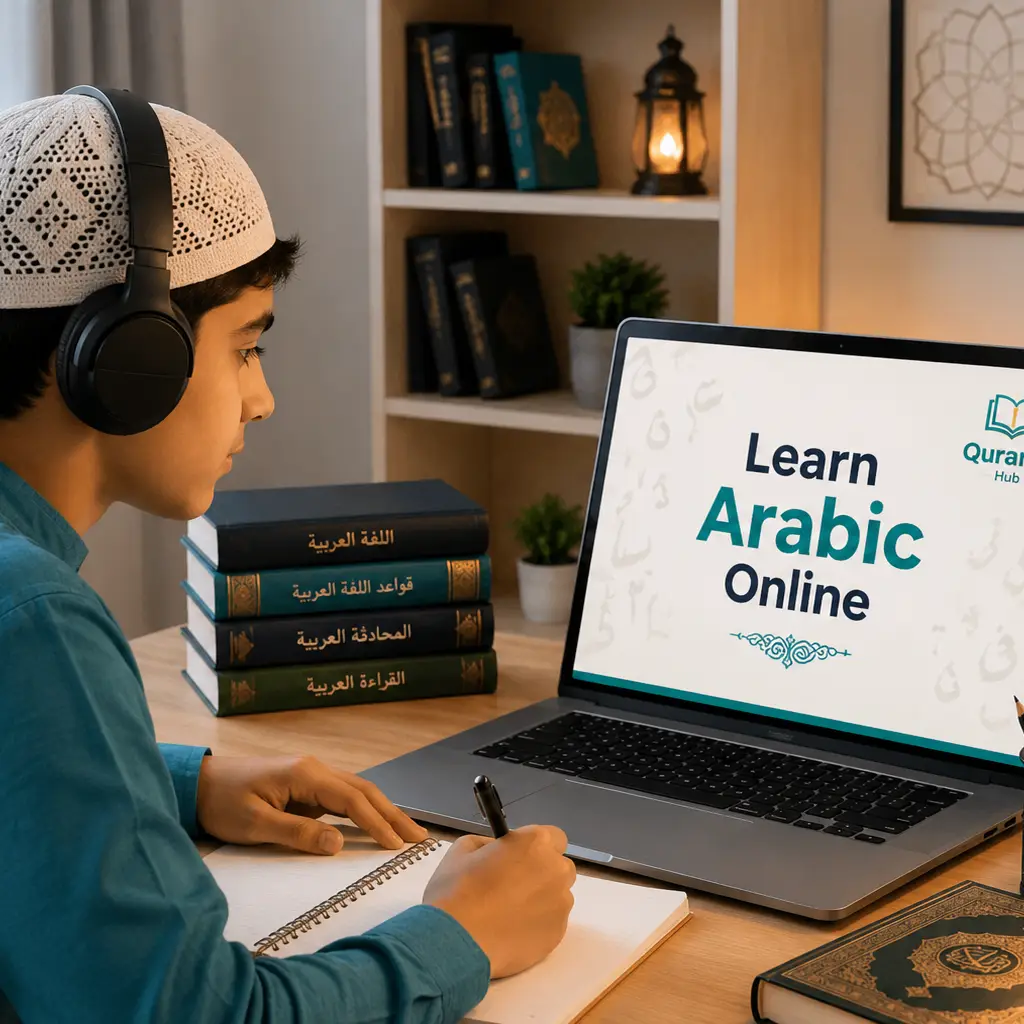
Most Cologne families start by looking for a tutor in their own district, and usually find a short, often-full list. A mosque school has fixed hours, one working language and a waiting list, and its classes are shared. A family that wants one-to-one teaching, a female tutor for a daughter, or a Tajweed teacher who corrects every word has three choices: wait, travel, or go online. Waiting means the child’s mistakes set. Travelling means the lesson competes with homework, sport and a school calendar that Karneval disrupts for weeks every year, and with a public-transport trip that can genuinely separate Chorweiler from Rodenkirchen. Going online means the tutor comes to the child’s own room, at the hour the family chooses, with the full thirty minutes belonging to one student. That is the whole argument for online in one paragraph, and it is why the families in Ehrenfeld and Mülheim who could walk to a mosque still book a class on Zoom.
Female Quran Teacher in Cologne
Requests for a female tutor come up often among Cologne families, for daughters and mothers alike. This is available at the standard price with no waiting list. Any of the seven courses can be booked one-to-one by an adult woman, at her own pace.
Tajweed Classes in Cologne
Getting Tajweed rules corrected properly needs a tutor who can hear the difference in real time. Cologne students get that same live correction online that they’d get from an in-person class, without needing a specific tutor to have space nearby. See our full Tajweed course page.
Hifz Course in Cologne
Hifz is a long-term commitment, and it’s exactly the kind of course where an inconsistent teacher does real damage. Our online Hifz course keeps the same dedicated tutor throughout, running the sabaq-sabqi-manzil cycle session by session, timed around a Cologne school week. See our full Hifz course page.
Quranic Arabic and Tafseer for Students in Cologne
Understanding the text is a common goal among Cologne students, not just reciting it. Our Quranic Arabic course covers the grammar for that directly; our Tafseer classes cover meaning, referencing Ibn Kathir and Al-Jalalayn.
The Free Trial in Cologne: One Real Class Before You Pay
What Happens Inside the Free Trial Class
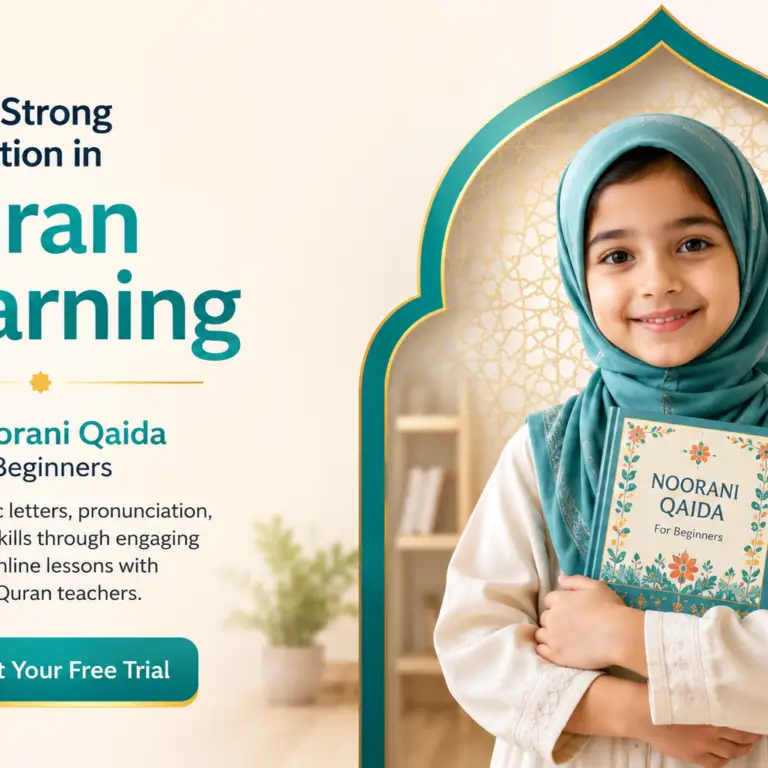
One free class, thirty minutes, live and one-to-one, on Zoom, with the tutor your child would actually keep. The tutor starts by listening. If your child reads already, the tutor hears a few lines of recitation and finds the level. If your child is starting from zero, the tutor begins with Noorani Qaida, slowly, and watches how the child responds. Then the tutor teaches something small and checks whether it stays. The last five minutes are for you: what the tutor noticed, what the next step would be, and what the pace should look like. Nothing is charged, and no card is taken. The trial is one class because one class is enough to see the fit, and because a longer free period would be a different promise. If you want to try a different tutor after the trial, say so. The class is free either way.
The Trial Shapes Other Academies Use
Not every academy offers the same trial, and the shape tells you what the academy thinks a trial is for. Tibyan offers a free trial class first, with no registration fee and no contract. A three-class trial gives you more time to judge the teacher, and a one-class trial gives you less, and the wider market shows both shapes: KidsQuran offers three free classes before the monthly plan starts, and Peace Academy offers two free classes first. The honest question is not how many free classes you get. It is what the academy says the free part is, before you book. If the website says “free trial” and the booking form asks for a card, walk away. If it says three classes free and the trial is three real classes with a real teacher, that is a fair offer. And if it says “free” with no end date and no price anywhere, that is usually a free first class followed by a monthly plan that only appears after you have already invested an hour of your time.
Four Questions Before You Book Any Trial
Before you book any trial, ask four things, and ask them in writing if you can. First, how many free classes, exactly, and how long is each one? Second, what happens the day the free part ends: does the plan start automatically, or do you choose? Third, what is the monthly price after the trial, in writing, before the first class? Fourth, is there a registration fee, an admission fee, or any one-time charge on top of the monthly price? An academy that hides its price behind “contact us for pricing” until you are already invested is telling you something about how it will treat you later. The trial is where that gets tested. If you want the same decision made on price grounds instead of learning grounds, our guide on how much online Quran classes cost sets out the same questions from the price side.
Scheduling Around Cologne’s School Year and Karneval Season
Cologne has a calendar most German cities don’t: Karneval season, running from early January through Rosenmontag and Ash Wednesday, genuinely disrupts school hours, after-school activities and family routines across the city for several weeks every year, on top of North Rhine-Westphalia’s standard school holiday dates, which differ from those in Hesse or Bavaria. A fixed weekly class booked months in advance doesn’t bend around a Rosenmontag school closure or a Karneval-week disruption to normal routines — online scheduling does, because every session is booked around the family’s actual week rather than a fixed term timetable set in advance.
The same flexibility applies outside Karneval season: a class can sit on a Tuesday evening one week and a Saturday morning the next without needing to notify a school or re-enrol, and sessions run on CET/CEST so there’s no confusion about start times. It also means a sibling on a different school schedule, which happens often with North Rhine-Westphalia’s staggered holiday system, can be booked on their own timetable rather than forcing both children into the same slot.
What Online Quran Classes in Cologne Actually Cost: €30 to €45, and How Long Each Course Takes
A price on its own tells you almost nothing. Thirty euros a month could mean eight classes or twenty. It could mean a group, or one-to-one. It could mean the same teacher every week, or whoever happens to be free. So here is what QuranlyHub’s fee actually buys, in plain numbers, and then how long each course takes, because the price of a month and the length of a course are two different questions.
The Plans, in Plain Numbers
The plans run €30 a month for eight classes, €35 for twelve, €40 for sixteen, and €45 for twenty, all of them live, one-to-one, thirty minutes each, on Zoom. That works out at €3.75 a class for eight classes, about €2.92 a class for twelve, €2.50 a class for sixteen, and €2.25 a class for twenty. Siblings each get their own one-to-one class, even back-to-back with the same tutor, and the second child in a family gets a 10 percent discount, which brings the second child’s plan to €27 a month for eight classes, €31.50 for twelve, €36 for sixteen, or €40.50 for twenty. The standalone Tafseer course costs €70 a month for twelve classes, three days a week, taught in Urdu or English. If you want to know what a good Tafseer course covers before you choose one, our best Quran Tafseer guide sets out the same questions from the student’s side. The Alim and Aalimah scholar track is a different plan because it covers several subjects at once, in longer sessions: €80 a month for two classes a week, or €100 a month for four classes a week, each session 40 minutes. Every plan includes a monthly progress report that shows where the student stands, and the same teacher each week, so the teacher knows which page the student is on without having to ask.
The market, for comparison, looks like this. Tibyan, which has a page for Germany serving Berlin, Frankfurt, Munich, Hamburg and Cologne, charges $30 a month for four classes, $35 for eight, $40 for twelve, and $50 for twenty, with a free trial first and no registration fee, and bills in US dollars, so a German bank converts the payment to euros. Quran In Depth charges in euros: €35 a month for two classes a week, €50 for three, €68 for four, and €85 for five classes a week on its Daily Hifz Circle, with one free trial lesson. Al-Noor Academy charges $35 a month for eight classes, $45 for twelve, and $60 for twenty, accepts payment by SEPA transfer, card or PayPal, and charges no registration fee and no contract. AlhudaQuranTutor charges in euros: €45 a month for twelve classes, €50 for sixteen, and €60 for twenty. Elbayan charges $40 a month for eight classes and $80 for sixteen, at $5 a 30-minute class, with the first class free and a 10 percent family discount, and teaches in English, Arabic and French, not in German. 92 Campus charges in euros: €30 a month for three days a week, €40 for five days a week, and €30 for weekend classes, with a 20 percent sibling discount for the second and third child. Online Quran Live, which has a page for Cologne itself, charges a monthly fee starting at €40, with Turkish, Arabic and German speaking teachers, and classes from 7 AM to 10 PM CET. QuranlyHub’s plans sit at or below the low end of that market, in euros, with the same 30-minute one-to-one format throughout.
How Long Each Course Actually Takes
A student’s second question, after the price, is how long it takes. Noorani Qaida takes 2 to 3 months on the 16-class plan, or 3 to 5 months on the 8-class plan, and at the end of it a student reads the Quran on their own. Hifz takes 2 to 2.5 years, at 7 to 8 new lines a day, with daily revision of the old lessons, sabaq, sabqi and manzil, and the youngest children finish Juz Amma in 2 to 3 months. Quranic Arabic takes 9 to 12 months. No confirmed duration exists for Tajweed or for Tafseer, and this page does not invent one: Tajweed takes as long as the student’s reading needs, and Tafseer is taught as an ongoing course, not a fixed-length one. Homework is Hifz-only: the student revises what the teacher set, nothing else. If your child is finding a page hard, our guide on how to memorize the Quran step by step walks through sabaq, sabqi and manzil the way the teacher does it, so you can see what the method is and why it works.
The seasons change the timeline too, and in Cologne more than most places, because the city runs on a state school calendar and a carnival calendar at once. North Rhine-Westphalia sets its own holiday dates: the autumn break in 2026 is 19 to 30 October, the Christmas break is 23 December 2026 to 6 January 2027, and the Easter break in 2027 is 22 March to 3 April. The state has no February winter break at all, which is why Karneval week, not a school holiday, is the disruption in February: the season opens on 11 November at 11:11, the street carnival runs from Weiberfastnacht on Thursday 4 February 2027 to Shrove Tuesday 9 February, Rosenmontag is Monday 8 February, and Ash Wednesday is 10 February, and the schools close on Rosenmontag and the following Tuesday. Ramadan 2027 falls in February and March, when the days are still short, and the academy keeps its Ramadan timing flexible, so a family can move the class around iftar rather than through it. The durations above are the academy’s plans for each course, not a promise for any one student, because the pace depends on the student, the frequency, and the season, in that order.
The Fine Print: Advance Payment, Refunds, and Makeup Classes
The price is only half the story. Fees are paid in advance by bank transfer, and the class runs for the month that has been paid for. If a student leaves, there is no refund for the month, and a family should know that before they pay. If the teacher cannot continue, the fees are refunded, because that is the academy’s side of the same promise. If the teacher misses a lesson, a makeup class is arranged. If the student misses one, it is not made up, and the month is not extended. A student can stop at the end of any month. None of this is hidden in a terms page. It is written here because a family who knows the fine print before the first lesson will never have to argue about it after the tenth. Ask any academy these four questions before you pay: how do I pay, what happens if we leave, what happens if the teacher leaves, and what happens if a lesson is missed. The answers should take one minute, and they should match what is written on the page.
Pricing: What Online Quran Classes in Cologne Actually Cost
Tafseer costs €70 a month for 12 classes, three days a week. The following plans cover Noorani Qaida, Tajweed, Advanced Tajweed, Hifz and Quranic Arabic, with four schedules to fit a Cologne week:
| Plan | Classes / Month | Schedule | Price |
|---|---|---|---|
| Weekend Plan | 8 classes | Sat & Sun | €30/month |
| 3 Days a Week | 12 classes | Any 3 weekdays | €35/month |
| 4 Days a Week Most Popular | 16 classes | Any 4 weekdays | €40/month |
| 5 Days a Week | 20 classes | Mon to Fri | €45/month |
All plans include a free trial class, monthly progress reports, and a dedicated Ijazah-certified tutor. Enrolling siblings? Every additional child in the same family gets a 10% discount. See the full pricing page for the Alim & Aalimah scholar track.
The Safety Question: Who Is Teaching Your Child, and What You Can Check
A free trial tells you what a class feels like. It does not tell you who is teaching it, or whether anyone has actually checked that person. For a child learning online, that is the question to settle first, before the price, before the timetable, before anything else. And it is the question most academies answer with a badge on their website, which is the weakest answer of all.
No Certificate Exists for an Overseas Tutor
Here is the honest limit, stated plainly. Every country has its own check for people who work with children: Britain has the DBS check, Canada has the vulnerable sector check, Australia has the working with children check. Germany asks anyone who works with children for an extended certificate of good conduct, the erweitertes Führungszeugnis, and the same limit applies there too. A parent is right to expect the same care from anyone who teaches their child. None of that gives a parent a certificate to ask for. Each of those checks is a check for people working with children in that country, and an online tutor teaching from Pakistan cannot hold one, because no such certificate exists for an overseas tutor. So when an academy tells a family that all its tutors are “DBS-checked” or “background-checked” for teaching children online, the parent should ask what that actually means, and in which country the check was done. A badge on a website is not a check. What a parent can check is a real person, a real qualification and a real class. Ask, too, who granted the teacher’s Ijazah and in which subject, because a named teacher with a named chain is the oldest check in this tradition. What QuranlyHub does instead is say plainly what has been done. Every tutor is Ijazah-certified, identity-verified and reference-checked before they take a class, and the academy names a safeguarding contact, Adeel Ahmad, so a family always knows who to write to.
Four Checks Before the First Lesson
The trial class is the real test, and a parent should treat it that way. Sit in on it, or ask a family member to. Watch how the teacher handles a hard question, whether they admit what they do not know, and whether the child looks forward to the next one. Ask for the lesson to be recorded, because a recording lets the family hear it later, and a teacher who welcomes a recording has nothing to hide. Check that the only contact between the teacher and the student is the official channel. There is no private messaging, no personal number, and no side arrangement. If any of those appear, stop the class and write to the safeguarding contact. Four things, then, before you commit to anything. Sit in on the trial. Ask for a recording. Confirm there is no private contact outside the official channel. Know the name of the safeguarding contact. At QuranlyHub that contact is Adeel Ahmad, who answers families directly. None of these takes more than an hour, and together they tell you more about an academy than any claim on its website.
Daughters and Sisters: A Female Teacher Throughout
Girls and daughters learn only with a female teacher, and that should not cost extra. At QuranlyHub a female teacher is available at no extra cost, and the rule holds for every course, from Qaida to the Alim track. The female teacher is a Hafiza. The class runs the same way, on the same Zoom setup, for the same 30 minutes. The camera is optional for adult sisters, and the student decides how the class looks. What matters is that the family controls the setup from the start, not that the academy decides it for them. If you are weighing this choice, our guide to finding a female Quran teacher online asks the same questions a family would ask, so you can see what a good answer looks like before you book. A student who has already asked these questions before the trial will not need to ask them again after it.
All 7 Online Quran Courses in Cologne, One Platform
Whichever course your family starts with, the same tutor-matching and free trial process applies across all seven, for every age from Noorani Qaida beginners to the Alim & Aalimah scholar track:





Also Available in Germany
Book Your Free Trial Class
See for yourself before you commit to a plan. Book a free trial class with an Ijazah-certified tutor, matched to your child’s or your own age, level and preferred schedule.
Frequently Asked Questions
Is online Quran learning safe for my child in Cologne?
Yes — every class is one-on-one over video with a vetted, Ijazah-certified tutor, and a parent can stay nearby throughout the session.
Can my child start with Noorani Qaida if they’ve never read Arabic before?
Yes — Noorani Qaida is specifically the starting point for complete beginners, teaching letters and joining rules before real Quran reading begins.
Is a female Quran tutor available in Cologne?
Yes, at no extra cost — mention your preference when booking your free trial.
Do you offer Advanced Tajweed for students who already recite well?
Yes — Advanced Tajweed refines makharij and sifaat for students who’ve completed the basics.
How much do online Quran classes cost in Cologne?
€30/month for 8 classes, up to €45/month for 20 classes, one-on-one, 30 minutes each. Tafseer costs €70 a month for 12 classes, three days a week.
Is there a free trial before I have to pay?
Yes — every course starts with a free trial class, no card required.
Does the schedule adjust around German school holidays or local events like Karneval?
Yes — because each plan is rebooked around your family’s week rather than a fixed term, a school closure, holiday period or local event like Karneval doesn’t cost you a class, just a reschedule.