
Short answer: Online Quran classes give Muslim families in Malmö access to live, one-on-one Ijazah-certified tutors across Noorani Qaida, Tajweed, Hifz, Tafseer and Quranic Arabic, scheduled around Malmö time with a free trial before any payment. Families searching for online quran classes in malmo will find full pricing, scheduling and trial-class details below.
Malmö has one of the highest concentrations of Muslim residents of any city in Scandinavia. The Islamic Center of Malmö estimates the city’s Muslim population at over 50,000 — out of a total population of roughly 362,000 — concentrated in areas including Rosengard and Fosie.
Why Malmö Families Are Choosing an Online Quran Academy
Most Malmö families start by looking for a tutor within their own neighbourhood, and usually find a short, often-full list. Moving online removes that limit entirely: you select a tutor by teaching style, gender and specialism, not simply by which district you live in.
- One-to-one, not group classes: full tutor attention every session, not shared among six or more students.
- Ijazah-certified tutors: a formal chain-of-transmission certificate verifying the tutor’s own recitation.
- Flexible scheduling: weekday evenings, weekends, or a mix, without a fixed classroom timetable.
- A genuine free trial: a real class with the actual tutor, not a sales consultation.
Malmö’s Muslim Community: Mosques, Neighbourhoods and Why Online Fits
The lead above names the number: about 50,000 Muslims in a city of roughly 362,000, one of the highest concentrations in Scandinavia. Numbers like that hide the real question, which is not how many Muslims live in Malmö but where they learn, and whether a family can actually get a place. This section is about the city itself: its mosques, its neighbourhoods, and why a family that lives five minutes from a mosque can still end up learning online.
The Mosques and Neighbourhoods Behind the Numbers
Malmö Mosque, in Jägersro, was inaugurated on 20 April 1984, the second oldest mosque in Sweden, run by the Islamic Center with a charter school beside it. It holds about 1,000 people at Friday prayers and serves families from across Scania and from Copenhagen, just across the water. Two newer mosques sit alongside it: the Mahmood Mosque, opened in 2016, and the Khadija Mosque, opened in 2017 and described as the largest in Scandinavia, with room for about 2,000 people. The community behind those buildings is wide: almost half the city’s population has a foreign background, with people from 187 different countries, and the largest Muslim neighbourhoods are Rosengård and Fosie, in the east of the city. A family in Rosengård lives close to other Muslim families, to halal shops and to the mosque. What it does not always live close to is a Quran teacher with a free slot, at the hour the family needs, for the course the child needs. That is the gap the rest of this page is about.
What the Lead Numbers Actually Mean
About 50,000 Muslims, around 14 percent of the city, according to the Islamic Center. Sweden keeps no official statistics on religious belief, so that figure is the Center’s own estimate, not a census count, and other estimates put the community anywhere from 45,000 in the city to 100,000 across the region. The honest way to read it is this: roughly one person in seven in Malmö has a Muslim background, which makes Malmö one of the most Muslim cities in Sweden by share, and one of the most Muslim cities in Scandinavia. The city itself is Sweden’s third largest, joined to Copenhagen by the Öresund Bridge since 2000, about half an hour by train, so a Malmö family’s world runs in two countries and two languages at once. The classes on this page are built for that world: scheduled on Malmö time, taught in English, Arabic or Urdu, and fitted around a Swedish school year rather than a generic European one.
Why a Malmö Family Chooses Online Over the Local List
Most Malmö families start by looking for a tutor in their own neighbourhood, and usually find a short, often-full list. The Islamic Center runs a school beside the mosque, with around 250 pupils, which is a small number against a community of about 50,000, and its hours are fixed and its classes are shared. A family that wants one-to-one teaching, a female tutor for a daughter, or a Tajweed teacher who corrects every word has three choices: wait, travel, or go online. Waiting means the child’s mistakes set. Travelling means the lesson competes with homework, sport and the dark winter evenings. Going online means the tutor comes to the child’s own room, at the hour the family chooses, with the full thirty minutes belonging to one student. That is the whole argument for online in one paragraph, and it is why the families in Rosengård and Fosie who could walk to a mosque still book a class on Zoom.
Female Quran Teacher in Malmö
Requests for a female tutor come up often among Malmö families, for daughters and mothers alike. This is available at the standard price with no waiting list. Any of the seven courses can be booked one-to-one by an adult woman, at her own pace.
Tajweed Classes in Malmö
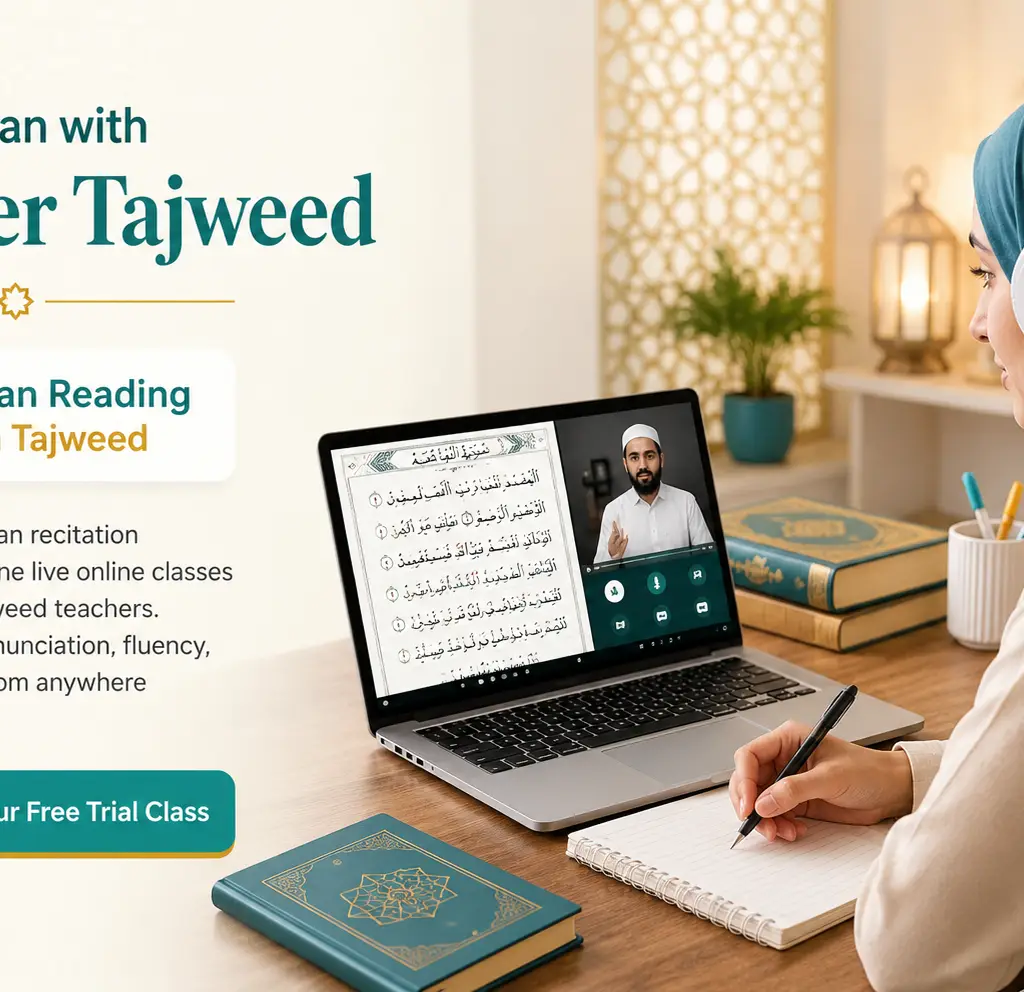
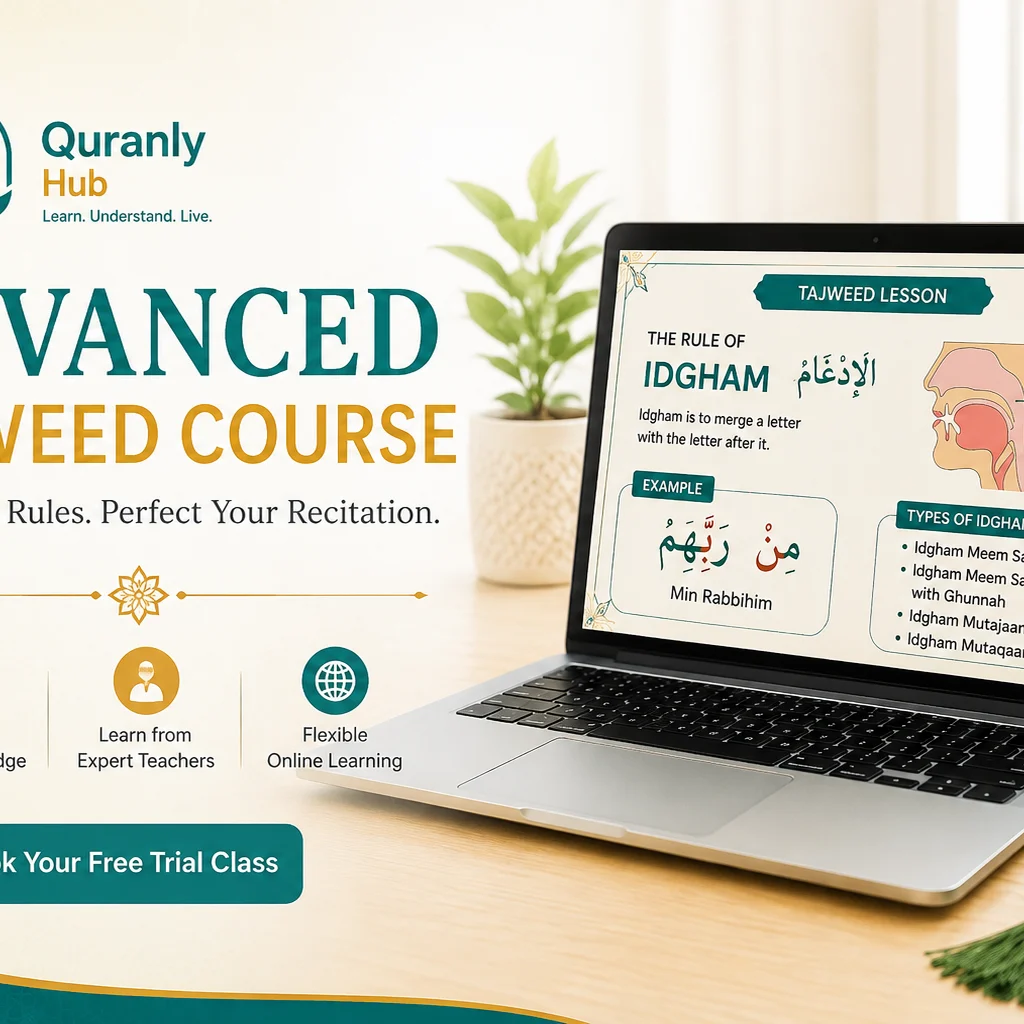
In Malmö, Tajweed classes run the same online as in person: live correction of makharij, elongation rules and details a shared class would miss. A tutor watching over video spots the same mistakes an in-person class would — with no waitlist to join. See our full Tajweed course page.
Hifz Course in Malmö
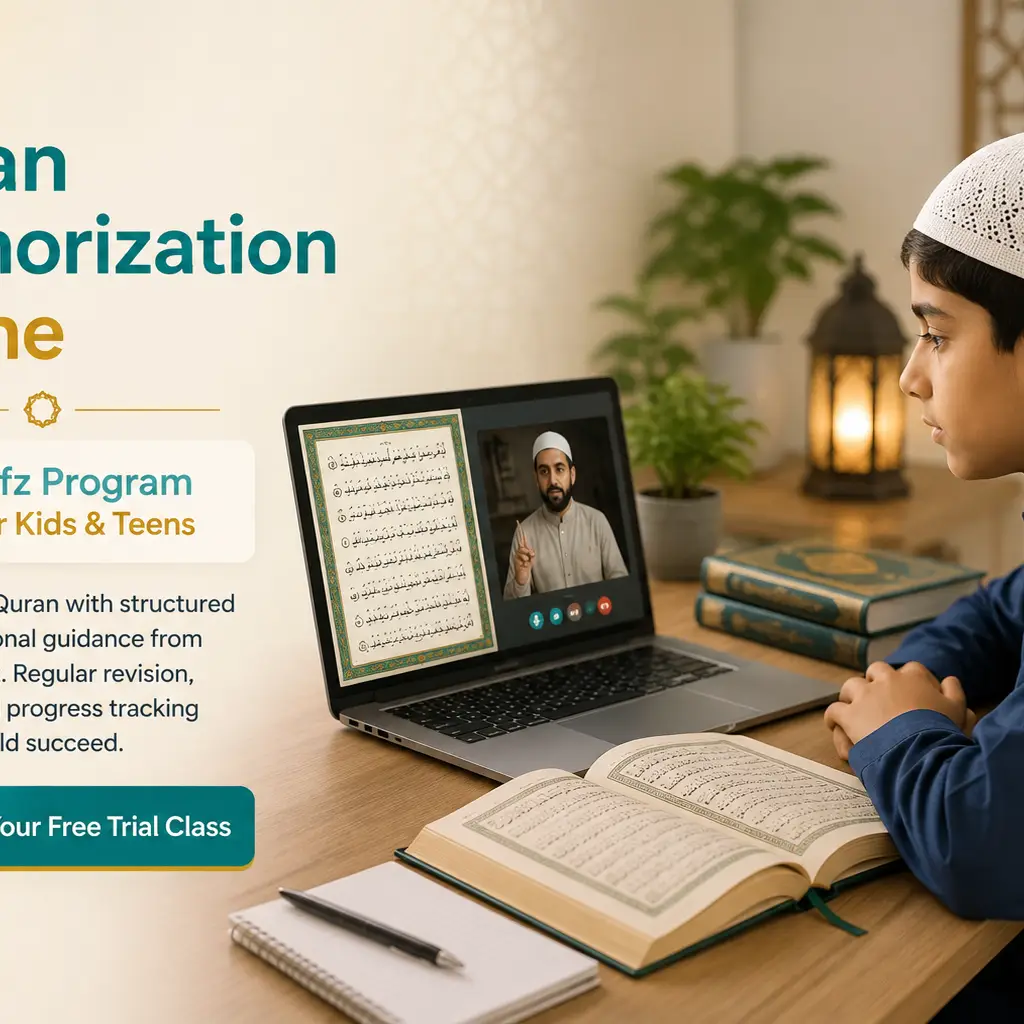
Malmö families don’t need a boarding route for Hifz. The online course runs the sabaq, sabqi and manzil cycle just as a residential programme would, tracked lesson by lesson, and timed around school hours instead of competing with them. See our full Hifz course page.
Quranic Arabic and Tafseer for Students in Malmö
Understanding the text is a common goal among Malmö students, not just reciting it. Our Quranic Arabic course covers the grammar for that directly; our Tafseer classes cover meaning, referencing Ibn Kathir and Al-Jalalayn.
The Free Trial in Malmo: One Real Class Before You Pay
This page promises a free trial class at the end, and the questions below mention a free trial too. Here is what that trial actually is, what other academies offer instead, and the four questions that tell you whether a trial is real.
What Happens Inside the Free Trial Class
One free class, thirty minutes, live and one-to-one, on Zoom, with the tutor your child would actually keep. The tutor starts by listening. If your child reads already, the tutor hears a few lines of recitation and finds the level. If your child is starting from zero, the tutor begins with Noorani Qaida, slowly, and watches how the child responds. Then the tutor teaches something small and checks whether it stays. The last five minutes are for you: what the tutor noticed, what the next step would be, and what the pace should look like. Nothing is charged, and no card is taken. The trial is one class because one class is enough to see the fit, and because a longer free period would be a different promise. If you want to try a different tutor after the trial, say so. The class is free either way.
The Trial Shapes Other Academies Use
Not every academy offers the same trial, and the shape tells you what the academy thinks a trial is for. Tibyan offers a free trial class first, with no registration fee and no contract. Al-Noor Academy offers a free start, with no registration fee and no contract. My Online Quran Tutor offers a free start too. None of these is a trick. A three-class trial gives you more time to judge the teacher, and a one-class trial gives you less, and the wider market shows both shapes: KidsQuran offers three free classes before the monthly plan starts, and Peace Academy offers two free classes first. The honest question is not how many free classes you get. It is what the academy says the free part is, before you book. If the website says “free trial” and the booking form asks for a card, walk away. If it says three classes free and the trial is three real classes with a real teacher, that is a fair offer. And if it says “free” with no end date and no price anywhere, that is usually a free first class followed by a monthly plan that only appears after you have already invested an hour of your time.
Four Questions Before You Book Any Trial
Before you book any trial, ask four things, and ask them in writing if you can. First, how many free classes, exactly, and how long is each one? Second, what happens the day the free part ends: does the plan start automatically, or do you choose? Third, what is the monthly price after the trial, in writing, before the first class? Fourth, is there a registration fee, an admission fee, or any one-time charge on top of the monthly price? An academy that hides its price behind “contact us for pricing” until you are already invested is telling you something about how it will treat you later. The trial is where that gets tested. If you want the same decision made on price grounds instead of learning grounds, our guide on how much online Quran classes cost sets out the same questions from the price side.
Scheduling Classes Through Malmö’s Light and Dark Seasons
Malmö’s far-northern latitude means its daylight swings much further than families further south are used to — a winter afternoon can be dark by mid-afternoon, while a June evening barely gets properly dark at all, and that shift genuinely changes how a household’s evening runs across the year. A 5pm class slot that feels like early evening in June can feel like the middle of the night to a tired child in December, and a fixed weekly time booked once a year doesn’t account for that swing at all.
Online scheduling adjusts with the seasons instead of fighting them: a family can move a child’s class earlier through the darker months and later once summer evenings stretch on, without re-enrolling or losing continuity with their tutor. Sweden’s school calendar adds its own rhythm too, with breaks like höstlov (autumn) and sportlov (February) sitting at different points than school holidays elsewhere in Europe, so a class plan built around Malmö’s actual Swedish term dates, rather than a generic European school year, tends to fit better over a full year. For families in Rosengard, Fosie and across the city balancing Swedish school hours with evening Qur’an study, that flexibility — rebooking around the season and the term, not a fixed slot — is often the practical difference between a class that sticks and one that quietly stops happening by November.
What Online Quran Classes in Malmo Actually Cost: $30 to $45, and How Long Each Course Takes
A price on its own tells you almost nothing. Thirty dollars a month could mean eight classes or twenty. It could mean a group, or one-to-one. It could mean the same teacher every week, or whoever happens to be free. So here is what QuranlyHub’s fee actually buys, in plain numbers, and then how long each course takes, because the price of a month and the length of a course are two different questions. One fact first: Sweden uses the krona, not the euro, and there is no confirmed krona price for these classes, so the table below stays in US dollars, the currency the plans are billed in, and a Swedish bank converts the payment to kronor.
The Plans, in Plain Numbers
The plans run $30 a month for eight classes, $35 for twelve, $40 for sixteen, and $45 for twenty, all of them live, one-to-one, thirty minutes each, on Zoom. Eight classes a month means weekends only. Twelve classes means any three weekdays. Sixteen classes means any four weekdays, and that is the most popular plan. Twenty classes means Monday to Friday. That works out at $3.75 a class for eight classes, about $2.92 a class for twelve, $2.50 a class for sixteen, and $2.25 a class for twenty. Siblings each get their own one-to-one class, even back-to-back with the same tutor, and the second child in a family gets a 10 percent discount, which brings the second child’s plan to $27 a month for eight classes, $31.50 for twelve, $36 for sixteen, or $40.50 for twenty. The standalone Tafseer course costs USD 70 a month for twelve classes, three days a week, taught in Urdu or English. If you want to know what a good Tafseer course covers before you choose one, our best Quran Tafseer guide sets out the same questions from the student’s side. The Alim and Aalimah scholar track is a different plan because it covers several subjects at once, in longer sessions: $80 a month for two classes a week, or $100 a month for four classes a week, each session 40 minutes. Every plan includes a monthly progress report that shows where the student stands, and the same teacher each week, so the teacher knows which page the student is on without having to ask.
The market, for comparison, looks like this. Tibyan, which has a page for Sweden, charges $30 a month for four classes, $35 for eight, and $50 for twenty, with a free trial first and no registration fee, and bills in US dollars, so a Swedish bank converts the payment to kronor. Al-Noor Academy charges $35 a month for eight classes, $45 for twelve, and $60 for twenty, accepts payment in kronor and by Swish on request, and charges no registration fee and no contract. My Online Quran Tutor charges in euros: €28 a month for eight classes, €37 for twelve, €42 for sixteen, and €46 for twenty, with no registration fee. TarteeleQuran charges from USD 39 a month for two classes a week. Al-Walid Academy puts beginner classes at $20 to $30 a month, intermediate at $30 to $50, advanced at $45 to $70, and very advanced at $70 to $100. The wider one-to-one market looks like this. KidsQuran charges $29 a month for eight classes, $38 for twelve and $54 for twenty, with three free classes and no card. Peace Academy charges $30 a month for eight lessons, $40 for twelve, $50 for sixteen and $60 for twenty, with two free classes first and a 5 percent family discount for each additional family member. Al Miftah charges $33 a month for three days a week, $39 a month for four days a week and $49 a month for five days a week, with a monthly progress report and no registration fee. Al Tahoor charges $44.99 to $74.99 a month for eight to twenty lessons, with the first class free and a 100 percent money-back guarantee. QuranlyHub’s plans sit at or below the low end of that market, in dollars, with the same 30-minute one-to-one format throughout.
How Long Each Course Actually Takes
A student’s second question, after the price, is how long it takes. Noorani Qaida takes 2 to 3 months on the 16-class plan, or 3 to 5 months on the 8-class plan, and at the end of it a student reads the Quran on their own. Hifz takes 2 to 2.5 years, at 7 to 8 new lines a day, with daily revision of the old lessons, sabaq, sabqi and manzil, and the youngest children finish Juz Amma in 2 to 3 months. Quranic Arabic takes 9 to 12 months. No confirmed duration exists for Tajweed or for Tafseer, and this page does not invent one: Tajweed takes as long as the student’s reading needs, and Tafseer is taught as an ongoing course, not a fixed-length one. Homework is Hifz-only: the student revises what the teacher set, nothing else. If your child is finding a page hard, our guide on how to memorize the Quran step by step walks through sabaq, sabqi and manzil the way the teacher does it, so you can see what the method is and why it works. The point of the durations is not to promise a date. It is to show that the academy has a plan for each course, and that the plan is measured in months and years, not in vague promises.
The seasons change the timeline too, and in Malmö more than most places. A class booked for 5pm in June, when the evening is still light, feels like a different hour in December, when the afternoon has been dark since half past three, and a tired child learns less in the dark. That is why the scheduling section above matters: the same thirty minutes, moved earlier through the winter and later through the summer, keeps the lesson in the part of the day when the child is still awake enough to learn. Ramadan 2027 falls in February and March, when the days are still short, and the academy keeps its Ramadan timing flexible, so a family can move the class around iftar rather than through it. The durations above are the academy’s plans for each course, not a promise for any one student, because the pace depends on the student, the frequency, and the season, in that order.
The Fine Print: Advance Payment, Refunds, and Makeup Classes
The price is only half the story. Fees are paid in advance by bank transfer, and the class runs for the month that has been paid for. If a student leaves, there is no refund for the month, and a family should know that before they pay. If the teacher cannot continue, the fees are refunded, because that is the academy’s side of the same promise. If the teacher misses a lesson, a makeup class is arranged. If the student misses one, it is not made up, and the month is not extended. A student can stop at the end of any month. None of this is hidden in a terms page. It is written here because a family who knows the fine print before the first lesson will never have to argue about it after the tenth. Ask any academy these four questions before you pay: how do I pay, what happens if we leave, what happens if the teacher leaves, and what happens if a lesson is missed. The answers should take one minute, and they should match what is written on the page.
Pricing: What Online Quran Classes in Malmo Actually Cost
Tafseer costs USD 70 a month for 12 classes, three days a week. The following plans cover Noorani Qaida, Tajweed, Advanced Tajweed, Hifz and Quranic Arabic, with four schedules to fit a Malmö week:
| Plan | Classes / Month | Schedule | Price |
|---|---|---|---|
| Weekend Plan | 8 classes | Sat & Sun | $30/month |
| 3 Days a Week | 12 classes | Any 3 weekdays | $35/month |
| 4 Days a Week Most Popular | 16 classes | Any 4 weekdays | $40/month |
| 5 Days a Week | 20 classes | Mon to Fri | $45/month |
All plans include a free trial class, monthly progress reports, and a dedicated Ijazah-certified tutor. Enrolling siblings? Every additional child in the same family gets a 10% discount. See the full pricing page for the Alim & Aalimah scholar track.
The Safety Question: Who Is Teaching Your Child, and What You Can Check
A free trial tells you what a class feels like. It does not tell you who is teaching it, or whether anyone has actually checked that person. For a child learning online, that is the question to settle first, before the price, before the timetable, before anything else. And it is the question most academies answer with a badge on their website, which is the weakest answer of all.
No Certificate Exists for an Overseas Tutor
Here is the honest limit, stated plainly. Every country has its own check for people who work with children: Britain has the DBS check, Canada has the vulnerable sector check, Australia has the working with children check. Sweden asks anyone who works with children for an extract from the criminal record, and the same limit applies there too. A parent is right to expect the same care from anyone who teaches their child. None of that gives a parent a certificate to ask for. Each of those checks is a check for people working with children in that country, and an online tutor teaching from Pakistan cannot hold one, because no such certificate exists for an overseas tutor. So when an academy tells a family that all its tutors are “DBS-checked” or “background-checked” for teaching children online, the parent should ask what that actually means, and in which country the check was done. A badge on a website is not a check. What a parent can check is a real person, a real qualification and a real class. Ask, too, who granted the teacher’s Ijazah and in which subject, because a named teacher with a named chain is the oldest check in this tradition. What QuranlyHub does instead is say plainly what has been done. Every tutor is Ijazah-certified, identity-verified and reference-checked before they take a class, and the academy names a safeguarding contact, Adeel Ahmad, so a family always knows who to write to.
Four Checks Before the First Lesson
The trial class is the real test, and a parent should treat it that way. Sit in on it, or ask a family member to. Watch how the teacher handles a hard question, whether they admit what they do not know, and whether the child looks forward to the next one. Ask for the lesson to be recorded, because a recording lets the family hear it later, and a teacher who welcomes a recording has nothing to hide. Check that the only contact between the teacher and the student is the official channel. There is no private messaging, no personal number, and no side arrangement. If any of those appear, stop the class and write to the safeguarding contact. Four things, then, before you commit to anything. Sit in on the trial. Ask for a recording. Confirm there is no private contact outside the official channel. Know the name of the safeguarding contact. At QuranlyHub that contact is Adeel Ahmad, who answers families directly. None of these takes more than an hour, and together they tell you more about an academy than any claim on its website.
Daughters and Sisters: A Female Teacher Throughout
Girls and daughters learn only with a female teacher, and that should not cost extra. At QuranlyHub a female teacher is available at no extra cost, and the rule holds for every course, from Qaida to the Alim track. The female teacher is a Hafiza. The class runs the same way, on the same Zoom setup, for the same 30 minutes. The camera is optional for adult sisters, and the student decides how the class looks. What matters is that the family controls the setup from the start, not that the academy decides it for them. If you are weighing this choice, our guide to finding a female Quran teacher online asks the same questions a family would ask, so you can see what a good answer looks like before you book. A student who has already asked these questions before the trial will not need to ask them again after it.
All 7 Online Quran Courses in Malmo, One Platform
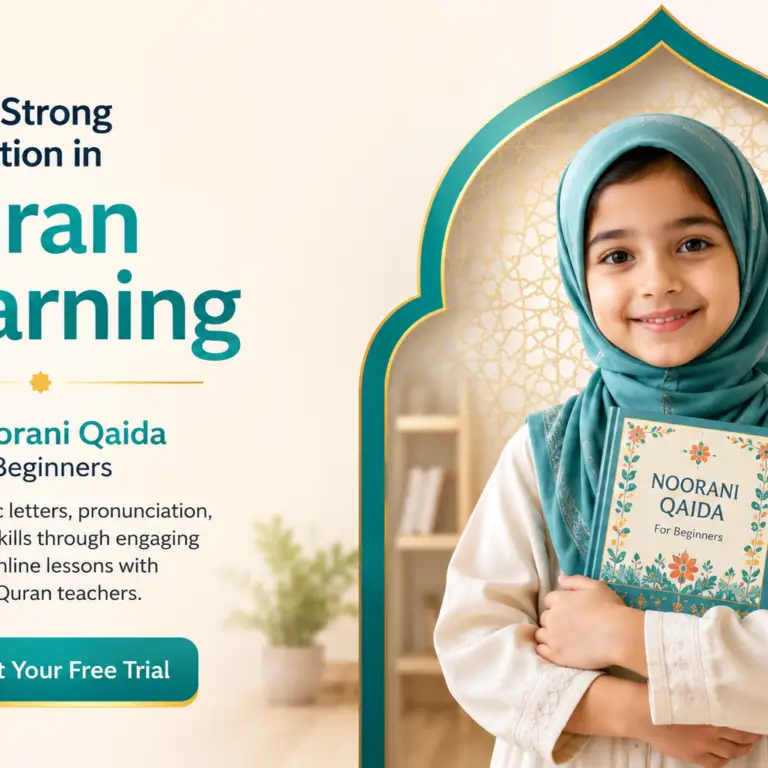
Whichever course your family starts with, the same tutor-matching and free trial process applies across all seven, for every age from Noorani Qaida beginners to the Alim & Aalimah scholar track:


Also Available in Sweden
Book Your Free Trial Class
See for yourself before you commit to a plan. Book a free trial class with an Ijazah-certified tutor, matched to your child’s or your own age, level and preferred schedule.
Frequently Asked Questions
With such a large Muslim community in Malmö, why choose online over a local teacher?
A large community doesn’t always mean a spot in the class or teacher you actually want. Online, one-on-one classes give your child a tutor’s full attention every session, without waiting for a place to open up.
Are classes available in Swedish, English or Arabic?
Tutors can teach in English, Arabic, Somali or Urdu depending on availability — whichever suits your family best.
Is a female Quran teacher available in Malmö?
Yes, at no extra cost — mention your preference when booking your free trial.
Can adults join, or is this only for children?
Adults join just as often, especially for Tajweed correction, Tafseer, or starting from zero as a new Muslim.
How much do online Quran classes cost in Malmö?
$30/month for 8 classes, up to $45/month for 20 classes, one-on-one, 30 minutes each. Tafseer costs USD 70 a month for 12 classes, three days a week.
Is there a free trial before I pay?
Yes — every course starts with a free trial class, no card required.
Does the class schedule adjust for Malmö’s seasonal daylight changes?
Yes — families often shift session times earlier through the darker winter months and later in summer; because scheduling isn’t fixed to one slot, that adjustment is simple to make.