Short answer: online Quran classes in Riyadh give Muslim families across Riyadh and its surrounding districts access to one-to-one, Ijazah-certified tutors across Noorani Qaida, Tajweed, Hifz, Tafseer and Quranic Arabic, with Gulf-friendly scheduling and a free trial before any payment. QuranlyHub’s online Quran classes in Riyadh follow this exact model, including a female tutor option for daughters and women’s classes.
Riyadh’s size works against families as much as it helps them: a tutor “nearby” can still mean a long drive across the city, and a specific gender or teaching pace isn’t always available close to home. Online Quran classes in Riyadh solve that directly – your family is matched with an Ijazah-certified tutor and a schedule built around your own week. This guide covers how it works, alongside our full pricing page, Learn Quran Online overview, and comparison of local vs online Quran classes.

Riyadh’s Muslim Community: What’s Actually Known
Riyadh has a population of around 7.95 million, the Kingdom’s capital and largest city, with a sizeable expat community working in government, finance and major infrastructure projects. The community is organised around mosques and centres including mosques across Riyadh’s Olaya, Diplomatic Quarter and Al Malaz districts, with families spread across Riyadh and its surrounding districts.
Learning the Quran in Riyadh: Grand Mosques, Districts, and the Waiting List
Most Riyadh families start by looking for a Quran teacher at the mosque. That is the natural first step, and it should be. But a mosque class and a one-to-one tutor are different things, and the section before this one already says so. What it doesn’t say is what the local options actually look like, and where they stop. Here is that part.
The Grand Mosque in Dirah
Riyadh has a grand mosque with a history that goes back to the founding of the Second Saudi State. The Imam Turki bin Abdullah Mosque, known simply as the Grand Mosque of Riyadh, stands in ad-Dirah, in Deera Square, next to Qasr al-Hukm and a short walk from Al Masmak Fortress. The first mosque on the site dates to about 1830, and the present building, rebuilt in 1992 and reopened in January 1993, holds around 17,000 worshippers and won the Aga Khan Award for Architecture in 1995. Two other mosques are worth knowing by name. The Al Rajhi Grand Mosque, in the Al-Jazirah neighbourhood on the eastern ring road, was inaugurated in September 2004 and holds about 20,000 worshippers, making it one of the largest mosques in the city. The King Khalid Grand Mosque, in Umm Al Hamam, is one of the best known in Riyadh. But three big names are not the whole picture. Most families pray at a small neighbourhood mosque, not a grand one, and it is in those small mosques that most children first meet the Quran.
Why the Waiting List Is So Long
A waiting list does not mean a mosque school is doing something wrong. It means the room is too small for the neighbourhood. A class that meets in a neighbourhood mosque holds a dozen children, sometimes twenty, and the teacher is often a volunteer with a full-time job of their own. When the class fills up, the next family waits a term, sometimes a year. In Riyadh the wait has a second cause, and it is the one the lead on this page already names: distance. A tutor who lives “nearby” can still mean a long drive across a city of about seven million people, and a parent who works shifts or runs a business cannot always make that drive twice a week. A child who needs individual correction, or a daughter who needs a female teacher, waits longer still, because the class that has a place is not always the class that fits. None of this makes the mosque school a bad choice. For many children it is the right start, and it costs little or nothing. But a parent should know what the queue actually looks like before they join it, and the only reliable way to find out is to call the mosque and ask, not to trust a search result.
Olaya, Al Malaz, the Diplomatic Quarter, and Everywhere Else
The lead on this page names Olaya, the Diplomatic Quarter and Al Malaz, and those three districts do hold a large share of Riyadh’s expat families. But the city’s Muslim families do not live in three districts. They live in Al Nakheel and Al Yasmin in the north, in Al Rawdah and Al Hamra in the east, in Al Naseem and Al Sulimaniyah, in Al Batha and Al Aziziyah in the south, and in Diriyah, fourteen kilometres northwest of the centre. A family in Al Yasmin faces a different trip to the Grand Mosque than a family in Al Batha does, and a parent working shifts faces a different week than a parent working office hours. The Riyadh Metro, which opened on 1 December 2024 with six lines and 85 stations over 176 kilometres, has made some of those trips shorter, but it does not reach every street, and it does not teach a child to read. Online classes remove the district from the decision entirely. You choose a tutor by teaching style, by gender, and by specialism, not by which district you happen to live in. The class comes to your living room, at a time that fits your week, whether that week runs on school hours, shift patterns, or both. And when the school holidays come, the class moves with them: the 1448 school year began on Sunday 23 August 2026, the autumn break runs from Friday 20 November to Saturday 28 November 2026, and the Eid al-Fitr break runs from Friday 26 February to Saturday 13 March 2027, so a plan is rebooked around those dates.
Why Families in Riyadh Choose an Online Quran Academy
Riyadh’s size can be deceptive – plenty of tutors exist across the capital, but narrow the search to a specific gender, pace or specialism and the shortlist thins out quickly, especially outside districts like Olaya or Al Malaz. Online classes remove that constraint entirely: your family selects a tutor on fit and teaching style, with location no longer dictating who’s even an option.
- Private, one-to-one sessions: full attention, not shared with a group of six or eight.
- Ijazah-certified tutors, each holding a formal chain-of-transmission certificate.
- Flexible timing that works around office hours and school runs alike.
- A genuine trial lesson with your actual prospective tutor, not a sales pitch.
Quran Classes for Ladies and a Female Quran Teacher in Riyadh
A female tutor – for a daughter, or for a mother’s own lessons – is one of the most common requests we get from Riyadh families, and local supply doesn’t always keep up. Online, it’s available immediately at no extra cost. Adult women can also book any of the six courses one-to-one, at their own pace.
Tajweed Classes in Riyadh: Correcting Recitation One-to-One
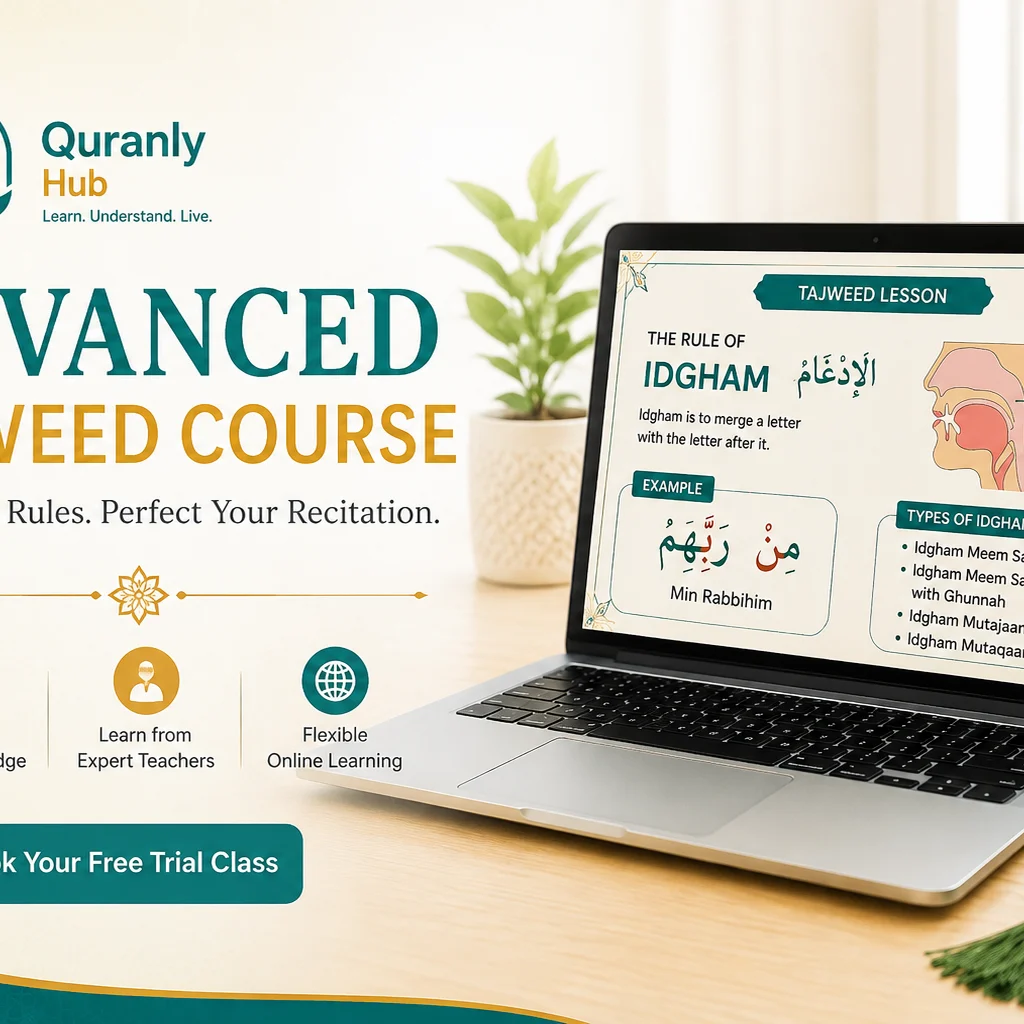
Online Tajweed for Riyadh students still means real-time correction – makharij (letter articulation points), elongation rules, and the small errors that are genuinely hard to self-diagnose. A tutor watching your Mushaf and mouth over video call catches exactly what an in-person teacher would, without a local wait.
Hifz Course in Riyadh: Structured Memorization From Home
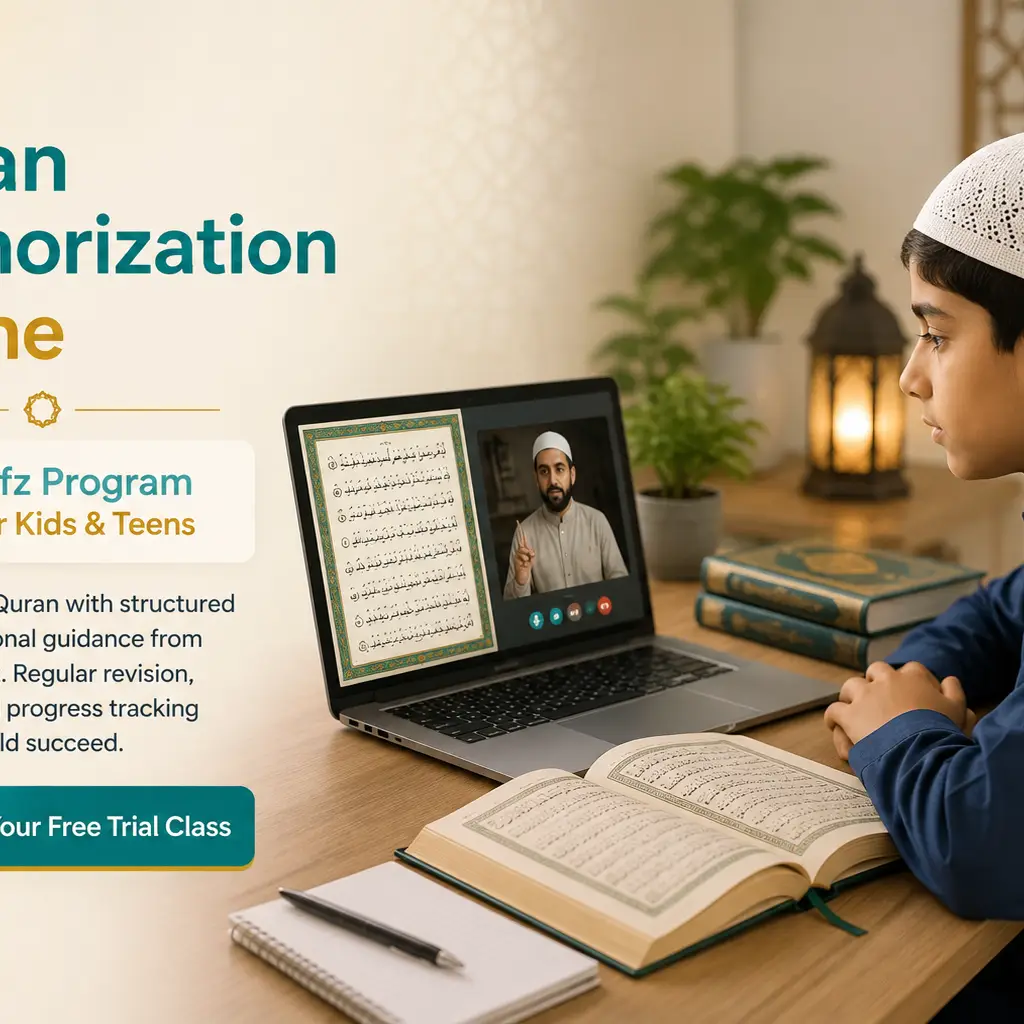
A Riyadh child doesn’t need a residential programme abroad to start Hifz. The online course keeps the traditional sabaq (new portion), sabqi (recent revision) and manzil (long-term revision) cycle, tracked lesson by lesson and built around school rather than replacing it.
The Free Trial in Riyadh: One Real Class Before You Pay
This page promises a free trial before any payment, and the FAQ says every course starts with one. Here is what that trial actually is, what other academies offer instead, and the four questions that tell you whether a trial is real.
What Happens in the Free Trial Class
QuranlyHub offers one free class, thirty minutes, live and one-to-one, with the actual tutor your child would keep. No card, no payment details, no commitment. That is the whole free part, and it is labelled as exactly that: one class. The tutor listens to the student recite what they already know, even if that is just a short surah. Then the tutor checks where mistakes creep in, not just during recitation but during memorization, and gives a genuinely honest estimate of pace. Not an inflated one. A child who already knows Juz Amma gets a different plan from a child starting from the first page, and the trial is where that difference shows up. A parent can sit in on the trial, and should. Watch how the teacher handles a hard question, whether they admit what they do not know, and whether the child looks forward to the next one. If the “free class” turns out to be a scripted sales call with no actual recitation involved, that is a sign to look elsewhere. The whole point of a trial is seeing the teaching itself.
One Free Class, Two, or Three: Trial Shapes in the Market
Other academies do it differently. Quran Pak Teacher gives three free trial classes before its monthly plan starts. Websink gives the first lesson free. Quran In Depth gives one free trial lesson. None of these is a trick. A three-class trial gives you more time to judge the teacher, and a one-class trial gives you less. The honest question is not how many free classes you get. It is what the academy says the free part is, before you book. If the website says “free trial” and the booking form asks for a card, walk away. If it says three classes free and the trial is three real classes with a real teacher, that is a fair offer. And if it says “free” with no end date and no price anywhere, that is usually a free first class followed by a monthly plan that only appears after you have already invested an hour of your time.
Four Questions Before You Book Any Trial
Before you book any trial, ask four things, and ask them in writing if you can. First, how many free classes, exactly, and how long is each one? Second, what happens the day the free part ends: does the plan start automatically, or do you choose? Third, what is the monthly price after the trial, in writing, before the first class? Fourth, is there a registration fee, an admission fee, or any one-time charge on top of the monthly price? An academy that hides its price behind “contact us for pricing” until you are already invested is telling you something about how it will treat you later. The trial is where that gets tested. If you want the same decision made on price grounds instead of learning grounds, our guide on how much online Quran classes cost sets out the same questions from the price side.
Quranic Arabic and Tafseer for Students in Riyadh
Recitation is only part of it for many Riyadh students – understanding the meaning matters too. Quranic Arabic builds the grammar and vocabulary to read the text directly; Tafseer works through each ayah’s meaning using classical commentary like Ibn Kathir and Al-Jalalayn, one-to-one, for a student in Olaya, Al Malaz or the Diplomatic Quarter.
What Riyadh Families Actually Pay: SAR 112.50 to SAR 168.75, and How Long Each Course Takes
A price on its own tells you almost nothing. Thirty dollars a month could mean eight classes or twenty. It could mean a group, or one-to-one. It could mean the same teacher every week, or whoever happens to be free. So here is what QuranlyHub’s fee actually buys, in plain numbers, and then how long each course takes, because the price of a month and the length of a course are two different questions. When a family in Riyadh searches “online quran classes in riyadh”, the number they actually need is the monthly one, in dollars, with the class count next to it. Here it is.
The Plans, in Plain Numbers
The plans on this page run from SAR 112.50 a month for eight classes to SAR 168.75 a month for twenty, all of them live, one-to-one, thirty minutes each, on Zoom. Eight classes a month means weekends only. Twelve classes means any three weekdays. Sixteen classes means any four weekdays, and that is the most popular plan. Twenty classes means Monday to Friday. The trial class is free, with no card needed, and the second child in a family gets a 10 percent discount. The standalone Tafseer course costs SAR 262.50 a month for twelve classes, three days a week, taught in Urdu or English. If you want to know what a good Tafseer course covers before you choose one, our best Quran Tafseer guide sets out the same questions from the student’s side. Every plan includes a monthly progress report that shows where the student stands, and the same teacher each week, so the teacher knows which page the student is on without having to ask.
The market around Riyadh quotes in riyals, and the range is wide. MyOnlineQuranTutor charges SAR 113 a month for eight classes, SAR 150 for twelve, SAR 169 for sixteen and SAR 188 for twenty. Quran In Depth charges SAR 130 to SAR 360 a month, billed in riyals. Quran Pak Teacher charges $30 a month for twenty classes, which it lists as SAR 112.50 at the fixed 3.75 rate. Bismillah Online Quran Academy charges SAR 165 to SAR 200 a month for three days a week, and SAR 220 to SAR 260 a month for five days a week. Alwalid Academy charges SAR 200 a month for its Basic plan, SAR 350 for Advanced and SAR 500 for its Ijazah plan. Wanoyasserka charges SAR 250, SAR 350, SAR 500 and SAR 1,000 a month across its packages. Websink charges SAR 299 a month for three lessons a week and SAR 499 for five, but every lesson is a full hour, not thirty minutes, so it is not like with like. QuranlyHub’s plans sit at or below the low end of that market for thirty-minute lessons, in dollars, with the same 30-minute one-to-one format throughout. No riyal price for QuranlyHub is stated on this page, because none has been set: the academy’s prices are quoted in dollars, and this page does not convert them.
How Long Each Course Actually Takes
A parent’s second question, after the price, is how long it takes. Noorani Qaida takes 2 to 3 months on the 16-class plan, or 3 to 5 months on the 8-class plan, and at the end of it a child reads the Quran on their own. Hifz takes 2 to 2.5 years, at 7 to 8 new lines a day, with daily revision of the old lessons, sabaq, sabqi and manzil, and the youngest children finish Juz Amma in 2 to 3 months. Quranic Arabic takes 9 to 12 months. No confirmed duration exists for Tajweed or for Tafseer, and this page does not invent one: Tajweed takes as long as the student’s reading needs, and Tafseer is taught as an ongoing course, not a fixed-length one. Homework is Hifz-only: the student revises what the teacher set, nothing else. If your child is finding a page hard, our guide on how to memorize the Quran step by step walks through sabaq, sabqi and manzil the way the teacher does it, so you can see what the method is and why it works. The point of the durations is not to promise a date. It is to show that the academy has a plan for each course, and that the plan is measured in months and years, not in vague promises.
The Fine Print: Advance Payment, Refunds, and Makeup Classes
The price is only half the story. Fees are paid in advance by bank transfer, and the class runs for the month that has been paid for. If a student leaves, there is no refund for the month, and a family should know that before they pay. If the teacher cannot continue, the fees are refunded, because that is the academy’s side of the same promise. If the teacher misses a lesson, a makeup class is arranged. If the student misses one, it is not made up, and the month is not extended. A student can stop at the end of any month. None of this is hidden in a terms page. It is written here because a family who knows the fine print before the first lesson will never have to argue about it after the tenth. Ask any academy these four questions before you pay: how do I pay, what happens if we leave, what happens if the teacher leaves, and what happens if a lesson is missed. The answers should take one minute, and they should match what is written on the page.
Pricing: What Online Quran Classes in Riyadh Actually Cost
Tafseer costs SAR 262.50 a month for 12 classes, three days a week. The following plans cover Noorani Qaida, Tajweed, Advanced Tajweed, Hifz and Quranic Arabic, with four schedules to fit around a work and school week in Riyadh:
| Plan | Classes / Month | Schedule | Price |
|---|---|---|---|
| Weekend Plan | 8 classes | Fri & Sat | SAR 112.50/month |
| 3 Days a Week | 12 classes | Any 3 weekdays | SAR 131.25/month |
| 4 Days a Week Most Popular | 16 classes | Any 4 weekdays | SAR 150.00/month |
| 5 Days a Week | 20 classes | Mon to Fri | SAR 168.75/month |
All plans include a free trial class, monthly progress reports, and a dedicated Ijazah-certified tutor. Enrolling siblings? Every additional child in the same family gets a 10% discount.
The Safety Question: Child Protection Law M/14, and What Riyadh Parents Can Actually Check
A free trial tells you what a class feels like. It doesn’t tell you who is teaching it, or whether anyone has actually checked that person. For a child learning online, that is the question to settle first, before the price, before the timetable, before anything else. And it is the question most academies answer with a badge on their website, which is the weakest answer of all.
Saudi Arabia Has a Child Protection Law, but No Saudi Certificate for an Overseas Tutor
Here is the honest limit, stated plainly. Saudi Arabia takes child safety seriously in law. The Child Protection Law, issued by Royal Decree M/14 on 25 November 2014, protects every person under eighteen, and its Article 22 says anyone who learns of abuse or neglect must report it promptly to the competent agencies. A parent in Olaya or Al Malaz is right to expect the same care from anyone who teaches their child. None of that gives a parent a certificate to ask for. The law sets out duties and reporting, not a background-check certificate a family can request from a tutor, and an online tutor teaching from Pakistan cannot hold a Saudi certificate, because no such certificate exists for an overseas tutor. So when an academy tells a Riyadh family that all its tutors are “checked in Saudi Arabia”, the parent should ask what that actually means. A badge on a website is not a check. What a parent can check is a real person, a real qualification and a real class. Ask, too, who granted the teacher’s Ijazah and in which subject, because a named teacher with a named chain is the oldest check in this tradition. What QuranlyHub does instead is say plainly what has been done. Teachers are identity-verified and reference-checked before they take a class, and the academy names a safeguarding contact, Adeel Ahmad, so a family always knows who to write to. And if a family ever worries about a child in Saudi Arabia, the national Child Support Line is 116111, run under the National Family Safety Programme, free, in Arabic and English, from 7am to 11pm every day; in immediate danger, call the police on 999.
Four Checks Before the First Lesson
The trial class is the real test, and a parent should treat it that way. Sit in on it, or ask a family member to. Watch how the teacher handles a hard question, whether they admit what they do not know, and whether the child looks forward to the next one. Ask for the lesson to be recorded, because a recording lets the family hear it later, and a teacher who welcomes a recording has nothing to hide. Check that the only contact between the teacher and the student is the official channel. There is no private messaging, no personal number, and no side arrangement. If any of those appear, stop the class and write to the safeguarding contact. Four things, then, before you commit to anything. Sit in on the trial. Ask for a recording. Confirm there is no private contact outside the official channel. Know the name of the safeguarding contact. At QuranlyHub that contact is Adeel Ahmad, who answers families directly. None of these takes more than an hour, and together they tell you more about an academy than any claim on its website.
Daughters and Sisters: A Female Teacher Throughout
Girls and daughters learn only with a female teacher, and that should not cost extra. At QuranlyHub a female teacher is available at no extra cost, and the rule holds for every course, from Qaida to Quranic Arabic. The female teacher is a Hafiza, and she teaches the same courses as the male teachers, so a daughter is not offered a thinner version of the timetable. The class runs the same way, on the same Zoom setup, for the same 30 minutes. The camera is optional for adult sisters, and the student decides how the class looks. What matters is that the family controls the setup from the start, not that the academy decides it for them. If you are weighing this choice, our guide to finding a female Quran teacher online asks the same questions a family would ask, so you can see what a good answer looks like before you book. A student who has already asked these questions before the trial will not need to ask them again after it.
All 6 Online Quran Courses in Riyadh, One Platform
Whichever course your family starts with, the same tutor-matching and free trial process applies across all six, for every age from Noorani Qaida beginners to Quranic Arabic learners:


Book Your Free Trial Class
See for yourself before you commit to a plan. Book a free trial class with an Ijazah-certified tutor, matched to your child’s or your own age, level and preferred schedule.
Explore Our Other Courses
Also Available in Other Cities
Related Guides
Frequently Asked Questions
Is a female Quran teacher in Riyadh available online?
Yes. You can request a female tutor for daughters or for women’s classes at no extra cost when you book your free trial – no waitlist, since scheduling isn’t limited to whoever teaches locally.
What times work for Riyadh’s time zone?
Classes are scheduled around Saudi Arabia time (AST), including evening and weekend slots, so lessons fit around school and work.
Can my child join a Hifz course in Riyadh online?
Yes. An online Hifz course follows the same sabaq-sabqi-manzil revision structure as an in-person programme, with a dedicated Ijazah-certified Hifz tutor tracking memorisation one-to-one.
Are there online Islamic courses for ladies in Riyadh, not just children’s classes?
Yes. Adult women can book any of the six courses one-to-one with a female tutor, at a pace and time that suits their own schedule.
How much do online Quran classes in Riyadh cost?
Plans range from SAR 112.50/month (8 classes, weekends only) up to SAR 168.75/month (20 classes, Monday to Friday), 30 minutes each. The 4-days-a-week plan at SAR 150.00/month is the most popular. Families enrolling more than one child get a 10% discount. Tafseer costs SAR 262.50 a month for 12 classes, three days a week.
Is there a free trial before I pay?
Yes, every course starts with a free trial class with a real tutor, so you can judge fit before choosing a plan.