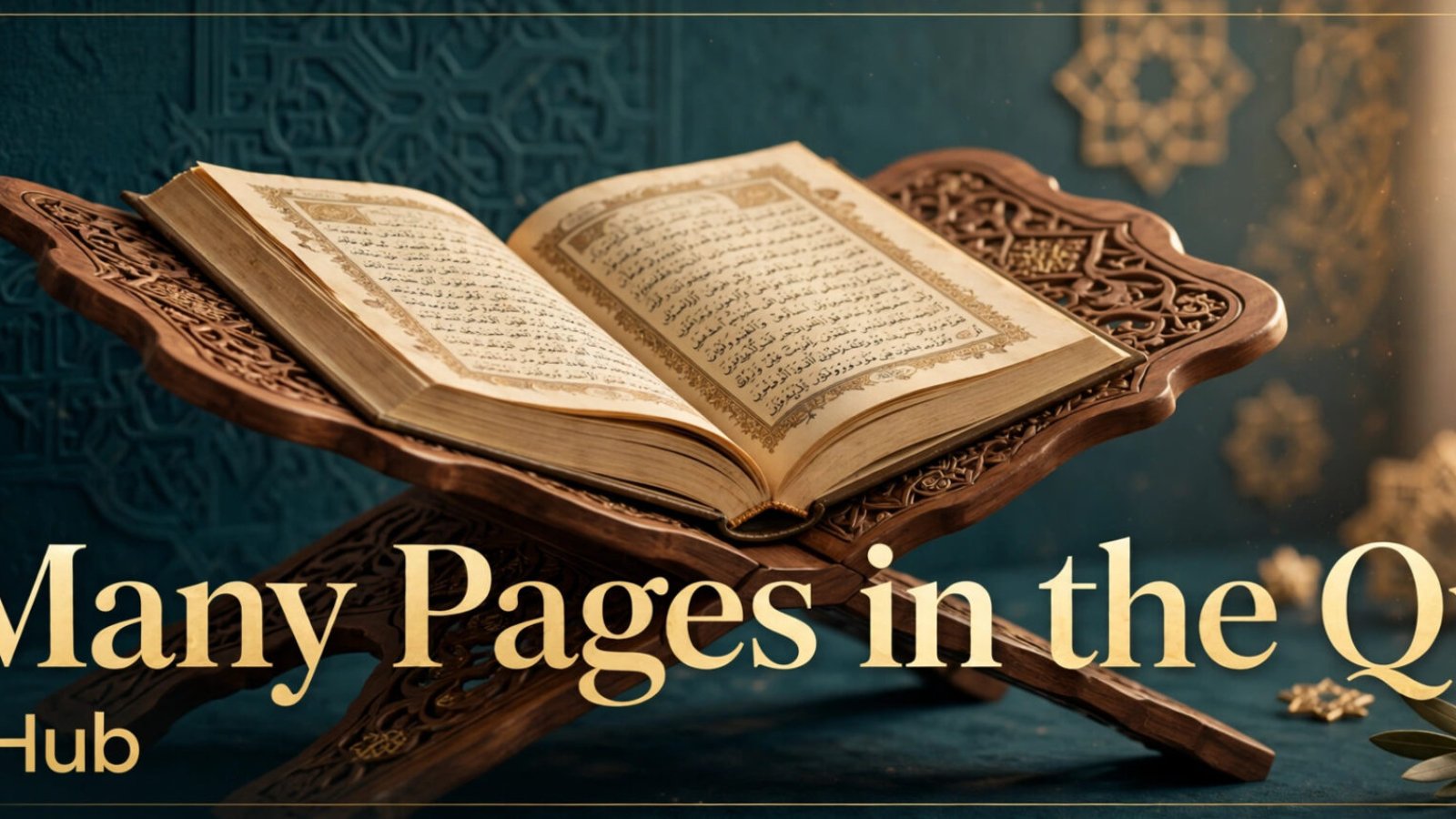
The Quran has 604 pages in the standard Madani Mushaf. That’s the copy most of the world reads today, the one printed by the King Fahd Complex in Madinah with 15 lines on every page. Open any copy of it, anywhere on earth, and page 293 will show you the same verses.
But hold on. If you pick up a different print, the number changes. So the honest answer has two parts: 604 pages in the standard copy, and a different count in other prints. Both are true, and this article explains why.
Define Quran
Start with the word itself. “Quran” comes from the Arabic root qara’a, which means to read or to recite. Al-Quran literally means “the Recitation.”
Muslims call it that for a plain reason. It is read aloud every day, in every prayer, in mosques and homes across the world. It isn’t a book that sits on a shelf. It is recited.
Definition of Quran
The Quran is the literal Word of Allah, revealed to Prophet Muhammad (peace be upon him) through the Angel Jibreel over about 23 years, from 610 CE until 632 CE. It came down in Arabic, part by part, as events unfolded in his life and in the life of the early Muslim community.
It begins with Surah Al-Fatihah and ends with Surah An-Nas. Between those two covers sits guidance for how to believe, how to worship, how to treat people, and how to live. Muslims believe every word of it is from Allah, preserved exactly as it was revealed.
How Long Is the Quran?
That question has two answers, and both help.
First, how long did it take to come down? About 23 years. Thirteen of those years were in Makkah, before the Hijrah, and ten were in Madinah, after it. That’s why you hear about Makki and Madani Surahs. The early ones mostly build faith and character. The later ones mostly lay down laws and community rules.
Second, how long does it take to read? A fluent reciter can read the whole Quran aloud in roughly 10 to 15 hours of steady recitation. That’s an estimate, and your pace will differ. Most people don’t read it in one sitting, and that’s fine. Here’s what actually works for ordinary readers:
- One Juz a day, and you finish in 30 days. This is the classic Ramadan plan.
- Twenty pages a day, and you finish in about a month too, since 20 times 30 is 600, just short of 604.
- Four pages after each of the five daily prayers, and you hit the same 20 pages a day without ever sitting down for a long session.
- Two pages a day, and you finish in about ten months. Slow? Sure. But you finish.
Pick the pace you will actually keep. That’s the whole secret.
Quran Chapters
The Quran has 114 chapters, called Surahs. They are not arranged in the order they were revealed. They are arranged in the order the Prophet (peace be upon him) taught, and that order is part of the Mushaf itself.
Most books count 86 Makki Surahs and 28 Madani Surahs. Scholars differ on a handful of Surahs, so you may see slightly different splits elsewhere. The total never changes: 114.
Length varies a lot. Surah Al-Baqarah, the second chapter, is the longest. It has 286 verses and runs for about 48 pages. Surah Al-Kawthar, near the end, is the shortest. Three verses, part of a single page.
Here’s a detail students love: the first Surah, Al-Fatihah, has just 7 verses, and Muslims recite it in every unit of every prayer. The last Surah, An-Nas, has 6 verses. From the shortest prayer to the longest chapter, the whole book fits between those two covers.
How Many Pages Are in Each Juz?
The Quran is split into 30 equal parts called Juz (plural: Ajza). Each Juz runs to roughly 20 pages in the Madani Mushaf. 604 divided by 30 is just over 20, so “about 20” is the honest way to say it.
Each Juz splits again into two Hizb, giving 60 Hizb in total. Teachers use these divisions to set homework. A Hifz student might learn one Hizb a week. A Ramadan reader does one Juz a night in Taraweeh. The divisions exist so the book can be learned in pieces.
Why Do Different Copies Show Different Page Counts?
Because page count is about printing, not about text. The words don’t change. The layout does.
- The Madani Mushaf (Madinah print, Uthmani script, 15 lines per page): 604 pages.
- The Indo-Pak print (Nastaliq script, used across Pakistan, India and Bangladesh): around 558 pages.
- Large print editions for older readers: 800 pages or more.
Same words, different font, different line spacing, different page size. Add a translation or commentary next to the Arabic, and the page count jumps again, because now two texts share the page.
One practical tip from my own teaching: if you are memorizing, pick one copy and stay with it. Hifz runs on page memory. When you always open the same layout, you start to remember where each verse sits on the page. Switch copies halfway and that picture breaks.
FAQs
How many pages are in the Quran? 604 pages in the standard Madani Mushaf. Other prints differ because of font and layout, not because of different text.
How many verses are in the Quran? 6,236 verses in the count used in the Madani Mushaf. If you count the Bismillah at the start of each Surah as a verse, the count rises to 6,349. The words are the same either way. Only the counting differs.
How many pages should I read each day to finish in a month? About 20 pages a day. Four pages after each prayer gets you there without a long sitting.
Is the Quran the same in every copy in the world? The Arabic text is the same. What changes is the script style, the font size, the page layout, and whether a translation sits next to it.
How many words are in the Quran? Around 77,430 words is the figure most books cite. Word counts shift a little depending on how you count joined words, so treat it as approximate.
Want to read it yourself, properly, with a teacher who corrects your recitation? QuranlyHub offers live one-to-one Quran lessons with male and female teachers, and your first class is free. Start with our Online Quran Learning Guide, and if memorization is your goal, read How to Memorize Quran Step by Step.