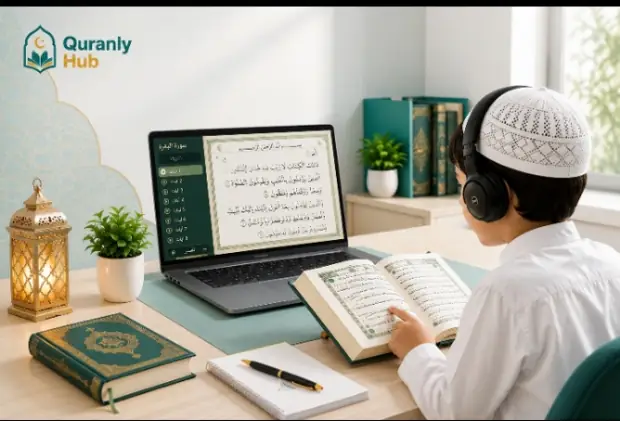
Young boy following along on his own Quran while his teacher recites during a video call in an online Hifz class

Online Hifz Course in the UK: How Quran Memorisation Actually Works

Short answer: an online Hifz course in the UK works the same way a good in-person one does, just without the commute: one-on-one sessions with an Ijazah-certified Hafiz, structured daily revision using the traditional Sabaq, Sabqi and Manzil system, and a pace built around your child’s actual memorisation speed rather than a fixed class timetable. QuranlyHub runs exactly this for Hifz students across the UK, starting with a free trial class.

Young boy following along on his own Quran while his teacher recites during a video call in an online Hifz class

Why UK Families Are Choosing an Online Hifz Course

A dedicated Hifz teacher, someone qualified to guide daily memorisation rather than just general Quran reading, is genuinely hard to find locally in most of the UK outside a handful of larger cities. Term-time school schedules and weekend madrasa timetables rarely leave much room either. An online Hifz course removes both problems: your child studies with a qualified Hafiz on a schedule built around your week, not the other way round.

How QuranlyHub’s Online Hifz Course Actually Works

The Sabaq, Sabqi, Manzil System

Hifz memorisation at QuranlyHub follows the traditional three-part daily revision system used by Huffaz for centuries. Sabaq is today’s new memorisation. Sabqi is the last one to two weeks of memorisation, revised until it’s solid. Manzil is the long-term bank of everything memorised so far, revised on rotation so it doesn’t fade. See our full glossary entry on Sabaq, Sabqi and Manzil for how the three fit together.

An Ijazah-Certified Hafiz, Not Just a Fast Reciter

Memorising quickly and teaching memorisation well are different skills. Every QuranlyHub Hifz tutor holds a documented Ijazah with a named Sanad, specifically for teaching Hifz, not just a general claim of having memorised the Quran themselves. See how we verify tutors.

A Pace Built Around Your Child

Some children memorise half a page a day comfortably; others need a smaller, steadier daily target to actually retain it. A rushed Hifz pace that isn’t retained is wasted effort. Sessions are scheduled directly with you, around UK school and family hours, so pace stays realistic rather than fixed to a class average.

What an Online Hifz Course Costs in the UK

Hifz is priced the same as QuranlyHub’s other standard courses: $30/month for 8 classes, or $40/month for 16 classes, each 30 minutes, one-on-one. See the full pricing breakdown. A free trial class comes first, before any payment.

Before Hifz: Is Noorani Qaida or Tajweed Needed First?

A student should be reading fluently, ideally with solid Tajweed, before starting formal Hifz, since memorising mistakes is harder to undo than learning correctly the first time. If your child hasn’t reached that stage yet, our Noorani Qaida or Tajweed courses build that foundation first.

Frequently Asked Questions

Can Hifz really work online, one-on-one?

Yes. The tutor listens to your child recite live over video for both new memorisation and revision, correcting mistakes the same way they would in person.

How is Sabaq different from Sabqi and Manzil?

Sabaq is today’s new portion. Sabqi is the last one to two weeks of memorisation, still being reinforced. Manzil is everything memorised further back, revised on rotation so it stays retained long-term.

What if my child already started Hifz elsewhere?

The tutor assesses what’s already memorised and how solid it is in the first session, then continues from there rather than restarting.

Is there a female Hifz tutor available?

Yes, on request, at no extra cost.

Is there a free trial before I commit?

Yes, before any paid plan.

Book a Free Trial Hifz Class

Message QuranlyHub on WhatsApp to get matched with a Hifz tutor and book a free trial class.


Two children learning Quran online with QuranlyHub, Sydney Opera House and Harbour Bridge in the background, online Quran classes in Australia

Quran Classes Near Me in Australia: Why Online Beats the Local Search

Short answer: if you’re searching “quran classes near me” or “quran teacher near me” in Australia and coming up short, that’s not unusual. Muslim families are spread thin across most Australian cities and regional areas, so a genuinely good local Quran teacher near you often doesn’t exist within driving distance. An online, one-on-one Quran class solves the actual problem “near me” was trying to solve: a qualified tutor, live, on your schedule.

Two children learning Quran online with QuranlyHub, Sydney Opera House and Harbour Bridge in the background, online Quran classes in Australia

Why “Quran Teacher Near Me” Is the Wrong Search in Australia

Even in Sydney and Melbourne, where the Muslim community is largest, a genuinely qualified local Quran teacher near you, someone who actually holds an Ijazah with a real Sanad, rather than simply reciting well, is a small pool. Outside the major cities, in regional Australia, that pool is often close to zero. Searching “quran teaching near me” repeatedly and finding nothing isn’t a sign you’re doing something wrong; it reflects how thinly the community is spread across the country.

What Online Actually Gets You That Local Doesn’t

  • A wider pool of qualified tutors, not just whoever happens to live in your suburb
  • One-on-one attention, not a fixed group class size or pace
  • Scheduling arranged directly with you, around Australian school and work hours, not a fixed timetable
  • A female Quran teacher available on request, which can be genuinely hard to find locally outside major cities
  • No commute for a 30-minute lesson, on either side

Quran Courses Available Across Australia

All seven QuranlyHub courses are taught one-on-one, live over video, to students anywhere in Australia, from Sydney and Melbourne to regional towns with no local Quran teacher at all:

What It Costs

Every standard course above is $30/month for 8 classes or $40/month for 16 classes, 30 minutes each, one-on-one. The Alim & Aalimah course is $80/month for 8 classes or $100/month for 16, 40 minutes each. See the full pricing breakdown. Every plan starts with a free trial class before you pay anything.

How We Verify Every Tutor

Since you can’t sit in the room to check a tutor’s Ijazah yourself, we do that check before a tutor ever teaches a student. Every tutor teaching Noorani Qaida, Tajweed or Hifz holds a documented Ijazah with a named Sanad, a specific, checkable chain of certified teachers. See how we verify tutors for the full process.

Frequently Asked Questions

Is online really as good as a local Quran teacher?

For most Australian families the realistic comparison isn’t “online vs. an excellent local teacher”, it’s “online vs. no local teacher at all” or a long drive for a group class. One-on-one online with a verified Ijazah-certified tutor generally beats both.

Do you teach students outside Sydney and Melbourne?

Yes. Regional and remote Australian students are taught exactly the same way as students in major cities, since every class happens over live video.

Can I get a female Quran teacher for my daughter?

Yes, on request, at no extra cost.

Is there a free trial before I pay?

Yes, for every course, before you commit to a paid plan.

Book a Free Trial Class

Message QuranlyHub on WhatsApp to get matched with a tutor and book a free trial class for any of the seven courses above.

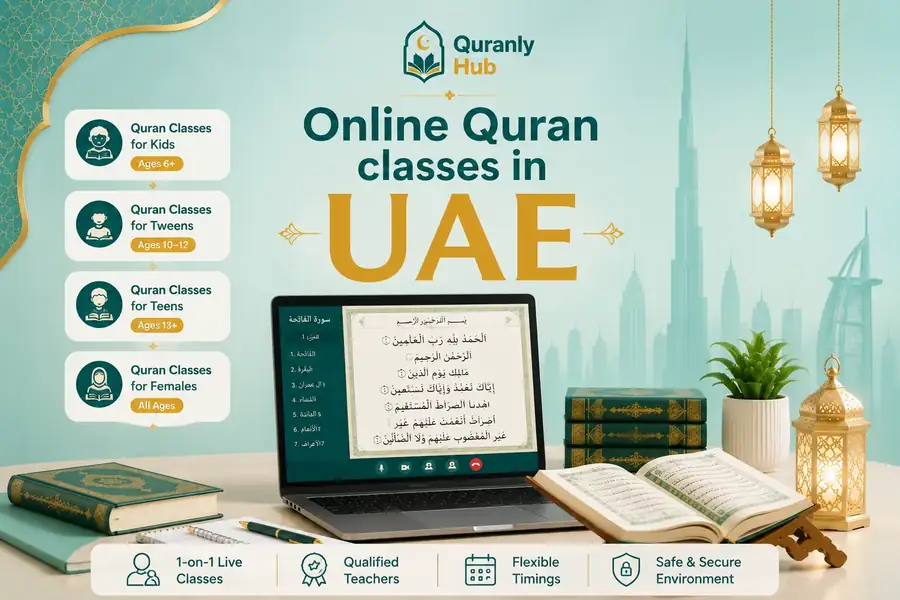
QuranlyHub online Quran classes for kids and adults in the UAE, live one-to-one lesson on a laptop with Quran open

Online Quran Classes for Kids in the UAE: What to Look for Before You Enrol

Short answer: the best online Quran classes for kids in the UAE are one-on-one, taught by an Ijazah-certified tutor with a documented Sanad, and start with a proper assessment rather than dropping your child into a fixed group lesson. QuranlyHub runs exactly this model for children across Dubai, Abu Dhabi, Sharjah and the rest of the UAE, starting with a free trial class before you pay anything.

QuranlyHub online Quran classes for kids and adults in the UAE, live one-to-one lesson on a laptop with Quran open

If you’ve searched “quran classes in uae” or “quran courses in uae” and found a wall of directory listings and WhatsApp groups with no real information, you’re not alone. Most UAE parents looking for online Quran reading lessons for their child end up asking the same three questions on a phone call before they’ll even consider paying: who is actually teaching, what happens if my child doesn’t get along with the tutor, and how much does this really cost per month. This article answers all three directly.

Why More UAE Parents Are Choosing Online Quran Classes

Finding a qualified Quran teacher near you in person in the UAE isn’t always straightforward, particularly outside the main Quran teachers near me search results in Dubai and Abu Dhabi, where families are often juggling shift work, school runs, and long commutes across the Emirates. Online quran reading classes remove the travel problem entirely: your child logs in from home, at a time that actually fits your week, with the same one-on-one attention a good local tutor would give, minus the drive.

What a Real Online Quran Class for Kids Should Include

A Real Ijazah, Not Just a Claim

“Certified” gets used loosely. A real Ijazah is a formal certification a teacher earns to recite and to teach recitation, backed by a Sanad, a named chain of teachers behind it. Every QuranlyHub tutor teaching Noorani Qaida, Tajweed or Hifz holds a documented Ijazah with a checkable Sanad, not just a verbal claim of experience. See how we verify tutors for the full process.

One-on-One, Not a Group Call

A child who is quietly struggling with a letter sound in a group class of six often just doesn’t get corrected that day. One-on-one means the tutor hears every word your child reads, every single session.

A Curriculum That Starts Where Your Child Actually Is

A true beginner starts with Noorani Qaida, Arabic letter recognition and pronunciation from the very first letter. A child who already reads should never be restarted from scratch just because that’s the default lesson plan; a short assessment in the first class should confirm where your child actually is before a single new lesson is assigned.

Quran Courses Available for Kids in the UAE

All seven QuranlyHub courses are available to children across the UAE, each taught one-on-one, live over video:

  • Noorani Qaida — the starting point for a child with no prior reading experience
  • Quran Reading with Tajweed — our tajweed classes online for correct recitation once the basics are solid
  • Advanced Tajweed — for a child ready to refine recitation further
  • Hifz (Quran Memorization) — our online hifz course, with structured daily revision (Sabaq, Sabqi, Manzil)
  • Tafseer — understanding the meaning of the Quran, not just reciting it
  • Quranic Arabic — our quranic arabic course for a child ready to understand the language directly

A female Quran teacher is available on request for parents who prefer one for their daughter, at no extra cost.

What Online Quran Classes for Kids Actually Cost in the UAE

Every standard QuranlyHub course, including all the ones listed above, is priced the same: $30/month for 8 classes, or $40/month for 16 classes, each class 30 minutes, one-on-one. There is no separate “UAE pricing” or hidden setup fee. See the full pricing breakdown for every course.

What a Typical First Month Looks Like

You message QuranlyHub on WhatsApp, get matched with a tutor, and your child sits a free trial class, no payment required. The tutor assesses reading level, agrees a weekly schedule that fits UAE school hours and time zones, and the first real lesson starts from exactly where your child is, not from a fixed starting point everyone gets pushed through.

Frequently Asked Questions

Are online Quran classes for kids in the UAE actually one-on-one?

Yes. Every QuranlyHub class is one tutor and one student, live over video, not a group call.

Is there a free trial before I have to pay?

Yes. A free trial class comes before you commit to any paid plan.

Can I request a female Quran teacher for my daughter?

Yes, at no extra cost, on request.

What age can a child start Noorani Qaida?

There’s no fixed minimum age. A child who can sit through a 30-minute one-on-one session and recognise basic shapes and sounds can typically start.

Do you serve families outside Dubai and Abu Dhabi?

Yes. Since classes are entirely online, students across Sharjah, Ajman, Ras Al Khaimah, Fujairah and Umm Al Quwain are taught exactly the same way. See our full UAE overview for city-specific scheduling notes.

Book a Free Trial Class

Message QuranlyHub on WhatsApp to get matched with a tutor and book your child’s free trial class, no payment required until you’re ready to enrol.


Close-up of an open Quran, the starting point for online recitation lessons

Best Time to Schedule Online Quran Classes in Saudi Arabia (Time Zone Guide)

Saudi Arabia uses Arabian Standard Time (AST, UTC+3) year-round, with no daylight saving changes. The most popular windows for online Quran classes tend to be early morning before work or school, after Asr, or in the evening after Maghrib — but the right time for your family depends on your own routine and prayer schedule.

Student scheduling an online Quran class around Saudi Arabia prayer times

Understanding Saudi Arabia’s Time Zone for Online Learning

Because AST does not shift with daylight saving time, scheduling stays consistent throughout the year, which makes it easier to build a steady Quran learning routine. The main variable families need to plan around is not the time zone itself, but daily rhythms: work hours, school hours, and the five daily prayers.

Best Times of Day for Online Quran Classes in Saudi Arabia

A few time windows tend to work well for most households, though the right choice depends on your own schedule:

  • Early morning after Fajr: before the day’s work or school responsibilities begin, when the household is often quietest.
  • After Asr: a natural pause point in the afternoon for many families.
  • Evening after Maghrib: once work and school are finished for the day, before dinner and family time.
  • Weekend slots: useful for catching up if weekday timing does not work consistently.

Since each class is 30 minutes, most of these windows fit into a single natural gap in the day rather than requiring a large block of free time.

Scheduling Around the Saudi Work and School Week

The working week in Saudi Arabia typically runs Sunday through Thursday, which shifts the “start of week” and “weekend” pattern compared to many Western countries. When planning a regular Quran class time, it helps to think in terms of this local week rather than assuming a Friday-Saturday schedule feels the same as a Saturday-Sunday one. Building your class slot around this rhythm — for example, a consistent weekday evening time and a flexible weekend catch-up slot — tends to hold up better over a full month than trying to fix the exact same clock time every single day.

Setting Up a Consistent Weekly Schedule

Once you have picked a general time window, a few small habits make it easier to stick with long-term:

  • Set a recurring reminder on your phone or calendar for the agreed class time, rather than relying on memory.
  • Choose one primary weekly slot and one backup slot, so a single busy day does not break the whole week’s routine.
  • Let your tutor know in advance about any regular exceptions, such as a weekly late meeting or a school event.
  • Review the schedule every few months, since work hours, school terms, and prayer times can shift gradually over the year.

This kind of simple structure matters more than picking the “perfect” time of day — consistency is what actually builds progress in Quran learning.

Staying Consistent During Ramadan and Travel Seasons

Routines naturally shift during Ramadan, and again around Hajj, Umrah, or family travel. Rather than dropping classes entirely during these periods, many families simply move their usual slot earlier or later to fit the changed routine. Our Ramadan Quran learning plan has more detail on adjusting a learning schedule specifically for that month.

How QuranlyHub Works With Your Time Zone

Classes are taught live, one-to-one, over Zoom, so there is no fixed group timetable to work around — your class time is arranged directly with your tutor based on what actually suits your day. The QuranlyHub team is available 24/7 over WhatsApp, so questions about timing can be raised whenever they come up, not just during office hours.

Adjusting the Schedule as Kids Get Older

A class time that works well for a seven-year-old rarely still fits the same family once that child is twelve and juggling school activities, sports or an older sibling’s exam schedule. Rather than keeping the same fixed slot indefinitely, it’s worth revisiting the weekly schedule every school year, since a slot right after Asr might work fine at one age and become impossible once evening tuition or extracurriculars are added. Families with more than one child studying often stagger session times by a few years’ age gap rather than scheduling everyone back-to-back, since younger children’s attention spans and older children’s homework load pull the ideal time in different directions. A quick check-in with the tutor each term about whether the current time still fits tends to catch this drift before it turns into missed classes.

During particularly hot summer months, some Saudi families also shift household routines later into the evening generally, which can push a good class slot later too. Checking in with your tutor seasonally, not just once at sign-up, keeps the schedule realistic year-round.

Frequently Asked Questions

What time zone should I use when booking online Quran classes in Saudi Arabia?

Arabian Standard Time (AST, UTC+3) applies across Saudi Arabia year-round, with no daylight saving adjustment needed.

Can I change my class time if my work or school schedule changes?

Scheduling needs can change, so it’s best to discuss timing directly with the QuranlyHub team through the contact page so your class slot can be arranged around your current routine.

How many classes per week are available?

Standard single-subject courses are offered as a Starter plan ($30/month, 8 classes) or a Monthly plan ($40/month, 16 classes), with each class lasting 30 minutes.

Explore Quran Learning Options in Saudi Arabia

For more on learning Quran online in Saudi Arabia, visit the Saudi Arabia location page, or see our general guide on fitting Quran learning into a real week. To find a class time that works for your household, get in touch through the contact page and request a free trial class.

What is the best time to schedule Quran classes in Saudi Arabia?

Since Saudi Arabia uses AST (UTC+3) year-round with no daylight saving changes, evening slots after Maghrib tend to work best for most families, avoiding conflicts with Isha and other evening commitments.

Do class times need to change during Ramadan in Saudi Arabia?

Many families shift to a slot right after Asr and before Iftar preparations, since that window conflicts with the fewest Ramadan commitments like Suhoor, Iftar, and Taraweeh.

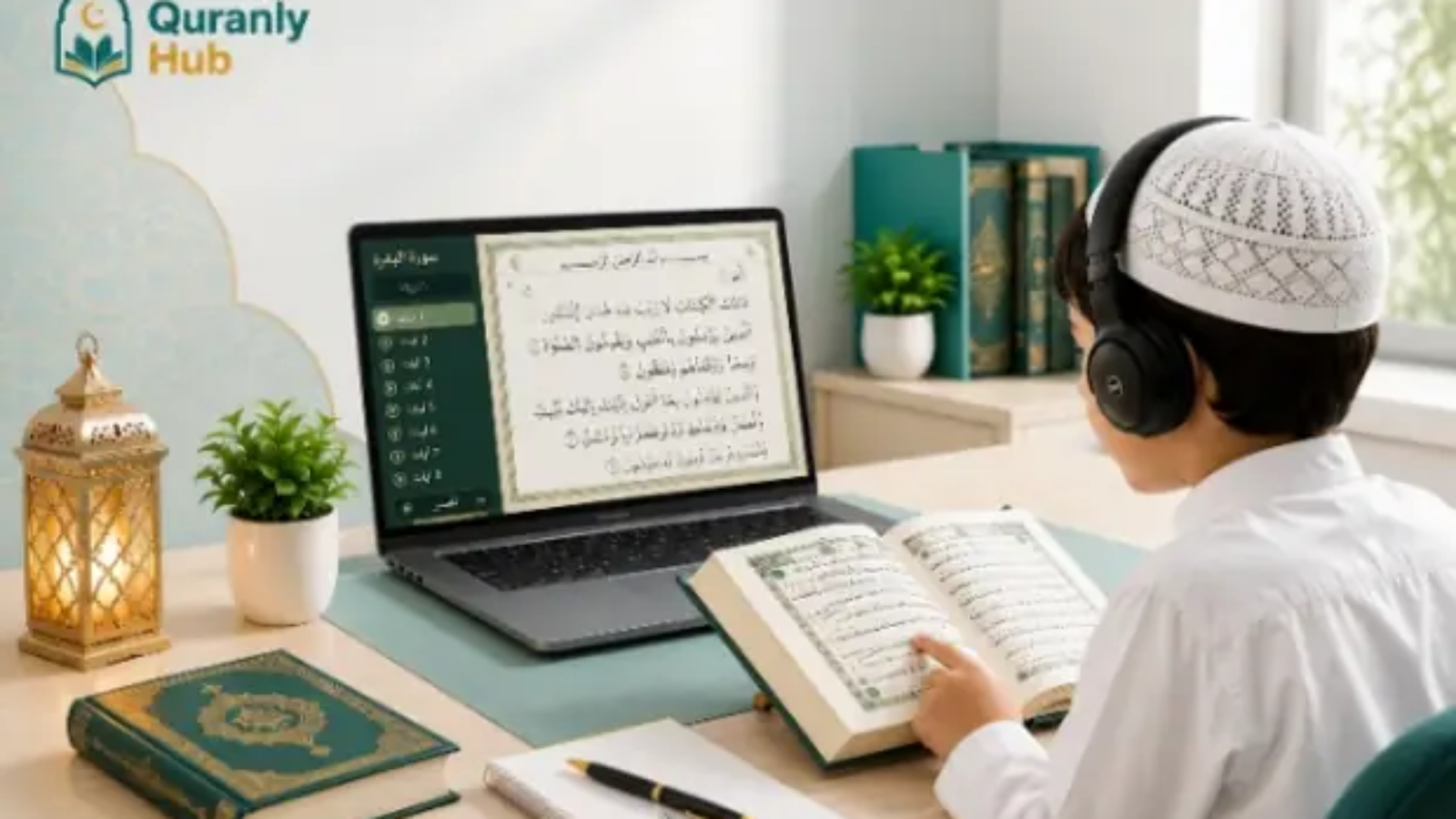
Student taking an online Quran recitation course with headphones, following an open Quran beside a laptop

Online Quran Classes for Busy Professionals: A Realistic Schedule Guide

Yes, you can learn the Quran online even with a demanding job. The key is choosing short, flexible class slots and a course format that adapts to your calendar instead of fighting it. Many working adults assume Quran study requires long, fixed-schedule commitments, but live one-to-one online classes are actually built around exactly the kind of unpredictable week a busy professional has.

Busy professional studying Quran online around a work schedule

Why Online Quran Classes Work Well for Working Professionals

Online learning removes two of the biggest barriers professionals face: commuting and fixed timetables. There is no travel time to a physical academy, and each class happens through a simple video call from your home, office, or hotel room while traveling. Classes are one-to-one with a tutor, so the pace of the lesson is set around you rather than a group of other students.

Common Scheduling Challenges Professionals Face

Before looking at solutions, it helps to name the actual problems most working adults run into when trying to keep up a regular Quran learning habit:

  • Rotating or unpredictable shifts that make the same time slot difficult to hold every week.
  • Time zone differences for professionals living or working abroad.
  • Meetings and deadlines that regularly run over into personal time.
  • Work travel that disrupts a routine built around one location.

None of these rule out consistent Quran learning — they simply mean the course format needs to be flexible rather than rigid.

How to Build a Quran Learning Routine Around a Full-Time Job

A realistic routine is more sustainable than an ambitious one you cannot keep up. A few practical approaches that work well for busy schedules:

  • Before work: a 30-minute class early in the morning, before emails and meetings start, when the mind is fresh.
  • During a lunch break: one focused session in the middle of the day instead of scrolling on a break.
  • Right after work: a short class before the evening’s other commitments begin.
  • Weekends: using Saturday or Sunday to catch up if weekday classes were missed.

Because each class is 30 minutes, it fits into a single gap in the day rather than requiring you to clear an entire evening.

One-to-One Classes Make a Real Difference for Busy Schedules

Group classes usually run on a fixed timetable that everyone in the group must follow. One-to-one classes are different: the lesson is scheduled around a single student, which makes it far easier to fit around shifting work hours. If you are deciding between the two formats, our guide on group vs. one-to-one Quran classes breaks down the practical differences in more detail.

What to Look for in a Course If You Have a Busy Schedule

When comparing options, working professionals should prioritize:

  • A live one-to-one format rather than a fixed group timetable.
  • A simple, familiar video platform for classes — QuranlyHub teaches through Zoom, which most professionals already use for work.
  • The ability to discuss your preferred timing directly with the academy before you commit.
  • A clear course structure so you know exactly what you are working toward.

Choosing the Right Course for Your Goals

QuranlyHub offers several single-subject courses — including Quran Reading with Tajweed, Quran Memorization, Advanced Tajweed, Tafseer, and Learn Quranic Arabic — as well as the multi-subject Alim & Aalimah Course for students who want a deeper, structured path. You can compare all current courses on the courses page and choose the one that matches the time and goals you have right now, rather than an idealized version of your schedule.

Realistic Weekly Time Commitment for Adult Learners

Most working adults overestimate how much time Quran study actually needs and underestimate how much consistency matters more than duration. Two or three sessions a week of 30-40 minutes each, at a fixed time that doesn’t compete with work meetings, is a realistic starting point for most professionals, rather than an ambitious daily schedule that gets abandoned within a month. What matters more than the total hours is protecting whichever slot is chosen, early morning before the workday starts tends to survive schedule chaos better than an evening slot competing with meetings running late or family time. Adjusting frequency after a few weeks, once the actual weekly rhythm becomes clear, works better than committing to an ambitious schedule upfront and quietly dropping sessions when work gets busy.

One more thing worth planning for: travel weeks and unusually heavy work periods will happen. Agreeing upfront with your tutor on how a missed session gets handled, rescheduled rather than simply lost, keeps a temporarily disrupted week from turning into a dropped routine altogether.

Frequently Asked Questions

How many Quran classes can I realistically manage each week?

For standard single-subject courses, QuranlyHub offers a Starter plan at $30/month (8 classes) and a Monthly plan at $40/month (16 classes), with each class lasting 30 minutes. If your schedule is unpredictable, starting with fewer classes per month and building up once you find a rhythm is often more sustainable than committing to the maximum from day one.

Can I reschedule a class if work gets in the way?

Scheduling details can vary, so it is best to discuss your preferred timing and any rescheduling needs directly with the QuranlyHub team before enrolling. You can reach out anytime through the contact page.

Is one-to-one or group learning better for a busy schedule?

One-to-one classes are generally easier to fit around unpredictable work hours since the lesson time is arranged around a single student rather than a fixed group timetable.

Start With a Free Trial

If you are unsure whether online Quran classes can realistically fit your schedule, the simplest way to find out is to try one. Our broader guide on fitting Quran learning into a real week covers this beyond professionals specifically. You can request a free trial class through the contact page and see how a 30-minute session fits into your actual week before committing to a plan.

Can I fit online Quran classes into a demanding work schedule?

Yes, short 30-minute sessions scheduled early morning, during a lunch break, or in the evening work for most busy professionals. Tutors across time zones make it easier to find a slot that survives a packed calendar.

What if I have to reschedule a Quran class due to work?

Message your tutor directly on WhatsApp to reschedule; occasional rescheduling for work conflicts is normal and expected, since flexibility around real adult schedules is part of how online classes are designed to work.

QuranlyHub, a trusted online Quran academy helping students worldwide

How to Choose a Safe, Trustworthy Online Quran Academy in the USA

A trustworthy online Quran academy in the USA should be able to show three things clearly: verified tutor credentials (such as an Ijazah), a transparent pricing structure, and a safe, familiar video platform for classes. If an academy cannot answer basic questions about any of these before you enroll, that is a warning sign worth taking seriously.

Trusted online Quran academy serving students in the USA

Why Safety and Trust Matter When Choosing an Online Quran Academy

Online Quran education has grown quickly, which means the quality gap between academies has also grown. For US families, the process usually happens without ever meeting the academy in person, so trust has to be established through clear information rather than a physical visit. Getting this right matters more when children are involved, but it applies to adult learners too.

Key Signs of a Trustworthy Online Quran Academy

  • Ijazah-certified tutors. An Ijazah is a formal chain of certification in Quran recitation. If you are unfamiliar with the term, our guide on what Ijazah means explains it in plain English.
  • Transparent pricing. A reputable academy will tell you the cost per plan and what is included before you enroll, not after.
  • A clear trial process. A free trial class lets you evaluate the teaching style and platform before paying anything.
  • A familiar, safe video platform. Classes conducted over a standard platform like Zoom make it easy for parents to sit in or check on a lesson at any time.
  • Responsive communication. You should be able to reach a real person with questions before and after enrolling.

How to Verify Tutor Credentials Yourself

Do not just take “Ijazah-certified” at face value from any academy, including this one — it is reasonable to ask follow-up questions. A genuine Ijazah is a specific, traceable chain of authorization, so you can ask the academy which recitation the certification covers and how it was verified internally. An academy confident in its credentials will not hesitate to answer. This same approach applies whether you are evaluating a large academy or an individual freelance tutor.

Questions to Ask Before Enrolling

Before choosing an academy, it is worth asking directly:

  • What certification do your tutors hold, and can you confirm it?
  • What exactly is included in each pricing plan?
  • Can I request a free trial class before committing?
  • Which platform are classes taught on, and can a parent observe a lesson?
  • How do I get in touch if I have a question about scheduling or billing?

A trustworthy academy should be able to answer all of these clearly and without hesitation.

How QuranlyHub Approaches Safety and Trust

Every QuranlyHub tutor is Ijazah-certified in Quran recitation. Classes are taught live over Zoom, a platform most US families are already comfortable using, which makes it simple for a parent to be present during a child’s lesson. Pricing is transparent: standard single-subject courses are offered on a Starter plan ($30/month, 8 classes) or a Monthly plan ($40/month, 16 classes), with each class lasting 30 minutes. The team is available 24/7 through WhatsApp for questions before or after enrolling. Full detail on how tutor verification actually works is on its own page.

What to Avoid When Choosing an Online Quran Academy

  • Vague answers about tutor qualifications or unwillingness to confirm certification.
  • Pricing that is unclear until after you have provided payment details.
  • No option to try a class before enrolling.
  • Pressure to commit quickly without time to ask questions.

If you want a broader framework for evaluating any academy, not just for safety, our guide on how to choose an online Quran teacher covers the full decision process.

Red Flags That Should Make You Walk Away

A few warning signs are worth treating as dealbreakers rather than minor concerns. An academy that won’t name or verify a specific tutor’s Ijazah chain when asked directly, pricing that’s vague or changes after you’ve already committed to a trial, and pressure to pay for a long-term package before a single class has happened are all signs to walk away rather than negotiate around. Legitimate academies are usually comfortable answering credential questions plainly, offer a free or low-cost trial specifically so you can judge fit before paying, and let a family choose a plan length rather than pushing the largest one available. If something feels rushed or evasive during the sign-up conversation itself, that tends to predict how the rest of the relationship will go.

It’s also reasonable to ask an academy for a reference or a recent parent review specific to the tutor you’d actually be assigned, not just a general testimonial page. A program confident in its teaching quality usually accommodates this without hesitation.

Frequently Asked Questions

Is online Quran learning safe for kids in the USA?

It can be, provided the academy uses a standard, familiar video platform and is transparent about who is teaching your child. Parents supervising or sitting in on early classes is a reasonable and common practice.

What is an Ijazah and why does it matter?

An Ijazah is a certification showing a tutor has been formally authorized to teach Quran recitation. It is one of the clearest ways to verify a tutor’s qualification. See our full explanation on what Ijazah means.

How much do online Quran classes cost in the USA?

Pricing varies by academy, so ask for a clear breakdown before enrolling. As an example, QuranlyHub’s standard single-subject courses are offered on a Starter plan ($30/month, 8 classes) or a Monthly plan ($40/month, 16 classes), with each class lasting 30 minutes.

Learn More About Quran Classes in the USA

For a broader look at learning Quran online as a US-based family, visit our USA location page, or reach out through the contact page to ask questions or request a free trial class.

What certifications should a trustworthy online Quran academy show?

Look for verified tutor Ijazah credentials, clear pricing with no hidden fees, and a genuine free trial before payment. An academy that’s vague about tutor qualifications or pushes payment before a trial is a red flag.

How can I verify a Quran academy is legitimate before paying?

Ask for a free trial class first, check for real reviews, and ask directly about the specific tutor’s Ijazah and experience rather than the academy’s general marketing claims.