
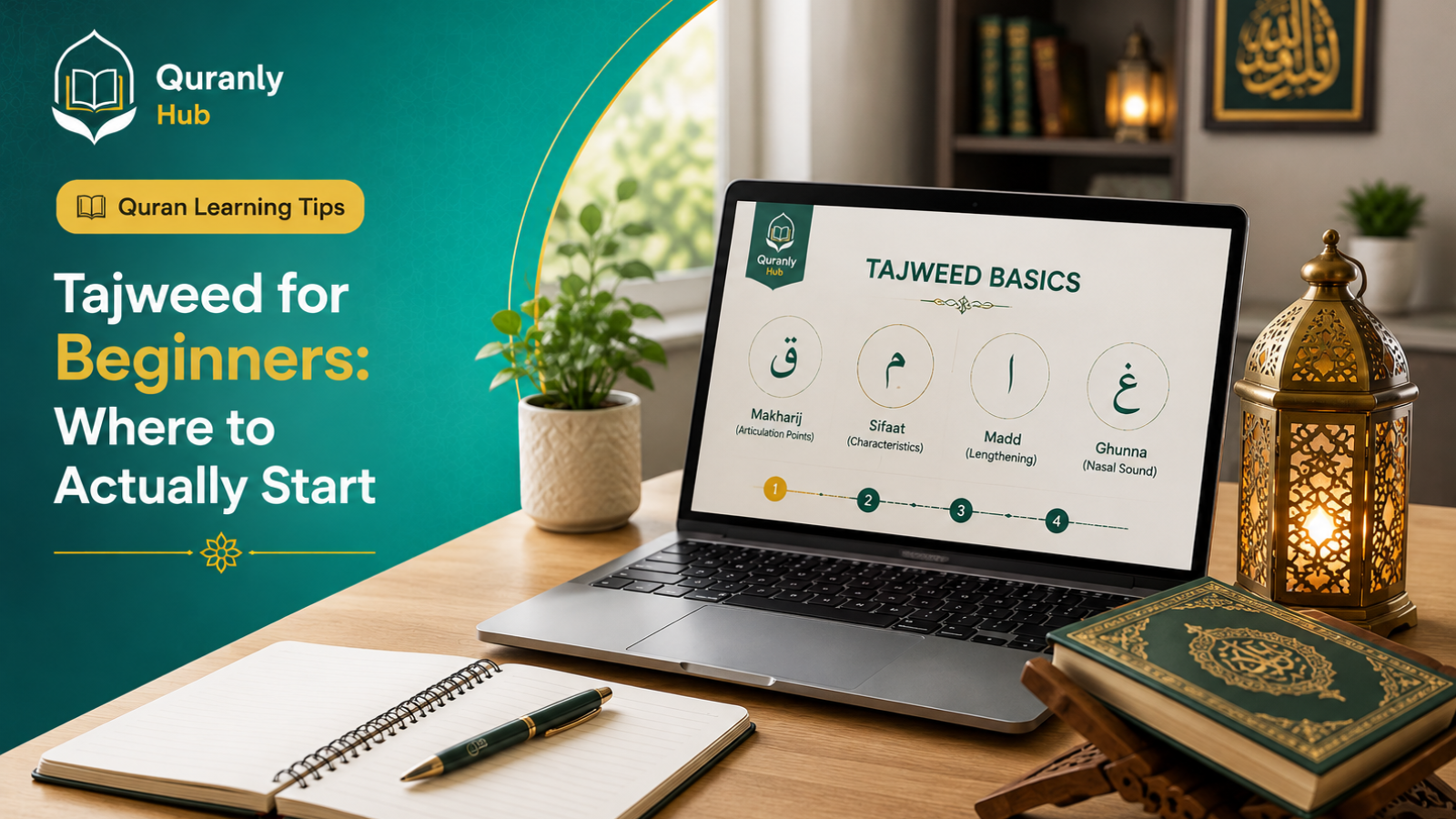
Short answer: start with the articulation points of the letters (Makharij), not with the named rules. Almost every beginner who struggles with Tajweed started in the wrong place, memorising rule names like Ikhfa and Idgham before they could reliably produce the letters those rules apply to. Get the articulation points right first, and tajweed classes online become far easier to follow.
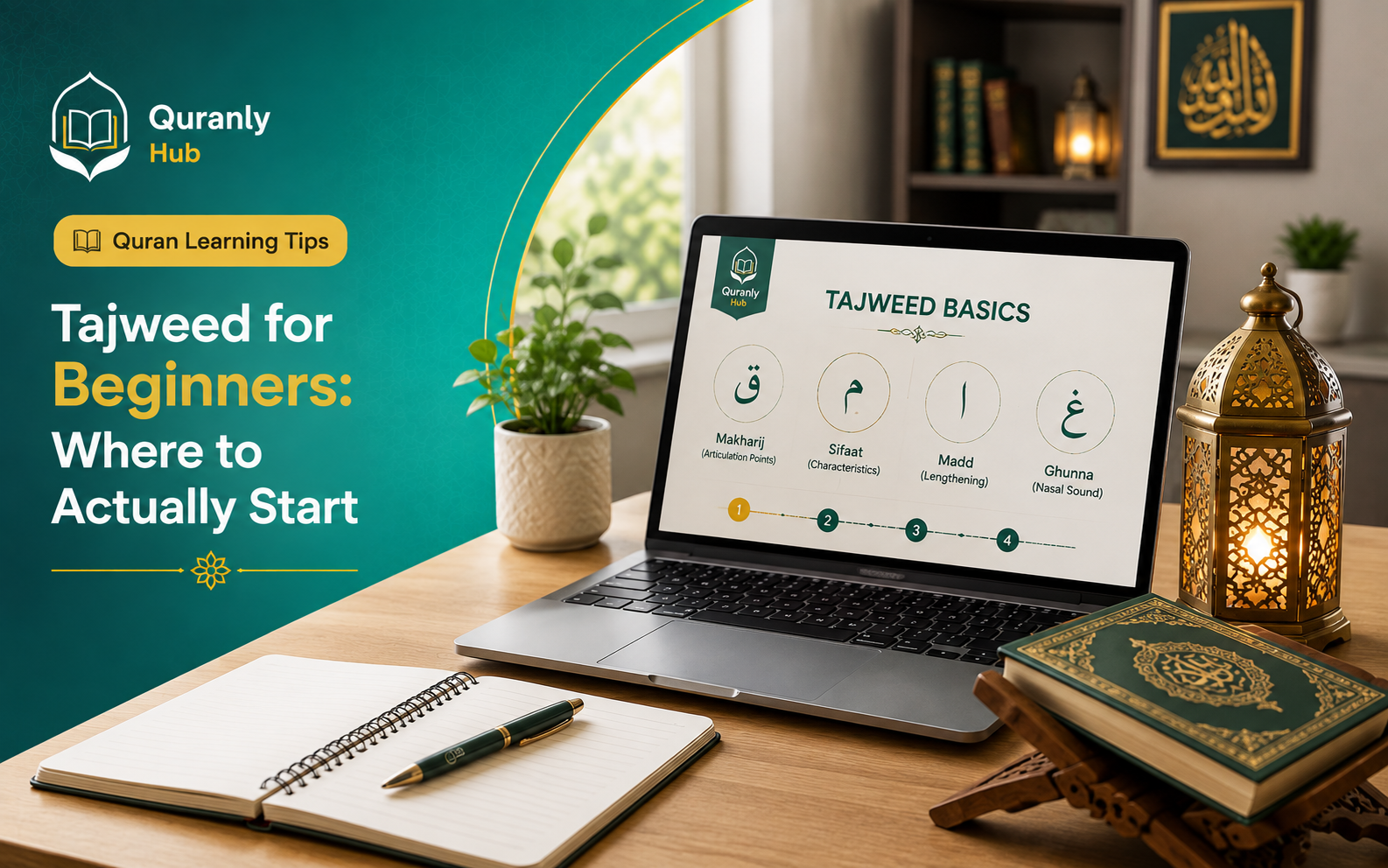
If you have tried to learn Tajweed online and felt lost, it is very likely a sequencing problem rather than an ability problem. Here is the order that actually works, and roughly how long each stage takes.
What Tajweed actually means
Tajweed is the set of rules governing how the Quran is pronounced: where each letter is formed in the mouth and throat, what qualities it carries, and how letters change when they meet each other. The purpose is preservation. Recited correctly, the text sounds as it was transmitted.
Two practical points beginners often miss. First, Tajweed is a practical skill, not a theoretical subject; you cannot learn it from reading alone, because it depends on a trained ear correcting you. Second, you are already applying much of it before you can name any of it.
Stage 1: Makharij, the articulation points
This is where to begin, and where most self taught learners skip ahead.
Arabic has letters that English does not distinguish. If your haa and haa sound the same, or your seen, saad and thaa collapse into one sound, no amount of rule memorisation will fix the recitation. The rules operate on letters; if the letters are wrong, the rules are decorating an error.
The commonly confused pairs worth drilling early:
- The two forms of haa, one from the deep throat and one from the middle
- Seen against saad, and thaa against seen
- Kaaf against qaaf
- Taa against taa, and daal against daad
- Zhaa, dhaal and zaay
Expect this stage to take several weeks. It is slow, it feels unglamorous, and it determines everything after it.
Stage 2: Sifaat, the qualities of letters
Once a letter is coming from the right place, the next layer is how it is produced. Is it heavy or light? Does the sound run or stop? Is there a slight bounce when it carries a sukoon?
This stage is what separates recitation that is technically correct from recitation that sounds right. It is also where a teacher becomes genuinely necessary, because you cannot hear your own heaviness accurately.
Stage 3: The Noon Sakinah and Tanween rules
Now the named rules make sense, because you have the letters to apply them to. There are four, and they cover a large share of what you will meet on any page:
| Rule | What happens |
|---|---|
| Izhar | The noon is pronounced clearly |
| Idgham | The noon merges into the following letter |
| Iqlab | The noon converts to a meem sound |
| Ikhfa | The noon is partially hidden, with a nasal sound |
Learn them by hearing and applying, not by memorising the letter groups first. The groups are a reference, not the lesson.
Stage 4: Madd, the lengthenings
Madd governs how long a vowel is held. Get the natural two count length stable first, then the longer cases. Inconsistent madd is the most audible beginner error, and the easiest to fix once someone points it out.
A realistic timeline
For an adult starting with reasonable reading fluency, attending two to three Tajweed classes online per week:
- Makharij and correcting confused letters: roughly four to eight weeks
- Sifaat: another four to six weeks, overlapping
- Noon Sakinah and Tanween rules: three to four weeks
- Madd and consolidation: ongoing
Applying it consistently while reciting at normal speed takes considerably longer than learning it. That is normal and not a sign of failure.
Related reading: Tajweed rules are only half the job. See how a Quran recitation course with an Ijazah teacher corrects the sounds you cannot hear yourself.
Already comfortable with the basics and want to check for hidden habits? See our guide on common Tajweed mistakes English speakers make and how to actually fix them.
Already reading fluently and want to refine further? See our guide on advanced Tajweed to check if you are ready for the next level.
New to structured Quran study altogether, not just Tajweed specifically? Our full guide to learning Quran online covers certified tutors, scheduling and what to expect for adults, sisters and kids.
Frequently asked questions
Can I learn Tajweed without a teacher?
You can learn the theory from books and videos. You cannot reliably learn the practice, because Tajweed depends on someone hearing your recitation and correcting it. Self study plus regular correction works well; self study alone tends to embed errors.
Do I need to finish Qaida first?
You need to read Arabic letters and join them. If you are still sounding out individual letters, complete a structured Qaida course first; Tajweed will come much faster afterwards.
How long does an online Tajweed course take?
Most students cover the core rules in three to six months of consistent weekly classes. Fluent application usually takes a year or more.
Is Tajweed obligatory?
Scholars distinguish between the level of Tajweed required to avoid changing meaning, which is considered necessary, and the finer points of beautification, which are recommended. Any qualified teacher can explain this in more detail.
Are tajweed classes online as effective as in-person lessons?
For correction, yes — what matters is a tutor hearing your recitation in real time, which live video delivers just as well as sitting in the same room.
What’s the difference between reading Quran online and taking a proper online tajweed course?
Reading Quran online is reciting the text; an online tajweed course teaches the precise pronunciation rules behind that recitation, so mistakes get corrected rather than repeated.
Can I learn tajweed online for free before committing to a course?
Free videos can introduce the concepts, but they can’t correct your recitation. Most academies, including QuranlyHub, offer a free trial class instead, which gives you real feedback before you commit to a paid plan.
Should I look for online quran classes with tajweed built in, or learn to read first and add Tajweed later?
Build it in from the start. Online quran tajweed classes that separate reading from Tajweed tend to create habits students later have to unlearn. Whether it’s called quran tajweed classes online or simply learning to learn quran online with tajweed from day one, starting both together is easier than correcting mispronunciation after it’s already automatic.
Starting properly
If you take one thing from this: do not begin with rule names. Begin with the letters. Everything else follows more easily than you expect.
QuranlyHub runs one to one Tajweed courses, structured in exactly this order, with an Advanced Tajweed course to progress into once the basics are solid. Book a free trial class and have your recitation assessed before you commit.
Do I need to know the Arabic alphabet before starting Tajweed?
Yes. Tajweed builds on being able to already read Arabic letters and basic words, typically through completing Noorani Qaida first. Starting Tajweed rules before the alphabet is solid tends to create confusion rather than progress.
What is the very first Tajweed rule a beginner learns?
Makharij al-huroof, the correct articulation points for each letter, comes first, since every other Tajweed rule depends on pronouncing the underlying letters correctly.
[…] Beginners normally start with the Noorani Qaida and gradually learn the foundations of Quran reading and pronunciation. As students progress, they can study rules such as: […]
[…] Fluency with basic Tajweed […]