Online Quran classes in South Africa - Noorani Qaida, Tajweed, Hifz, Ijazah, free trial class

Online Quran Classes in South Africa: Noorani Qaida, Tajweed, Hifz & Ijazah

Short answer: Muslim families across South Africa — Cape Town, Johannesburg, Durban and Pretoria — can enrol in live, one-on-one online Quran classes today: Noorani Qaida, Tajweed, Hifz, Ijazah, Qirat and Tafseer, with a certified tutor and a free trial class before you pay anything.

Online Quran Classes in South Africa: Why Families Choose an Online Academy

South Africa’s Muslim community — including Cape Town’s historic Cape Malay community, with its own deep tradition of ngaji (Quran study circles) — is spread across cities where a genuinely qualified local teacher is often fully booked or only available on fixed weekend slots. An online quran academy solves this directly: the same certified, Ijazah-holding tutor, matched to your family’s schedule, without depending on weekend quran classes near me being the only option that fits.

Whether you’re searching for a quran teacher near me, a private quran tutor, or simply quran classes for adults near me that actually has openings, a live one-on-one tutor over video removes the local-availability problem completely.

The 3-Hour Gap: South Africa Time, Pakistan Time, and Your Tutor’s Clock

Here is the part most guides skip. Your tutor sits in Pakistan, and Pakistan runs three hours ahead of South Africa. That gap decides which slots your tutor can actually teach, and which ones sound fine on paper and fall apart in real life. Get the gap right and the rest of the schedule is easy. Get it wrong and you will keep booking times nobody can keep.

5 pm in Cape Town Is 8 pm in Pakistan

South Africa keeps one time zone from Cape Town to Durban: South African Standard Time, UTC+2, all year, with no daylight saving. Pakistan runs on PKT, UTC+5, all year, with no daylight saving either. Subtract, and the gap is three hours, every day of the year. Five in the evening in Cape Town is eight in the evening in Pakistan. Eight at night in Cape Town is eleven at night for your tutor. A Fajr class at five in the morning in Cape Town starts at eight in the morning in Pakistan. None of this ever changes, because neither country moves its clocks. Johannesburg, Durban and Pretoria all read the same clock as Cape Town, so a family that moves from Durban to Johannesburg keeps the same class slot. The only conversion that matters is the one between South Africa and wherever the tutor sits, and that one never changes either.

School Runs January to December: the Southern-Hemisphere Year

South Africa’s school year runs the other way round from the northern hemisphere. Public schools open in mid-January and close in early December, in four terms, with the long summer break from mid-December to mid-January. In 2026 the year runs from 14 January to 9 December, with term breaks in late March, late June and late September. School days usually start around half past seven in the morning, so the after-school window opens in the early afternoon, not the late afternoon the way it does in Britain or Pakistan. That matters for the Quran slot. A child home by half past two has a long afternoon, and the best class times sit in it: after Asr, or after Maghrib, with homework done in between. December is the other big shift. No school for six weeks, late mornings, and evening classes that can start later. And if your child is in Grade 12, the last term is different again: regular classes end in late October for the matric exams, so plan the Quran timetable around the exam season, not through it.

Prayer Times Decide the Windows: Fajr, Maghrib and Isha in Cape Town

The prayer times draw the real timetable in a South African home. In Cape Town, Fajr falls at 3:41 in the morning at its earliest, in mid-December, and at 6:21 in the morning at its latest, in early July. Maghrib falls at 5:44 in the evening at its earliest, in mid-June, and at 8:01 in the evening at its latest, in early January. That is more than two hours of drift across the year, and a slot fixed to a clock number will slowly slide away from the prayer it was built around. On 17 November 2026, Fajr in Cape Town falls at 3:57 in the morning, Maghrib at 7:36 in the evening and Isha at 8:59. Johannesburg and Durban run a little earlier than Cape Town, because they sit further east. So check the slot every few months and move it with the prayers, not against them. Ramadan makes the same point sharper. In Ramadan 2026, which began on 18 February, most families moved the Quran class to after Iftar, and the Fajr slot, so quiet in other months, became the hardest one to keep.

Noorani Qaida — Reading Arabic From Scratch

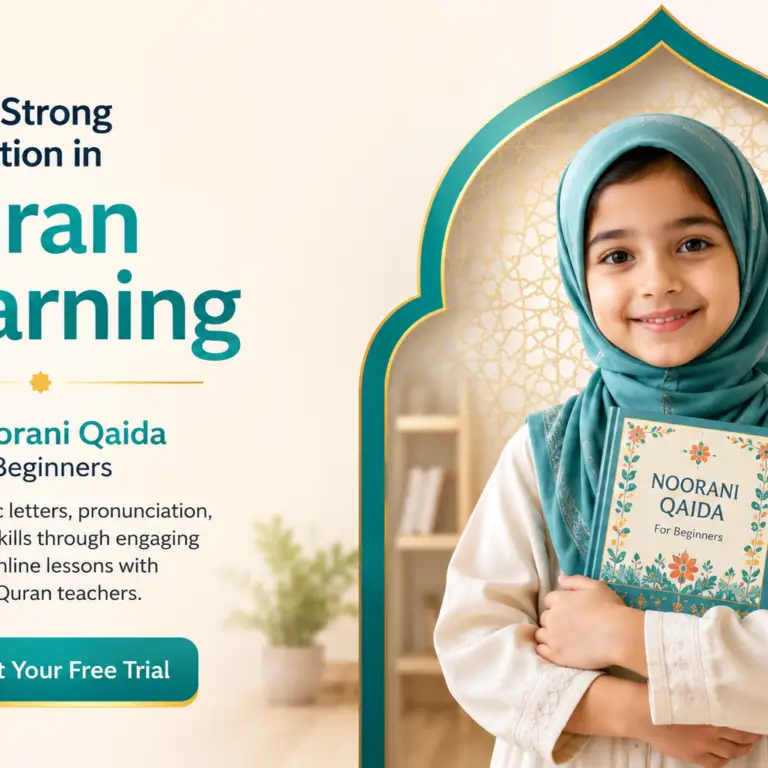
Our Noorani Qaida course is the traditional 17-lesson foundation — Arabic letters, joining rules, vowels, tanween, sukoon and shaddah — for complete beginners of any age, taught live and one-on-one.

Tajweed and Qirat Classes Online in South Africa

Tajweed classes online refine pronunciation (Makharij) and recitation rules with a certified tutor correcting you live. Students further along who want to learn qirat online — the melodic recitation styles — can build that within the same one-on-one format, at their own pace.

Hifz (Hifdh) — Quran Memorization

Our online Hifz course follows a structured daily sabaq (new memorization), sabqi (recent revision) and manzil (long-term revision) cycle, one-on-one with a certified Hafiz tutor. Families searching for hifdh classes near me, an online hifz course, or quran hifz classes near me for ladies get the same structured programme regardless of city.

Ijazah Course

An ijazah course is a certified, chain-linked authorization confirming a student can recite — and in some cases teach — the Quran to the required standard. Our tajweed ijazah course moves through the requirements at your own pace, one-on-one.

Quranic Arabic

A dedicated quranic arabic course online teaches the vocabulary and grammar patterns that repeat throughout the Quran, so you start understanding meaning directly from the Arabic text.

Tafseer — Understanding What You Recite

Our online Tafseer classes go beyond recitation, covering the context, meaning and lessons behind the verses you already read, in English, one-on-one with a tutor.

Quran Classes for Women and Girls

A female quran teacher is available as standard across every course — not a special request — at no extra cost, covering online islamic courses for ladies and women’s quran classes alike.

Cape Malay, Indian and Newcomer: Who Learns the Quran in South Africa

South Africa’s Muslims are a small community with very deep roots, and the Quran sits at the centre of all three of its parts. Knowing who your neighbours are helps you see why an online class fits so well here: the community is spread across four cities, and a good local teacher is rarely around the corner.

975,049 Muslims: a Small Community With Deep Roots

The 2022 Census counted 975,049 Muslims in South Africa, about 1.6 percent of a country of 62 million people. The Western Cape holds the highest share of any province, and Cape Town’s Muslim share sits around 9 percent. Durban holds the next large concentration, in KwaZulu-Natal, and Johannesburg holds the third, in Gauteng. That spread is the whole problem this page solves. A family in Cape Town, a family in Durban and a family in Johannesburg all want the same thing, a qualified teacher at a time that fits, and in none of those cities is a good teacher easy to find on a fixed weekend slot. An online class removes the distance. The tutor is the same, the timetable is yours, and the city you live in stops deciding whether your child learns.

The Cape Malay Ngaji Tradition

Cape Town’s Muslims are the oldest Muslim community in the country, and the Quran has been taught in their homes for centuries. The Bo-Kaap, the old Malay quarter above the city centre, still carries that history in its streets and its mosques. The tradition has a name: ngaji, the Quran study circles where children learned to read, sitting with a teacher after school, the way children still do in madrasas across the country. The Cape Malay community even wrote Afrikaans in Arabic script, and the first book ever written in Afrikaans was written that way, by a Cape Muslim. That is how deep the link between this community and the written Quran runs. An online class does not replace that tradition. It carries it into a home where the local circle no longer meets, or where the teacher moved away.

Durban, Johannesburg and the Indian South African Community

Durban and Johannesburg hold South Africa’s large Indian Muslim communities, and with them the country’s strongest madrasa tradition. Lenasia, south of Johannesburg, hosts the Darul Uloom Zakariyya seminary, and the Madrasah Uthmaan RA online madrasa, run by the Cii Youth Foundation, teaches from a curriculum built on the Jamiatul Ulama Tasheel Series and the Lenasia Muslim Association syllabus. That is the local standard, and it is a serious one. So why would a family in Durban or Lenasia look online at all? For the same reason a family in Cape Town does: the local teacher is fully booked, the madrasa runs on fixed days that clash with school or work, or the child needs one-to-one attention a group class cannot give. The online lesson is not a rival to the madrasa. It is the extra hour the madrasa timetable does not have, with a tutor who teaches only your child.

Quran Classes in South Africa: Pricing in Rand (ZAR)

Classes are one-on-one, 30 minutes per session, on a flexible monthly plan: from ZAR 499.81/month for 8 classes (2 a week), or ZAR 666.41/month for 16 classes (4 a week). Every course starts with a free trial class. Message us on WhatsApp with your preferred days and times, and we’ll confirm your exact schedule and rate.

Choose your Quran learning plan

✦ GREAT FOR BEGINNERS

Starter Plan

ZAR 499.81 / month

8 classes / month

✓ 2 classes per week

✓ 8 lessons per month

◷ 30 minutes per class

↗ Monthly progress report

✓ Standard Quran courses excluding Tafseer

★ MOST POPULAR

Monthly Plan

ZAR 666.41 / month

16 classes / month

✓ 16 lessons per month

◷ 30 minutes per class

✓ Tafseer: USD 70 a month for 12 classes, three days a week

✓ 1-on-1 certified Quran tutor

↗ Progress reports

Local currency equivalents of USD 30 / USD 40. Exchange rates dated 4 October 2026; amounts rounded. Free trial before payment.

What Quran Classes Cost in South Africa

Prices in South Africa come in rand and dollars mixed together, and the numbers look very different until you count classes instead of months. A cheap monthly price with four classes costs more per lesson than a higher price with twenty. So count the lessons, check the length, and ask what the trial actually includes before you compare anything.

What Other Academies Charge in South Africa

One academy lists its South Africa plans in rand: R540 a month for 8 classes, R720 for 12, R810 for 16 and R900 for 20, each 30 minutes, one-to-one, with a 10 percent family discount for two children. A second, a local online madrasa in Lenasia, lists its 30-minute plans at R324 a month for 4 classes, R630 for 8, R936 for 12, R1242 for 16 and R1534 for 20, with longer 45-minute and 60-minute plans costing more, and fees paid a quarter in advance. A third charges in dollars: $30 to $50 a month for 4 to 20 classes, each 30 minutes, one-to-one, with a free trial first and no registration fee. A fourth route is a private tutor on a marketplace, where Quran tutors list at R153 an hour at the low end and R508 an hour at the high end. The spread is wide, and the cheapest price is not always the best deal, because class length, group size and trial terms differ. Notice what most of those prices share: thirty-minute lessons and a free trial before you pay.

What ZAR 499.81 and ZAR 666.41 Buy at QuranlyHub

QuranlyHub charges from ZAR 499.81 a month for 8 classes and ZAR 666.41 a month for 16 classes, one-to-one, live online, each class 30 minutes. That works out at about R62 a class on the 8-class plan and about R42 a class on the 16-class plan. A 10 percent family discount applies for more than one enrolment, and every plan starts with a free trial class before you pay anything. Tafseer costs USD 70 a month for 12 classes, three days a week, and Tafseer lessons run longer than a standard 30-minute class, because a verse’s words, its context and what the scholars said about it don’t fit into half an hour. No rand figure for Tafseer is listed on this page: your bank converts the dollars at the day’s rate, so check it before you book, not after. The teaching covers Noorani Qaida, Tajweed, Hifz, Tafseer, Quranic Arabic and Islamic Studies, and the schedule is built around your day, not a fixed group timetable. You only need a phone, a tablet or a computer with an internet connection.

How to Compare Prices Without Being Fooled

Three checks before you pay anyone. First, divide the monthly price by the number of classes, then by the minutes in each class. A R900 plan with 20 classes of 30 minutes gives you 600 minutes of teaching a month. A R499.81 plan with 8 classes of 30 minutes gives you 240 minutes, for less money, but at a higher price per lesson, which is why the 16-class plan costs less per class than the 8-class plan. Second, ask whether the class is one-to-one or a group. A group class splits the teacher’s ear across every student in the room, and the whole point of Tajweed and Hifz is a trained ear on your recitation alone. Third, ask what the trial actually includes. A free trial with the actual tutor you will learn with, at the actual time you want to book, tells you more than any price list. A trial with a different teacher, or a recorded lesson, tells you nothing. And one warning that applies to every academy on this page: a price that looks cheap per month can still be expensive per lesson. What does that lesson actually cost?

How to Enrol in Online Quran Classes in South Africa

1. Message us on WhatsApp with the course you want and your preferred days and times.
2. Book your free trial class — meet your tutor, no payment required.
3. Confirm your monthly plan once you’re happy, and your regular schedule starts.

All 7 Courses, One Platform
Noorani Qaida course

Noorani Qaida

Start from the very first letter with a structured, one-on-one Qaida foundation.

Learn More
Tajweed course

Tajweed

Learn correct Quran recitation rules with a certified Tajweed tutor.

Learn More
Advanced Tajweed course

Advanced Tajweed

Refine your recitation with advanced makharij and qirat practice.

Learn More
Hifz (Memorization) course

Hifz (Memorization)

Memorize the Quran with a structured daily revision plan.

Learn More
Tafseer course

Tafseer

Understand the meaning and context behind the verses you recite.

Learn More
Quranic Arabic course

Quranic Arabic

Learn the Arabic grammar and vocabulary needed to understand the Quran directly.

Learn More
Alim & Aalimah Course course

Alim & Aalimah Course

A structured Islamic scholarship track for young men and women.

Learn More

How to Pick a Quran Tutor in South Africa

Three questions separate a good Quran tutor from a weak one, and you can ask all three in the trial class.

Ijazah First, Checks Second

Ask who the tutor learned from, and ask to hear the tutor recite. A real Ijazah means the tutor recited the whole Quran to a certified teacher and was given permission to teach it, and a good tutor will tell you the chain without being pressed. Then ask what the academy checked before the tutor taught a single student. At QuranlyHub, tutors are identity-verified and reference-checked, and the safeguarding contact is Adeel Ahmad, reachable around the clock. If a provider cannot name a person for that question, the first answers don’t matter much. And one warning: no academy teaching online from Pakistan can honestly promise a DBS check or a Working With Children Check. Those checks are built for in-person work inside the UK and Australia, and any South Africa page that claims one for an overseas online tutor is selling you a line.

English or Urdu: Match the Tutor to Your Home

Most South African families want the Quran taught in English, the language their children speak at school. Plenty of families in Durban and Johannesburg also want Urdu, the language spoken at home. Neither choice is wrong. The wrong choice is a tutor in a language your child only half understands. At QuranlyHub, lessons run in English or Urdu, matched to the student, so say which one your child follows best when you book. A child who understands the teacher keeps coming back. A child who doesn’t will find a reason to miss the next class.

Try the Slot Before You Commit: the Free Trial Class

Every course starts with a free trial class, with the actual tutor you will learn with, at the actual time you want to book. That is the one check that matters most, because no price list tells you whether the tutor explains things in a way your child actually follows, whether the slot fits your evening, or whether three days a week feels right for your family. In my experience, the trial tells you more in one lesson than any price list tells you in a week. Book the trial, sit in on it with your questions ready, and decide after it, not before.

Madrasa or Online: What Fits Your Family

Some families in South Africa have a good madrasa nearby and a child who is happy there. Keep it. The online lesson is not there to replace a madrasa that works. It is there for the family whose madrasa runs on fixed days that clash with school, whose local teacher is fully booked, or whose child needs one-to-one help with Tajweed that a group class cannot give. A few families do both: madrasa for the group learning and the community, online for the one-to-one recitation practice. That combination works well, because each one does what the other cannot. Ask yourself which problem you are solving. If the problem is a timetable that never fits, the online class solves it. If the problem is a child who needs a teacher’s full attention on every letter, the one-to-one lesson solves it. If neither is the problem, the madrasa you already have is probably the right answer.

Frequently Asked Questions

Do you teach Quran classes to families in South Africa?

Yes — every class is delivered live over video, so families anywhere in South Africa, from Cape Town to Johannesburg, Durban and Pretoria, get the same certified-tutor matching as everywhere else we teach.

What is Noorani Qaida and do I need it first?

Noorani Qaida is the 17-lesson foundation covering Arabic letters, joining rules and vowels, taught before a student reads the Quran itself. It’s the starting point for complete beginners of any age.

What is an Ijazah course?

An Ijazah is a certified authorization, passed through an unbroken chain of qualified teachers, confirming a student can recite (and in some cases teach) the Quran to the required standard.

Do you offer Hifz (Hifdh) classes?

Yes — our online Hifz course follows a daily sabaq, sabqi and manzil revision cycle, one-on-one with a certified Hafiz tutor, for children and adults alike.

Is a female teacher available?

Yes — a female Quran teacher is available as standard for daughters, sisters and women learning as adults, across every course, at no extra cost.

How much do classes cost in South Africa?

From ZAR 499.81/month for 8 classes, or ZAR 666.41/month for 16 classes, one-on-one, 30 minutes per session. Message us on WhatsApp to confirm your exact rate. Tafseer costs USD 70 a month for 12 classes, three days a week. Tafseer lessons run longer than a standard 30-minute class.

Is there a free trial class?

Yes — every course starts with a free trial class, no payment and no obligation.

How do I enrol?

Message us on WhatsApp with the course you want and your preferred days and times, book your free trial class, then confirm your monthly plan once you’re happy.
Online Quran Classes and Tuition in Ireland - Noorani Qaida, Tajweed, Hifz, Ijazah, free trial class

Online Quran Classes & Tuition in Ireland: Noorani Qaida, Tajweed, Hifz & Ijazah

Short answer: Muslim families across Ireland — Dublin, Cork, Galway and Limerick — can enrol in live, one-on-one online Quran tuition today: Noorani Qaida, Tajweed, Hifz, Ijazah, Quranic Arabic and Tafseer, with a certified tutor and a free trial class before you pay anything. See full pricing or message us on WhatsApp to book your trial now.

Why Families in Ireland Choose Online Quran Tuition Over In-Person Classes

A lot of parents start out searching for in person quran classes near me, and quickly hit the same wall: a genuinely qualified local teacher is either fully booked, only teaches fixed evening slots, or simply isn’t within reach outside Dublin. Live online quran classes solve this directly — the same certified, Ijazah-holding tutor, matched to your family’s actual schedule, without a drive across the city. Nothing about the teaching quality changes; what changes is that a slot is actually available this week.

If you’re comparing an online quran teacher against a local option, ask the same three questions of both: who exactly teaches the class, what happens if a session is missed, and what the free trial actually includes. That’s usually enough to tell a serious academy apart from a thin one.

What Online Quran Classes in Ireland Cost in 2026: The Real Range

The short answer on this page says families in Ireland can find a live, one-to-one, Ijazah-holding tutor for every course, and that is true. What it doesn’t say is what that actually costs. This section puts numbers on it: what the market charges, what each plan costs per class, and why the cheapest number on a homepage is rarely the cheapest price over a year. Ireland pays in euros, and it is in the eurozone and in SEPA, so a euro price on the page is a euro price in the bank. QuranlyHub’s own table is in euros, so the euro figures in this section are the ones that matter when an Ireland family compares plans.

The Range, in Plain Numbers

Start with the range. Tibyan charges $30 to $50 a month for 4 to 20 classes, with a free trial first, no registration fee and no contract. eQuranSchool charges €56 a month for 20 lessons in Europe, with a second sibling at €45. eQuranCoaching charges $45 a month for 8 classes of 30 minutes, $75 for 12 classes of 45 minutes and $135 for 20 classes of 60 minutes. E-Quran Academy charges $50 a month for its Starter plan, $60 for Standard and $90 for Premium. E Quran Institute charges £25 a month for its Start Up plan of 8 classes, £28 for the Weekend package, £32 for Standard, £38 for Plus, £42 for Premium and £50 for the Elite Hifz plan. Elbayan charges $40 a month for 8 classes and $80 for 16, which works out at $5 a class. Quran In Depth charges €35 a month for two classes a week, €50 for three, €68 for four and €85 for five. Al Tahoor charges $44.99 a month for 8 classes, $49.99 for a weekend-only plan, $54.99 for 12 and $74.99 for 20. AlhudaQuranTutor charges €45 a month for 12 classes, €50 for 16 and €60 for 20. My Online Quran Tutor starts at €28 a month for 8 classes. Online Quran Live charges from €40 a month. Murouj Academy charges from €6 per 30-minute lesson. TarteeleQuran charges $39 a month for two classes a week. 92 Campus charges €30 a month for three days a week and €40 for five days a week, with a 20 percent sibling discount for a second or third child. Three academies publish no price at all: Kanzulilm asks for a customised monthly plan in euros over WhatsApp, International Quran Academy will not publish a price, and Madani Islamic Academy gives no figure either. Al-Noor Academy charges $35 a month for 8 classes, $45 for 12 and $60 for 20. A €30 plan that buys eight classes is €3.75 a class; €35 for twelve is €2.92; €40 for sixteen is €2.50; €45 for twenty is €2.25. A €6 lesson is €6 a class, the dearest single euro lesson in this list.

Why One Number Never Fits Every Family

Four things explain the range, and each one moves the price in a predictable direction. Format comes first: one-to-one costs more per hour than a group class, because the tutor’s time belongs to one student. Frequency comes second: eight classes a month costs less in total than twenty, but more per class. Course comes third: Noorani Qaida and basic Tajweed are usually priced the same, while Hifz and Tafseer can cost more, because Hifz needs daily revision and Tafseer needs longer preparation. Tutor experience comes fourth: a tutor who has taught for many years may be priced higher than a new tutor. A family comparing two academies should compare the same format, the same frequency and the same course, or the comparison means nothing. In Ireland there is one more factor: the school day. Irish schools run a long day with after-school activities, so one child may be free at half past three and the next only after six in the evening. A tutor who can teach at either hour is worth more than a cheaper plan that only offers one.

Online vs In-Person: Where the Money Actually Goes

An online class is usually cheaper than an in-person class for the same thirty minutes, and the reason is overhead, not quality: an in-person class pays for a room, for travel, and for a fixed hour that cannot move, while an online class pays for the tutor’s time and nothing else. The saving has a limit, though: the tutor’s time is still the cost, and a good tutor’s time is not cheap anywhere. A family that finds an online class for a fraction of every other academy’s price should ask what is being left out: the tutor’s qualification, the length of the class, or the number of students sharing it. The cheapest class is not the one with the lowest monthly number. It’s the one where the child learns the most in the time paid for. Most mosque weekend schools run on fixed hours and shared classes, so the online class does the part the mosque cannot do: one-to-one teaching, at the child’s own pace. In Ireland the mosque picture is uneven: Dublin has the Dublin Mosque on the South Circular Road and the Islamic Cultural Centre of Ireland in Clonskeagh, the largest mosque in the country, while Cork has its mosque in Ballyphehane and Limerick has the Islamic Cultural Centre in Dooradoyle. A family in Galway or Limerick may live far from the nearest weekend school, and a family in a small town may have no local class at all. The online class covers the weekday teaching the mosque cannot fit in, and the mosque covers the community the screen cannot give.

Courses You Can Enrol In Today

Every course below is taught live, one-on-one, and starts with a free trial class — no payment, no obligation, until you’ve actually met your tutor.

What Happens in Your Free Trial Class

Every QuranlyHub course starts with one free 30-minute class on Zoom, with no card taken. This section walks through that half hour, and then says what other academies offer before a family pays, so the free start can be compared like-for-like.

Inside the Trial: What the Tutor Actually Does

The tutor starts by listening, not by teaching. In the first five minutes the tutor asks the child to read a few lines, or to recite a surah the child already knows, and listens for where the reading is steady and where it breaks. That’s the level the plan is built from, not a guess made before the call. In the next fifteen minutes the tutor teaches a real lesson at that level: a few new letters for a Qaida beginner, a correction of makharij for a Tajweed student, or a few new lines for a Hifz student. The tutor teaches in English, with Urdu support where it helps. There’s no Irish-medium teaching, and the trial runs the same way, so a family hears exactly how the lessons will sound before paying. The parent sits in, and at the end the tutor tells the parent where the child stands and which plan fits: eight classes a month for a slow start, or sixteen for a child who is ready to move faster. The last five minutes are for the parent’s questions. The time is chosen around Ireland, not around the tutor: Ireland runs on GMT in winter and IST in summer, and Pakistan sits 5 hours ahead in winter and 4 hours ahead in summer, so 5 pm in Dublin is 10 pm in Pakistan in winter and 9 pm in summer. Daylight saving starts on 28 March 2027 and ends on 31 October 2027, and the class time moves with it.

What Other Academies Offer Before You Pay

The free start is not one thing. Tibyan, eQuranSchool, Al Tahoor and Murouj each start with one free trial class or session. E Quran Institute lists a free trial in its packages. Quran In Depth offers one free trial evaluation, with no card. TarteeleQuran offers free trial classes. International Quran Academy offers three free trial classes. Madani Islamic Academy offers a two-day free trial. Al-Noor Academy starts with three free classes and takes no card. Quran Focus offers a one-week free trial. Elbayan’s first class is free. Kanzulilm starts with one free 30-minute class. What follows the free classes differs: Quran In Depth from €35 a month, Murouj from €6 a lesson, Tibyan from $30 a month, Al Tahoor from $44.99 a month, Al-Noor from $35 a month, Elbayan $40 a month for 8 classes, and TarteeleQuran $39 a month. Read the free offer together with the monthly price, because a free start on an expensive plan costs more over a year than a single free class on a cheaper one.

Noorani Qaida — Reading Arabic From Scratch

Our Noorani Qaida course is the traditional 17-lesson foundation — Arabic letters, joining rules, vowels, tanween, sukoon and shaddah — for complete beginners of any age. It’s the right starting point whether your child is beginning for the first time or you’re an adult who never had the chance to learn properly.

Tajweed & Qirat Classes Online

Tajweed classes online refine pronunciation (Makharij) and recitation rules with a certified tutor correcting you live, not after the fact. Students further along who want to develop the melodic recitation styles known as qirat can work on that within the same one-on-one format, at their own pace.

Hifz — Quran Memorization

Our online Hifz course follows a structured daily sabaq (new memorization), sabqi (recent revision) and manzil (long-term revision) cycle, one-on-one with a certified Hafiz tutor — whether you’re searching for hifz quran near me, an online hifz course, or a programme with real availability for adults working full-time.

Ijazah Course

An Ijazah course is a certified, chain-linked authorization confirming a student can recite — and in some cases teach — the Quran to the required standard. Our tajweed ijazah course follows the same one-on-one model as every other course, moving through the requirements at your own pace rather than a fixed cohort timetable.

Quranic Arabic

A dedicated quranic arabic course online teaches the vocabulary and grammar patterns that repeat throughout the Quran, so you start recognising meaning directly from the Arabic rather than relying only on an English translation.

Tafseer — Understanding What You Recite

Our online Tafseer classes go beyond recitation, covering the context, meaning and lessons behind the verses you already read, in English, one-on-one with a tutor rather than a pre-recorded lecture.

Quran Tuition for Women and Girls

A female quran teacher is available as standard across every course — not a special request that depends on who’s free that week, and at no extra cost. This covers online islamic courses for ladies and women’s quran classes alike, whether it’s Noorani Qaida, Tajweed, Hifz or Tafseer.

Pricing: What Online Quran Classes in Ireland Actually Cost

Classes are one-on-one, 30 minutes per session, on a flexible monthly plan: €30 a month for 8 classes (2 a week), or €40 a month for 16 classes (4 a week). The dedicated Hifz track (40-minute sessions) is €85/month for 16 classes. Every course starts with a free trial class, and there’s no registration fee.

Choose your Quran learning plan

✦ GREAT FOR BEGINNERS

Starter Plan

€30 / month

8 classes / month

✓ 2 classes per week

✓ 8 lessons per month

◷ 30 minutes per class

↗ Monthly progress report

✓ Standard Quran courses excluding Tafseer

★ MOST POPULAR

Monthly Plan

€40 / month

16 classes / month

✓ 16 lessons per month

◷ 30 minutes per class

✓ Tafseer: €70 a month for 12 classes, three days a week

✓ 1-on-1 certified Quran tutor

↗ Progress reports

Free trial before payment.

What Online Quran Classes in Ireland Cost, in Plain Numbers

€30 a month could mean eight classes or twenty, a group class or a one-to-one class, thirty minutes or sixty. Until a family knows all three, the number means nothing, so this section states QuranlyHub’s Ireland prices in full, with the per-class figure next to each plan.

QuranlyHub’s Four Plans, and What Each Class Costs

There are four plans, and the only difference between them is how many classes a family books each month. Eight classes a month costs €30, which is €3.75 a class. Twelve classes a month costs €35, which is €2.92 a class. Sixteen classes a month costs €40, which is €2.50 a class. Twenty classes a month costs €45, which is €2.25 a class. Every class is 30 minutes, one-to-one, on Zoom, with the same teacher each week. Every plan starts with one free 30-minute trial class and includes a monthly progress report, so a parent knows what was taught and what comes next without having to ask. Enrolling a second child in the same family takes 10 percent off that child’s plan. Tafseer is priced separately: €70 a month for 12 classes, three days a week, taught in Urdu or English, with the translation of the Quran taught inside the course. For the difference between translation and Tafseer, see the guide on tarjuma vs tafseer. The Alim and Aalimah scholar track is also priced separately: €80 a month for 8 sessions and €100 a month for 16 sessions, with 40-minute sessions. See the full pricing page for every plan in one place.

Against the market, the table holds up: the cheapest headline monthly price above is My Online Quran Tutor at €28 a month for 8 classes, two euros below QuranlyHub’s entry plan, and the dearest single euro lesson in the list is Murouj at €6 a lesson. A family in Ireland pays the euro figure exactly as printed, and the payment goes by SEPA bank transfer.

How Long Each Course Takes, and What It Costs Over Time

A monthly price is only half the question. The other half is how many months the course runs for, so this section states only the durations QuranlyHub has confirmed. Noorani Qaida takes 2 to 3 months on a 16-class plan and 3 to 5 months on an 8-class plan, which works out at €80 to €120 in total on the 16-class plan and €90 to €150 on the 8-class plan. Hifz takes 2 to 2.5 years, at 7 to 8 new lines a day, with the daily sabaq, sabqi and manzil cycle that the Hifz course follows, and a Hifz test every week. At the 16-class rate of €40 a month, two years of Hifz works out at €960 in total and two and a half years at €1,200, paid month by month, never in advance for the whole course. Quranic Arabic takes 9 to 12 months, which works out at €360 to €480 in total on the 16-class plan. No confirmed duration exists for Tajweed or for Tafseer, so none is stated here. A family should be wary of any academy that promises a Hifz finish date in months, because memorisation moves at the child’s pace, not the academy’s. The translation test inside Tafseer comes every week too.

Ireland’s 2026/27 school dates are worth planning around. The Halloween mid-term break runs 26 to 30 October 2026. The Christmas break closes on 22 December 2026 and schools reopen on 6 January 2027. The February mid-term runs 18 to 19 February 2027 for primary schools and 15 to 19 February for post-primary schools. St Patrick’s Day, 17 March 2027, is a public holiday. The Easter break closes on 19 March 2027 and schools reopen on 5 April 2027. The school year starts the week of 31 August 2026, and the summer holidays run from late June 2027. The two best windows to start are the start of the school year and the Christmas break. Ramadan 2027 falls inside the school term: the first fast is expected on Monday 8 February, with 9 February also possible by moon sighting, and Eid al-Fitr falls on Tuesday 9 March. Class times move earlier in the day during the fast, before Iftar or after Taraweeh, and the tutor fits the class around the family’s fast, not the other way round. Homework is set only for Hifz students, because only Hifz needs daily revision at home; other courses are practised in the lesson itself.

The Fine Print: Payment, Refunds and Makeup Classes

Fees are paid in advance by bank transfer. Ireland is in SEPA, so the transfer goes as a SEPA bank transfer in euros, with no conversion and no extra charge on the family’s side. There is no refund if a student leaves on their own, and there is a refund if the teacher cannot continue. A makeup class is given only when the teacher misses a lesson, so a family should pick a class time it can keep. A student may cancel, but the advance fee is not refunded. A parent may sit in on any class, and a class may be recorded with the tutor’s agreement. The trial is free, with no card taken, and the first month is paid only after the trial. For how the free trial works, see the free trial class page.

How to Enrol — 3 Simple Steps

1. Message us on WhatsApp with the course you want and your preferred days and times.
2. Book your free trial class — meet your tutor, no payment required.
3. Confirm your monthly plan once you’re happy, and your regular schedule starts.

Ready to start? Book your free trial class now, or see the full pricing breakdown for every course first.

All 7 Online Quran Courses in Ireland, One Platform

Noorani Qaida course

Noorani Qaida

Start from the very first letter with a structured, one-on-one Qaida foundation.

Learn More
Tajweed course

Tajweed

Learn correct Quran recitation rules with a certified Tajweed tutor.

Learn More
Advanced Tajweed course

Advanced Tajweed

Refine your recitation with advanced makharij and qirat practice.

Learn More
Hifz (Memorization) course

Hifz (Memorization)

Memorize the Quran with a structured daily revision plan.

Learn More
Tafseer course

Tafseer

Understand the meaning and context behind the verses you recite.

Learn More
Quranic Arabic course

Quranic Arabic

Learn the Arabic grammar and vocabulary needed to understand the Quran directly.

Learn More
Alim & Aalimah Course course

Alim & Aalimah Course

A structured Islamic scholarship track for young men and women.

Learn More

Frequently Asked Questions

Do you teach Quran tuition to families in Ireland?

Yes — every class is delivered live over video, so families anywhere in Ireland, from Dublin to Cork, Galway and Limerick, get the same certified-tutor matching as everywhere else we teach.

Is online tuition as good as in-person classes?

The teaching quality is the same — a certified tutor correcting your recitation live, in real time. What changes is availability: an online tutor is matched to your schedule, rather than whichever local slot happens to be free.

What is Noorani Qaida and do I need it first?

Noorani Qaida is the 17-lesson foundation covering Arabic letters, joining rules and vowels, taught before a student reads the Quran itself. It’s the starting point for complete beginners of any age.

What is an Ijazah course?

An Ijazah is a certified authorization, passed through an unbroken chain of qualified teachers, confirming a student can recite (and in some cases teach) the Quran to the required standard.

Do you offer Hifz (memorization) classes?

Yes — our online Hifz course follows a daily sabaq, sabqi and manzil revision cycle, one-on-one with a certified Hafiz tutor, for children and adults alike.

Is a female teacher available?

Yes — a female Quran teacher is available as standard for daughters, sisters and women learning as adults, across every course, at no extra cost.

How much does Quran tuition cost in Ireland?

€30 a month for 8 classes, or €40 a month for 16 classes, one-on-one, 30 minutes per session. The dedicated Hifz track is €85/month for 16 classes. Tafseer costs €70 a month for 12 classes, three days a week.

Is there a free trial class?

Yes — every course starts with a free trial class, no payment and no obligation, so you can meet your tutor before enrolling.

How do I enrol?

Message us on WhatsApp with the course you want and your preferred days and times, book your free trial class, then confirm your monthly plan once you’re happy.
How We Keep Your Child Safe Online

A parent who hands a child to an online tutor is trusting a stranger on a screen. This section says what QuranlyHub does, what it cannot show, and what a parent can check before the first paid class.

What No Online Tutor Can Show You

An Ijazah is a teaching certificate. It says the tutor’s own recitation was checked, and it names the teacher who checked it. It says nothing about whether that tutor is safe to teach a child alone on a video call. In Ireland, the check parents know is Garda vetting, run by the National Vetting Bureau under the National Vetting Bureau (Children and Vulnerable Persons) Acts 2012 to 2016. Since 29 April 2016, anyone working with children or vulnerable adults in Ireland must be vetted before starting, and vetting is done only through a registered organisation: a self-employed person cannot apply for it alone. An online tutor teaching from Pakistan cannot hold Garda vetting, because no such check exists for an overseas tutor, and no honest academy can show one. The same limit applies everywhere else: the UK’s Enhanced DBS check, Canada’s vulnerable sector check, Australia’s working with children check, Germany’s erweitertes Führungszeugnis, and in the USA the checks are set state by state. No honest academy can show a safeguarding certificate for an online tutor, because no country issues one to a teacher working from another country. So what can QuranlyHub show? Every tutor is Ijazah-certified, identity-verified and reference-checked, and every tutor’s Ijazah names the teacher who granted it. The safeguarding contact is Adeel Ahmad, and a parent can reach him directly.

Four Checks Before the First Paid Class

Four checks take ten minutes. First, ask for the tutor’s Ijazah and the name of the teacher who granted it. Second, sit in on the free trial class and watch how the tutor speaks to your child. Third, ask who the safeguarding contact is and how to reach them: the answer should be a name and a number, not a form. Fourth, ask what happens if the teacher is ill or away. A family that has done all four has done more than any certificate could do, because a certificate says nothing about how a tutor treats a child, and the trial shows it.

A Female Teacher for Your Daughter, at No Extra Cost

A female teacher is available for daughters and mothers alike, at no extra cost, and any of the seven courses can be booked one-to-one with her. For an adult sister, the camera is optional, and the class can run on voice only. A parent who wants a female teacher should say so when booking the free trial, and the academy will match the child with one. For more on how that works, see the guide to female Quran teachers online.

Best Online Quran Academy in New Zealand - Noorani Qaida, Tajweed, Hifz, Ijazah, free trial class

Best Online Quran Academy in New Zealand: Classes, Hifz, Tajweed & Ijazah Courses

Short answer: Muslim families across New Zealand — from Auckland and Wellington to Christchurch and Hamilton — are increasingly choosing an online Quran academy over a local search, because a certified, Ijazah-holding tutor is easier to book over video than to find nearby. QuranlyHub teaches Noorani Qaida, Tajweed, Hifz, Tafseer and Quranic Arabic live, one-on-one, with a free trial class before you commit.

Why NZ Families Search for an Online Quran Academy Instead of a Local Teacher

New Zealand’s Muslim community is spread across a handful of cities, and a good local Quran teacher is often already fully booked, teaches on fixed evening slots, or simply isn’t within a reasonable distance for a family outside the main centres. An online quran academy removes the local-availability problem completely — a certified tutor is one video call away, matched to your family’s actual schedule rather than whichever slot a nearby teacher happens to have free.

Whether you’re searching for an online quran teacher, a quran teacher near me with real availability, or simply the online quran classes near me your search keeps failing to surface, the underlying need is the same: a live, one-on-one tutor who corrects mistakes as they happen, not a recorded course.

Noorani Qaida — Where Every Student Starts

Our Noorani Qaida course is the traditional 17-lesson foundation — Arabic letters, joining rules, vowels, tanween, sukoon and shaddah — taught live and one-on-one before a student reads the Quran itself. It’s the right starting point whether you’re looking to learn quran online for the first time as an adult, or want your child reading correctly from scratch rather than guessing at pronunciation.

Tajweed Classes Online — Reciting the Quran Correctly

Once a student can read confidently, Tajweed classes online refine pronunciation (Makharij) and recitation rules, one-on-one with a certified tutor listening and correcting in real time. This is exactly what separates learn tajweed online from an app or recorded course — someone actually catching a mistake the moment it happens, rather than reviewing a recording after the fact.

Ijazah Course — Certified, Chain-Linked Authorization to Teach and Recite

For students who want to go beyond personal recitation, an ijazah course is a certified authorization, passed down through an unbroken chain of qualified teachers, confirming a student can recite (and in some cases teach) a portion of the Quran to the required standard. Our online ijazah course and tajweed ijazah course are built on the same one-on-one model as every other course — your tutor moves you through the requirements at your own pace, not a fixed cohort schedule.

Hifz — Quran Memorization Online

Our online Hifz course follows a structured daily sabaq (new memorization), sabqi (recent revision) and manzil (long-term revision) cycle, one-on-one with a certified Hafiz tutor. Families searching for hifz classes near me, an online hifz course, or a quran hifz classes near me for ladies option get the same structured programme, whether in Auckland, Wellington, Christchurch or a smaller town with no local Hifz programme at all.

Quranic Arabic Course — Understanding the Language Itself

A dedicated quranic arabic course online teaches the vocabulary and grammar patterns that repeat throughout the Quran, so a student can start recognising meaning directly from the Arabic rather than relying only on an English translation.

Female (and Male) Quran Teachers Available

A female quran teacher is available as standard for daughters, sisters and women learning as adults — not a special request that depends on who’s free that week — and a male tutor is equally available for sons and men who prefer one. This applies across every course: Noorani Qaida, Tajweed, Hifz, Ijazah and Tafseer.

Quran Tafseer — Understanding What You Recite

Our online Tafseer classes go beyond recitation, covering the context, meaning and lessons behind the verses you already read, in English, one-on-one with a tutor rather than a pre-recorded lecture. Many students come to their first Tafseer class already familiar with well-known contemporary teachers, such as Nouman Ali Khan; QuranlyHub is an independent academy, not affiliated with any individual teacher, but our tutors work through the same verses one-on-one and answer your own questions as they come up.

Pricing for New Zealand (NZD)

Classes are one-on-one, 30 minutes per session, on a flexible monthly plan: from NZD 53.44/month for 8 classes (2 a week), or NZD 71.26/month for 16 classes (4 a week). Every course starts with a free trial class. Message us on WhatsApp with your preferred days and times, and we’ll confirm your exact schedule and rate — or see our full pricing breakdown for every course.

Choose your Quran learning plan

✦ GREAT FOR BEGINNERS

Starter Plan

NZD 53.44 / month

8 classes / month

✓ 2 classes per week

✓ 8 lessons per month

◷ 30 minutes per class

↗ Monthly progress report

✓ Standard Quran courses excluding Tafseer

★ MOST POPULAR

Monthly Plan

NZD 71.26 / month

16 classes / month

✓ 16 lessons per month

◷ 30 minutes per class

✓ Tafseer: USD 60/month for 8 classes or USD 100/month for 16

✓ 1-on-1 certified Quran tutor

↗ Progress reports

Local currency equivalents of USD 30 / USD 40. Exchange rates dated 4 October 2026; amounts rounded. Free trial before payment.

How to Choose the Right Online Quran Academy in New Zealand

Before enrolling anywhere, confirm the tutor’s Ijazah or certification directly, ask what happens to a missed class given New Zealand’s time-zone difference from most tutors, and treat the free trial as a real test, not a formality. A provider offering genuine schedule flexibility — your timing, not theirs — combined with a certified tutor, is worth continuing with past the first month.

All 7 Courses, One Platform

Noorani Qaida course

Noorani Qaida

Start from the very first letter with a structured, one-on-one Qaida foundation.

Learn More
Tajweed course

Tajweed

Learn correct Quran recitation rules with a certified Tajweed tutor.

Learn More
Advanced Tajweed course

Advanced Tajweed

Refine your recitation with advanced makharij and qirat practice.

Learn More
Hifz (Memorization) course

Hifz (Memorization)

Memorize the Quran with a structured daily revision plan.

Learn More
Tafseer course

Tafseer

Understand the meaning and context behind the verses you recite.

Learn More
Quranic Arabic course

Quranic Arabic

Learn the Arabic grammar and vocabulary needed to understand the Quran directly.

Learn More
Alim & Aalimah Course course

Alim & Aalimah Course

A structured Islamic scholarship track for young men and women.

Learn More

Frequently Asked Questions

Do you teach Quran classes to families in New Zealand?

Yes — every class is delivered live over video, so families anywhere in New Zealand, from Auckland to Christchurch, get the same certified-tutor matching as everywhere else we teach.

What is Noorani Qaida and do I need it first?

Noorani Qaida is the 17-lesson foundation covering Arabic letters, joining rules and vowels, taught before a student reads the Quran itself. It’s the starting point for complete beginners of any age.

What is an Ijazah course?

An Ijazah is a certified authorization, passed through an unbroken chain of qualified teachers, confirming a student can recite (and in some cases teach) the Quran to the required standard.

Do you offer Hifz (memorization) classes?

Yes — our online Hifz course follows a daily sabaq, sabqi and manzil revision cycle, one-on-one with a certified Hafiz tutor, for children and adults alike.

Is a female teacher available?

Yes — a female Quran teacher is available as standard for daughters, sisters and women learning as adults, across every course, at no extra cost.

How much do classes cost in New Zealand?

From NZD 53.44/month for 8 classes, or NZD 71.26/month for 16 classes, one-on-one, 30 minutes per session. Message us on WhatsApp to confirm your exact schedule and rate. Tafseer costs USD 60/month for 8 classes (2 per week) or USD 100/month for 16 classes.

Do you teach Quranic Arabic?

Yes — our Quranic Arabic course teaches the vocabulary and grammar patterns that repeat throughout the Quran, so you can understand meaning directly from the Arabic text.

Is there a free trial class?

Yes — every course starts with a free trial class, no payment and no obligation, so you can meet your tutor before enrolling.

How do time zones work between New Zealand and my tutor?

Tutors accommodate New Zealand time when scheduling, including early morning or evening slots — message us your preferred days and times and we’ll confirm a schedule that actually fits.

How do I enrol?

Message us on WhatsApp to book a free trial class, or see our full pricing and course list first.

Online Tajweed classes in the USA with Tafsir Ibn Kathir in English - Noorani Qaida, Hifz, certified tutors, free trial class

Online Tajweed Classes in the USA: Correct Quran Recitation + Tafsir Ibn Kathir in English

Short answer: Most Quran students in the USA search for two things at different stages — correct Tajweed (reciting the Quran the right way) first, then Tafsir Ibn Kathir in English to actually understand it. QuranlyHub teaches both live, one-on-one, with an Ijazah-certified tutor and a free trial class before you commit. See the full course list and USD pricing for the USA.

Why So Many Americans Search for Correct Quran Recitation (Tajweed)

Short answer: Tajweed is the set of rules for pronouncing Quranic Arabic correctly — and most self-taught readers in the US never had anyone correct their mistakes in real time, which is exactly what live Tajweed classes fix.

Many students grow up listening to renowned reciters — the measured, precise Murattal style of Sheikh Mahmoud Khalil Al-Hussary is a common reference point — and want their own recitation to sound closer to that standard. A recording can inspire that goal, but it can’t correct a mispronounced letter while you’re making it. That’s the actual gap qur an tajweed classes are built to close: a live tutor listening in real time, catching a mistake the moment it happens instead of letting it repeat into a habit.

What Online Tajweed Classes in the USA Cost in 2026: The Real Range

The short answer on this page says a family in the USA can find a live, one-to-one, Ijazah-certified tutor for Tajweed and for Tafsir Ibn Kathir in English, and that is true. What it doesn’t say is what that actually costs. This section puts numbers on it: what the market charges, what each plan costs per class, and why the cheapest number on a homepage is rarely the cheapest price over a year. The dollar figures are the ones that matter; the euro and pound figures below only show what the same class costs elsewhere.

The Range, in Plain Numbers

Start with the range. Tibyan charges $30 to $50 a month for 4 to 20 classes, with a free trial first. eQuranSchool charges $74 a month for 20 lessons in the USA, with a free trial session first. eQuranCoaching charges $45 a month for 8 classes of 30 minutes, $75 for 12 classes of 45 minutes and $135 for 20 classes of 60 minutes. E-Quran Academy charges $50 a month for its Starter plan, $60 for Standard and $90 for Premium. Al Tahoor charges $44.99 a month for 8 classes, $49.99 for a weekend-only plan, $54.99 for 12 and $74.99 for 20. Elbayan charges $40 a month for 8 classes and $80 for 16, which works out at $5 a class. Al-Noor Academy charges $35 a month for 8 classes, $45 for 12 and $60 for 20. TarteeleQuran charges $39 a month for two classes a week. The euro academies price the same kind of class in euros: eQuranSchool charges €56 a month for 20 lessons in Europe, with a second sibling at €45. Quran In Depth charges €35 a month for two classes a week, €50 for three, €68 for four and €85 for five. My Online Quran Tutor starts at €28 a month for 8 classes. Murouj Academy charges from €6 per 30-minute lesson. 92 Campus charges €30 a month for three days a week and €40 for five days a week. E Quran Institute charges £25 a month for its Start Up plan of 8 classes, rising to £50 for the Elite Hifz plan. Three academies publish no price at all. A $74 plan that buys twenty lessons is $3.70 a lesson; $40 for eight is $5.00 a class; $30 for four is $7.50 a class. The cheapest dollar headline is $30 a month, and the dearest single dollar lesson in this list is $7.50 a class. For a family in the USA, the dollar price is the whole story: no conversion, no bank rate, no surprise on the statement.

Why One Number Never Fits Every Family

Four things explain the range, and each one moves the price in a predictable direction. Format comes first: one-to-one costs more per hour than a group class, because the tutor’s time belongs to one student. Frequency comes second: eight classes a month costs less in total than twenty, but more per class. Course comes third: Noorani Qaida and basic Tajweed are usually priced the same, while Hifz and Tafseer can cost more, because Hifz needs daily revision and Tafseer needs longer preparation. Tutor experience comes fourth: a tutor who has taught for many years may be priced higher than a new tutor. A family comparing two academies should compare the same format, the same frequency and the same course, or the comparison means nothing. In the USA there is one more factor: the clock. Four mainland time zones stretch the school day across the country, so a child in New York finishes school three hours before a child in California starts the same afternoon. A tutor who can teach at either hour is worth more than a cheaper plan that only offers one. An after-school slot between 3 pm and 6 pm local time is the hour most families want.

Online vs In-Person: Where the Money Actually Goes

An online class is usually cheaper than an in-person class for the same thirty minutes, and the reason is overhead, not quality: an in-person class pays for a room, for travel, and for a fixed hour that cannot move, while an online class pays for the tutor’s time and nothing else. The saving has a limit: the tutor’s time is still the cost. A family that finds an online class for a fraction of every other academy’s price should ask what is being left out: the tutor’s qualification, the length of the class, or the number of students sharing it. The cheapest class is not the one with the lowest monthly number. It’s the one where the child learns the most in the time paid for. Most mosque weekend schools run on fixed hours and shared classes. The USA has 2,769 mosques, counted in 2020, and the biggest counts are in New York with 343, California with 304, Texas with 224, Florida with 157 and New Jersey with 141. A family in New York or Houston may live near a weekend school, and a family in a smaller town may have no local class at all. The online class covers the weekday teaching the mosque cannot fit in, and the mosque covers the community the screen cannot give.

What Online Tajweed Classes Actually Teach

Our Tajweed classes online cover Makharij (correct articulation points for every letter), the rules of noon sakinah and tanween, madd (elongation), qalqalah, and the rhythm and pacing that turns technically-correct reading into fluent, confident recitation — one-on-one, live, with a certified tutor correcting you as you go rather than reviewing a recording after the fact.

What Happens in Your Free Trial Class

Every QuranlyHub course starts with one free 30-minute class on a live video call, with no card taken. This section walks through that half hour, then says what other academies offer, so the free start can be compared like-for-like.

Inside the Trial: What the Tutor Actually Does

The tutor starts by listening, not by teaching. In the first five minutes the tutor asks the child to read a few lines, or to recite a surah the child already knows, and listens for where the reading is steady and where it breaks. That is the level the plan is built from, not a guess made before the call. In the next fifteen minutes the tutor teaches a real lesson at that level: a few new letters for a Qaida beginner, a correction of makharij for a Tajweed student, or a few new lines for a Hifz student. The tutor teaches in English, with Urdu support where it helps. There is no French-medium teaching, and the trial runs the same way, so a family hears exactly how the lessons will sound before paying. The parent sits in, and at the end the tutor says where the child stands and which plan fits. The last five minutes are for the parent’s questions. The time is chosen around the USA, not around the tutor: 5 pm Eastern is 3 am in Pakistan in winter and 2 am in summer, and 5 pm Pacific is 6 am in winter and 5 am in summer. Daylight saving starts on 14 March 2027 and ends on 7 November 2027, and the class time moves with it.

What Other Academies Offer Before You Pay

The free start is not one thing. Tibyan, eQuranSchool, Al Tahoor and Murouj each start with one free trial class or session. E Quran Institute lists a free trial in its packages. Quran In Depth offers one free trial evaluation, with no card. TarteeleQuran offers free trial classes. International Quran Academy offers three free trial classes. Madani Islamic Academy offers a two-day free trial. Al-Noor Academy starts with three free classes and takes no card. Quran Focus offers a one-week free trial. Elbayan’s first class is free. Kanzulilm starts with one free 30-minute class. What follows differs: Tibyan from $30 a month, Al Tahoor from $44.99, Al-Noor from $35, Elbayan $40 for 8 classes, TarteeleQuran $39, Quran In Depth from €35 and Murouj from €6 a lesson. Read the free offer together with the monthly price, because a free start on an expensive plan costs more over a year than a single free class on a cheaper one.

Four Questions to Ask Your Trial Tutor

First, what level is my child at, and what would the first month actually cover? A tutor who can name the next five lessons has a plan; a tutor who can’t is guessing. Second, how much new memorisation will you set each day, and how will you revise it? For Hifz, the answer should name a number of new lines and the daily sabaq, sabqi and manzil cycle. Third, will my child keep the same teacher each week? QuranlyHub’s answer is yes, and a family should hear the same answer from any academy before paying. Fourth, what happens if the teacher is ill or away? The honest answer is a makeup class, or a substitute the family meets first, not a lost lesson. Ask all four in the trial, and write the answers down, because the trial is free and the first month is not. I’ve seen families skip this step and regret it in the first month.

Well-Known Quran Educators in the US — and How a Live Tutor Is Different

Some students first discover Tajweed through well-known US-based Quran educators and self-paced apps — names like Wisam Sharieff come up often in that search. QuranlyHub is an independent academy and isn’t affiliated with any individual teacher, app or publisher. What a live, one-on-one class adds on top of a self-paced course or app is simple: someone actually listening to your recitation and correcting it in the moment, at a pace matched to you specifically, rather than a fixed lesson plan.

Noorani Qaida — Where Tajweed Actually Starts

If you’re not yet reading Arabic script confidently, Tajweed isn’t the starting point — Noorani Qaida is. It’s the traditional 17-lesson foundation covering Arabic letters, joining rules, short and long vowels, tanween, sukoon and shaddah, taught live and one-on-one to complete beginners of any age, child or adult.

Tafsir Ibn Kathir in English: What Online Tafseer Classes in the USA Teach

Short answer: Yes — our online Tafseer classes are taught in English, live and one-on-one, drawing on Tafsir Ibn Kathir and other major classical works.

Reciting the Quran correctly is one skill; understanding what it means is another, and it’s the one most self-taught readers never quite get to. Tafsir Ibn Kathir in English is one of the most-requested ways into that second skill — sessions go through the context, meaning and lessons behind the verses you already recite, one-on-one with a tutor, not a pre-recorded lecture.

Ibn Kathir, Al-Jalalayn, As-Sa’di — Comparing the Major Tafsir Traditions in English

Classical Quran commentary generally falls into two traditions: tafseer bil-ma’thur, which explains a verse using the Quran itself, hadith, and how the earliest generations understood it — the approach behind Tafsir Ibn Kathir — and tafseer bil-ra’y, which reasons through language, grammar and context, seen in more concise works like Tafsir Al-Jalalayn and the more modern Tafsir As-Sa’di. Our tutors draw on all of these rather than teaching from one fixed text, explaining what classical and modern scholars understood a verse to mean, then discussing how it applies today. See our full comparison of Ibn Kathir, Al-Jalalayn and Al-Tabari for how these works actually differ.

Studying the Tafsir of Popular Surahs — Al-Fatiha, Al-Baqarah, Al-Mulk

There’s no fixed order — your tutor works through whichever surah or ayah you bring to the session. Commonly requested starting points include Surah Al-Fatiha (recited in every prayer), Surah Al-Baqarah, and Surah Al-Mulk, but sessions are built around your own questions, not a syllabus.

Hifz — For Students Who Want to Memorize, Not Just Understand

Our online Hifz course follows a structured daily sabaq (new memorization), sabqi (recent revision) and manzil (long-term revision) cycle, one-on-one with a certified Hafiz tutor — for children starting early and adults fitting memorization around a full-time job.

Quranic Arabic — Understanding the Language Itself

A step below full Tafsir, a dedicated Quranic Arabic course teaches the vocabulary and grammar patterns that repeat throughout the Quran, so you can start recognizing meaning directly from the Arabic instead of relying only on an English translation or Tafsir.

Online Tajweed Classes in the USA: Pricing in USD

Tajweed and Noorani Qaida are one-on-one, 30 minutes per session, at $30 a month for 8 classes (2 a week), $35 a month for 12 classes, $40 a month for 16 classes (4 a week), or $45 a month for 20 classes. Tafseer costs $70 a month for 12 classes, three days a week. Every course starts with a free trial class. See the full course list and pricing for the USA, or message us on WhatsApp with your time zone and preferred days.

What Tajweed and Tafsir Classes in the USA Cost, in Plain Numbers

$30 a month could mean four classes or twenty, a group class or a one-to-one class, thirty minutes or sixty. Until a family knows all three, the number means nothing, so this section states QuranlyHub’s USA prices in full.

QuranlyHub’s Four Plans, and What Each Class Costs

There are four plans, and the only difference between them is how many classes a family books each month. Eight classes a month costs $30, which is $3.75 a class. Twelve classes a month costs $35, which is $2.92 a class. Sixteen classes a month costs $40, which is $2.50 a class. Twenty classes a month costs $45, which is $2.25 a class. Every class is 30 minutes, one-to-one, on a live video call, with the same teacher each week. Every plan starts with one free 30-minute trial class and includes a monthly progress report. Enrolling a second child in the same family takes 10 percent off that child’s plan. Tafseer is priced separately: $70 a month for 12 classes, three days a week, taught in Urdu or English, with the translation of the Quran taught inside the course and a translation test every week. The English Tafsir Ibn Kathir most students in the USA buy is the Darussalam ten-volume abridged edition, translated by a group of scholars under Shaykh Safiur-Rahman Al-Mubarakpuri, second edition July 2003. The classes draw on Ibn Kathir, Al-Jalalayn and As-Sa’di, not one fixed text. For the difference between translation and Tafseer, see the guide on tarjuma vs tafseer. The Alim and Aalimah scholar track is also priced separately: $80 a month for 8 sessions and $100 a month for 16 sessions, with 40-minute sessions. See the full pricing page for every plan in one place.

Against the market, the table holds up: QuranlyHub’s $30 entry plan matches the cheapest headline price above, while giving eight classes where Tibyan’s $30 plan gives four. A family in the USA pays the dollar figure exactly as printed, with no conversion in between.

How Long Each Course Takes, and What It Costs Over Time

A monthly price is only half the question. The other half is how many months the course runs for. Noorani Qaida takes 2 to 3 months on a 16-class plan and 3 to 5 months on an 8-class plan, which works out at $80 to $120 in total on the 16-class plan and $90 to $150 on the 8-class plan. Hifz takes 2 to 2.5 years, at 7 to 8 new lines a day, with the daily sabaq, sabqi and manzil cycle that the Hifz course follows, and a Hifz test every week. At $40 a month, two years of Hifz works out at $960 and two and a half years at $1,200, paid month by month. Quranic Arabic takes 9 to 12 months. No confirmed duration exists for Tajweed or for Tafseer, so none is stated here. A family should be wary of any academy that promises a Hifz finish date in months, because memorisation moves at the child’s pace, not the academy’s.

America’s 2026/27 school dates are worth planning around. There is no single national calendar, so the dates below are the typical shape. School starts in mid-to-late August 2026, or after Labor Day on Monday 7 September 2026 in the north-east. Thanksgiving falls on Thursday 26 November 2026, and most districts close from 25 to 27 November. The winter break runs about two weeks around Christmas on Friday 25 December 2026 and New Year’s Day on Friday 1 January 2027: New York City closes 24 December 2026 to 1 January 2027, Chicago 21 December 2026 to 1 January 2027, Houston 21 December 2026 to 4 January 2027, and Los Angeles 21 December 2026 to 8 January 2027. The spring break runs one week in late March or early April 2027, often around Easter on Sunday 28 March 2027. School ends in late May or June 2027. Ramadan 2027 falls inside the school term: the first fast is expected on Monday 8 February, and Eid al-Fitr falls on Tuesday 9 March. Class times move earlier during the fast, before Iftar or after Taraweeh. Homework is set only for Hifz students; other courses are practised in the lesson itself.

The Fine Print: Payment, Refunds and Makeup Classes

Fees are paid in advance by bank transfer. There is no refund if a student leaves on their own, and there is a refund if the teacher cannot continue. A makeup class is given only when the teacher misses a lesson, so a family should pick a class time it can keep. A parent may sit in on any class, and a class may be recorded with the tutor’s agreement. The trial is free, and the first month is paid only after the trial.

How to Choose the Right Online Tajweed or Tafsir Teacher in the USA

Whether you’re comparing Tajweed tutors or a Tafsir Ibn Kathir class, the same three checks apply: confirm the tutor’s Ijazah or certification directly, ask what happens to a missed class, and treat the free trial as a real test of teaching style, not a formality. A tutor who corrects clearly and explains patiently is worth continuing with past the first month.

Frequently Asked Questions

What is Tajweed and why does it matter?

Tajweed is the set of rules for pronouncing Quranic Arabic correctly — articulation points, elongation, and letter rules. It’s what separates technically-readable recitation from correct, fluent recitation.

Do I need Noorani Qaida before Tajweed?

Yes, if you’re not yet reading Arabic script confidently. Noorani Qaida is the 17-lesson foundation that comes before Tajweed for complete beginners, child or adult.

Do you teach Tafsir Ibn Kathir in English?

Yes. Tafsir classes are taught live and one-on-one in English, drawing on Tafsir Ibn Kathir alongside other major classical and modern works.

What’s the difference between Ibn Kathir, Al-Jalalayn and As-Sa’di?

Ibn Kathir explains verses using the Quran, hadith and early scholarly understanding (tafseer bil-ma’thur). Al-Jalalayn and As-Sa’di are more concise, reasoning through language, grammar and context (tafseer bil-ra’y). Our tutors draw on all three rather than one fixed text.

Are you affiliated with any well-known Tajweed teacher or app?

No — QuranlyHub is an independent academy, not affiliated with Wisam Sharieff or any other individual teacher, publisher or app. We offer live, one-on-one classes as a complement to self-paced learning.

Can I study the Tafsir of a specific surah?

Yes — there’s no fixed order. Your tutor works through whichever surah or ayah you bring to the session, including commonly requested ones like Al-Fatiha, Al-Baqarah and Al-Mulk.

How much do Tajweed and Tafsir classes cost in the USA?

Tajweed costs $30 a month for 8 classes or $40 a month for 16 classes, one-on-one, 30 minutes per session. Tafseer costs $70 a month for 12 classes, three days a week.

Is there a free trial class?

Yes — every course, including Tajweed and Tafsir, starts with a free trial class, no payment and no obligation.

Can adults join, or is this only for children?

Adults join regularly — correcting self-taught Tajweed, starting Noorani Qaida for the first time, or working through Tafsir and Hifz around a full-time job.

How do I enroll?

Message us on WhatsApp to book a free trial class, or see the full course list and pricing for the USA first.

How We Keep Your Child Safe Online

A parent who hands a child to an online tutor is trusting a stranger on a screen. This section says what QuranlyHub does, what it cannot show, and what a parent can check first.

What No Online Tutor Can Show You

An Ijazah is a teaching certificate. It says the tutor’s own recitation was checked, and it names the teacher who checked it. It says nothing about whether that tutor is safe to teach a child alone on a video call. In the USA there is no single national teacher check: each state sets its own rules. California requires fingerprint checks for all school employees, Florida requires state and federal fingerprinting, and Ohio requires state and FBI checks every five years. The FBI’s own Identity History Summary is not a national background check at all: only the person named on the record can ask for a copy, it costs $18, and the FBI’s own form says it may not include information from state repositories. An online tutor teaching from Pakistan can’t hold a US state check, because no such check exists for an overseas tutor, and no honest academy can show one. The same limit applies everywhere else: the UK’s Enhanced DBS check, Canada’s vulnerable sector check, Australia’s working with children check and Germany’s erweitertes Führungszeugnis all work the same way. No honest academy can show a safeguarding certificate for an online tutor, because no country issues one to a teacher working from another country. So what can QuranlyHub show? Every tutor is identity-verified and reference-checked, and every tutor’s Ijazah names the teacher who granted it. The safeguarding contact is Adeel Ahmad.

Four Checks Before the First Paid Class

Four checks take ten minutes. First, ask for the tutor’s Ijazah and the name of the teacher who granted it. Second, sit in on the free trial class and watch how the tutor speaks to your child. Third, ask who the safeguarding contact is and how to reach them: the answer should be a name and a number, not a form. Fourth, ask what happens if the teacher is ill or away. A family that has done all four has done more than any certificate could do, because a certificate says nothing about how a tutor treats a child.

A Female Teacher for Your Daughter, at No Extra Cost

A female teacher is available for daughters and mothers alike, at no extra cost, and any of the seven courses can be booked one-to-one with her. For an adult sister, the camera is optional, and the class can run on voice only. A parent who wants a female teacher should say so when booking the free trial. For more on how that works, see the guide to female Quran teachers online.

Noorani Qaida course online in Pakistan with Quran Tafseer in Urdu - Tajweed, Hifz, certified tutors, free trial class

Noorani Qaida Course Online in Pakistan + Quran Tafseer in Urdu: The Complete Learning Path

Short answer: Noorani Qaida is where every Quran student in Pakistan starts — the 17-lesson foundation for reading Arabic correctly — and Quran Tafseer in Urdu is where serious students go next, to actually understand what they’ve been reciting. QuranlyHub teaches both live, one-on-one, with an Ijazah-certified tutor and a free trial class before you commit. See full course list and PKR pricing for Pakistan.

What Is Noorani Qaida, and Why Does Every Student Start Here?

Short answer: Noorani Qaida is the traditional 17-lesson course that teaches the Arabic alphabet, letter joining, vowels and basic Tajweed rules before a student reads the Quran itself — and it’s the required starting point for children and adults alike.

Our online Noorani Qaida course follows the traditional structure used across Pakistan: individual Arabic letters and their shapes, joined letters, short vowels (fatha, kasra, damma), long vowels (madd), tanween, sukoon, shaddah, and the noon and meem rules that prepare a student for fluent Quran reading. Each lesson builds directly on the one before it, taught live and one-on-one, so mistakes are corrected the moment they happen rather than repeated into a habit — which is exactly why consistent, correctly-taught Noorani Qaida usually moves faster than self-study or an app.

How Long Does Noorani Qaida Take, and Is It Only for Kids?

Short answer: No — Noorani Qaida is taught to complete beginners of any age, and how long it takes depends on the student’s pace, not a fixed calendar.

Most families searching for a noorani qaida course assume it’s only for young children, but a large share of our students are adults — reverts, parents learning alongside their kids, or adults who were never taught to read Arabic correctly the first time. Because lessons are one-on-one, an adult beginner and a 6-year-old both move at exactly the pace their own recitation supports.

After Qaida: Tajweed, Then Tafseer — the Natural Next Steps

Once a student can read confidently, the next step is usually Tajweed — refining pronunciation (Makharij) and recitation rules so reading becomes accurate, not just possible. After that, the question most students ask is no longer “can I read this ayah,” but “what does this ayah actually mean” — and that’s where Tafseer comes in.

Quran Tafseer in Urdu — Turning Reading Into Understanding

Short answer: Yes — our online Tafseer classes are taught in Urdu as well as English, live and one-on-one, built around the verses and questions you actually bring to each session.

Tafseer is the study and explanation of what the Quran’s verses mean — the context they were revealed in, and how they connect to one another. Reading and reciting teaches pronunciation; quran tafseer in urdu is what turns that reading into real understanding. Because QuranlyHub is Pakistan-based, teaching Tafseer in Urdu alongside English is one of our specialities — you can study in whichever language you understand best, and switch mid-conversation whenever that helps a concept land more clearly.

Which Tafseer Do You Teach From — Ibn Kaseer, Al-Jalalayn, or Something Else?

Classical Quran commentary generally falls into two traditions: tafseer bil-ma’thur, which explains a verse using the Quran itself, hadith, and how the earliest generations understood it — the approach behind Tafseer Ibn Kaseer — and tafseer bil-ra’y, which reasons through language, grammar and context, seen in more concise works like Tafsir Al-Jalalayn. Our tutors draw on both traditions rather than one fixed text, explaining what classical scholars understood a verse to mean, then discussing how that understanding applies today. See our full comparison of Ibn Kathir, Al-Jalalayn and Al-Tabari for how these classical works actually differ.

Studying the Tafseer of Popular Surahs — Al-Fatiha, Al-Baqarah, Al-Kahf, Al-Mulk

Many students come to their first Tafseer class already knowing which surah they want to start with — Surah Al-Fatiha’s tafseer as the opening of every prayer, Surah Al-Baqarah for its length and legal detail, Surah Al-Kahf for its Friday recitation, or Surah Al-Mulk before sleep. There’s no fixed order: your tutor works through whichever surah or ayah you bring to the session, at whatever pace lets the meaning actually land.

A Note on Dr. Israr Ahmed’s Bayan-ul-Quran and Other Well-Known Urdu Tafseer Works

Many students come to us after listening to well-known Urdu Tafseer series — Dr. Israr Ahmed’s Bayan-ul-Quran, Ahsan-ul-Bayan, or Tafseer Ibn Kaseer in Urdu — wanting a tutor to walk through the same verses one-on-one and answer their own questions as they come up. QuranlyHub is an independent academy and isn’t affiliated with any individual scholar or publisher, but our tutors draw on the same classical and modern Urdu commentary tradition these works come from, so a session can pick up exactly where a lecture or book left off.

Word-by-Word Tafseer — Understanding Every Ayah, Not Just the Surah

For students who want more than a general summary, sessions can go word-by-word through an ayah — matching each Arabic word to its Urdu or English meaning before discussing the verse as a whole. This is usually where the “I’ve read this a hundred times but never actually understood it” moment happens.

Hifz — Memorizing What You Now Understand

Some students move from Tafseer into Hifz — memorization is easier and more meaningful once a student already understands what a verse means, rather than memorizing sound alone. Our online Hifz course follows a daily sabaq (new memorization), sabqi (recent revision) and manzil (long-term revision) cycle, one-on-one with a certified Hafiz tutor.

Female Quran Teacher for Girls, Sisters and Women

A female quran teacher is available as standard for Noorani Qaida, Tajweed, Tafseer and Hifz alike — not a special request that depends on who happens to be free that week, and at no extra cost.

Noorani Qaida & Tafseer Fees in Pakistan

Noorani Qaida and Tajweed are one-on-one, 30 minutes per session, at PKR 3,500/month for 8 classes (2 a week), or PKR 5,500/month for 16 classes (4 a week). Tafseer costs USD 60/month for 8 classes (2 per week) or USD 100/month for 16 classes. A 10% family discount applies when more than one family member enrols, and there’s no registration fee. Every course starts with a free trial class. See the full pricing breakdown or message us on WhatsApp with your preferred days and times.

Looking specifically for a standalone Tarjuma and Tafseer course, without the Noorani Qaida track? See our dedicated Quran Tarjuma & Tafseer course guide.

\n\n\n

How to Choose the Right Noorani Qaida or Tafseer Teacher in Pakistan

Whether you’re comparing a noorani qaida teacher or a quran tafseer in urdu tutor, the same three checks apply: confirm the tutor’s Ijazah or certification directly, ask what happens to a missed class, and treat the free trial as a real test, not a formality. A teacher who answers clearly, in the language you actually understand best, is the one worth continuing with past the first month.

Frequently Asked Questions

What is Noorani Qaida and why do I need it first?

Noorani Qaida is the traditional 17-lesson course that teaches Arabic letters, joining rules, vowels and basic Tajweed before a student reads the Quran itself. It’s the foundation every later course — Tajweed, Tafseer, Hifz — depends on.

Is Noorani Qaida only for children?

No. A large share of our Noorani Qaida students are adults — reverts, parents learning alongside their children, or adults correcting reading they were never taught properly the first time.

Do you teach Quran Tafseer in Urdu?

Yes. Tafseer is taught in Urdu as well as English, live and one-on-one — you can study in whichever language you understand best and switch mid-conversation whenever that helps.

Which Tafseer books do your tutors draw on — Ibn Kaseer, Al-Jalalayn?

Our tutors draw on both major traditions — Tafseer Ibn Kaseer (tafseer bil-ma’thur) and Tafsir Al-Jalalayn (tafseer bil-ra’y) — rather than teaching from one fixed text, explaining classical scholarly views and how they apply today.

Are you affiliated with Dr. Israr Ahmed’s Bayan-ul-Quran?

No — QuranlyHub is an independent academy, not affiliated with Dr. Israr Ahmed or any other individual scholar. Many students do come to us after listening to his Bayan-ul-Quran lectures wanting a tutor to walk through the same verses one-on-one.

Can I study the Tafseer of a specific surah, like Al-Fatiha or Al-Kahf?

Yes — there’s no fixed order. Your tutor works through whichever surah or ayah you bring to the session, including commonly requested ones like Al-Fatiha, Al-Baqarah, Al-Kahf and Al-Mulk.

What is word-by-word Tafseer?

It’s going through an ayah word by word, matching each Arabic word to its Urdu or English meaning before discussing the verse as a whole — useful for students who want more than a general summary.

How much do Noorani Qaida and Tafseer classes cost in Pakistan?

Noorani Qaida costs PKR 3,500/month for 8 classes or PKR 5,500/month for 16 classes, one-on-one, 30 minutes per session. Tafseer costs USD 60/month for 8 classes (2 per week) or USD 100/month for 16 classes. A 10% discount applies for more than one family member.

Is a female teacher available for Noorani Qaida and Tafseer?

Yes — a female Quran teacher is available as standard across every course, including Noorani Qaida and Tafseer, at no extra cost.

Can I move from Noorani Qaida straight into Hifz?

Most students move through Tajweed first so recitation is accurate, then into Hifz or Tafseer depending on their goal — but your tutor can adjust the path to what you actually want.

Is there a free trial class?

Yes — every course, including Noorani Qaida and Tafseer, starts with a free trial class, no payment and no obligation.

How do I enrol?

Message us on WhatsApp to book a free trial class, or see the full course list and PKR pricing for Pakistan first.

Best Online Quran Classes in Pakistan - Tajweed, Hifz, Tafseer, Quranic Arabic

Best Online Quran Classes in Pakistan: Academy, Tajweed, Hifz & Tafseer Courses Explained

Short answer: Families across Pakistan — from Lahore and Karachi to Islamabad and every smaller city in between — are moving away from a local “Quran academy near me” search and choosing an online Quran academy in Pakistan instead, because a genuinely qualified, one-to-one tutor is easier to book over video than to find nearby. Every course starts with a free trial class before you pay anything.

Already know what you’re looking for? See courses, PKR pricing and FAQs for Pakistan and book a free trial on WhatsApp. Still comparing your options? This guide covers what a good online Quran academy in Pakistan actually offers, what it costs, and how to tell a serious academy from a thin one.

What to Look for in an Online Quran Academy in Pakistan

Pakistan has no shortage of people offering to “teach Quran online” — the harder part is telling a serious online Quran academy apart from someone teaching part-time on the side. A genuine online quran academy in pakistan should be able to show you a certified, Ijazah-holding tutor, a fixed weekly schedule you actually keep (not one that quietly slides every week), and a real person answering questions before you enrol, not just a landing page.

If you’re comparing more than one online quran classes provider, ask each one the same three questions: who exactly teaches the class, what happens if a session is missed, and what a free trial class actually includes. A provider that answers clearly, in minutes, is usually the one that delivers clearly too. This is also why so many families now search for the best online quran classes or an academy that ranks among the better online quran academy options, rather than just picking whichever result loads first.

Online Tajweed Classes — Learn to Recite the Quran Correctly

Most students in Pakistan can already read Arabic script by the time they look for a dedicated tajweed course — what they’re missing is correction. An online tajweed course in pakistan should sit with the student one-to-one, listen to real recitation, and correct mistakes live, the same way a good local teacher would, except without the commute or the waitlist. See our full Tajweed classes in Pakistan guide for exactly which mistakes this course corrects.

QuranlyHub’s Tajweed classes online work exactly this way: a certified tutor listens to your recitation in real time and corrects it as you go, whether you’re starting from scratch or want to fix years of self-taught habits. Adults who never had the chance to learn tajweed online as children join just as often as school-age students preparing for their own tajweed classes near me alternative that actually fits their evening schedule.

Online Hifz Classes in Pakistan — Quran Memorization at Your Own Pace

Hifz is a long-term commitment, and it’s exactly the kind of course where a rushed or inconsistent teacher does real damage. Our online Hifz course follows a structured daily sabaq (new memorization), sabqi (recent revision) and manzil (long-term revision) cycle, one-to-one with a dedicated Hafiz tutor, so a student’s online quran hifz classes pakistan actually build on each other instead of starting over every few weeks. Read our dedicated online Hifz course in Pakistan guide for the full sabaq-sabqi-manzil breakdown and fees.

This suits children starting their hifz quran online journey early, as much as it suits adults who want online hifz classes around a full-time job rather than a fixed evening slot at a local madrassah. If you’ve searched for a quran hafiz course, online hifz tutor, or simply hifz classes near me and found nothing with real availability, this is built to solve exactly that gap.

Online Tafseer Course in Pakistan — Understanding the Meaning, Not Just the Recitation

Reciting the Quran with correct Tajweed is one skill; understanding what it actually means is another, and it’s the one most self-taught learners never get to. Our online Tafseer classes go beyond recitation, covering the context, meaning and lessons behind the verses a student already reads — drawing on Tafseer Ibn Kathir and Tafsir Al-Jalalayn, one-to-one with a tutor rather than a pre-recorded lecture. For an English-medium, adult-focused option, see our Tafseer classes for adults in Pakistan guide.

An online tafseer course in pakistan is especially useful for students who’ve already completed Hifz or a solid Tajweed foundation and are ready to go further, as well as adults who simply want to understand the Quran they’ve been reciting for years.

Quranic Arabic Course Online — Read the Quran in Its Own Language

A step below full Tafseer, a dedicated quranic arabic course online teaches the vocabulary and grammar patterns that repeat throughout the Quran, so a student can start recognising meaning directly from the Arabic instead of relying only on translation. Families searching for arabic quran lessons or a way to learn arabic and quran online together often start here before moving on to full Tafseer. See our full Quranic Arabic course in Pakistan guide for what you’ll actually be able to read on your own.

Noorani Qaida — Learning to Read Quran Online From Scratch

For a complete beginner, none of the above matters yet — the starting point is Noorani Qaida, the 17-lesson foundation that teaches Arabic letters, joining rules and basic Tajweed before a student ever attempts fluent recitation. This is the right course for both young children just starting out and adults who want to properly learn to read Quran online for the first time, rather than skip straight to a level they’re not ready for. See our Noorani Qaida classes for kids in Pakistan guide for readiness signs and what’s covered lesson by lesson.

Online Quran Classes for Adults, Beginners and Every Age in Between

A common assumption is that online Quran classes are mainly for children — in practice, a large share of enrolments are adults. Online quran classes for adults in Pakistan usually fall into one of three groups: adults who never had a proper chance to learn as children, adults refining Tajweed they picked up informally, and working professionals who simply need evening or weekend timing that a local madrassah can’t offer.

Whichever group you’re in, the course pace is set to the student, not a fixed classroom curriculum. That’s true whether you’re looking for quran classes for beginners starting completely from zero, or an adult-focused track for someone who already reads but wants to actually learn quran online properly, with correction, rather than continuing to self-teach indefinitely.

Female Quran Teacher Online — Classes for Sisters and Ladies

A female quran teacher online is available as standard for daughters, sisters and women learning as adults — not a special request that depends on who happens to be free that week. This covers everything from Noorani Qaida and Tajweed to Hifz and Tafseer, so online quran classes for ladies and dedicated online islamic courses for ladies run with the same certified-tutor standard as every other course, at no extra cost. It also removes the need to search for a female quran teacher near me or a home quran teacher near me who may or may not actually have availability.

Online Quran Academy Fees in Pakistan

One of the most common questions is simply the online quran academy fees in pakistan — and pricing here is genuinely straightforward. Classes are one-to-one, 30 minutes per session, on a flexible monthly plan: PKR 3,500/month for 8 classes (2 a week), or PKR 5,500/month for 16 classes (4 a week). A dedicated Hifz track with a 40-minute session runs at PKR 13,500/month for 16 classes. A 10% family discount applies when more than one family member enrols, and there’s no registration fee.

Every plan starts with a free trial class, so you can meet your tutor and confirm timing before committing to a monthly plan. See the full pricing breakdown for every course, or message us on WhatsApp directly with your preferred days and times.

Advanced Tajweed and the Alim & Aalimah Track

Already comfortable with basic Tajweed? Our Advanced Tajweed course in Pakistan goes further into makharij and sifaat for students ready to refine their recitation. For adults and young scholars who want a structured, certified Islamic studies path, see our Alim & Aalimah course in Pakistan.

Want to go deeper into meaning, not just recitation? See our dedicated Quran Tarjuma & Tafseer course guide for Pakistan.

\n\n\n

Best Online Quran Academy Options by City in Pakistan

Because every class is delivered live over video, city no longer limits which tutor you’re matched with — but families still search by location, so here’s how it applies across Pakistan’s largest cities.

Online Quran Academy in Lahore

Families searching for an online quran academy in lahore get the same certified-tutor matching, PKR pricing and free trial as anywhere else in Pakistan, without depending on which local teachers happen to have evening slots free in your part of the city.

Online Quran Academy in Islamabad

The same applies for an online quran academy in islamabad — a one-to-one tutor matched to your schedule, rather than a fixed-timing local class that may or may not fit around school or work hours in the capital.

Online Quran Academy in Karachi

For families searching online quran academy karachi or simply quran classes in karachi, the same one-to-one format applies across Pakistan’s largest and most spread-out city, where a genuinely nearby teacher is often the hardest to find.

How Classes Are Delivered — Zoom, WhatsApp and One-to-One Video

Classes run as live, one-to-one video sessions — most families use Zoom or a simple WhatsApp video call, whichever is already set up on their phone or laptop, so there’s nothing extra to install or learn. Some parents still remember booking skype quran classes pakistan-style lessons years ago; the format hasn’t really changed, just the app, and zoom quran classes or a WhatsApp session both work exactly the same way today. Every class is genuinely live — a real tutor correcting recitation in real time, never a pre-recorded course.

How to Choose the Right Online Quran Classes in Pakistan

Before enrolling anywhere, a few checks are worth doing regardless of which academy you’re considering: confirm the tutor’s Ijazah or certification directly, ask what happens to a missed class, and always take the free trial seriously rather than treating it as a formality. A provider offering genuine online quran classes near me-style flexibility — meaning your schedule, not theirs — combined with a certified tutor and transparent PKR pricing, covers the three things that actually predict whether a course sticks past the first month.

Frequently Asked Questions

What is the fee for an online Quran academy in Pakistan?

PKR 3,500/month for 8 classes, or PKR 5,500/month for 16 classes, one-to-one, 30 minutes per session. The dedicated Hifz track (40-minute sessions) is PKR 13,500/month for 16 classes. A 10% discount applies for more than one family member.

Which is the best online Quran academy in Pakistan?

The right academy for your family is the one that can show you a certified tutor, a schedule you can actually keep, and a free trial class you can judge before paying. Compare on those three points rather than price alone.

Can I learn Hifz Quran online in Pakistan?

Yes — our online Hifz course follows a daily sabaq, sabqi and manzil revision cycle, one-to-one with a certified Hafiz tutor, for children and adults alike.

Do you offer online Tajweed classes?

Yes. A certified tutor listens to your recitation live and corrects it in real time, whether you’re a complete beginner or fixing years of self-taught mistakes.

Is there an online Quranic Arabic course?

Yes — our Quranic Arabic course teaches the vocabulary and grammar patterns that repeat throughout the Quran, so you can start understanding meaning directly from the Arabic text.

What do online Tafseer classes cover?

Our online Tafseer course covers the meaning, context and lessons behind verses you already recite, drawing on Tafseer Ibn Kathir and Al-Jalalayn, one-to-one with a tutor.

Is a female Quran teacher available?

Yes. A female Quran teacher is available as standard for daughters, sisters and women learning as adults, at no extra cost, across every course.

Do classes run over Zoom, Skype or WhatsApp?

Live one-to-one classes run over Zoom or a WhatsApp video call — whichever your family already has set up. It’s the same format many people still call it Skype Quran classes, just on a different app.

Are online Quran classes available in Lahore, Karachi and Islamabad?

Yes — since every class is delivered live over video, families in Lahore, Karachi, Islamabad and every other city in Pakistan get the same certified-tutor matching and PKR pricing.

Can adults join, or is this only for children?

Adults join regularly, whether learning to read Quran properly for the first time, refining self-taught Tajweed, or working through Hifz or Tafseer as a working professional.

Is there a free trial before I have to pay?

Yes — every course starts with a free trial class, no payment and no obligation, so you can meet your tutor before enrolling.

How do I enrol?

Message us on WhatsApp to book a free trial class, or see the full course list and PKR pricing for Pakistan first.