Boy wearing a headset attending a live online Quran class on his laptop, with his tutor visible on screen and the QuranlyHub logo

Online Quran Classes in Brussels

Short answer: Online Quran classes give Muslim families in Brussels access to live, one-on-one Ijazah-certified tutors across Noorani Qaida, Tajweed, Hifz, Tafseer and Quranic Arabic, scheduled around Brussels time with a free trial before any payment. Families searching for online quran classes in brussels will find full pricing, scheduling and trial-class details below.

Brussels has the highest Muslim population share of any capital city in Western Europe — an estimated 24% of the Brussels-Capital Region’s 1.2 million residents, per Catholic University of Louvain sociologist Jan Hertogen’s widely-cited research — concentrated in communes including Molenbeek, Schaerbeek and Anderlecht.

Book Your Free Trial in Brussels

One-to-one · Ijazah-certified tutors · No card required

Why Brussels Families Are Choosing an Online Quran Academy

A large local community in Brussels doesn’t always mean an easy match — a specific tutor gender, teaching pace, or evening slot can still mean a real wait. Moving online solves this directly: your family is matched with an Ijazah-certified tutor and a schedule built around your own week, not the other way round.

  • One-to-one, not group classes: full tutor attention every session, not shared among six or more students.
  • Ijazah-certified tutors: a formal chain-of-transmission certificate verifying the tutor’s own recitation.
  • Flexible scheduling: weekday evenings, weekends, or a mix, without a fixed classroom timetable.
  • A genuine free trial: a real class with the actual tutor, not a sales consultation.

Brussels’ Muslim Community: Mosques, Communes and Why Online Fits

The lead above names the number: about one Brussels resident in four is Muslim, around 24 percent of a region of 1.2 million people, the highest Muslim share of any capital city in Western Europe. Numbers like that hide the real question, which is not how many Muslims live in Brussels but where they learn, and whether a family can actually get a place.

The Mosques and Communes Behind the Numbers

The Great Mosque of Brussels, in the Parc du Cinquantenaire, is the oldest mosque in the city: a 19th-century Oriental pavilion, lent to King Faisal of Saudi Arabia in 1967 and inaugurated as a mosque in 1978, once the seat of the Islamic and Cultural Centre of Belgium, which ran a school and a research centre beside it, with room for about 2,000 worshippers. Around it sit the neighbourhood mosques of Molenbeek, Schaerbeek, Anderlecht, Saint-Josse and Brussels-Centre, the five communes where about three quarters of the Muslim-background population lives, out of nineteen communes in the whole region. Across Belgium there are an estimated 300 mosques, of which 87 to 89 are officially recognised, 21 to 26 of them in Brussels. The community behind those buildings is wide: the largest heritage groups are Moroccan and Turkish, and almost 40 percent of all Belgian Muslims live in Brussels, with the rest spread across Flanders and Wallonia. A family in Molenbeek lives close to other Muslim families, to halal shops and to the mosque.

What the Lead Numbers Actually Mean

About 24 percent, per Jan Hertogen of the Catholic University of Louvain. Belgium keeps no official statistics on religious belief, religious censuses are forbidden, so that figure is a research estimate, not a census count, and other estimates put the community anywhere from 17 percent to 25.5 percent depending on the method and the year. The region itself is small and dense, nineteen communes holding about 1.2 million people, and it is also the capital of the European Union, so a Brussels family’s world runs in several languages at once: French or Dutch at school, Arabic or Turkish at home, and often English at work. The classes on this page are built for that world: scheduled on Brussels time, CET in winter and CEST in summer, taught in English, Arabic or Urdu, and fitted around a Belgian school year rather than a generic European one.

Why a Brussels Family Chooses Online Over the Local List

Most Brussels families start by looking for a tutor in their own commune, and usually find a short, often-full list. A mosque school has fixed hours, one working language and a waiting list, and its classes are shared. A family that wants one-to-one teaching, a female tutor for a daughter, or a Tajweed teacher who corrects every word has three choices: wait, travel, or go online. Waiting means the child’s mistakes set. Travelling means the lesson competes with homework, sport and two school calendars that do not even agree on the holidays. Going online means the tutor comes to the child’s own room, at the hour the family chooses, with the full thirty minutes belonging to one student. Belgian schools also finish early on Wednesdays, which opens a midweek afternoon slot that other countries do not have, and an online class can take it

Female Quran Teacher in Brussels

Requests for a female tutor come up often among Brussels families, for daughters and mothers alike. This is available at the standard price with no waiting list. Any of the seven courses can be booked one-to-one by an adult woman, at her own pace.

Tajweed Classes in Brussels

Getting Tajweed rules corrected properly needs a tutor who can hear the difference in real time. Brussels students get that same live correction online that they’d get from an in-person class, without needing a specific tutor to have space nearby. See our full Tajweed course page.

Hifz Course in Brussels

Hifz is a long-term commitment, and it’s exactly the kind of course where an inconsistent teacher does real damage. Our online Hifz course keeps the same dedicated tutor throughout, running the sabaq-sabqi-manzil cycle session by session, timed around a Brussels school week. See our full Hifz course page.

Quranic Arabic and Tafseer for Students in Brussels

Understanding the text is a common goal among Brussels students, not just reciting it. Our Quranic Arabic course covers the grammar for that directly; our Tafseer classes cover meaning, referencing Ibn Kathir and Al-Jalalayn.

The Free Trial in Brussels: One Real Class Before You Pay

What Happens Inside the Free Trial Class

One free class, thirty minutes, live and one-to-one, on Zoom, with the tutor your child would actually keep. The tutor starts by listening. If your child reads already, the tutor hears a few lines of recitation and finds the level. If your child is starting from zero, the tutor begins with Noorani Qaida, slowly, and watches how the child responds. Then the tutor teaches something small and checks whether it stays. The last five minutes are for you: what the tutor noticed, what the next step would be, and what the pace should look like. Nothing is charged, and no card is taken. The trial is one class because one class is enough to see the fit, and because a longer free period would be a different promise. If you want to try a different tutor after the trial, say so. The class is free either way.

The Trial Shapes Other Academies Use

Not every academy offers the same trial, and the shape tells you what the academy thinks a trial is for. Tibyan offers a free trial class first, with no registration fee and no contract. Al-Noor Academy offers a free start, with no registration fee and no contract. My Online Quran Tutor offers a free start too. Quran Classes Academy offers a free 30-minute evaluation. Elbayan offers a first class free. None of these is a trick. A three-class trial gives you more time to judge the teacher, and a one-class trial gives you less, and the wider market shows both shapes: KidsQuran offers three free classes before the monthly plan starts, and Peace Academy offers two free classes first. The honest question is not how many free classes you get. It is what the academy says the free part is, before you book. If the website says “free trial” and the booking form asks for a card, walk away. If it says three classes free and the trial is three real classes with a real teacher, that is a fair offer.

Four Questions Before You Book Any Trial

Before you book any trial, ask four things, and ask them in writing if you can. First, how many free classes, exactly, and how long is each one? Second, what happens the day the free part ends: does the plan start automatically, or do you choose? Third, what is the monthly price after the trial, in writing, before the first class? Fourth, is there a registration fee, an admission fee, or any one-time charge on top of the monthly price? An academy that hides its price behind “contact us for pricing” until you are already invested is telling you something about how it will treat you later. The trial is where that gets tested. If you want the same decision made on price grounds instead of learning grounds, our guide on how much online Quran classes cost sets out the same questions from the price side.

Teaching Across Brussels’ Language Lines

Brussels is officially bilingual — French and Dutch both carry legal status — and in practice a huge number of its residents, including many Muslim families with roots in Morocco, Turkey and across the EU, move between French, Dutch, Arabic and English depending on who they’re talking to and where. A local Qur’an class or mosque school usually settles into one working language because that’s what its teacher and community speak, which can leave a family comfortable mainly in Dutch, or an EU-posted household that mostly speaks English and Arabic at home, without a straightforward local option that matches how they actually communicate.

Online tutor-matching sidesteps that constraint directly: a tutor is chosen by the language a family is most comfortable learning in — English, Arabic, Turkish or Urdu among the options — rather than by whichever mosque or centre happens to run classes in that language locally. It also means a family split across Brussels’ communes, from Molenbeek to Woluwe, isn’t limited to whichever class happens to run in their own neighbourhood. For households connected to Brussels’ large international and EU community, who may be more used to English-medium schooling than Dutch or French religious education, that language-first matching often solves the actual barrier to getting started, rather than just the scheduling one.

What Online Quran Classes in Brussels Actually Cost: €30 to €45, and How Long Each Course Takes

A price on its own tells you almost nothing. Thirty euros a month could mean eight classes or twenty. It could mean a group, or one-to-one. It could mean the same teacher every week, or whoever happens to be free. One fact first: Belgium uses the euro, so the table below is in euros, the currency the plans are billed in, with no conversion and no surprise on the bank statement.

The Plans, in Plain Numbers

The plans run €30 a month for eight classes, €35 for twelve, €40 for sixteen, and €45 for twenty, all of them live, one-to-one, thirty minutes each, on Zoom. Eight classes a month means weekends only. Twelve classes means any three weekdays. Sixteen classes means any four weekdays, and that is the most popular plan. Twenty classes means Monday to Friday. That works out at €3.75 a class for eight classes, about €2.92 a class for twelve, €2.50 a class for sixteen, and €2.25 a class for twenty. Siblings each get their own one-to-one class, even back-to-back with the same tutor, and the second child in a family gets a 10 percent discount, which brings the second child’s plan to €27 a month for eight classes, €31.50 for twelve, €36 for sixteen, or €40.50 for twenty. The standalone Tafseer course costs €70 a month for twelve classes, three days a week, taught in Urdu or English. If you want to know what a good Tafseer course covers before you choose one, our best Quran Tafseer guide sets out the same questions from the student’s side. The Alim and Aalimah scholar track is a different plan because it covers several subjects at once, in longer sessions: €80 a month for two classes a week, or €100 a month for four classes a week, each session 40 minutes.

The market, for comparison, looks like this. Tibyan, which has a page for Belgium serving Brussels, Antwerp, Ghent and Liège, charges $30 a month for four classes, $35 for eight, $40 for twelve, and $50 for twenty, with a free trial first and no registration fee, and bills in US dollars, so a Belgian bank converts the payment to euros. Quran Classes Academy charges in euros: €36 a month for eight classes, €55 for twelve, and €93 for twenty, with a free 30-minute evaluation and sibling discounts. Elbayan charges $40 a month for eight classes and $80 for sixteen, at $5 a 30-minute class, with the first class free and a 10 percent family discount. Al-Noor Academy charges $35 a month for eight classes, $45 for twelve, and $60 for twenty, accepts payment by SEPA transfer, card or Bancontact, and charges no registration fee and no contract. My Online Quran Tutor charges in euros: €28 a month for eight classes, €37 for twelve, €42 for sixteen, and €46 for twenty, with no registration fee. The wider one-to-one market looks like this. KidsQuran charges $29 a month for eight classes, $38 for twelve and $54 for twenty, with three free classes and no card. Peace Academy charges $30 a month for eight lessons, $40 for twelve, $50 for sixteen and $60 for twenty, with two free classes first and a 5 percent family discount for each additional family member. Al Miftah charges $33 a month for three days a week, $39 a month for four days a week and $49 a month for five days a week, with a monthly progress report and no registration fee. Al Tahoor charges $44.99 to $74.99 a month for eight to twenty lessons, with the first class free and a 100 percent money-back guarantee. QuranlyHub’s plans sit at or below the low end of that market, in euros, with the same 30-minute one-to-one format throughout.

How Long Each Course Actually Takes

A student’s second question, after the price, is how long it takes. Noorani Qaida takes 2 to 3 months on the 16-class plan, or 3 to 5 months on the 8-class plan, and at the end of it a student reads the Quran on their own. Hifz takes 2 to 2.5 years, at 7 to 8 new lines a day, with daily revision of the old lessons, sabaq, sabqi and manzil, and the youngest children finish Juz Amma in 2 to 3 months. Quranic Arabic takes 9 to 12 months. No confirmed duration exists for Tajweed or for Tafseer, and this page does not invent one: Tajweed takes as long as the student’s reading needs, and Tafseer is taught as an ongoing course, not a fixed-length one. Homework is Hifz-only: the student revises what the teacher set, nothing else. If your child is finding a page hard, our guide on how to memorize the Quran step by step walks through sabaq, sabqi and manzil the way the teacher does it, so you can see what the method is and why it works..

The seasons change the timeline too, and in Brussels more than most places, because the city runs on two school calendars at once. A Dutch-language school follows the Flemish calendar and a French-language school follows the French Community calendar, and only the Christmas break matches: the Flemish autumn break is 2 to 8 November 2026 while the French Community autumn break is 19 October to 1 November, carnival is 8 to 14 February 2027 in Flemish schools and 22 February to 7 March in French schools, and the French Community spring break runs 26 April to 9 May 2027, not at Easter. A family with children in both networks plans around two different holidays, and a class that can move with the calendar is worth more than a fixed slot that collides with one of them. Ramadan 2027 falls in February and March, when the days are still short, and the academy keeps its Ramadan timing flexible, so a family can move the class around iftar rather than through it. The durations above are the academy’s plans for each course, not a promise for any one student, because the pace depends on the student, the frequency, and the season, in that order.

The Fine Print: Advance Payment, Refunds, and Makeup Classes

The price is only half the story. Fees are paid in advance by bank transfer, and the class runs for the month that has been paid for. If a student leaves, there is no refund for the month, and a family should know that before they pay. If the teacher cannot continue, the fees are refunded, because that is the academy’s side of the same promise. If the teacher misses a lesson, a makeup class is arranged. If the student misses one, it is not made up, and the month is not extended. A student can stop at the end of any month. None of this is hidden in a terms page. It is written here because a family who knows the fine print before the first lesson will never have to argue about it after the tenth..

Pricing: What Online Quran Classes in Brussels Actually Cost

Tafseer costs €70 a month for 12 classes, three days a week. The following plans cover Noorani Qaida, Tajweed, Advanced Tajweed, Hifz and Quranic Arabic, with four schedules to fit a Brussels week:

PlanClasses / MonthSchedulePrice
Weekend Plan8 classesSat & Sun€30/month
3 Days a Week12 classesAny 3 weekdays€35/month
5 Days a Week20 classesMon to Fri€45/month

All plans include a free trial class, monthly progress reports, and a dedicated Ijazah-certified tutor. Enrolling siblings? Every additional child in the same family gets a 10% discount. See the full pricing page for the Alim & Aalimah scholar track.

The Safety Question: Who Is Teaching Your Child, and What You Can Check

A free trial tells you what a class feels like. It does not tell you who is teaching it, or whether anyone has actually checked that person. For a child learning online, that is the question to settle first, before the price, before the timetable, before anything else. And it is the question most academies answer with a badge on their website, which is the weakest answer of all.

No Certificate Exists for an Overseas Tutor

Here is the honest limit, stated plainly. Every country has its own check for people who work with children: Britain has the DBS check, Canada has the vulnerable sector check, Australia has the working with children check. Belgium asks anyone who works with children for an extract from the criminal record, the model 596.2 extract, and the same limit applies there too. A parent is right to expect the same care from anyone who teaches their child. None of that gives a parent a certificate to ask for. Each of those checks is a check for people working with children in that country, and an online tutor teaching from Pakistan cannot hold one, because no such certificate exists for an overseas tutor. So when an academy tells a family that all its tutors are “DBS-checked” or “background-checked” for teaching children online, the parent should ask what that actually means, and in which country the check was done. A badge on a website is not a check. What a parent can check is a real person, a real qualification and a real class. Ask, too, who granted the teacher’s Ijazah and in which subject, because a named teacher with a named chain is the oldest check in this tradition. What QuranlyHub does instead is say plainly what has been done. Every tutor is Ijazah-certified, identity-verified and reference-checked before they take a class, and the academy names a safeguarding contact, Adeel Ahmad, so a family always knows who to write to.

Four Checks Before the First Lesson

The trial class is the real test, and a parent should treat it that way. Sit in on it, or ask a family member to. Watch how the teacher handles a hard question, whether they admit what they do not know, and whether the child looks forward to the next one. Ask for the lesson to be recorded, because a recording lets the family hear it later, and a teacher who welcomes a recording has nothing to hide. Check that the only contact between the teacher and the student is the official channel. There is no private messaging, no personal number, and no side arrangement. If any of those appear, stop the class and write to the safeguarding contact. Four things, then, before you commit to anything. Sit in on the trial. Ask for a recording. Confirm there is no private contact outside the official channel. Know the name of the safeguarding contact. At QuranlyHub that contact is Adeel Ahmad, who answers families directly. None of these takes more than an hour, and together they tell you more about an academy than any claim on its website.

Daughters and Sisters: A Female Teacher Throughout

Girls and daughters learn only with a female teacher, and that should not cost extra. At QuranlyHub a female teacher is available at no extra cost, and the rule holds for every course, from Qaida to the Alim track. The female teacher is a Hafiza. The class runs the same way, on the same Zoom setup, for the same 30 minutes. The camera is optional for adult sisters, and the student decides how the class looks. What matters is that the family controls the setup from the start, not that the academy decides it for them. If you are weighing this choice, our guide to finding a female Quran teacher online asks the same questions a family would ask, so you can see what a good answer looks like before you book. A student who has already asked these questions before the trial will not need to ask them again after it.

All 7 Online Quran Courses in Brussels, One Platform

Whichever course your family starts with, the same tutor-matching and free trial process applies across all seven, for every age from Noorani Qaida beginners to the Alim & Aalimah scholar track:

Noorani Qaida course

Beginner

Noorani Qaida

Start from the very first letter with a structured, one-on-one Qaida foundation.

Learn More
Quran Reading with Tajweed course

Intermediate

Quran Reading with Tajweed

Recite the Quran correctly, one-on-one with an Ijazah-certified tutor.

Learn More
Advanced Tajweed course

Advanced

Advanced Tajweed

Refine recitation further with advanced Tajweed rules and correction.

Learn More
Hifz (Quran Memorization) course

Advanced

Hifz (Quran Memorization)

Structured daily revision (sabaq, sabqi, manzil) built around your pace.

Learn More
Tafseer course

Intermediate

Tafseer

Understand the meaning of the Quran directly with a tutor, not just recitation.

Learn More
Quranic Arabic course

Beginner

Quranic Arabic

Understand the Quran’s own language directly, not just recite it.

Learn More
Alim & Aalimah Course course

Scholar Track

Alim & Aalimah Course

A structured path to becoming a certified Islamic scholar: Quran, Fiqh, Hadith and Arabic.

Learn More

Also Available in Belgium

Book Your Free Trial Class

See for yourself before you commit to a plan. Book a free trial class with an Ijazah-certified tutor, matched to your child’s or your own age, level and preferred schedule.

Frequently Asked Questions

With such a large Muslim community in Brussels, why choose online over a local teacher?

A large community doesn’t always mean a spot in the class or teacher you actually want. Online, one-on-one classes give a tutor’s full attention every session, without a wait for a place to open up.

Are classes available in French as well as English?

No — classes are taught in English, with Urdu support where it helps. There is no French-medium teaching.

Is a female Quran teacher available in Brussels?

Yes, at no extra cost — just mention your preference when booking your free trial.

Can my child start Hifz straight away, or does Tajweed come first?

Ideally Tajweed comes first or runs alongside Hifz, so memorisation happens with correct pronunciation from the start.

How much do online Quran classes cost in Brussels?

€30/month for 8 classes, up to €45/month for 20 classes, one-on-one, 30 minutes each. Tafseer costs €70 a month for 12 classes, three days a week.

Is there a free trial before I pay?

Yes, every course starts with a free trial class with a real tutor.

Can I get a tutor who teaches in English rather than French or Dutch?

Yes — tutors are matched by the language your family is most comfortable with, including English, Arabic, Turkish and Urdu, regardless of which languages a local class happens to run in.

Boy wearing a headset attending a live online Quran class on his laptop, with his tutor visible on screen and the QuranlyHub logo

Online Quran Classes in The Hague

Short answer: Online Quran classes give Muslim families in The Hague access to live, one-on-one Ijazah-certified tutors across Noorani Qaida, Tajweed, Hifz, Tafseer and Quranic Arabic, scheduled around The Hague time with a free trial before any payment. Families searching for online quran classes in the hague will find full pricing, scheduling and trial-class details below.

The Hague’s Muslim community is estimated at close to 15% of the city’s roughly 550,000 residents, among the highest shares in the Netherlands, concentrated in areas including Transvaal, Schilderswijk and Laak.

Book Your Free Trial in The Hague

One-to-one · Ijazah-certified tutors · No card required

Why The Hague Families Are Choosing an Online Quran Academy

The Hague’s Muslim community is spread across multiple neighbourhoods, and a well-regarded local tutor in one part of the city isn’t much use to a family living across town. Online classes remove that limit: pick a tutor by teaching style and specialism, and the class happens over video wherever in The Hague you live.

  • One-to-one, not group classes: full tutor attention every session, not shared among six or more students.
  • Ijazah-certified tutors: a formal chain-of-transmission certificate verifying the tutor’s own recitation.
  • Flexible scheduling: weekday evenings, weekends, or a mix, without a fixed classroom timetable.
  • A genuine free trial: a real class with the actual tutor, not a sales consultation.

What Online Quran Classes in The Hague Cost in 2026: The Real Range

What it does not say is what that actually costs, or what a family should expect to pay for a proper one-to-one class with a qualified tutor. This section puts numbers on it: what the market charges, what each plan costs per class, and why the cheapest number on a homepage is rarely the cheapest price over a year.

The Range, in Plain Numbers

Start with the range. The named academies on this page charge from $25 to $75 a month for a one-to-one online Quran plan, and the middle of the market, where most families actually buy, sits between $30 and $50 a month for 8 to 16 classes. The point is not that one of these is right and the others are wrong. What one family pays tells you almost nothing about what another should pay, because the number bundles together the course, the tutor, the length of each class, how many classes a week, and who is paying from where. A thirty-minute class is not the same product as an hour class, and $40 a month for 8 classes is $5.00 a class. A $40 a month for 16 classes is $2.50 a class, and the per-class number is the one to watch, not the monthly number. The named academies all charge in US dollars, and the currency matters: QuranlyHub charges in euros, and a family paying in euros from a Dutch account should compare the euro price with the dollar price after conversion, not before. A $40 plan that leaves a Dutch account as €37 is cheaper than a €40 plan, and the difference is small, but it is real.

Why One Number Never Fits Every Family

First is the course: Noorani Qaida is a shorter, simpler course than Tajweed, and Hifz is a longer commitment than either, so the price follows the course, not the other way round. Second is frequency: a child who takes 20 classes a month pays more in total than a child who takes 8, but less per class, because the tutor’s time is bought in bulk. Third is class length: a 60-minute class costs more than a 30-minute class, and a 30-minute class is the standard for a child. Tutor experience comes fourth: a tutor who teaches several recitation styles, or who has taught for many years, may be priced higher than a new tutor.

Online vs In-Person: Where the Money Actually Goes

An online class is usually cheaper than an in-person class for the same thirty minutes, and the reason is simple: there is no room to rent, no travel time, and no printed material to buy. An online class pays for the tutor’s time and nothing else, and the tutor can teach from anywhere, which is why a family can choose from a wider pool than the teachers in their own town. A mosque weekend school can still be the cheapest option of all, because the teaching is often given by volunteers, the class meets once or twice a week, and the fee is a token one — but a weekend school is a group class, and the teacher’s time is shared, so a child who needs one-to-one teaching, at the child’s own pace, with a tutor who knows exactly where that child stopped last time, will not get that from a group. That matters most in the neighbourhoods where the community is concentrated, Transvaal, Schilderswijk and Laak, and just as much in Scheveningen, Segbroek, Escamp, Loosduinen and Leidschenveen-Ypenburg, where a family may live far from the nearest weekend school.

Female Quran Teacher in The Hague

Requests for a female tutor come up often among The Hague families, for daughters and mothers alike. This is available at the standard price with no waiting list. Any of the seven courses can be booked one-to-one by an adult woman, at her own pace.

What Happens in Your Free Trial Class

Every plan on this page starts the same way: with one free 30-minute class, on Zoom, with a real tutor, before you pay anything. No card is taken, and nothing is charged if you decide not to continue. That is the whole of the offer, and it is worth spelling out, because a free trial is only useful if you know what to look for inside it. Here is what actually happens, minute by minute, and what to ask before the class ends.

Inside the Trial: What the Tutor Actually Does

The tutor starts by listening, not by teaching. Your child reads a few lines, usually from wherever they stopped last, and the tutor notes exactly which letters need work: the throat letters, the heavy and light sounds, and how long each madd stretches. That listening takes about five minutes, and it decides everything that follows, because a tutor who has heard your child read can place them at the right level instead of guessing. Then the tutor teaches for about fifteen minutes, at that level, with the child reading and the tutor correcting pronunciation letter by letter. In the last five minutes the tutor tells you plainly what level your child is at, what the next three months would look like, and which plan fits: eight classes a month for a steady start, or sixteen for a child who wants to move faster. Class times are set in The Hague time, CET in winter and CEST in summer, and the tutor in Pakistan is four hours ahead in winter and three hours ahead in summer, so an evening class in The Hague is a late-evening class for the tutor, and that is already built into the schedule.

What Other Academies Offer Before You Pay

A free first class is now the normal way to start, and the other academies all offer something before they ask for payment. Tibyan starts with a free trial class, with no registration fee and no contract. Al-Noor Academy starts with three free classes. Al Noor Islamic Center, a different organisation with a similar name, offers three free trial classes with every plan. Noor Ul Quran offers a three-day free trial with no upfront payment. QuranlyHub’s trial is one free 30-minute class, and the plans that follow it start at €30 a month.

Four Questions to Ask Your Trial Tutor

Ask these four questions before the trial ends, and write the answers down. First, what level is my child at, and what exactly needs fixing? A good tutor names the letters, not just the level. Second, how many new lines will my child learn each day, and how much revision will there be? The answer should be a number, not a promise. Third, who will teach the paid classes, the same tutor or someone else? If the trial tutor is not the class tutor, ask to meet the class tutor before you pay. Fourth, what happens if the tutor is away or my child is ill? The answer should be a makeup class, not a lost class. If a tutor answers all four clearly, you have found a good one. If a tutor cannot answer them, the trial has done its job anyway: it has told you not to pay.

Tajweed Classes in The Hague

Most students in The Hague can already read Arabic script — what’s often missing is correction. Our Tajweed course gives live, one-to-one feedback on makharij and elongation rules that a group class or weekend school rarely has time for. See our full Tajweed course page.

Hifz Course in The Hague

Our online Hifz course follows a structured daily sabaq (new memorisation), sabqi (recent revision) and manzil (long-term revision) cycle, one-to-one with a dedicated Hafiz tutor — the same structure a residential programme would use, without leaving The Hague. See our full Hifz course page.

Quranic Arabic and Tafseer for Students in The Hague

Understanding the text is a common goal among The Hague students, not just reciting it. Our Quranic Arabic course covers the grammar for that directly; our Tafseer classes cover meaning, referencing Ibn Kathir and Al-Jalalayn.

A City Shaped by an International Muslim Community

The Hague’s Muslim community looks a little different from many Dutch cities because of what The Hague itself is: the seat of the Dutch government and home to international bodies including the International Criminal Court and International Court of Justice, which brings a steady flow of diplomatic and international families through the city alongside its long-established Moroccan, Turkish and Surinamese-heritage communities in areas like Transvaal and Schilderswijk. That mix means a lot of Hague families are either relatively new to the city, moving every few years with a posting, or juggling a household where English, Dutch and a home language are all in daily use.

For families who may only be in The Hague for a contract of two or three years, building a relationship with a single local mosque or tutor often doesn’t make sense the way it would for a family settling permanently — and a move partway through a school year shouldn’t mean starting a child’s Qur’an education over with someone new. Online classes solve that specific problem: a tutor who already knows a child’s level, pace and the specific mistakes they’re working on can continue the relationship by video regardless of which city or country the family relocates to next. For The Hague’s more settled families, the same tutor-matching applies in reverse — choosing a teacher by specialism and teaching style rather than whoever happens to be reachable nearby.

Pricing: What Online Quran Classes in The Hague Actually Cost

Tafseer costs €70 a month for 12 classes, three days a week. The following plans cover Noorani Qaida, Tajweed, Advanced Tajweed, Hifz and Quranic Arabic, with four schedules to fit a The Hague week:

PlanClasses / MonthSchedulePrice
Weekend Plan8 classesSat & Sun€30/month
3 Days a Week12 classesAny 3 weekdays€35/month
5 Days a Week20 classesMon to Fri€45/month

All plans include a free trial class, monthly progress reports, and a dedicated Ijazah-certified tutor. Enrolling siblings? Every additional child in the same family gets a 10% discount. See the full pricing page for the Alim & Aalimah scholar track.

What Online Quran Classes in The Hague Cost, in Plain Numbers

Thirty euros a month could mean eight classes or twenty, depending on the plan, so the pricing paragraph on this page needs translating into plain numbers. This section does that: what each plan costs per class, what a second child costs, how the prices compare with other academies, how long each course takes, what it costs over time, and the fine print on payment, refunds and makeup classes.

QuranlyHub’s Four Plans, and What Each Class Costs

The four plans on this page are the whole price list: €30 a month for 8 classes, €35 a month for 12 classes, €40 a month for 16 classes, and €45 a month for 20 classes. Every class is 30 minutes, live and one-to-one on Zoom, with the same teacher each week. The 16-class plan at €40 a month is the most popular, and the arithmetic shows why: the 8-class plan works out at €3.75 a class, the 12-class plan at about €2.92 a class, the 16-class plan at €2.50 a class, and the 20-class plan at €2.25 a class. The more classes you book, the less each one costs, and the 20-class plan is the cheapest per class on the page. A second child in the same family gets a 10 percent discount on the same plans, which works out at €27 a month for 8 classes, €31.50 for 12 classes, €36 for 16 classes, and €40.50 for 20 classes, and the second child gets a different class time, not a shared one. Every plan includes a free trial class first and a monthly progress report, and all classes are one-to-one on Zoom, with the same teacher every week, and each class is 30 minutes long. Tafseer costs €70 a month for 12 classes, three days a week, taught in Urdu or English, and the difference between tarjuma and tafseer is explained in our guide. The Tafseer price is in euros, seventy euros a month, while the four plans above are also in euros, and the Alim and Aalimah scholar track is priced the same way: €80 a month for 8 sessions or €100 a month for 16 sessions, with each session lasting 40 minutes. That is the full price list, and the prices above are the prices you pay. See the full pricing page for every plan in one place.

How do those prices compare? Tibyan charges $30 a month for 4 classes, $35 for 8, $40 for 12 and $50 for 20, with a free trial first and no registration fee. Al-Noor Academy starts at $35 a month. The Al Noor Islamic Center charges $40 a month for 8 classes, $50 for 12, $65 for 16 and $75 for 20. Noor Quran Institute charges $49 a month for standard classes, $59 for Tajweed and Hifz, and $69 for Arabic. Al Noor Tuition charges $9 to $30 an hour, which works out at about $54 to $180 a month for three half-hour lessons a week. Noor Academy charges $32 a month for 8 classes, $38 for 12, $51 for 20 and $44 for its weekend plan, in dollars as published. Noor Ul Quran charges $35 a month for its weekend plan, $48 for its regular plan and $75 for its intensive plan. Every one of those prices is in dollars, as the academy charges it, and none of them has been converted. On the numbers alone, QuranlyHub’s euro table sits in the same range as the dollar prices the named competitors charge, and a family in The Hague pays the euro figure exactly as printed, with no conversion at the bank.

How Long Each Course Takes, and What It Costs Over Time

Noorani Qaida takes 2 to 3 months on the 16-class plan, or 3 to 5 months on the 8-class plan, for a child starting from the alphabet. At the 16-class rate of €40 a month, a Qaida course works out at about €80 to €120 in total, and at the 8-class rate of €30 a month it works out at about €90 to €150. Hifz takes 2 to 2.5 years, at 7 to 8 new lines a day, with daily revision of the new lesson, the recent lessons and the older portion, the sabaq, sabqi and manzil that every Hifz student learns to manage. Children usually finish Juz Amma, the last 37 surahs of the Quran, in 2 to 3 months, and that short section is the best first test of whether a child is ready for full Hifz, which follows our step-by-step Hifz method. At the 16-class rate, two years of Hifz works out at about €960 in monthly fees, and two and a half years at about €1,200, which is why the per-class price matters more than the monthly headline over a long course. Quranic Arabic takes 9 to 12 months. No confirmed duration is published for Tajweed or for Tafseer, and this page does not invent one: a Tajweed student’s timeline depends on how many letters need correcting, and a Tafseer student’s timeline depends on how much of the Quran they want to study. Ramadan in 2027 falls in February and March, when the days are still short, and class times move earlier in the day during the fast, as they do for every family. Homework is set only for Hifz students, never for Qaida, Tajweed or Tafseer, so a parent does not need to police a worksheet every evening.

The Fine Print: Payment, Refunds and Makeup Classes

Fees are paid in advance, by bank transfer, before the month’s classes begin. If a student leaves on their own, the advance fee is not refunded. If the teacher cannot continue, the fee is refunded. If the teacher misses a lesson, the lesson is made up at another time that suits the family. If the student misses a lesson, the lesson is not automatically made up, so tell the tutor as early as you can and ask what can be rearranged. A parent may sit in on any class, and a class may be recorded for the family to watch again, with the tutor’s agreement. The trial class itself is free, and nothing is charged until the family chooses a plan after it.

All 7 Online Quran Courses in The Hague, One Platform

Whichever course your family starts with, the same tutor-matching and free trial process applies across all seven, for every age from Noorani Qaida beginners to the Alim & Aalimah scholar track:

Noorani Qaida course

Beginner

Noorani Qaida

Start from the very first letter with a structured, one-on-one Qaida foundation.

Learn More
Quran Reading with Tajweed course

Intermediate

Quran Reading with Tajweed

Recite the Quran correctly, one-on-one with an Ijazah-certified tutor.

Learn More
Advanced Tajweed course

Advanced

Advanced Tajweed

Refine recitation further with advanced Tajweed rules and correction.

Learn More
Hifz (Quran Memorization) course

Advanced

Hifz (Quran Memorization)

Structured daily revision (sabaq, sabqi, manzil) built around your pace.

Learn More
Tafseer course

Intermediate

Tafseer

Understand the meaning of the Quran directly with a tutor, not just recitation.

Learn More
Quranic Arabic course

Beginner

Quranic Arabic

Understand the Quran’s own language directly, not just recite it.

Learn More
Alim & Aalimah Course course

Scholar Track

Alim & Aalimah Course

A structured path to becoming a certified Islamic scholar: Quran, Fiqh, Hadith and Arabic.

Learn More

Also Available in the Netherlands

Book Your Free Trial Class

See for yourself before you commit to a plan. Book a free trial class with an Ijazah-certified tutor, matched to your child’s or your own age, level and preferred schedule.

Frequently Asked Questions

Is it safe for my child to learn Quran online in The Hague?

Yes — every class is one-on-one over video with a vetted, Ijazah-certified tutor, and a parent can stay nearby throughout.

Can complete beginners join, or do I need prior knowledge?

Complete beginners start with Noorani Qaida — letters, joining rules and basic Tajweed — before moving to full Quran reading.

Is a female Quran tutor available in The Hague?

Yes, at no extra cost — mention your preference when booking your free trial.

Can adults join, or is this only for children?

Adults join just as often as children, especially for Tajweed correction, Tafseer, or starting from zero as a new Muslim.

How much do online Quran classes cost in The Hague?

€30/month for 8 classes, up to €45/month for 20 classes, one-on-one, 30 minutes each. Tafseer costs €70 a month for 12 classes, three days a week.

Is there a free trial before I pay?

Yes — every course starts with a free trial class, no card required.

What if my family relocates partway through the course?

Classes continue with the same tutor by video wherever you move to — useful for The Hague’s many diplomatic and internationally mobile families who may only be in the city for a few years.

How We Keep Your Child Safe Online

A parent handing a child to a teacher on a screen is right to ask how that child is kept safe. This page says nothing about safeguarding at all, and this section does not invent a certificate to fill that gap. It states plainly what checks exist, what checks do not exist, and the four things a parent should do before the first paid class.

What No Online Tutor Can Show You

Every tutor at QuranlyHub is Ijazah-certified, which means a named teacher granted that tutor’s Ijazah and can be asked about it. That is a teaching certificate, not a safeguarding certificate, and the two should not be confused. In the Netherlands, a person who works with children holds a VOG, a Verklaring Omtrent het Gedrag, a certificate of good conduct issued by the Dutch authorities. In Britain, the equivalent is an Enhanced DBS check. In Canada, it is a vulnerable sector check. In Australia, it is a working with children check. None of those checks exists for an overseas online tutor, because each one is issued by one country for people working with children in that country, and a tutor teaching from Pakistan cannot hold a Dutch, British, Canadian or Australian certificate. In the United States the position is the same, only messier: there is no single national scheme at all, and background checks for people working with children are set state by state, so no federal certificate exists that an overseas online tutor can hold either. So no honest academy can show you a safeguarding certificate for an online tutor, and any academy that claims one is not telling the truth. What QuranlyHub can show you is the tutor’s identity, verified and reference-checked, the tutor’s Ijazah and the teacher who granted it, and a safeguarding contact, Adeel Ahmad, who answers for every class. If a parent wants a check beyond that, the honest answer is that the check does not exist, and the parent should judge the academy on the four checks below instead.

Four Checks Before the First Paid Class

First, sit in on the trial class, and stay for the whole 30 minutes. You will hear how the tutor speaks to your child, and your child will tell you afterwards whether they liked the lesson. Second, ask for the tutor’s full name and Ijazah details, and check that the tutor on the trial is the same teacher who will teach the paid classes. Third, ask who the safeguarding contact is and how to reach them: at QuranlyHub it is Adeel Ahmad, and the contact is given to every family before the first paid class. Fourth, agree the practical rules before you pay: the camera stays on for the child, the class is held on Zoom and not on a private call, a recording of the class is available to the family, and no lesson happens without a parent knowing the time. Those four checks cost nothing, take one trial class to run, and tell you more about an academy than any certificate on a website.

A Female Teacher for Your Daughter, at No Extra Cost

Girls and daughters learn only with a female teacher, and that should not cost extra. At QuranlyHub a female teacher is available at no extra cost, for every course on this page, from Noorani Qaida to Tafseer. The female teacher is a Hafiza, a woman who has memorised the whole Quran. A female teacher costs nothing extra, and the trial itself can be taken with that teacher, so the family meets the real tutor before paying. Our guide to finding a female Quran teacher online explains what to look for and what to ask, and it is linked here for any parent who wants to read it before booking.

Boy wearing a headset attending a live online Quran class on his laptop, with his tutor visible on screen and the QuranlyHub logo

Online Quran Classes in Rotterdam

Short answer: Online Quran classes give Muslim families in Rotterdam access to live, one-on-one Ijazah-certified tutors across Noorani Qaida, Tajweed, Hifz, Tafseer and Quranic Arabic, scheduled around Rotterdam time with a free trial before any payment. Families searching for online quran classes in rotterdam will find full pricing, scheduling and trial-class details below.

Rotterdam has one of the highest Muslim population shares of any Dutch city — estimated at around 13-14% of its roughly 655,000 residents — concentrated in areas including Feijenoord, Delfshaven and Charlois.

Book Your Free Trial in Rotterdam

One-to-one · Ijazah-certified tutors · No card required

Why Rotterdam Families Are Choosing an Online Quran Academy

Most Rotterdam families start by looking for a tutor within their own neighbourhood, and usually find a short, often-full list. Moving online removes that limit entirely: you select a tutor by teaching style, gender and specialism, not simply by which district you live in.

  • One-to-one, not group classes: full tutor attention every session, not shared among six or more students.
  • Ijazah-certified tutors: a formal chain-of-transmission certificate verifying the tutor’s own recitation.
  • Flexible scheduling: weekday evenings, weekends, or a mix, without a fixed classroom timetable.
  • A genuine free trial: a real class with the actual tutor, not a sales consultation.

Learning the Quran in Rotterdam: Mosques, Weekend Schools, and the Waiting List

Most Rotterdam families start by looking for a Quran teacher at the mosque. That is the natural first step, and it should be. But a mosque class and a one-to-one tutor are different things, and the first section on this page already says so. What it does not say is what the local options actually look like, and where they stop. Here is that part.

Essalam, Mevlana, and the Weekend Mosque Schools

Rotterdam’s two best-known mosques sit on opposite sides of the city. The Essalam Mosque, near Afrikaanderplein in Feijenoord, is the largest mosque in the Netherlands. It opened in December 2010, has room for around 1,500 worshippers, and serves mainly the Moroccan community. The Mevlana Mosque in Delfshaven opened in 2001, with a turquoise dome and 42-metre minarets, and serves the Turkish community. Directories list more than twenty mosques and prayer places across the city, and most of them run a weekend mosque school, a moskee school, on Saturday and Sunday mornings. Children learn together, in a group, with other children from the same neighbourhood. That is the part a weekend school does well. A child hears the Quran read aloud by other children, learns the routine of going to the mosque, and grows up knowing the building. What a group cannot do is listen to one child read, line by line, and correct every letter. A teacher with a dozen children in front of them hears each child for a few minutes, not a full lesson.

What a Local Class Can and Cannot Give

A local class has three limits, and none of them is the mosque’s fault. The first is attention. A weekend class is a group, sometimes fifteen or twenty children in a room, and the teacher’s time is shared across all of them. The second is the timetable. The class runs when the mosque runs it, usually a weekend morning, and a family fits around that, not the other way round. The third is the waiting list. The first section on this page already says the local list is often full, and it is. A popular class fills up, and a family that arrives a term late waits. None of this makes the mosque school a bad choice. For many children it is the right start, and it costs little or nothing. But a child who needs individual correction, or a family that moved to Rotterdam-Noord or IJsselmonde, far from the big mosques, often finds there is nothing within a reasonable drive at all. That is not a failure of the mosque. It is what free, community-funded teaching can sustain, and it is honest to say so. If your local mosque has a class with a place open, take it. The question is only whether a place is actually open, and the only reliable way to find out is to call the mosque and ask, not to trust a search result.

Feijenoord, Delfshaven, Charlois, and Everywhere Else

The lead on this page names Feijenoord, Delfshaven and Charlois, and those three districts do hold the largest Moroccan and Turkish communities in the city. But Rotterdam’s Muslim families do not live in three districts. They live in Rotterdam-Noord and Kralingen, in Crooswijk and Overschie, in IJsselmonde and Hoogvliet, and in Schiedam and Vlaardingen just across the city line. A family in Hoogvliet faces a different drive to the Essalam Mosque than a family in Feijenoord does, and a parent working shifts at the port faces a different week than a parent working office hours. Online classes remove the district from the decision entirely. You choose a tutor by teaching style, by gender, and by specialism, not by which district you happen to live in. The class comes to your living room, at a time that fits your week, whether that week runs on school hours, shift patterns, or both.

Female Quran Teacher in Rotterdam

Requests for a female tutor come up often among Rotterdam families, for daughters and mothers alike. This is available at the standard price with no waiting list. Any of the seven courses can be booked one-to-one by an adult woman, at her own pace.

Tajweed Classes in Rotterdam

In Rotterdam, Tajweed classes run the same online as in person: live correction of makharij, elongation rules and details a shared class would miss. A tutor watching over video spots the same mistakes an in-person class would — with no waitlist to join. See our full Tajweed course page.

Hifz Course in Rotterdam

Rotterdam families don’t need a boarding route for Hifz. The online course runs the sabaq, sabqi and manzil cycle just as a residential programme would, tracked lesson by lesson, and timed around school hours instead of competing with them. See our full Hifz course page.

Quranic Arabic and Tafseer for Students in Rotterdam

Understanding the text is a common goal among Rotterdam students, not just reciting it. Our Quranic Arabic course covers the grammar for that directly; our Tafseer classes cover meaning, referencing Ibn Kathir and Al-Jalalayn.

The Free Trial in Rotterdam: One Real Class Before You Pay

This page promises a free trial before any payment, and the FAQ says every course starts with one. Here is what that trial actually is, what other academies offer instead, and the four questions that tell you whether a trial is real.

What Happens in the Free Trial Class

QuranlyHub offers one free class, thirty minutes, live and one-to-one, with the actual tutor your child would keep. No card, no payment details, no commitment. That is the whole free part, and it is labelled as exactly that: one class. The tutor listens to the student recite what they already know, even if that is just a short surah. Then the tutor checks where mistakes creep in, not just during recitation but during memorization, and gives a genuinely honest estimate of pace. Not an inflated one. A child who already knows Juz Amma gets a different plan from a child starting from the first page, and the trial is where that difference shows up. A parent can sit in on the trial, and should. Watch how the teacher handles a hard question, whether they admit what they do not know, and whether the child looks forward to the next one. If the “free class” turns out to be a scripted sales call with no actual recitation involved, that is a sign to look elsewhere. The whole point of a trial is seeing the teaching itself.

One Free Class, Two, or Three: Trial Shapes in the Market

Other academies do it differently. Al Kahaf Academy, which teaches Dutch families, gives a free three-day trial before its monthly plans start. Tibyan Quran Academy starts with a free trial class. Global Quran Institute says its first class is always free. 92 Campus takes a free trial request before any plan is confirmed. None of these is a trick. A three-day trial gives you more time to judge the teacher, and a one-class trial gives you less. The honest question is not how many free classes you get. It is what the academy says the free part is, before you book. If the website says “free trial” and the booking form asks for a card, walk away. If it says three days free and the trial is three real classes with a real teacher, that is a fair offer. And if it says “free” with no end date and no price anywhere, that is usually a free first class followed by a monthly plan that only appears after you have already invested an hour of your time.

Four Questions Before You Book Any Trial

Before you book any trial, ask four things, and ask them in writing if you can. First, how many free classes, exactly, and how long is each one? Second, what happens the day the free part ends: does the plan start automatically, or do you choose? Third, what is the monthly price after the trial, in writing, before the first class? Fourth, is there a registration fee, an admission fee, or any one-time charge on top of the monthly price? An academy that hides its price behind “contact us for pricing” until you are already invested is telling you something about how it will treat you later. The trial is where that gets tested. If you want the same decision made on price grounds instead of learning grounds, our guide on how much online Quran classes cost sets out the same questions from the price side.

Scheduling Classes Around Rotterdam’s School Calendar

The Netherlands splits its school summer holidays into three staggered regions — Noord, Midden and Zuid — specifically to avoid every family travelling at once, and Rotterdam falls in the Zuid region, meaning its school holiday dates often don’t match what a family sees quoted for “Dutch school holidays” generally, or for relatives living in Amsterdam or Utrecht. A class schedule fixed months in advance around a generic Dutch calendar can end up out of step with Rotterdam’s actual term dates more often than families expect.

Online scheduling avoids that mismatch by working from the family’s real calendar rather than an assumed one: every plan, whether eight classes a month on weekends or twenty across five weekdays, gets rebooked around whatever Rotterdam’s term dates and half-term breaks actually are that year, with sessions running on CET/CEST throughout. It also means a class doesn’t need to be cancelled outright when a half-term break falls at a different time than a sibling’s school in another region — it simply moves. For a port city where many parents work shift patterns tied to logistics, shipping or the harbour economy, that same flexibility extends to work schedules too: an evening class can shift earlier or later around a parent’s actual shift rather than assuming a standard office day.

What Rotterdam Families Actually Pay: €30 to €45, and How Long Each Course Takes

A price on its own tells you almost nothing. Thirty euros a month could mean eight classes or twenty. It could mean a group, or one-to-one. It could mean the same teacher every week, or whoever happens to be free. So here is what QuranlyHub’s fee actually buys, in plain numbers, and then how long each course takes, because the price of a month and the length of a course are two different questions. When a family in Rotterdam searches “online quran classes in rotterdam”, the number they actually need is the monthly one, in euros, with the class count next to it. Here it is.

The Plans, in Plain Numbers

The plans on this page run from €30 a month for eight classes to €45 a month for twenty, all of them live, one-to-one, thirty minutes each, on Zoom. Eight classes a month means weekends only. Twelve classes means any three weekdays. Sixteen classes means any four weekdays, and that is the most popular plan. Twenty classes means Monday to Friday. The trial class is free, with no card needed, and the second child in a family gets a 10 percent discount. The standalone Tafseer course costs €70 a month for twelve classes, three days a week, taught in Urdu or English. The Alim and Aalimah scholar track is a different plan because it covers several subjects at once, in longer sessions: €80 a month for two classes a week, or €100 a month for four classes a week, each session 40 minutes. If you want to know what a good Tafseer course covers before you choose one, our best Quran Tafseer guide sets out the same questions from the student’s side. Every plan includes a monthly progress report that shows where the student stands, and the same teacher each week, so the teacher knows which page the student is on without having to ask.

The market around Rotterdam is wide. Al Kahaf Academy charges $25 a month for two days a week, $35 for three days and $45 for five days, and families can pay in euros or dollars. Al-Noor Academy charges $35 a month for its Starter plan of eight classes, $45 for Regular with twelve classes and $60 for Intensive with twenty classes, and takes euros by SEPA transfer or iDEAL. Tibyan Quran Academy charges $30 a month for four classes, $35 for eight, $40 for twelve and $50 for twenty, every class 30 minutes and one to one. MyOnlineQuranTutor charges in euros: €28 a month for eight classes, €37 for twelve, €42 for sixteen and €46 for twenty. 92 Campus charges €30 a month for three days a week and €40 for five days. Global Quran Institute charges €35 a month for its Starter plan, €55 for Standard and €80 for its Hifz course. QuranlyHub’s plans sit at or below the low end of that market, in euros, with the same 30-minute one-to-one format throughout.

How Long Each Course Actually Takes

A parent’s second question, after the price, is how long it takes. Noorani Qaida takes 2 to 3 months on the 16-class plan, or 3 to 5 months on the 8-class plan, and at the end of it a child reads the Quran on their own. Hifz takes 2 to 2.5 years, at 7 to 8 new lines a day, with daily revision of the old lessons, sabaq, sabqi and manzil, and the youngest children finish Juz Amma in 2 to 3 months. Quranic Arabic takes 9 to 12 months. No confirmed duration exists for Tajweed or for Tafseer, and this page does not invent one: Tajweed takes as long as the student’s reading needs, and Tafseer is taught as an ongoing course, not a fixed-length one. Homework is Hifz-only: the student revises what the teacher set, nothing else. If your child is finding a page hard, our guide on how to memorize the Quran step by step walks through sabaq, sabqi and manzil the way the teacher does it, so you can see what the method is and why it works. The point of the durations is not to promise a date. It is to show that the academy has a plan for each course, and that the plan is measured in months and years, not in vague promises.

The Fine Print: Advance Payment, Refunds, and Makeup Classes

The price is only half the story. Fees are paid in advance by bank transfer, and the class runs for the month that has been paid for. If a student leaves, there is no refund for the month, and a family should know that before they pay. If the teacher cannot continue, the fees are refunded, because that is the academy’s side of the same promise. If the teacher misses a lesson, a makeup class is arranged. If the student misses one, it is not made up, and the month is not extended. A student can stop at the end of any month. None of this is hidden in a terms page. It is written here because a family who knows the fine print before the first lesson will never have to argue about it after the tenth. Ask any academy these four questions before you pay: how do I pay, what happens if we leave, what happens if the teacher leaves, and what happens if a lesson is missed. The answers should take one minute, and they should match what is written on the page.

Pricing: What Online Quran Classes in Rotterdam Actually Cost

Tafseer costs €70 a month for 12 classes, three days a week. The following plans cover Noorani Qaida, Tajweed, Advanced Tajweed, Hifz and Quranic Arabic, with full schedules to fit a Rotterdam week:

PlanClasses / MonthSchedulePrice
Weekend Plan8 classesSat & Sun€30/month
3 Days a Week12 classesAny 3 weekdays€35/month
5 Days a Week20 classesMon to Fri€45/month

All plans include a free trial class, monthly progress reports, and a dedicated Ijazah-certified tutor. Enrolling siblings? Every additional child in the same family gets a 10% discount. See the full pricing page for the Alim & Aalimah scholar track.

The Safety Question: the VOG, and What Rotterdam Parents Can Actually Check

A free trial tells you what a class feels like. It does not tell you who is teaching it, or whether anyone has actually checked that person. For a child learning online, that is the question to settle first, before the price, before the timetable, before anything else. And it is the question most academies answer with a badge on their website, which is the weakest answer of all.

The Netherlands Has a VOG, but No Dutch Certificate for an Overseas Tutor

Here is the honest limit, stated plainly. The Netherlands takes child safety seriously in law. Anyone who works in education or childcare must hold a VOG, a Verklaring Omtrent het Gedrag, a certificate of conduct issued by Justis, the screening authority of the Ministry of Justice and Security. It shows the holder has no criminal record relevant to the job, and childcare workers are screened on an ongoing basis. If something changes, the employer is told. A parent in Feijenoord, Delfshaven or Charlois is right to expect the same care from anyone who teaches their child. None of that gives a parent a certificate to ask for. A VOG is a Dutch criminal-records check, and an online tutor teaching from Pakistan cannot hold one, because no such certificate exists for an overseas tutor. So when an academy tells a Rotterdam family that all its tutors are “VOG-checked in the Netherlands”, the parent should ask what that actually means. A badge on a website is not a check. What a parent can check is a real person, a real qualification and a real class. Ask, too, who granted the teacher’s Ijazah and in which subject, because a named teacher with a named chain is the oldest check in this tradition. What QuranlyHub does instead is say plainly what has been done. Teachers are identity-verified and reference-checked before they take a class, and the academy names a safeguarding contact, Adeel Ahmad, so a family always knows who to write to. And if a family ever worries about a child in the Netherlands, the national advice and reporting centre is Veilig Thuis, free on 0800 2000, day and night; in immediate danger, call 112.

Four Checks Before the First Lesson

The trial class is the real test, and a parent should treat it that way. Sit in on it, or ask a family member to. Watch how the teacher handles a hard question, whether they admit what they do not know, and whether the child looks forward to the next one. Ask for the lesson to be recorded, because a recording lets the family hear it later, and a teacher who welcomes a recording has nothing to hide. Check that the only contact between the teacher and the student is the official channel. There is no private messaging, no personal number, and no side arrangement. If any of those appear, stop the class and write to the safeguarding contact. Four things, then, before you commit to anything. Sit in on the trial. Ask for a recording. Confirm there is no private contact outside the official channel. Know the name of the safeguarding contact. At QuranlyHub that contact is Adeel Ahmad, who answers families directly. None of these takes more than an hour, and together they tell you more about an academy than any claim on its website.

Daughters and Sisters: A Female Teacher Throughout

Girls and daughters learn only with a female teacher, and that should not cost extra. At QuranlyHub a female teacher is available at no extra cost, and the rule holds for every course, from Qaida to the Alim track. The female teacher is a Hafiza, and she teaches the same courses as the male teachers, so a daughter is not offered a thinner version of the timetable. The class runs the same way, on the same Zoom setup, for the same 30 minutes. The camera is optional for adult sisters, and the student decides how the class looks. What matters is that the family controls the setup from the start, not that the academy decides it for them. If you are weighing this choice, our guide to finding a female Quran teacher online asks the same questions a family would ask, so you can see what a good answer looks like before you book. A student who has already asked these questions before the trial will not need to ask them again after it.

All 7 Online Quran Courses in Rotterdam, One Platform

Whichever course your family starts with, the same tutor-matching and free trial process applies across all seven, for every age from Noorani Qaida beginners to the Alim & Aalimah scholar track:

Noorani Qaida course

Beginner

Noorani Qaida

Start from the very first letter with a structured, one-on-one Qaida foundation.

Learn More
Quran Reading with Tajweed course

Intermediate

Quran Reading with Tajweed

Recite the Quran correctly, one-on-one with an Ijazah-certified tutor.

Learn More
Advanced Tajweed course

Advanced

Advanced Tajweed

Refine recitation further with advanced Tajweed rules and correction.

Learn More
Hifz (Quran Memorization) course

Advanced

Hifz (Quran Memorization)

Structured daily revision (sabaq, sabqi, manzil) built around your pace.

Learn More
Tafseer course

Intermediate

Tafseer

Understand the meaning of the Quran directly with a tutor, not just recitation.

Learn More
Quranic Arabic course

Beginner

Quranic Arabic

Understand the Quran’s own language directly, not just recite it.

Learn More
Alim & Aalimah Course course

Scholar Track

Alim & Aalimah Course

A structured path to becoming a certified Islamic scholar: Quran, Fiqh, Hadith and Arabic.

Learn More

Also Available in the Netherlands

Book Your Free Trial Class

See for yourself before you commit to a plan. Book a free trial class with an Ijazah-certified tutor, matched to your child’s or your own age, level and preferred schedule.

Frequently Asked Questions

With a large Muslim community already in Rotterdam, why choose online over a local teacher?

A large community doesn’t always mean a spot in the class or teacher you actually want. Online, one-on-one classes give a tutor’s full attention every session, without a wait for a place to open up.

Can my child join Tafseer classes, or is that only for adults?

Tafseer suits older children and adults who already read fluently and want to understand meaning, not just recitation — the tutor adjusts depth to age.

Is a female Quran teacher available in Rotterdam?

Yes, as a standard option at no extra cost.

What age should my child start Noorani Qaida?

Most children start between ages 4 and 7, though older beginners and adults join at their own pace too.

How much do online Quran classes cost in Rotterdam?

€30/month for 8 classes, up to €45/month for 20 classes, one-on-one, 30 minutes each. Tafseer costs €70 a month for 12 classes, three days a week.

Is there a free trial before I have to pay?

Yes, every course starts with a free trial class with a real tutor.

Does scheduling account for Rotterdam’s specific school holiday dates?

Yes — the Netherlands’ Zuid-region holiday dates often differ from other Dutch regions, and your class schedule is rebuilt around your family’s actual term dates each year rather than a generic calendar.

Boy wearing a headset attending a live online Quran class on his laptop, with his tutor visible on screen and the QuranlyHub logo

Online Quran Classes in Amsterdam

Short answer: Online Quran classes give Muslim families in Amsterdam access to live, one-on-one Ijazah-certified tutors across Noorani Qaida, Tajweed, Hifz, Tafseer and Quranic Arabic, scheduled around Amsterdam time with a free trial before any payment. Families searching for online quran classes in amsterdam will find full pricing, scheduling and trial-class details below.

Amsterdam’s Muslim community is estimated at around 12% of the city’s roughly 920,000 residents, concentrated in areas including Amsterdam-West, Slotervaart and Bos en Lommer, drawing mainly on Moroccan and Turkish-heritage families alongside a growing international community.

Book Your Free Trial in Amsterdam

One-to-one · Ijazah-certified tutors · No card required

Why Amsterdam Families Choose Online Quran Classes

Finding the right local tutor in Amsterdam often means calling around and joining a waiting list before a single class starts. Online, one-on-one classes remove that step completely — a tutor matched to your family’s needs, not whoever happens to have space nearby.

  • One-to-one, not group classes: full tutor attention every session, not shared among six or more students.
  • Ijazah-certified tutors: a formal chain-of-transmission certificate verifying the tutor’s own recitation.
  • Flexible scheduling: weekday evenings, weekends, or a mix, without a fixed classroom timetable.
  • A genuine free trial: a real class with the actual tutor, not a sales consultation.

The Safety Question: the VOG, and What Amsterdam Parents Can Actually Check

Most Amsterdam parents ask the same question first, and it is not about the slot. It is about the teacher. Who is teaching my child, what checks have actually been done, and what can I check myself? The Netherlands has a real system for checking people who work with children, and it is worth knowing what it does and does not do. The best online Quran classes in Amsterdam answer plain questions with plain answers. A badge on a website is not an answer. Here is what to ask, and what an honest answer sounds like.

The Netherlands Has a VOG, but No Dutch Certificate for an Overseas Tutor

The Netherlands takes child safety seriously in law. Anyone who works in education or childcare must hold a VOG, a Verklaring Omtrent het Gedrag, a certificate of conduct issued by Justis, the screening authority of the Ministry of Justice and Security. It shows the holder has no criminal record relevant to the job, and childcare workers are screened on an ongoing basis. If something changes, the employer is told. A parent in Slotervaart, Bos en Lommer or Amsterdam-West is right to expect the same care from anyone who teaches their child.

None of that gives a parent a certificate to ask for. A VOG is a Dutch criminal-records check, and an online tutor teaching from Pakistan cannot hold one, because no such certificate exists for an overseas tutor. So when an academy tells an Amsterdam family that all its tutors are “VOG-checked in the Netherlands”, the parent should ask what that actually means. A badge on a website is not a check. What a parent can check is a real person, a real qualification and a real class. What QuranlyHub does instead is say plainly what has been done. Teachers are identity-verified and reference-checked before they take a class, and the academy names a safeguarding contact, Adeel Ahmad, so a parent always knows who to write to. And if a family ever worries about a child in the Netherlands, the national advice and reporting centre is Veilig Thuis, free on 0800 2000, day and night; in immediate danger, call 112.

Girls Learn Only With a Female Teacher

For daughters, the teacher question has a second half. A girl should learn with a female teacher, and that should not cost extra. At QuranlyHub a female teacher is available at no extra cost, and girls learn only with a female teacher. That is a rule of the academy, not a request a parent has to make. The female teacher is a Hafiza, and she teaches the same courses as the male teachers, so a daughter is not offered a thinner version of the timetable. Parents can ask for her by name when they book, and the class runs the same way, on the same Zoom setup, for the same 30 minutes.

The camera is optional for adult sisters, and for younger girls the parent decides how the class looks. What matters is that the family controls the setup from the start, not that the academy decides it for them. If you are weighing this choice, our guide to finding a female Quran teacher online sets out the same questions from the family’s side, so you can see what a good answer looks like before you book. A parent who has already asked these questions before the trial will not need to ask them again after it.

Four Things a Parent Can Check in the First Week

The trial class is the real test, and a parent should treat it that way. Sit in on it. Watch how the teacher corrects a letter, how they handle a tired child, and whether the child looks forward to the next one. Ask for the lesson to be recorded, because a recording lets both parents hear it later, and a teacher who welcomes a recording has nothing to hide. Check that the only contact between the teacher and the child is the official channel. There is no private messaging, no personal number, and no side arrangement. If any of those appear, stop the class and write to the safeguarding contact.

Four things, then, before you commit to anything. Sit in on the trial. Ask for a recording. Confirm there is no private contact outside the official channel. Know the name of the safeguarding contact. At QuranlyHub that contact is Adeel Ahmad, who answers families directly. None of these takes more than an hour, and together they tell you more about an academy than any claim on its website. A good academy will welcome all four, because each one is easy to pass when the setup is honest.

Female Quran Teacher in Amsterdam

Requests for a female tutor come up often among Amsterdam families, for daughters and mothers alike. This is available at the standard price with no waiting list. Any of the seven courses can be booked one-to-one by an adult woman, at her own pace.

Online Tajweed Classes in Amsterdam: Correcting Recitation One-to-One

Tajweed correction is hard to get right without someone listening closely in real time. Our online Tajweed course gives Amsterdam students exactly that: live, one-to-one feedback on makharij and elongation, session by session. See our full Tajweed course page.

Hifz Course in Amsterdam

For Amsterdam families considering Hifz, the online course runs the same sabaq, sabqi and manzil revision cycle a residential or mosque-based programme would use, tracked lesson by lesson by a dedicated Hafiz tutor. See our full Hifz course page.

Quranic Arabic and Tafseer Classes in Amsterdam: Understanding the Quran

Understanding the text is a common goal among Amsterdam students, not just reciting it. Our Quranic Arabic course covers the grammar for that directly; our Tafseer classes cover meaning, referencing Ibn Kathir and Al-Jalalayn.

From Qaida to Hifz: Which Course Fits Which Student in Amsterdam

The course order matters more than the timetable, because each course asks for something different from the week. Most Amsterdam students already read some Arabic by the time they look for a teacher, so the path here often starts in a different place than it does for a family starting from zero. The best online Quran classes in Amsterdam put a student on the right course first. Selling the longest plan is a different job. Here is that order, with the time each step actually takes.

Noorani Qaida: Two to Five Months, Then Real Reading

Complete beginners start with Noorani Qaida. It teaches the letters, the joins, and the first rules of reading, and a child who finishes it properly can open the Quran and read. That takes two to three months on the 16-class plan, or three to five months on the 8-class plan. Children start from age four, and the sessions are 30 minutes, one to one, live on Zoom. The reason the shorter plan takes longer is simple: a child who meets the teacher twice a week needs more weeks than a child who meets the teacher four times a week. Either way, the plan is finished when the child can read, not when a date arrives.

Parents get a monthly progress report, so they can see which letters are secure and which still need work. If a child struggles with a particular sound, the teacher stays on it instead of moving on. That is the whole point of one-to-one teaching. A child who is pushed through Qaida too fast will carry the gaps into everything after it, and fixing them later takes longer than learning them properly the first time.

Tajweed and Quranic Arabic: For Students Who Already Read

Many Amsterdam students already read Arabic script, often from years at a weekend mosque school, so for them the starting point is Tajweed, not Qaida. Tajweed is correction: where each letter comes from, how long to hold a madd, when to hide a noon and when to say it clearly. A weekend class split across a dozen children cannot give that kind of correction, because the teacher hears each child read for only a few minutes. One to one, the teacher hears every letter, and the student hears the difference at once. There is no fixed finish date for Tajweed, because the goal is not a certificate. The goal is a student who can open the Quran and read it right.

Quranic Arabic sits next to Tajweed. It teaches the vocabulary and grammar a reader needs to follow the text without a translation, and most students need nine to twelve months to get there. It is the course for the student who can already read and now wants to understand what they are reading. Together, Tajweed and Quranic Arabic are the two courses that turn a reader into someone who understands the Quran in its own words.

Hifz and Tafseer: The Long Steps

Hifz is the longest step, and it should be planned in years, not months. It takes two to two and a half years at seven to eight new lines a day, and that pace is the one a family should hold the academy to. The method is old and simple: sabaq is the new lesson, sabqi is the recent revision, and manzil is the old revision that keeps the earlier Juz strong. A child who learns ten lines today and forgets them tomorrow has not memorised anything. A child who learns seven lines and still has them next month is building something real.

Homework is Hifz-only. No other course sets homework, because reading does not need it, and Hifz cannot be done without it. The daily practice is the lesson, and the lesson is where the teacher checks it. If your child is finding a page hard, our guide on how to memorize the Quran step by step walks through the same method step by step, so you can see what the teacher is doing and why. Tafseer works the other way: it goes beyond recitation into meaning and context, drawing on Tafsir Ibn Kathir and Tafsir al-Jalalayn, in Urdu or English, whichever the student follows best. There is no confirmed duration for a Tafseer course as a whole, so none is stated here.

Online Classes Alongside Amsterdam’s Weekend Moskee Schools

Amsterdam’s Moroccan and Turkish-heritage families have long relied on weekend Qur’an classes run through local mosques, particularly in Amsterdam-West and Slotervaart, where children attend alongside friends from the same neighbourhood after the regular school week ends. These weekend programmes do real work in building a child’s sense of community and often teach Arabic or Dutch alongside Qur’an reading. What they generally can’t offer is one-to-one correction time: a weekend class split across a dozen or more children of mixed ages means a tutor hears each child read for only a few minutes out of the whole session.

An online, one-to-one class fills that specific gap rather than replacing the weekend school outright. A dedicated tutor hears every word a child reads, every session, correcting Tajweed mistakes as they happen instead of once a class gets round to it. Many Amsterdam families use both: the weekend mosque class for community, language and Islamic studies broadly, and focused online sessions — often just two or three times a week — for the recitation accuracy and Hifz revision that benefit most from individual attention. For a family weighing the two, the real question usually isn’t “online or local” but which gaps the weekend class leaves, and whether filling those with a dedicated one-to-one tutor is worth it.

Online Quran Classes in Amsterdam: Pricing and What You Actually Pay

Tafseer costs USD 70 a month for 12 classes, three days a week. The following plans cover Noorani Qaida, Tajweed, Advanced Tajweed, Hifz and Quranic Arabic, with four schedules to fit a Amsterdam week:

PlanClasses / MonthSchedulePrice
Weekend Plan8 classesSat & Sun$30/month
3 Days a Week12 classesAny 3 weekdays$35/month
5 Days a Week20 classesMon to Fri$45/month

All plans include a free trial class, monthly progress reports, and a dedicated Ijazah-certified tutor. Enrolling siblings? Every additional child in the same family gets a 10% discount. See the full pricing page for the Alim & Aalimah scholar track.

What Quran Classes Cost in Amsterdam, and What the Price Should Include

The first question an Amsterdam family asks is what it costs. The second question, and the one that actually matters, is what the price includes. A cheap plan that charges for every extra lesson, or that only offers group classes, can cost more by the end of the month than a dearer plan that includes everything. The best online Quran classes in Amsterdam state their price plainly, in a currency the family can check. A cheap headline number means little on its own. Here is the market as it is published in 2026, and then what QuranlyHub charges.

The Market in 2026: What Other Academies Publish

Academies that teach Dutch families publish their prices in dollars, and the range is wide enough to mean something. Al Kahaf Academy charges $25 a month for two days a week, $35 for three days and $45 for five days, with a free three-day trial, and families can pay in euros or dollars. Al-Noor Academy charges $35 a month for its Starter plan of eight classes, $45 for Regular with twelve classes and $60 for Intensive with twenty classes, and takes euros by SEPA transfer or iDEAL. Tibyan Quran Academy charges $30 a month for four classes, $35 for eight, $40 for twelve and $50 for twenty, every class 30 minutes and one to one, with a free trial first.

The Europe-wide academies publish in euros. Quran In Depth lists classes from €32 to €85 a month, with children’s classes from €35 a month, and one free trial lesson. Tarbiyatul Quran Academy charges $35 a month for its Standard plan, about €30, $55 for Intensive, about €47, and $70 for a full-week plan, about €60, though its classes run a full hour each, not 30 minutes. Quran Pak Teacher charges $30 a month for twenty classes, €30 in Europe. Online Quran Ilm Academy charges $40 a month for its Starter plan of eight lessons, €40, $55 for Standard with twelve lessons, €45, $65 for Regular with sixteen, €55, and $80 for Fast-track with twenty, €60. Every one of these pages offers a free trial before any payment. If you want the same decision made on price grounds instead of learning grounds, our guide on how much online Quran classes cost sets out the same questions from the price side.

What $30 and $40 Actually Buy at QuranlyHub

QuranlyHub charges $30 a month for eight classes, or $40 a month for sixteen classes. That is the standard price, and it is the whole price. There is no extra charge for a female teacher. Every class is live, one to one, for 30 minutes, on Zoom, with the same teacher each week. The second child in a family gets a 10 percent discount, and the trial class is free, with no card needed to book it. It is stated here so a parent can check it against the market in the section above.

Tafseer is priced separately, at USD 70 a month for twelve classes, three days a week. That is the Tafseer price, and it is the only Tafseer price this post carries. Tafseer lessons run longer than the standard 30-minute class, because a Tafseer lesson has to work through the meaning of the verses, not just the reading of them. There is no confirmed duration for a Tafseer course as a whole, so none is stated here. If Tafseer is what you want, ask for the Tafseer plan by name when you book.

The Fine Print That Matters More Than the Price

The price is only half the story. Fees are paid in advance by bank transfer, and the class runs for the month that has been paid for. If a student leaves, there is no refund for the month, and a parent should know that before they pay. If the teacher cannot continue, the fees are refunded, because that is the academy’s side of the same promise. If the teacher misses a lesson, a makeup class is arranged. If the student misses one, it is not made up, and the month is not extended. A family can stop at the end of any month.

None of this is hidden in a terms page. It is written here because a parent who knows the fine print before the first lesson will never have to argue about it after the tenth. Ask any academy these four questions before you pay: how do I pay, what happens if we leave, what happens if the teacher leaves, and what happens if a lesson is missed. The answers should take one minute, and they should match what is written on the page.

All 7 Courses, One Platform

Whichever course your family starts with, the same tutor-matching and free trial process applies across all seven, for every age from Noorani Qaida beginners to the Alim & Aalimah scholar track:

Noorani Qaida course

Beginner

Noorani Qaida

Start from the very first letter with a structured, one-on-one Qaida foundation.

Learn More
Quran Reading with Tajweed course

Intermediate

Quran Reading with Tajweed

Recite the Quran correctly, one-on-one with an Ijazah-certified tutor.

Learn More
Advanced Tajweed course

Advanced

Advanced Tajweed

Refine recitation further with advanced Tajweed rules and correction.

Learn More
Hifz (Quran Memorization) course

Advanced

Hifz (Quran Memorization)

Structured daily revision (sabaq, sabqi, manzil) built around your pace.

Learn More
Tafseer course

Intermediate

Tafseer

Understand the meaning of the Quran directly with a tutor, not just recitation.

Learn More
Quranic Arabic course

Beginner

Quranic Arabic

Understand the Quran’s own language directly, not just recite it.

Learn More
Alim & Aalimah Course course

Scholar Track

Alim & Aalimah Course

A structured path to becoming a certified Islamic scholar: Quran, Fiqh, Hadith and Arabic.

Learn More

The Amsterdam Clock and the School Year: When Classes Actually Happen

A class time only works if it fits the Amsterdam day, and the Amsterdam day has three clocks running at once: the school clock, the prayer clock, and the time-zone clock. The school clock decides which evenings are free, and it runs Monday to Friday, with the weekend free for mosque school. The prayer clock decides when Asr and Maghrib fall, and in November the gap between them is short. The time-zone clock decides what time it is for the teacher in Pakistan. The best online Quran classes in Amsterdam are the ones that fit all three clocks at once, because a slot that fits one and breaks another will not last. Here are the three clocks.

CET, CEST and the Four-Hour Gap to Pakistan

Amsterdam-West, Slotervaart, Bos en Lommer, Nieuw-West, Amsterdam-Noord. One clock. Amsterdam runs on Central European Time, UTC+1, in winter and Central European Summer Time, UTC+2, in summer. The clocks go back on Sunday 25 October 2026 and forward again on Sunday 28 March 2027, so a 5 pm class in October is still a 5 pm class in February, and the academy keeps the slot the same for the family all year round.

Your tutor sits in Pakistan, four hours ahead of you in winter and three hours ahead in summer. A 7 pm class in Amsterdam is 11 pm in Pakistan in winter and 10 pm in summer, and a 5 pm class in Slotervaart is 9 pm in Lahore in winter. That is the whole gap. It means an evening class in Amsterdam is still an evening class for the tutor, not the middle of the night, which is why Amsterdam families get a wide choice of slots. A 7 pm class in New York is 5 am in Pakistan. Yours is 11 pm. That difference is the reason your tutor is fresh and your child is not the last lesson of a very long night.

Prayer Times and the After-School Window

Prayer times are the second clock, and in Amsterdam they sit right inside the after-school window. On 17 November 2026, by the Muslim World League method, the method used by the Dutch Contact Body for Muslims and Government, Fajr was about 6:05 am, Dhuhr about 12:25 pm, Asr about 2:23 pm, Maghrib about 4:45 pm, and Isha about 6:39 pm. That means a child who comes home from school at half past three has about an hour before Maghrib, and the class that works best is usually the one after it. Methods differ slightly, and the Hanafi Asr falls later, about 2:57 pm, so treat every prayer time on this page as an “about” figure, and check the timetable your own mosque follows. The class should fit around the prayers, not the other way round.

The after-school window that works for both sides runs roughly 4:00 to 7:30 pm CET on weekdays, with weekend mornings, and many Amsterdam families prefer a recurring slot after Asr or after Isha, once the day’s prayers are settled, rather than mid-afternoon when Dhuhr and Asr fall close together. Friday afternoons work well too, because the school week ends on Friday and the house is already in a slower rhythm. Many Amsterdam families also spend Maghrib and Isha at the Westermoskee or their neighbourhood mosque when they can, so a slot after Isha often fits the household better than one squeezed between the two prayers. The one-to-one format means the lesson starts when the child is ready, not when a hall full of children is ready.

The Dutch School Year and Ramadan 2027

The school year decides when a family can actually attend, and the dates are set by the Ministry of Education, Culture and Science. Amsterdam sits in the Midden region, one of three holiday regions in the Netherlands, so its dates are the middle set. The 2026-27 school year started in the last week of August 2026. The autumn break ran Friday 17 to Sunday 25 October 2026. The Christmas break runs Saturday 19 December 2026 to Sunday 3 January 2027. The spring break runs Saturday 20 to Sunday 28 February 2027. The May break runs Saturday 24 April to Sunday 2 May 2027. The summer break runs Saturday 17 July to Sunday 29 August 2027. The autumn and spring dates are advisory, and a school may move them, so the school guide wins over this page.

Ramadan 2027 will fall across the school year in a way it has not for years. It is expected to start on Monday 8 February 2027, with Eid al-Fitr expected on 9 or 10 March 2027, though the moon sighting decides both dates. That means Ramadan will overlap with the spring break, and classes can be moved earlier in the day during Ramadan, because the academy keeps the timing flexible in that month. A family should not cancel for Ramadan. They should ask for a different slot instead. If you want the whole picture in one place, our online Quran learning guide puts the timetable, the courses and the prices together, so you can plan the week instead of guessing it.

Also Available in the Netherlands

Book Your Free Trial Class

See for yourself before you commit to a plan. Book a free trial class with an Ijazah-certified tutor, matched to your child’s or your own age, level and preferred schedule.

Frequently Asked Questions

Is it hard to find a Quran teacher near me in Amsterdam?

Amsterdam has real options overall, but a specific tutor gender or teaching pace nearby can still mean a wait — online removes that limit entirely.

Are lessons available in Dutch, English or Arabic?

Tutors can teach in English, Arabic, Turkish or Urdu — whichever suits your family best; Dutch is not typically the teaching language but can be discussed on request.

Can I request a female Quran tutor in Amsterdam?

Yes, at no extra cost and no separate waiting list.

What does the Hifz course actually involve?

A structured daily sabaq (new memorisation), sabqi (recent revision) and manzil (long-term revision) cycle, one-to-one with a dedicated Hafiz tutor.

How much do online Quran classes cost in Amsterdam?

$30/month for 8 classes, up to $45/month for 20 classes, one-on-one, 30 minutes each. Tafseer costs USD 70 a month for 12 classes, three days a week.

Is there a free trial before I pay?

Yes — every course starts with a free trial class, no card required.

Can online classes work alongside my child’s weekend mosque school?

Yes — many Amsterdam families keep their weekend class for community and language, and add one-to-one online sessions specifically for Tajweed correction and Hifz revision.

Boy wearing a headset attending a live online Quran class on his laptop, with his tutor visible on screen and the QuranlyHub logo

Online Quran Classes in Cologne

Short answer: Online Quran classes give Muslim families in Cologne access to live, one-on-one Ijazah-certified tutors across Noorani Qaida, Tajweed, Hifz, Tafseer and Quranic Arabic, scheduled around Cologne time with a free trial before any payment. Families searching for online quran classes in cologne will find full pricing, scheduling and trial-class details below.

Cologne is home to one of Germany’s largest Muslim communities — estimated at roughly 12% of the city’s population of a little over 1 million, concentrated in areas including Ehrenfeld, Mülheim and Chorweiler — though, as with most German cities, exact figures aren’t officially tracked and vary by source.

Book Your Free Trial in Cologne

One-to-one · Ijazah-certified tutors · No card required

Why Cologne Families Are Choosing an Online Quran Academy

A large local community in Cologne doesn’t always mean an easy match — a specific tutor gender, teaching pace, or evening slot can still mean a real wait. Moving online solves this directly: your family is matched with an Ijazah-certified tutor and a schedule built around your own week, not the other way round.

  • One-to-one, not group classes: full tutor attention every session, not shared among six or more students.
  • Ijazah-certified tutors: a formal chain-of-transmission certificate verifying the tutor’s own recitation.
  • Flexible scheduling: weekday evenings, weekends, or a mix, without a fixed classroom timetable.
  • A genuine free trial: a real class with the actual tutor, not a sales consultation.

Cologne’s Muslim Community: Mosques, Districts and Why Online Fits

Numbers like that hide the real question, which is not how many Muslims live in Cologne but where they learn, and whether a family can actually get a place. This section is about the city itself: its mosques, its districts, and why a family that lives five minutes from a mosque can still end up learning online.

The Mosques and Districts Behind the Numbers

The DITIB Central Mosque in Ehrenfeld, on Venloer Strasse, is the largest mosque in Germany: completed in 2017 and inaugurated in September 2018, Ottoman in style with glass walls, two minarets and a dome, with room for about 4,000 worshippers, and a bazaar and rooms open to people of all religions beside it. Around it sit about 30 mosques and prayer rooms across the city, run by DITIB, VIKZ and Moroccan and Arab associations, in Ehrenfeld, Mülheim, Chorweiler, Kalk and Nippes. The Turkish heart of the city is Keupstrasse in Mülheim, known as Little Istanbul, with halal shops and restaurants on every side, and the community behind those streets is wide: the largest heritage group is Turkish, with Moroccan and Arab families beside it, and almost all of it lives in the districts the lead names. A family in Ehrenfeld lives close to other Muslim families, to halal shops and to the mosque. What it does not always live close to is a Quran teacher with a free slot, at the hour the family needs, for the course the child needs. That is the gap the rest of this page is about.

What the Lead Numbers Actually Mean

About 12 percent, of a city of a little over 1 million people, which works out at roughly 120,000 to 130,000 Muslims, or 12 to 13 percent depending on the estimate. The honest way to read it is this: roughly one person in eight in Cologne has a Muslim background, which makes Cologne one of the most Muslim cities in Germany by share, and the largest Muslim community in North Rhine-Westphalia. The city itself is small and dense for its size, and it is also a Rhine city with a cathedral at its centre, so a Cologne family’s world runs in several languages at once: German at school, Turkish or Arabic at home, and often English at work. The classes on this page are built for that world, and the lead’s next claim is that they are all run the same way: one-to-one, with a named teacher, on Zoom, at an hour the family chooses.

Why a Cologne Family Chooses Online Over the Local List

Most Cologne families start by looking for a tutor in their own district, and usually find a short, often-full list. A mosque school has fixed hours, one working language and a waiting list, and its classes are shared. A family that wants one-to-one teaching, a female tutor for a daughter, or a Tajweed teacher who corrects every word has three choices: wait, travel, or go online. Waiting means the child’s mistakes set. Travelling means the lesson competes with homework, sport and a school calendar that Karneval disrupts for weeks every year, and with a public-transport trip that can genuinely separate Chorweiler from Rodenkirchen. Going online means the tutor comes to the child’s own room, at the hour the family chooses, with the full thirty minutes belonging to one student. That is the whole argument for online in one paragraph, and it is why the families in Ehrenfeld and Mülheim who could walk to a mosque still book a class on Zoom.

Female Quran Teacher in Cologne

Requests for a female tutor come up often among Cologne families, for daughters and mothers alike. This is available at the standard price with no waiting list. Any of the seven courses can be booked one-to-one by an adult woman, at her own pace.

Tajweed Classes in Cologne

Getting Tajweed rules corrected properly needs a tutor who can hear the difference in real time. Cologne students get that same live correction online that they’d get from an in-person class, without needing a specific tutor to have space nearby. See our full Tajweed course page.

Hifz Course in Cologne

Hifz is a long-term commitment, and it’s exactly the kind of course where an inconsistent teacher does real damage. Our online Hifz course keeps the same dedicated tutor throughout, running the sabaq-sabqi-manzil cycle session by session, timed around a Cologne school week. See our full Hifz course page.

Quranic Arabic and Tafseer for Students in Cologne

Understanding the text is a common goal among Cologne students, not just reciting it. Our Quranic Arabic course covers the grammar for that directly; our Tafseer classes cover meaning, referencing Ibn Kathir and Al-Jalalayn.

The Free Trial in Cologne: One Real Class Before You Pay

What Happens Inside the Free Trial Class

One free class, thirty minutes, live and one-to-one, on Zoom, with the tutor your child would actually keep. The tutor starts by listening. If your child reads already, the tutor hears a few lines of recitation and finds the level. If your child is starting from zero, the tutor begins with Noorani Qaida, slowly, and watches how the child responds. Then the tutor teaches something small and checks whether it stays. The last five minutes are for you: what the tutor noticed, what the next step would be, and what the pace should look like. Nothing is charged, and no card is taken. The trial is one class because one class is enough to see the fit, and because a longer free period would be a different promise. If you want to try a different tutor after the trial, say so. The class is free either way.

The Trial Shapes Other Academies Use

Not every academy offers the same trial, and the shape tells you what the academy thinks a trial is for. Tibyan offers a free trial class first, with no registration fee and no contract. A three-class trial gives you more time to judge the teacher, and a one-class trial gives you less, and the wider market shows both shapes: KidsQuran offers three free classes before the monthly plan starts, and Peace Academy offers two free classes first. The honest question is not how many free classes you get. It is what the academy says the free part is, before you book. If the website says “free trial” and the booking form asks for a card, walk away. If it says three classes free and the trial is three real classes with a real teacher, that is a fair offer. And if it says “free” with no end date and no price anywhere, that is usually a free first class followed by a monthly plan that only appears after you have already invested an hour of your time.

Four Questions Before You Book Any Trial

Before you book any trial, ask four things, and ask them in writing if you can. First, how many free classes, exactly, and how long is each one? Second, what happens the day the free part ends: does the plan start automatically, or do you choose? Third, what is the monthly price after the trial, in writing, before the first class? Fourth, is there a registration fee, an admission fee, or any one-time charge on top of the monthly price? An academy that hides its price behind “contact us for pricing” until you are already invested is telling you something about how it will treat you later. The trial is where that gets tested. If you want the same decision made on price grounds instead of learning grounds, our guide on how much online Quran classes cost sets out the same questions from the price side.

Scheduling Around Cologne’s School Year and Karneval Season

Cologne has a calendar most German cities don’t: Karneval season, running from early January through Rosenmontag and Ash Wednesday, genuinely disrupts school hours, after-school activities and family routines across the city for several weeks every year, on top of North Rhine-Westphalia’s standard school holiday dates, which differ from those in Hesse or Bavaria. A fixed weekly class booked months in advance doesn’t bend around a Rosenmontag school closure or a Karneval-week disruption to normal routines — online scheduling does, because every session is booked around the family’s actual week rather than a fixed term timetable set in advance.

The same flexibility applies outside Karneval season: a class can sit on a Tuesday evening one week and a Saturday morning the next without needing to notify a school or re-enrol, and sessions run on CET/CEST so there’s no confusion about start times. It also means a sibling on a different school schedule, which happens often with North Rhine-Westphalia’s staggered holiday system, can be booked on their own timetable rather than forcing both children into the same slot.

What Online Quran Classes in Cologne Actually Cost: €30 to €45, and How Long Each Course Takes

A price on its own tells you almost nothing. Thirty euros a month could mean eight classes or twenty. It could mean a group, or one-to-one. It could mean the same teacher every week, or whoever happens to be free. So here is what QuranlyHub’s fee actually buys, in plain numbers, and then how long each course takes, because the price of a month and the length of a course are two different questions.

The Plans, in Plain Numbers

The plans run €30 a month for eight classes, €35 for twelve, €40 for sixteen, and €45 for twenty, all of them live, one-to-one, thirty minutes each, on Zoom. That works out at €3.75 a class for eight classes, about €2.92 a class for twelve, €2.50 a class for sixteen, and €2.25 a class for twenty. Siblings each get their own one-to-one class, even back-to-back with the same tutor, and the second child in a family gets a 10 percent discount, which brings the second child’s plan to €27 a month for eight classes, €31.50 for twelve, €36 for sixteen, or €40.50 for twenty. The standalone Tafseer course costs €70 a month for twelve classes, three days a week, taught in Urdu or English. If you want to know what a good Tafseer course covers before you choose one, our best Quran Tafseer guide sets out the same questions from the student’s side. The Alim and Aalimah scholar track is a different plan because it covers several subjects at once, in longer sessions: €80 a month for two classes a week, or €100 a month for four classes a week, each session 40 minutes. Every plan includes a monthly progress report that shows where the student stands, and the same teacher each week, so the teacher knows which page the student is on without having to ask.

The market, for comparison, looks like this. Tibyan, which has a page for Germany serving Berlin, Frankfurt, Munich, Hamburg and Cologne, charges $30 a month for four classes, $35 for eight, $40 for twelve, and $50 for twenty, with a free trial first and no registration fee, and bills in US dollars, so a German bank converts the payment to euros. Quran In Depth charges in euros: €35 a month for two classes a week, €50 for three, €68 for four, and €85 for five classes a week on its Daily Hifz Circle, with one free trial lesson. Al-Noor Academy charges $35 a month for eight classes, $45 for twelve, and $60 for twenty, accepts payment by SEPA transfer, card or PayPal, and charges no registration fee and no contract. AlhudaQuranTutor charges in euros: €45 a month for twelve classes, €50 for sixteen, and €60 for twenty. Elbayan charges $40 a month for eight classes and $80 for sixteen, at $5 a 30-minute class, with the first class free and a 10 percent family discount, and teaches in English, Arabic and French, not in German. 92 Campus charges in euros: €30 a month for three days a week, €40 for five days a week, and €30 for weekend classes, with a 20 percent sibling discount for the second and third child. Online Quran Live, which has a page for Cologne itself, charges a monthly fee starting at €40, with Turkish, Arabic and German speaking teachers, and classes from 7 AM to 10 PM CET. QuranlyHub’s plans sit at or below the low end of that market, in euros, with the same 30-minute one-to-one format throughout.

How Long Each Course Actually Takes

A student’s second question, after the price, is how long it takes. Noorani Qaida takes 2 to 3 months on the 16-class plan, or 3 to 5 months on the 8-class plan, and at the end of it a student reads the Quran on their own. Hifz takes 2 to 2.5 years, at 7 to 8 new lines a day, with daily revision of the old lessons, sabaq, sabqi and manzil, and the youngest children finish Juz Amma in 2 to 3 months. Quranic Arabic takes 9 to 12 months. No confirmed duration exists for Tajweed or for Tafseer, and this page does not invent one: Tajweed takes as long as the student’s reading needs, and Tafseer is taught as an ongoing course, not a fixed-length one. Homework is Hifz-only: the student revises what the teacher set, nothing else. If your child is finding a page hard, our guide on how to memorize the Quran step by step walks through sabaq, sabqi and manzil the way the teacher does it, so you can see what the method is and why it works.

The seasons change the timeline too, and in Cologne more than most places, because the city runs on a state school calendar and a carnival calendar at once. North Rhine-Westphalia sets its own holiday dates: the autumn break in 2026 is 19 to 30 October, the Christmas break is 23 December 2026 to 6 January 2027, and the Easter break in 2027 is 22 March to 3 April. The state has no February winter break at all, which is why Karneval week, not a school holiday, is the disruption in February: the season opens on 11 November at 11:11, the street carnival runs from Weiberfastnacht on Thursday 4 February 2027 to Shrove Tuesday 9 February, Rosenmontag is Monday 8 February, and Ash Wednesday is 10 February, and the schools close on Rosenmontag and the following Tuesday. Ramadan 2027 falls in February and March, when the days are still short, and the academy keeps its Ramadan timing flexible, so a family can move the class around iftar rather than through it. The durations above are the academy’s plans for each course, not a promise for any one student, because the pace depends on the student, the frequency, and the season, in that order.

The Fine Print: Advance Payment, Refunds, and Makeup Classes

The price is only half the story. Fees are paid in advance by bank transfer, and the class runs for the month that has been paid for. If a student leaves, there is no refund for the month, and a family should know that before they pay. If the teacher cannot continue, the fees are refunded, because that is the academy’s side of the same promise. If the teacher misses a lesson, a makeup class is arranged. If the student misses one, it is not made up, and the month is not extended. A student can stop at the end of any month. None of this is hidden in a terms page. It is written here because a family who knows the fine print before the first lesson will never have to argue about it after the tenth. Ask any academy these four questions before you pay: how do I pay, what happens if we leave, what happens if the teacher leaves, and what happens if a lesson is missed. The answers should take one minute, and they should match what is written on the page.

Pricing: What Online Quran Classes in Cologne Actually Cost

Tafseer costs €70 a month for 12 classes, three days a week. The following plans cover Noorani Qaida, Tajweed, Advanced Tajweed, Hifz and Quranic Arabic, with four schedules to fit a Cologne week:

PlanClasses / MonthSchedulePrice
Weekend Plan8 classesSat & Sun€30/month
3 Days a Week12 classesAny 3 weekdays€35/month
5 Days a Week20 classesMon to Fri€45/month

All plans include a free trial class, monthly progress reports, and a dedicated Ijazah-certified tutor. Enrolling siblings? Every additional child in the same family gets a 10% discount. See the full pricing page for the Alim & Aalimah scholar track.

The Safety Question: Who Is Teaching Your Child, and What You Can Check

A free trial tells you what a class feels like. It does not tell you who is teaching it, or whether anyone has actually checked that person. For a child learning online, that is the question to settle first, before the price, before the timetable, before anything else. And it is the question most academies answer with a badge on their website, which is the weakest answer of all.

No Certificate Exists for an Overseas Tutor

Here is the honest limit, stated plainly. Every country has its own check for people who work with children: Britain has the DBS check, Canada has the vulnerable sector check, Australia has the working with children check. Germany asks anyone who works with children for an extended certificate of good conduct, the erweitertes Führungszeugnis, and the same limit applies there too. A parent is right to expect the same care from anyone who teaches their child. None of that gives a parent a certificate to ask for. Each of those checks is a check for people working with children in that country, and an online tutor teaching from Pakistan cannot hold one, because no such certificate exists for an overseas tutor. So when an academy tells a family that all its tutors are “DBS-checked” or “background-checked” for teaching children online, the parent should ask what that actually means, and in which country the check was done. A badge on a website is not a check. What a parent can check is a real person, a real qualification and a real class. Ask, too, who granted the teacher’s Ijazah and in which subject, because a named teacher with a named chain is the oldest check in this tradition. What QuranlyHub does instead is say plainly what has been done. Every tutor is Ijazah-certified, identity-verified and reference-checked before they take a class, and the academy names a safeguarding contact, Adeel Ahmad, so a family always knows who to write to.

Four Checks Before the First Lesson

The trial class is the real test, and a parent should treat it that way. Sit in on it, or ask a family member to. Watch how the teacher handles a hard question, whether they admit what they do not know, and whether the child looks forward to the next one. Ask for the lesson to be recorded, because a recording lets the family hear it later, and a teacher who welcomes a recording has nothing to hide. Check that the only contact between the teacher and the student is the official channel. There is no private messaging, no personal number, and no side arrangement. If any of those appear, stop the class and write to the safeguarding contact. Four things, then, before you commit to anything. Sit in on the trial. Ask for a recording. Confirm there is no private contact outside the official channel. Know the name of the safeguarding contact. At QuranlyHub that contact is Adeel Ahmad, who answers families directly. None of these takes more than an hour, and together they tell you more about an academy than any claim on its website.

Daughters and Sisters: A Female Teacher Throughout

Girls and daughters learn only with a female teacher, and that should not cost extra. At QuranlyHub a female teacher is available at no extra cost, and the rule holds for every course, from Qaida to the Alim track. The female teacher is a Hafiza. The class runs the same way, on the same Zoom setup, for the same 30 minutes. The camera is optional for adult sisters, and the student decides how the class looks. What matters is that the family controls the setup from the start, not that the academy decides it for them. If you are weighing this choice, our guide to finding a female Quran teacher online asks the same questions a family would ask, so you can see what a good answer looks like before you book. A student who has already asked these questions before the trial will not need to ask them again after it.

All 7 Online Quran Courses in Cologne, One Platform

Whichever course your family starts with, the same tutor-matching and free trial process applies across all seven, for every age from Noorani Qaida beginners to the Alim & Aalimah scholar track:
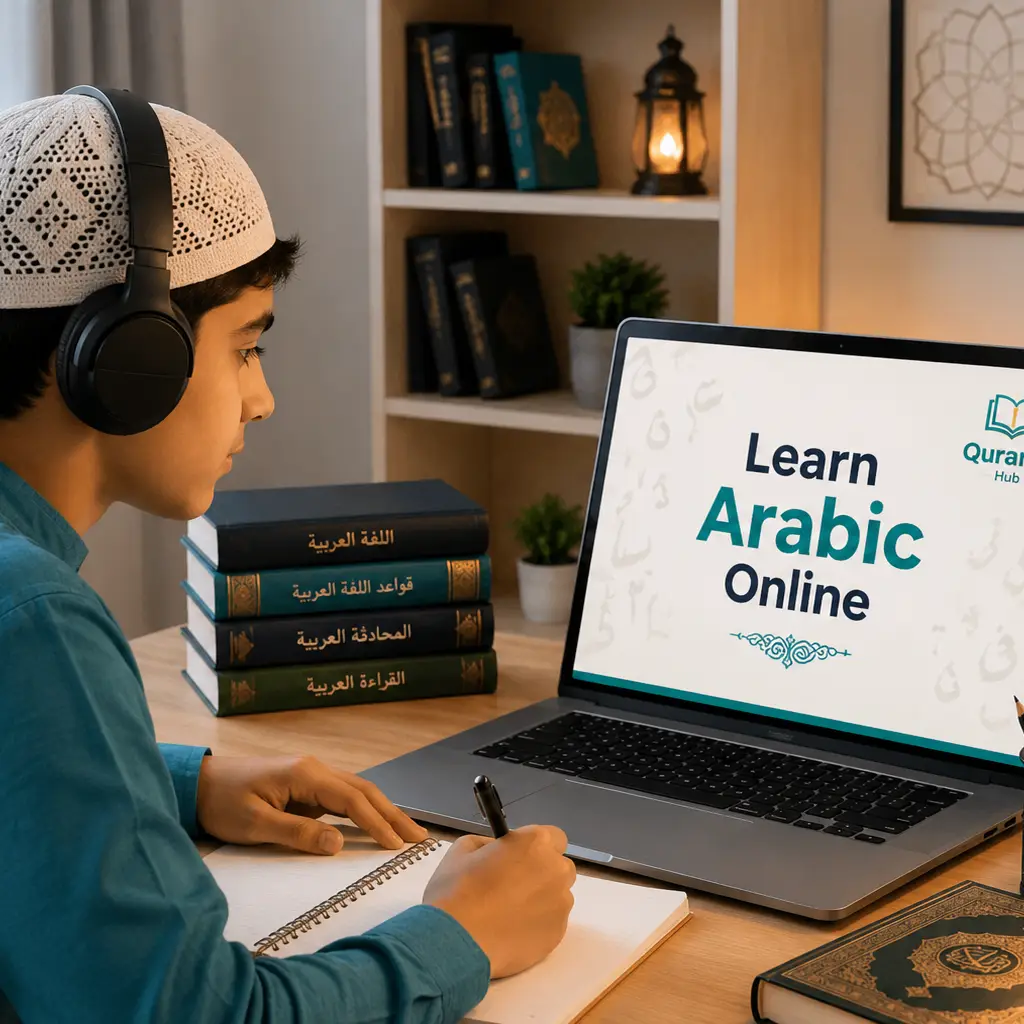
Noorani Qaida course

Beginner

Noorani Qaida

Start from the very first letter with a structured, one-on-one Qaida foundation.

Learn More
Quran Reading with Tajweed course

Intermediate

Quran Reading with Tajweed

Recite the Quran correctly, one-on-one with an Ijazah-certified tutor.

Learn More
Advanced Tajweed course

Advanced

Advanced Tajweed

Refine recitation further with advanced Tajweed rules and correction.

Learn More
Hifz (Quran Memorization) course

Advanced

Hifz (Quran Memorization)

Structured daily revision (sabaq, sabqi, manzil) built around your pace.

Learn More
Tafseer course

Intermediate

Tafseer

Understand the meaning of the Quran directly with a tutor, not just recitation.

Learn More
Quranic Arabic course

Beginner

Quranic Arabic

Understand the Quran’s own language directly, not just recite it.

Learn More
Alim & Aalimah Course course

Scholar Track

Alim & Aalimah Course

A structured path to becoming a certified Islamic scholar: Quran, Fiqh, Hadith and Arabic.

Learn More

Also Available in Germany

Book Your Free Trial Class

See for yourself before you commit to a plan. Book a free trial class with an Ijazah-certified tutor, matched to your child’s or your own age, level and preferred schedule.

Frequently Asked Questions

Is online Quran learning safe for my child in Cologne?

Yes — every class is one-on-one over video with a vetted, Ijazah-certified tutor, and a parent can stay nearby throughout the session.

Can my child start with Noorani Qaida if they’ve never read Arabic before?

Yes — Noorani Qaida is specifically the starting point for complete beginners, teaching letters and joining rules before real Quran reading begins.

Is a female Quran tutor available in Cologne?

Yes, at no extra cost — mention your preference when booking your free trial.

Do you offer Advanced Tajweed for students who already recite well?

Yes — Advanced Tajweed refines makharij and sifaat for students who’ve completed the basics.

How much do online Quran classes cost in Cologne?

€30/month for 8 classes, up to €45/month for 20 classes, one-on-one, 30 minutes each. Tafseer costs €70 a month for 12 classes, three days a week.

Is there a free trial before I have to pay?

Yes — every course starts with a free trial class, no card required.

Does the schedule adjust around German school holidays or local events like Karneval?

Yes — because each plan is rebooked around your family’s week rather than a fixed term, a school closure, holiday period or local event like Karneval doesn’t cost you a class, just a reschedule.

Boy wearing a headset attending a live online Quran class on his laptop, with his tutor visible on screen and the QuranlyHub logo

Online Quran Classes in Frankfurt

Short answer: Online Quran classes give Muslim families in Frankfurt access to live, one-on-one Ijazah-certified tutors across Noorani Qaida, Tajweed, Hifz, Tafseer and Quranic Arabic, scheduled around Frankfurt time with a free trial before any payment. Families searching for online quran classes in frankfurt will find full pricing, scheduling and trial-class details below.

Frankfurt has one of Germany’s highest Muslim population shares of any major city — estimates range from roughly 100,000 to 150,000 residents, around 15-18% of the city, served by more than 50 mosques across districts including Gallus, Griesheim and Bockenheim.

Book Your Free Trial in Frankfurt

One-to-one · Ijazah-certified tutors · No card required

Why Frankfurt Families Are Choosing an Online Quran Academy

Frankfurt’s Muslim community is spread across multiple neighbourhoods, and a well-regarded local tutor in one part of the city isn’t much use to a family living across town. Online classes remove that limit: pick a tutor by teaching style and specialism, and the class happens over video wherever in Frankfurt you live.

  • One-to-one, not group classes: full tutor attention every session, not shared among six or more students.
  • Ijazah-certified tutors: a formal chain-of-transmission certificate verifying the tutor’s own recitation.
  • Flexible scheduling: weekday evenings, weekends, or a mix, without a fixed classroom timetable.
  • A genuine free trial: a real class with the actual tutor, not a sales consultation.

What Online Quran Classes in Frankfurt Cost in 2026: The Real Range

This section puts numbers on it: what the market charges, what each plan costs per class, and why the cheapest number on a homepage is rarely the cheapest price over a year. Families who reached this page by searching online koran, the German spelling of the same lessons, will find the same euro prices below, because the academies are the same whichever spelling a parent types.

The Range, in Plain Numbers

Start with the range. The named academies on this page charge from €28 to €85 a month in euros for a one-to-one online Quran plan, and the middle of the market, where most families actually buy, sits between €35 and €68 a month for 8 to 16 classes. The point is not that one of these is right and the others are wrong. The point is that a monthly number on its own tells you almost nothing until you know how many classes it buys and how long each class lasts.

Why One Number Never Fits Every Family

Format comes first: one-to-one costs more per hour than a group class, because the tutor’s time belongs to one student, and that is the whole of the difference. Frequency comes second: eight classes a month costs less in total than twenty, but more per class, because the tutor’s time is bought in bulk. Course comes third: Noorani Qaida and basic Tajweed are usually priced the same, while Hifz and Tafseer can cost more, because Hifz needs daily revision and Tafseer needs longer preparation. Tutor experience comes fourth: a tutor who teaches several recitation styles, or who has taught for many years, may be priced higher than a new tutor. Currency and region come last: academies commonly price in US dollars, pounds or euros depending on their main audience, so the number you see may already reflect one region’s market rate, not a universal price. A family comparing two academies should compare the same format, the same frequency and the same course, or the comparison means nothing.

Online vs In-Person: Where the Money Actually Goes

An online class is usually cheaper than an in-person class for the same thirty minutes, and the reason is overhead, not quality. An in-person class pays for a room, for travel, and for a fixed hour that cannot move. An online class pays for the tutor’s time and nothing else, and the tutor can teach from anywhere, which is why a family can choose from a wider pool than the teachers in their own town. The saving is real, but it has a limit: the tutor’s time is still the cost, and a good tutor’s time is not cheap anywhere. A family that finds an online class for a fraction of every other academy’s price should ask what is being left out: the tutor’s qualification, the length of the class, or the number of students sharing it. The mosques themselves remain the centre of community life. Frankfurt has more than 50 mosques, from the DITIB Central Mosque on Münchener Strasse to the Abu Bakr Mosque, the Bilal Mosque, the Pak Darul-Islam Mosque and the Noor Mosque, which opened in 1959 as the first mosque in Frankfurt. A family that already prays at one of them does not need the online class to replace it. The online class covers the weekday teaching the mosque cannot fit in, and the mosque covers the community the screen cannot give.

Female Quran Teacher in Frankfurt

Requests for a female tutor come up often among Frankfurt families, for daughters and mothers alike. This is available at the standard price with no waiting list. Any of the seven courses can be booked one-to-one by an adult woman, at her own pace.

What Happens in Your Free Trial Class

Every plan on this page starts the same way: with one free 30-minute class, on Zoom, with a real tutor, before you pay anything. No card is taken, and nothing is charged if you decide not to continue. That is the whole of the offer, and it is worth spelling out, because a free trial is only useful if you know what to look for inside it. Here is what actually happens, minute by minute, and what to ask before the class ends.

Inside the Trial: What the Tutor Actually Does

The tutor starts by listening, not by teaching. Your child reads a few lines, usually from wherever they stopped last, and the tutor notes exactly which letters need work: the throat letters, the heavy and light sounds, and how long each madd stretches. Then the tutor teaches for about fifteen minutes, at that level, with the child reading and the tutor correcting pronunciation letter by letter. The tutor teaches in English, with Urdu support where it helps. There is no German-medium teaching, and the trial runs the same way, so a family hears exactly how the lessons will sound before paying. A parent can sit in on the whole class, and should, because the trial is your chance to judge the tutor, not just the other way round. In the last five minutes the tutor tells you plainly what level your child is at, what the next three months would look like, and which plan fits: eight classes a month for a steady start, or sixteen for a child who wants to move faster. Nothing is sold in the trial.

What Other Academies Offer Before You Pay

A free first class is now the normal way to start, and the other academies all offer something before they ask for payment. QuranlyHub’s trial is one free 30-minute class, and the plans that follow it start at €30 a month.

Four Questions to Ask Your Trial Tutor

Ask these four questions before the trial ends, and write the answers down. First, what level is my child at, and what exactly needs fixing? A good tutor names the letters, not just the level. Second, how many new lines will my child learn each day, and how much revision will there be? The answer should be a number, not a promise. Third, who will teach the paid classes, the same tutor or someone else? If the trial tutor is not the class tutor, ask to meet the class tutor before you pay. Fourth, what happens if the tutor is away or my child is ill? The answer should be a makeup class, not a lost class. If a tutor answers all four clearly, you have found a good one. If a tutor cannot answer them, the trial has done its job anyway: it has told you not to pay.

Tajweed Classes in Frankfurt

Most students in Frankfurt can already read Arabic script — what’s often missing is correction. Our Tajweed course gives live, one-to-one feedback on makharij and elongation rules that a group class or weekend school rarely has time for. See our full Tajweed course page.

Hifz Course in Frankfurt

Our online Hifz course follows a structured daily sabaq (new memorisation), sabqi (recent revision) and manzil (long-term revision) cycle, one-to-one with a dedicated Hafiz tutor — the same structure a residential programme would use, without leaving Frankfurt. See our full Hifz course page.

Quranic Arabic and Tafseer for Students in Frankfurt

Understanding the text is a common goal among Frankfurt students, not just reciting it. Our Quranic Arabic course covers the grammar for that directly; our Tafseer classes cover meaning, referencing Ibn Kathir and Al-Jalalayn.

Fitting Quran Classes Around a Frankfurt Family’s Week

Frankfurt runs on a different clock to many German cities — it’s a banking and logistics hub, home to the European Central Bank and one of Europe’s busiest airports, and a lot of parents work shift patterns tied to trading hours or airport operations rather than a standard 9-to-5. That makes a fixed weekly class time, whether at a mosque or a tuition centre, harder to commit to than it sounds. Online scheduling solves this by matching the class to the family, not the other way round: a parent on an early shift can book a late-morning slot before work; a parent working late can move a child’s class after dinner instead.

Hesse’s school holidays also run on their own dates, separate from neighbouring states, so a class schedule built for a generic “German school year” rarely lines up exactly with Frankfurt’s actual term dates. Because every plan — weekend, three, four or five days a week — is rebooked around the family’s own calendar rather than a fixed term timetable, a half-term break or a late finish at the airport doesn’t mean losing a class, just rescheduling it. All times are set and confirmed in CET/CEST, so there’s no ambiguity about when a session actually starts, something that matters more than it sounds for families juggling shift patterns against a child’s bedtime.

Pricing: What Online Quran Classes in Frankfurt Actually Cost

Tafseer costs €70 a month for 12 classes, three days a week. The following plans cover Noorani Qaida, Tajweed, Advanced Tajweed, Hifz and Quranic Arabic, with four schedules to fit a Frankfurt week:

PlanClasses / MonthSchedulePrice
Weekend Plan8 classesSat & Sun€30/month
3 Days a Week12 classesAny 3 weekdays€35/month
5 Days a Week20 classesMon to Fri€45/month

All plans include a free trial class, monthly progress reports, and a dedicated Ijazah-certified tutor. Enrolling siblings? Every additional child in the same family gets a 10% discount. See the full pricing page for the Alim & Aalimah scholar track.

What Online Quran Classes in Frankfurt Cost, in Plain Numbers

Families who found this page by searching online koran will find the same euro prices here, because the spelling changes nothing about the plans. One more thing matters as much as the price: whether your child keeps the same teacher every week, or gets whoever happens to be free. QuranlyHub keeps the same teacher, and that is the first thing worth checking before you compare prices.

QuranlyHub’ Four Plans, and What Each Class Costs

The four plans on this page are the whole price list: €30 a month for 8 classes, €35 a month for 12 classes, €40 a month for 16 classes, and €45 a month for 20 classes. Every class is 30 minutes, live and one-to-one on Zoom, with the same teacher each week. The 16-class plan at €40 a month is the most popular, and the arithmetic shows why: the 8-class plan works out at €3.75 a class, the 12-class plan at about €2.92 a class, the 16-class plan at €2.50 a class, and the 20-class plan at €2.25 a class. A second child in the same family gets a 10 percent discount on the same plans, which works out at €27 a month for 8 classes, €31.50 for 12 classes, €36 for 16 classes, and €40.50 for 20 classes. Every plan includes a free trial class first and a monthly progress report, so a parent always knows what the child has covered and what comes next. Two plans sit outside the table. Tafseer costs €70 a month for 12 classes, three days a week, taught in Urdu or English, and the difference between tarjuma and tafseer is explained in our guide. The Alim and Aalimah scholar track is priced the same way: €80 a month for 8 sessions or €100 a month for 16 sessions, with each session lasting 40 minutes. See the full pricing page for every plan in one place.

How do those prices compare? Quran In Depth charges €35 a month for two classes a week, €50 for three, €68 for four and €85 for five. AlhudaQuranTutor charges €45 a month for 12 classes, €50 for 16 and €60 for 20, which works out at €3.75 a class on the 12-class plan. eQuranSchool charges €56 a month for 20 classes, which works out at €2.80 a class. My Online Quran Tutor charges from €28 a month for 8 classes, which works out at €3.50 a class, the cheapest headline monthly price in this list. 92 Campus charges €30 a month for three days a week and €40 for five days a week, with a 20 percent sibling discount for a second or third child. Online Quran Live charges from €40 a month. Murouj Academy charges from €6 per 30-minute lesson. Tibyan charges $30 a month for 4 classes, $35 for 8, $40 for 12 and $50 for 20, with a free trial first and no registration fee. Al Tahoor charges $44.99 a month for 8 classes, $49.99 for its weekend-only plan, $54.99 for 12 and $74.99 for 20, and it gives a monthly progress report too. Al-Noor Academy charges $35 a month for 8 classes, $45 for 12 and $60 for 20. TarteeleQuran charges $39 a month for two classes a week. Elbayan charges $40 a month for 8 classes. Kanzulilm and International Quran Academy publish no price, so they cannot be compared on numbers at all. Every one of those prices is in the currency the academy charges, and none of them has been converted. On the numbers alone, QuranlyHub’s euro table sits at or below most named competitors’ entry prices, and a family in Frankfurt pays the euro figure exactly as printed, with no conversion at the bank.

How Long Each Course Takes, and What It Costs Over Time

Noorani Qaida takes 2 to 3 months on the 16-class plan, or 3 to 5 months on the 8-class plan, for a child starting from the alphabet. At the 16-class rate of €40 a month, a Qaida course works out at about €80 to €120 in total, and at the 8-class rate of €30 a month it works out at about €90 to €150. Hifz takes 2 to 2.5 years, at 7 to 8 new lines a day, with daily revision of the new lesson, the recent lessons and the older portion, the sabaq, sabqi and manzil that every Hifz student learns to manage. Children usually finish Juz Amma, the last 37 surahs of the Quran, in 2 to 3 months, and that short section is the best first test of whether a child is ready for full Hifz, which follows our step-by-step Hifz method. At the 16-class rate, two years of Hifz works out at about €960 in monthly fees, and two and a half years works out at about €1,200, which is why the per-class price matters more than the monthly headline over a long course. Quranic Arabic takes 9 to 12 months. No confirmed duration is published for Tajweed or for Tafseer, and this page does not invent one: a Tajweed student’s timeline depends on how many letters need correcting, and a Tafseer student’s timeline depends on how much of the Quran they want to study. The two best windows are the start of the school year, when the family routine is fresh, and the Christmas break, when a child has about three free weeks to build a daily practice habit before school starts again. Class times move earlier in the day during the fast, before Iftar or after Taraweeh, as they do for every family. Homework is set only for Hifz students, never for Qaida, Tajweed or Tafseer, so a parent does not need to police a worksheet every evening.

The Fine Print: Payment, Refunds and Makeup Classes

Fees are paid in advance, by bank transfer, before the month’s classes begin. A German family makes that transfer by SEPA, which is the standard way to move euros between bank accounts here. If a student leaves on their own, the advance fee is not refunded. If the teacher cannot continue, the fee is refunded. If the teacher misses a lesson, the lesson is made up at another time that suits the family. If the student misses a lesson, the lesson is not automatically made up, so tell the tutor as early as you can and ask what can be rearranged. A parent may sit in on any class, and a class may be recorded for the family to watch again, with the tutor’s agreement. The trial class itself is free, and nothing is charged until the family chooses a plan after it.

All 7 Online Quran Courses in Frankfurt, One Platform

Whichever course your family starts with, the same tutor-matching and free trial process applies across all seven, for every age from Noorani Qaida beginners to the Alim & Aalimah scholar track:

Noorani Qaida course

Beginner

Noorani Qaida

Start from the very first letter with a structured, one-on-one Qaida foundation.

Learn More
Quran Reading with Tajweed course

Intermediate

Quran Reading with Tajweed

Recite the Quran correctly, one-on-one with an Ijazah-certified tutor.

Learn More
Advanced Tajweed course

Advanced

Advanced Tajweed

Refine recitation further with advanced Tajweed rules and correction.

Learn More
Hifz (Quran Memorization) course

Advanced

Hifz (Quran Memorization)

Structured daily revision (sabaq, sabqi, manzil) built around your pace.

Learn More
Tafseer course

Intermediate

Tafseer

Understand the meaning of the Quran directly with a tutor, not just recitation.

Learn More
Quranic Arabic course

Beginner

Quranic Arabic

Understand the Quran’s own language directly, not just recite it.

Learn More
Alim & Aalimah Course course

Scholar Track

Alim & Aalimah Course

A structured path to becoming a certified Islamic scholar: Quran, Fiqh, Hadith and Arabic.

Learn More

Also Available in Germany

Book Your Free Trial Class

See for yourself before you commit to a plan. Book a free trial class with an Ijazah-certified tutor, matched to your child’s or your own age, level and preferred schedule.

Frequently Asked Questions

With so many mosques already in Frankfurt, why choose online over a local teacher?

A large local community doesn’t always mean a spot in the class or teacher you actually want. Online, one-on-one classes give your child a tutor’s full attention every session, without a wait for a place to open up.

Can I request a female Quran teacher in Frankfurt?

Yes, as a standard option at no extra cost — just ask when you book your free trial.

Do you teach Quranic Arabic for adults, not just children?

Yes — the Quranic Arabic course is open to adults and teens who want to understand the Quran directly rather than relying on translation.

What age can my child start Noorani Qaida?

Most children start between ages 4 and 7, though older beginners and adults join at any age, at their own pace.

How much do online Quran classes cost in Frankfurt?

€30 a month for 8 classes, up to €45 a month for 20 classes, one-to-one, 30 minutes each. Tafseer costs €70 a month for 12 classes, three days a week.

Is there a free trial before I pay?

Yes, every course starts with a free trial class with a real tutor.

Can classes work around shift-based or irregular work hours?

Yes — scheduling is built around your family’s actual week, not a fixed timetable, so a parent on irregular or shift hours can move sessions earlier, later, or to a different day as needed.

How We Keep Your Child Safe Online

A parent handing a child to a teacher on a screen is right to ask how that child is kept safe. This page says nothing about safeguarding at all, and this section does not invent a certificate to fill that gap. It states plainly what checks exist, what checks do not exist, and the four things a parent should do before the first paid class.

What No Online Tutor Can Show You

Every tutor at QuranlyHub is Ijazah-certified, which means a named teacher granted that tutor’s Ijazah and can be asked about it. That is a teaching certificate, not a safeguarding certificate, and the two should not be confused. In Germany, the check parents know is the erweitertes Führungszeugnis, the extended certificate of good conduct, which employers and youth-work organisations can require from people who work with children. An online tutor teaching from Pakistan cannot hold one, because no such certificate exists for an overseas tutor. The same limit applies everywhere else. In Britain, the equivalent check is an Enhanced DBS check. In Canada, it is a vulnerable sector check. In Australia, it is a working with children check. In the Netherlands, it is a VOG, a certificate of good conduct. None of those checks exists for an overseas online tutor, because each one is issued by one country for people working with children in that country, and a tutor teaching from Pakistan cannot hold a British, Canadian, Australian, Dutch or German certificate. In the United States the position is the same, only messier: there is no single national scheme at all, and background checks for people working with children are set state by state, so no federal certificate exists that an overseas online tutor can hold either. So no honest academy can show you a safeguarding certificate for an online tutor, and any academy that claims one is not telling the truth. What QuranlyHub can show you is the tutor’s identity, verified and reference-checked, the tutor’s Ijazah and the teacher who granted it, and a safeguarding contact, Adeel Ahmad, who answers for every class. If a parent wants a check beyond that, the honest answer is that the check does not exist, and the parent should judge the academy on the four checks below instead.

Four Checks Before the First Paid Class

First, sit in on the trial class, and stay for the whole 30 minutes. You will hear how the tutor speaks to your child, and your child will tell you afterwards whether they liked the lesson. Second, ask for the tutor’s full name and Ijazah details, and check that the tutor on the trial is the same teacher who will teach the paid classes. Third, ask who the safeguarding contact is and how to reach them: at QuranlyHub it is Adeel Ahmad, and the contact is given to every family before the first paid class. Fourth, agree the practical rules before you pay: the camera stays on for the child, the class is held on Zoom and not on a private call, a recording of the class is available to the family, and no lesson happens without a parent knowing the time. Those four checks cost nothing, take one trial class to run, and tell you more about an academy than any certificate on a website.

A Female Teacher for Your Daughter, at No Extra Cost

Girls and daughters learn only with a female teacher, and that should not cost extra. At QuranlyHub a female teacher is available at no extra cost, for every course on this page, from Noorani Qaida to Tafseer. The female teacher is a Hafiza, a woman who has memorised the whole Quran. A female teacher costs nothing extra, and the trial itself can be taken with that teacher, so the family meets the real tutor before paying. Our guide to finding a female Quran teacher online explains what to look for and what to ask, and it is linked here for any parent who wants to read it before booking.

Boy wearing a headset attending a live online Quran class on his laptop, with his tutor visible on screen and the QuranlyHub logo

Online Quran Classes in Berlin

Short answer: Online Quran classes give Muslim families in Berlin access to live, one-on-one Ijazah-certified tutors across Noorani Qaida, Tajweed, Hifz, Tafseer and Quranic Arabic, scheduled around Berlin time with a free trial before any payment. Families searching for online quran classes in berlin will find full pricing, scheduling and trial-class details below.

Berlin is home to a large and long-established Muslim community — an estimated 506,000 residents (around 13% of the city) have origins in Muslim-majority countries, per Deutsche Islam Konferenz 2023 figures — concentrated in districts including Neukölln, Kreuzberg, Wedding and Moabit. Even in a community this size, finding a specific tutor gender, teaching pace or evening slot locally can still mean a wait.

Book Your Free Trial in Berlin

One-to-one · Ijazah-certified tutors · No card required

Why Berlin Families Are Choosing an Online Quran Academy

Most Berlin families start by looking for a tutor within their own neighbourhood, and usually find a short, often-full list. Moving online removes that limit entirely: you select a tutor by teaching style, gender and specialism, not simply by which district you live in.

  • One-to-one, not group classes: full tutor attention every session, not shared among six or more students.
  • Ijazah-certified tutors: a formal chain-of-transmission certificate verifying the tutor’s own recitation.
  • Flexible scheduling: weekday evenings, weekends, or a mix, without a fixed classroom timetable.
  • A genuine free trial: a real class with the actual tutor, not a sales consultation.

What Online Quran Classes in Berlin Cost in 2026: The Real Range

The short answer on this page says families in Berlin can find a live, one-to-one, Ijazah-certified tutor for every course, and that is true. What it does not say is what that actually costs in euros. This section puts numbers on it: what the market charges, what each plan costs per class, and why the cheapest number on a homepage is rarely the cheapest price over a year. Families who reached this page by searching online koran, the German spelling of the same lessons, will find the same euro prices below, because Koranunterricht is just Quran teaching.

The Range, in Plain Numbers

Start with the range. The named academies on this page charge from €28 to €85 a month in euros for a one-to-one online Quran plan, and the middle of the market sits between €35 and €68 a month for 8 to 16 classes. My Online Quran Tutor starts at €28 a month for 8 classes. Quran In Depth charges €35 a month for two classes a week, €50 for three, €68 for four and €85 for five. AlhudaQuranTutor charges €45 a month for 12 classes, €50 for 16 and €60 for 20. eQuranSchool charges €56 a month for 20 classes. Online Quran Live charges from €40 a month. Murouj Academy charges from €6 per 30-minute lesson. 92 Campus charges €30 a month for three days a week and €40 for five days a week. Two academies publish no price at all: Kanzulilm asks families to request a customised monthly plan in euros over WhatsApp, and International Quran Academy will not publish a price it cannot verify. The dollar-billed academies sit alongside them: Tibyan $30 to $50 a month, Al Tahoor $44.99 to $74.99, Al-Noor Academy $35 to $60, TarteeleQuran $39 and Elbayan $40. A monthly number on its own tells you almost nothing until you know how many classes it buys and how long each class lasts. A €28 plan that buys eight classes is €3.50 a class, and a €6 lesson is €6 a class, the dearest single euro lesson in this list, even though it sounds small. QuranlyHub’s own plans run €30 to €45 a month, which works out at €3.75 a class for eight classes, €2.92 for twelve, €2.50 for sixteen and €2.25 for twenty. One more thing matters for a Berlin family: the currency. The euro is the currency a German family already uses, so a euro price is the price that leaves the bank account. A dollar price is converted by the family’s bank, at the bank’s own rate, on the day the payment is taken. QuranlyHub prices its Berlin plans in euros, €30 to €45 a month, so the number on the page is the number a Berlin family pays, with no conversion at the bank.

Why One Number Never Fits Every Family

Four things explain the range, and each one moves the price in a predictable direction. Format comes first: one-to-one costs more per hour than a group class, because the tutor’s time belongs to one student. Frequency comes second: eight classes a month costs less in total than twenty, but more per class. Course comes third: Noorani Qaida and basic Tajweed are usually priced the same, while Hifz and Tafseer can cost more, because Hifz needs daily revision and Tafseer needs longer preparation. Tutor experience comes fourth: a tutor who has taught for many years may be priced higher than a new one. A family comparing two academies should compare the same format, the same frequency and the same course. In Berlin there is one more factor: the school day is long. Since 1 August 2026 every first-grader in Germany has a legal right to all-day care of eight hours on five weekdays, including lessons, called Ganztag or Hort, so afternoons are fuller than they used to be. A child in Neukölln may be free at midday and a child in Charlottenburg only after six, and a tutor who can teach at either hour is worth more than a cheaper plan that only offers one.

Online vs In-Person: Where the Money Actually Goes

An online class is usually cheaper than an in-person class for the same thirty minutes, and the reason is overhead, not quality: an in-person class pays for a room, for travel, and for a fixed hour that cannot move, while an online class pays for the tutor’s time and nothing else. A family that finds an online class for a fraction of every other academy’s price should ask what is being left out: the tutor’s qualification, the length of the class, or the number of students sharing it. The cheapest class is not the one with the lowest monthly number. It’s the one where the child learns the most in the time paid for. Most mosque weekend schools run on fixed hours and shared classes, so the online class does the part the mosque cannot do. In Berlin the mosque picture is uneven. Neukölln has the Şehitlik Mosque, an Ottoman-style landmark, and the Dar As-Salam Mosque, Kreuzberg has the Omar Ibn Al-Khattab Mosque, and Wilmersdorf has the Ahmadiyya mosque from 1924, the oldest in the city. There are more than 80 mosques and around 90 prayer places across Berlin, yet a family in Schöneberg or Gesundbrunnen may still live far from the nearest weekend school. The online class covers the weekday teaching the mosque cannot fit in, and the mosque covers the community the screen cannot give.

Female Quran Teacher in Berlin

Requests for a female tutor come up often among Berlin families, for daughters and mothers alike. This is available at the standard price with no waiting list. Any of the seven courses can be booked one-to-one by an adult woman, at her own pace.

What Happens in Your Free Trial Class

Every plan on this page starts the same way: with one free 30-minute class, on Zoom, with a real tutor, before you pay anything. No card is taken, and nothing is charged if you decide not to continue. Here is what actually happens, minute by minute, and what to ask before the class ends.

Inside the Trial: What the Tutor Actually Does

The tutor starts by listening, not by teaching. Your child reads a few lines, usually from wherever they stopped last, and the tutor notes exactly which letters need work: the throat letters, the heavy and light sounds, and how long each madd stretches. That listening takes about five minutes. Then the tutor teaches for about fifteen minutes, at that level, with the child reading and the tutor correcting pronunciation letter by letter. The tutor teaches in English, with Urdu support where it helps. There is no German-medium teaching, and the trial runs the same way, so a family hears exactly how the lessons will sound before paying. A parent can sit in on the whole class, and should. In the last five minutes the tutor tells you plainly what level your child is at and which plan fits: eight classes a month for a steady start, or sixteen for a child who wants to move faster. Nothing is sold in the trial, and the class ends with a clear recommendation you can take away and think about. Class times are set in Berlin time, CET in winter and CEST in summer, and the tutor in Pakistan is four hours ahead in winter and three in summer, so a five o’clock lesson in Berlin is nine in the evening for the tutor in winter and eight in summer.

What Other Academies Offer Before You Pay

A free first class is now the normal way to start. Kanzulilm starts with one free 30-minute class, Quran In Depth with one free trial evaluation and no card, Al Tahoor with a free trial class booked through a form, Tibyan with a free trial class and no payment, TarteeleQuran with free trial classes, International Quran Academy with three free trial classes, Murouj Academy with one free trial class, Madani Islamic Academy with a two-day free trial, Al-Noor Academy with three free classes and no card, and Quran Focus with a one-week free trial. The differences are in what follows the free classes: Quran In Depth charges from €35 a month, Murouj from €6 a lesson, Tibyan from $30 a month, Al Tahoor from $44.99 a month, Al-Noor Academy from $35 a month, and TarteeleQuran $39 a month. Read the free offer together with the monthly price, because a free start on an expensive plan costs more over a year.

Four Questions to Ask Your Trial Tutor

Ask these four questions before the trial ends, and write the answers down. First, what level is my child at, and what exactly needs fixing? A good tutor names the letters, not just the level. Second, how many new lines will my child learn each day, and how much revision will there be? The answer should be a number, not a promise. Third, who will teach the paid classes, the same tutor or someone else? If the trial tutor is not the class tutor, ask to meet the class tutor before you pay. Fourth, what happens if the tutor is away or my child is ill? The answer should be a makeup class, not a lost class.

Tajweed Classes in Berlin

In Berlin, Tajweed classes run the same online as in person: live correction of makharij, elongation rules and details a shared class would miss. A tutor watching over video spots the same mistakes an in-person class would — with no waitlist to join. See our full Tajweed course page.

Hifz Course in Berlin

Berlin families don’t need a boarding route for Hifz. The online course runs the sabaq, sabqi and manzil cycle just as a residential programme would, tracked lesson by lesson, and timed around school hours instead of competing with them. See our full Hifz course page.

Quranic Arabic and Tafseer for Students in Berlin

Understanding the text is a common goal among Berlin students, not just reciting it. Our Quranic Arabic course covers the grammar for that directly; our Tafseer classes cover meaning, referencing Ibn Kathir and Al-Jalalayn.

Online Classes Alongside Berlin’s Weekend Qur’an Schools

Many Berlin families already know the Saturday or Sunday Qur’an course run out of a local mosque — a long-standing fixture of Turkish, Arab and Bosnian community life in districts like Neukölln and Wedding. These weekend schools do something online tutoring cannot: they put children among their own community, in their own language, with peers from the same neighbourhood. What they can’t easily do is give each child individual correction time. A typical weekend class groups ten, fifteen, sometimes twenty children of different ages and levels under one teacher for an hour or two, which means a child who mispronounces a letter might get corrected once in a session rather than every time it happens.

Online one-to-one classes work differently: the tutor hears every word a child reads, every session, and corrects it on the spot — the kind of attention a group class structurally cannot offer no matter how good the teacher is. It also removes the fixed Saturday-morning slot that competes with football training, birthday parties and family visits, replacing it with whichever evening or weekend time actually suits a Berlin family’s week. Many families we work with don’t choose one over the other — they keep the weekend class for its community and Arabic-language immersion, and add focused online sessions specifically for Tajweed correction or Hifz progress, the parts of learning that benefit most from one-to-one repetition. For a family still deciding, the honest comparison is simple: a weekend school teaches a child alongside their community; an online tutor corrects a child’s recitation, one mistake at a time.

Pricing: What Online Quran Classes in Berlin Actually Cost

Tafseer costs €70 a month for 12 classes, three days a week. The following plans cover Noorani Qaida, Tajweed, Advanced Tajweed, Hifz and Quranic Arabic, with four schedules to fit a Berlin week:

PlanClasses / MonthSchedulePrice
Weekend Plan8 classesSat & Sun€30/month
3 Days a Week12 classesAny 3 weekdays€35/month
5 Days a Week20 classesMon to Fri€45/month

All plans include a free trial class, monthly progress reports, and a dedicated Ijazah-certified tutor. Enrolling siblings? Every additional child in the same family gets a 10% discount. See the full pricing page for the Alim & Aalimah scholar track.

What Online Quran Classes in Berlin Cost, in Plain Numbers

€30 a month could mean eight classes or twenty, depending on the plan, so the pricing paragraph on this page needs translating into plain numbers. This section does that: what each plan costs per class, what a second child costs, how long each course takes, what it costs over time, and the fine print on payment, refunds and makeup classes. Families who found this page by searching online koran will find the same euro prices here, because the spelling changes nothing about the plans. One more thing matters as much as the price: whether your child keeps the same teacher every week. QuranlyHub keeps the same teacher, and that is the first thing worth checking before you compare prices.

QuranlyHub’s Four Plans, and What Each Class Costs

The four plans on this page are the whole price list: €30 a month for 8 classes, €35 a month for 12 classes, €40 a month for 16 classes, and €45 a month for 20 classes. Every class is 30 minutes, live and one-to-one on Zoom, with the same teacher each week. The 16-class plan at €40 a month is the most popular: the 8-class plan works out at €3.75 a class, the 12-class plan at about €2.92 a class, the 16-class plan at €2.50 a class, and the 20-class plan at €2.25 a class. A second child in the same family gets a 10 percent discount on the same plans: €27 a month for 8 classes, €31.50 for 12 classes, €36 for 16 classes, and €40.50 for 20 classes. Every plan includes a free trial class first and a monthly progress report, so a parent always knows what the child has covered and what comes next. Two plans sit outside the table. Tafseer costs €70 a month for 12 classes, three days a week, taught in Urdu or English, and the difference between tarjuma and tafseer is explained in our guide. The Alim and Aalimah scholar track is priced the same way: €80 a month for 8 sessions or €100 a month for 16 sessions, with each session lasting 40 minutes. That is the full price list. See the full pricing page for every plan in one place.

How do those prices compare? The closest euro plans are Quran In Depth at €35 a month for two classes a week, AlhudaQuranTutor at €45 a month for 12 classes, eQuranSchool at €56 a month for 20 classes, and My Online Quran Tutor from €28 a month for 8 classes. 92 Campus charges €30 a month for three days a week, Online Quran Live from €40 a month, and Murouj Academy from €6 a lesson. The dollar-billed academies charge Tibyan $30 to $50 a month, Al Tahoor $44.99 to $74.99, Al-Noor Academy $35 to $60, TarteeleQuran $39 and Elbayan $40, all in their own currency, none of them converted. On the numbers alone, QuranlyHub’s euro table sits at or below most named competitors’ entry prices.

How Long Each Course Takes, and What It Costs Over Time

Noorani Qaida takes 2 to 3 months on the 16-class plan, or 3 to 5 months on the 8-class plan, for a child starting from the alphabet: about €80 to €120 in total on the 16-class plan, and about €90 to €150 on the 8-class plan. Hifz takes 2 to 2.5 years, at 7 to 8 new lines a day, with daily revision of the new lesson, the recent lessons and the older portion, the sabaq, sabqi and manzil cycle, and a Hifz test every week. Children usually finish Juz Amma, the last 37 surahs of the Quran, in 2 to 3 months, the best first test of whether a child is ready for full Hifz, which follows our step-by-step Hifz method. At the 16-class rate, two years of Hifz works out at about €960 in monthly fees, and two and a half years at about €1,200. Quranic Arabic takes 9 to 12 months. No confirmed duration is published for Tajweed or for Tafseer. Inside Tafseer, the translation test comes every week too. The school year is the best guide to when to start. Berlin’s holidays for 2026-27 are 19 to 31 October (autumn), 23 December to 2 January (Christmas), 1 to 6 February (winter), 22 March to 2 April (Easter), and 1 July to 14 August (summer), with 7 May a single day without lessons and 18 to 19 May off. Good Friday falls on 26 March, Easter Sunday on 28 March and Easter Monday on 29 March. A few movable days are set by each school on its own, so a family should ask its own school. The two best windows are the start of the school year and the Christmas break. Ramadan in 2027 falls in February and March, when the days are still short: the first fast is expected on Monday 8 February, with 9 February also possible if the moon is sighted a day later, and Eid al-Fitr on Tuesday 9 March. Berlin’s winter break ends on 6 February, just before the fasts begin, and 8 March is a Berlin-only public holiday, the day before Eid. Class times move earlier in the day during the fast, before Iftar or after Taraweeh. Homework is set only for Hifz students, never for Qaida, Tajweed or Tafseer.

The Fine Print: Payment, Refunds and Makeup Classes

Fees are paid in advance, by bank transfer, before the month’s classes begin. A Berlin family makes that transfer by SEPA, the standard way to move euros between bank accounts here. If a student leaves on their own, the advance fee is not refunded. If the teacher cannot continue, the fee is refunded. If the teacher misses a lesson, the lesson is made up at another time that suits the family. If the student misses a lesson, the lesson is not automatically made up, so tell the tutor as early as you can. A parent may sit in on any class, and a class may be recorded for the family to watch again, with the tutor’s agreement. The trial class itself is free, and nothing is charged until the family chooses a plan after it.

All 7 Online Quran Courses in Berlin, One Platform

Whichever course your family starts with, the same tutor-matching and free trial process applies across all seven, for every age from Noorani Qaida beginners to the Alim & Aalimah scholar track:

Noorani Qaida course

Beginner

Noorani Qaida

Start from the very first letter with a structured, one-on-one Qaida foundation.

Learn More
Quran Reading with Tajweed course

Intermediate

Quran Reading with Tajweed

Recite the Quran correctly, one-on-one with an Ijazah-certified tutor.

Learn More
Advanced Tajweed course

Advanced

Advanced Tajweed

Refine recitation further with advanced Tajweed rules and correction.

Learn More
Hifz (Quran Memorization) course

Advanced

Hifz (Quran Memorization)

Structured daily revision (sabaq, sabqi, manzil) built around your pace.

Learn More
Tafseer course

Intermediate

Tafseer

Understand the meaning of the Quran directly with a tutor, not just recitation.

Learn More
Quranic Arabic course

Beginner

Quranic Arabic

Understand the Quran’s own language directly, not just recite it.

Learn More
Alim & Aalimah Course course

Scholar Track

Alim & Aalimah Course

A structured path to becoming a certified Islamic scholar: Quran, Fiqh, Hadith and Arabic.

Learn More

Also Available in Germany

Book Your Free Trial Class

See for yourself before you commit to a plan. Book a free trial class with an Ijazah-certified tutor, matched to your child’s or your own age, level and preferred schedule.

Frequently Asked Questions

Is there a Quran teacher near me in Berlin?

Online classes remove the need to search by neighbourhood — you get matched with a certified tutor by teaching style and specialism, live over video, wherever in Berlin you live, from Neukölln to Charlottenburg.

Are classes taught in German, English, or Arabic?

Classes are taught in English, with Urdu or Arabic support where it helps. There is no German-medium teaching.

Can I find a female Quran tutor in Berlin?

Yes, at no extra cost — just mention it when booking your free trial.

Is Hifz memorization taught online, or does my child need a local Hifz school?

Online Hifz runs the same sabaq-sabqi-manzil cycle a Berlin Hifz school would, one-to-one with a dedicated Hafiz tutor.

How much do online Quran classes cost in Berlin?

€30 a month for 8 classes, up to €45 a month for 20 classes, one-to-one, 30 minutes each. Tafseer costs €70 a month for 12 classes, three days a week.

Is there a free trial before I pay?

Yes — every course starts with a free trial class with a real tutor, no card required.

Should I replace my child’s weekend mosque class with online classes?

Not necessarily — many Berlin families keep their weekend class for community and add one-to-one online sessions specifically for Tajweed correction or Hifz progress, where individual attention matters most.

How We Keep Your Child Safe Online

A parent who hands a child to an online tutor is trusting a stranger on a screen. This section says what QuranlyHub does, what it cannot show, and what a parent can check before the first paid class.

What No Online Tutor Can Show You

An Ijazah is a teaching certificate. It says the tutor’s own recitation was checked, and it names the teacher who checked it. It says nothing about whether that tutor is safe to teach a child alone on a video call. In Germany, the check parents know is the erweitertes Führungszeugnis, the extended certificate of good conduct, which employers and youth-work organisations can require from people who work with children. An online tutor teaching from Pakistan cannot hold one, because no such certificate exists for an overseas tutor. The same limit applies everywhere else: the UK’s Enhanced DBS check, Canada’s vulnerable sector check, Australia’s working with children check, the Netherlands’ VOG, and in the USA the checks are set state by state. No honest academy can show a safeguarding certificate for an online tutor, because no country issues one to a teacher working from another country. What QuranlyHub can show is this: every tutor is identity-verified and reference-checked, every tutor’s Ijazah names the teacher who granted it, and the safeguarding contact is Adeel Ahmad.

Four Checks Before the First Paid Class

Four checks take ten minutes. First, ask for the tutor’s Ijazah and the name of the teacher who granted it. Second, sit in on the free trial class and watch how the tutor speaks to your child. Third, ask who the safeguarding contact is and how to reach them: the answer should be a name and a number, not a form. Fourth, ask what happens if the teacher is ill or away. A family that has done all four has done more than any certificate could do, because a certificate says nothing about how a tutor treats a child, and the trial shows it.

A Female Teacher for Your Daughter, at No Extra Cost

A female teacher is available for daughters and mothers alike, at no extra cost, and any of the seven courses can be booked one-to-one with her. For an adult sister, the camera is optional, and the class can run on voice only. A parent who wants a female teacher should say so when booking the free trial. For more on how that works, see the guide to female Quran teachers online.

Boy wearing a headset attending a live online Quran class on his laptop, with his tutor visible on screen and the QuranlyHub logo

Is Online Quran Classes Safe for Kids? A US Parent’s Complete Guide

Short answer: Yes, online Quran classes can be safe for kids — but only with a provider that’s specific about how: one-on-one only (never group video calls with strangers), an identity-verified and reference-checked tutor, sessions a parent can sit in on or have recorded, and a real free trial before you pay. QuranlyHub runs on exactly this model, with a female tutor option for daughters, from $30/month.

If you searched something like “is online Quran classes safe for kids” or “how do I know a Quran teacher is actually qualified,” you’re asking the right question — and most providers answer it badly. Nearly every academy’s website says some version of “certified and background-checked teachers” and stops there, with no detail on what that actually means. This guide answers the specific questions US parents ask before trusting anyone with their child: safety mechanics, what “Ijazah-certified” really means, female-tutor availability, age to start, what actually happens in a trial class, real pricing, and how online compares to a local mosque program.

Book a Free Trial Class for Your Child

One-to-one · Ijazah-certified tutors · No card required

Is It Actually Safe? What to Check Before You Trust Anyone With Your Child

“Certified and background-checked” is the single most repeated phrase across online Quran academies — and the least specific. Here’s what actually matters, and what QuranlyHub does about each one:

  • One-on-one only, never a group call with a stranger: every class is a private session between your child and their assigned tutor — not a shared classroom link.
  • Identity-verified and reference-checked before teaching a single lesson: a tutor doesn’t get matched with a student until this is done, not after.
  • You can be visible in the session, and lessons can be recorded on request: nothing about the class needs to happen somewhere you can’t see.
  • No direct, unsupervised contact channel between tutor and child: scheduling and communication run through you, the parent, via WhatsApp — not a side chat between your child and their tutor.
  • A genuine free trial first: you meet the actual assigned tutor in a real class before paying anything, not a sales call with someone else.

If a provider can’t tell you specifically what “background-checked” involves, that’s worth asking about directly before you enrol — for any academy, not just this one.

What Does “Ijazah-Certified” Actually Mean?

Almost every academy uses the word “Ijazah” as a badge without explaining it. An Ijazah is a formal certification of authorization: a teacher receives it from their own teacher only after reciting the Quran to them accurately, verse by verse, and being personally certified competent to teach it onward. It’s a traceable chain of transmission, teacher to teacher, back through history — not a diploma from a course, and not something a self-taught reciter can simply claim. Being able to recite the Quran well doesn’t automatically make someone able to teach it correctly to a child; an Ijazah is specifically what verifies both.

Can I Request a Female Teacher for My Daughter?

Yes — a female tutor is available as a standard option for daughters, at no extra cost and with no separate waiting list. If you’d prefer your son learn from a female tutor at a young age too, or a male tutor for either child, just say so when you book your free trial. This is a direct choice you make, not something left to whoever happens to be free.

What Age Should My Child Start?

There’s no single correct age, and any provider claiming otherwise is oversimplifying a genuinely open question. Informal exposure — short surahs, the word “Allah,” simple duas — can start as early as a parent likes. Formal, structured learning (Noorani Qaida, reading the Arabic letters) usually works best once a child can sit through a focused 20-30 minute activity, which for most children lands somewhere between ages 4 and 7. An older child or teenager starting from zero isn’t behind — pace is set individually either way, and sessions for younger children (roughly ages 4-8) run shorter than sessions for older kids and adults.

What Actually Happens in the Free Trial Class?

Most academies mention a “free trial” without explaining it. Here’s exactly how it works: message us on WhatsApp with your child’s age and current level, and we’ll arrange a time. The trial is a real class with a real tutor — not a sales call — over video (Zoom, Skype, Google Meet or WhatsApp video, whichever suits your family), where the tutor assesses your child’s current level and you get a feel for their teaching style before committing to anything. No card is required or stored to book it, and there’s no obligation to continue afterward.

What If My Child and Their Tutor Aren’t a Good Fit?

It happens, and it’s not something to just live with. Message us on WhatsApp and we’ll match your child with a different tutor — teaching style, pace and personality matter for a child staying engaged, and there’s no reason to force a mismatch through an entire course.

Real Pricing: What You Actually Pay

Most academies show one number with little explanation of what it includes. Here’s the full breakdown — every plan is one-on-one, not shared, with a dedicated Ijazah-certified tutor:

PlanClasses / MonthSchedulePrice
Weekend Plan8 classesSat & Sun$30/month
3 Days a Week12 classesAny 3 weekdays$35/month
5 Days a Week20 classesMon to Fri$45/month

Sessions run 30 minutes for most courses; Hifz and the Alim & Aalimah scholar track use a 40-minute session at a higher rate — message us on WhatsApp to confirm that figure. Younger children (roughly ages 4-8) are matched to shorter, age-appropriate session lengths within these plans. Every plan is billed monthly with no long-term contract, includes a free trial class, weekly progress updates, and the same dedicated tutor throughout — not a rotating roster. Enrolling more than one child from the same family gets each additional sibling a 10% discount. See the full pricing page for every course and country.

Online Quran Classes vs. a Local Mosque or Weekend School

This is a genuine trade-off, not a one-sided sales pitch. A local mosque or weekend Islamic school gives your child a peer group — the social benefit of not being “the only Muslim kid” — which online one-on-one classes can’t replicate. But most weekend programs run just one or two hours a week, in a shared class of a dozen or more children with one teacher’s attention split between them, at a fixed time that doesn’t move for anyone. Online, one-on-one classes flip that: your child gets a tutor’s full attention every session, scheduled around your family’s actual week, with real progress you can track — at the cost of that in-person peer community. Many families end up doing both: mosque for community, online for the individual attention and pace a group class can’t give.

My Child Gets Bored or Doesn’t Understand the Arabic — What Then?

This is one of the most common reasons kids disengage from Quran learning: memorizing or reciting Arabic sounds with no idea what any of it means. It’s also rarely addressed by academies focused purely on recitation speed. QuranlyHub’s Tafseer course exists specifically for this — explaining what a verse actually means, in English or Urdu, alongside (not instead of) correct Tajweed recitation, so a child’s Quran learning connects to something they understand rather than pure repetition. For younger children specifically, tutors build in short story-based explanations of the prophets and simple context around what’s being recited, rather than pure drill.

All 7 Courses, One Platform

Whichever course your child starts with, the same tutor-matching, free trial and one-on-one format applies across all seven, from complete beginners through to the Alim & Aalimah scholar track for older teens and adults:

Noorani Qaida course

Beginner

Noorani Qaida

Start from the very first letter with a structured, one-on-one Qaida foundation.

Learn More
Quran Reading with Tajweed course

Intermediate

Quran Reading with Tajweed

Recite the Quran correctly, one-on-one with an Ijazah-certified tutor.

Learn More
Advanced Tajweed course

Advanced

Advanced Tajweed

Refine recitation further with advanced Tajweed rules and correction.

Learn More
Hifz (Quran Memorization) course

Advanced

Hifz (Quran Memorization)

Structured daily revision (sabaq, sabqi, manzil) built around your pace.

Learn More
Tafseer course

Intermediate

Tafseer

Understand the meaning of the Quran directly with a tutor, not just recitation.

Learn More
Quranic Arabic course

Beginner

Quranic Arabic

Understand the Quran’s own language directly, not just recite it.

Learn More
Alim & Aalimah Course course

Scholar Track

Alim & Aalimah Course

A structured path to becoming a certified Islamic scholar: Quran, Fiqh, Hadith and Arabic.

Learn More

How to Enrol

  1. Message us on WhatsApp with your child’s age, current level and preferred days — and your tutor gender preference if you have one.
  2. Take a free trial class with the actual tutor who’d teach your child — no card, no obligation.
  3. Confirm your plan and start regular weekly classes with the same tutor each time.

More on Quran Classes for Kids

This guide focuses on safety, trust and choosing the right provider. For other angles, see our guides on what to expect at every age, trial classes and fees in more detail, keeping kids motivated, classes for special needs children, and our full USA city-by-city guide.

Frequently Asked Questions

Is it safe for my child to be alone on a video call with a Quran teacher?

Every class is one-on-one with an identity-verified, reference-checked tutor, and you’re welcome to be visible in the session throughout. Lessons can also be recorded on request, and all scheduling runs through you via WhatsApp, not a private channel between tutor and child.

What does “background-checked” actually mean here?

Tutors are identity-verified and reference-checked before they’re matched with any student — not after a complaint. If you want more detail on a specific tutor before your child’s trial, just ask on WhatsApp.

What is an Ijazah, and why does it matter?

An Ijazah is a formal authorization to teach, given by a teacher to a student only after verifying their recitation is accurate — a traceable chain of transmission, not a course certificate. It’s what separates someone who can recite well from someone qualified to teach a child correctly.

Can I request a female teacher for my daughter?

Yes, as a standard option at no extra cost and no waiting list — just mention it when you book your free trial. The same applies if you’d prefer a male tutor.

What age should my child start learning Quran?

There’s no single right age. Informal exposure can start anytime; structured lessons like Noorani Qaida usually work best from around age 4-7, once a child can sit through a focused 20-30 minutes. Older children and teenage beginners start from zero at their own pace too.

What actually happens in the free trial class?

It’s a real class with the tutor who would actually teach your child, not a sales call — they assess your child’s level and you see their teaching style firsthand. No card is required or stored, and there’s no obligation to continue.

How much do online Quran classes for kids actually cost?

From $30/month for 8 classes (weekends only) up to $45/month for 20 classes (Monday to Friday), 30 minutes each, one-on-one. Hifz and Alim & Aalimah use a longer 40-minute session at a different rate. A 10% discount applies for each additional sibling. Tafseer costs USD 60/month for 8 classes (2 per week) or USD 100/month for 16 classes.

Is there a long-term contract?

No — plans are billed monthly, and you can adjust or stop anytime by messaging us on WhatsApp.

What if my child and their assigned tutor aren’t a good fit?

Message us and we’ll match your child with a different tutor. Pace, personality and teaching style all affect whether a child stays engaged, so a mismatch isn’t something to just push through.

My child gets bored or doesn’t understand the Arabic — is that normal?

It’s a very common reason kids disengage, and it’s usually a sign recitation isn’t being connected to meaning. Our Tafseer course and story-based explanations for younger children address this directly, alongside correct Tajweed.

Online classes vs. our local mosque program — which is better?

They serve different needs. Mosque programs offer a peer community online can’t match; online one-on-one classes offer a tutor’s full attention and a schedule that fits your week, which a fixed group class often can’t. Many families use both.

What platform are classes taught on?

Whichever works for your family — Zoom, Skype, Google Meet or WhatsApp video. No special software purchase is required.

Is a female Quran teacher available, or only male tutors?

Both are available as a standard choice — you pick when you book your free trial, at no extra cost either way.

Do you teach kids outside a specific US city or state?

Yes — classes run live over video, so families anywhere in the USA get the same tutor options, pricing and scheduling. See our full USA city-by-city guide if you’re comparing local options too.

Boy wearing a headset attending a live online Quran class on his laptop, with his tutor visible on screen and the QuranlyHub logo

Online Quran Classes in Paris

Short answer: Online Quran classes give Muslim families across Paris and the wider Île-de-France region access to live, one-on-one Ijazah-certified tutors – Noorani Qaida, Tajweed, Hifz, Tafseer and Quranic Arabic – scheduled around Paris time, with a free trial before any payment. Families searching for online quran classes in paris will find full pricing, scheduling and trial-class details below.

Île-de-France is home to the largest concentration of Muslims in France – an estimated 35% of the country’s Muslim population, per France’s own Ministry of the Interior estimates, with Paris itself around 10-15% Muslim (roughly 220,000 people in the city proper). Even in a city this size, finding a specific tutor gender, teaching pace or evening slot locally can still mean a wait, especially outside the most established communities in Seine-Saint-Denis and the northern arrondissements.

Book Your Free Trial in Paris

One-to-one · Ijazah-certified tutors · No card required

Paris’ Muslim Community: What’s Actually Known

Estimates put Paris and Île-de-France home to roughly a third of France’s entire Muslim population, concentrated across Seine-Saint-Denis, the 18th, 19th and 20th arrondissements, and neighbouring suburbs like Aubervilliers and Saint-Denis. Because France does not collect religion data in its census, exact figures vary by source – but every estimate agrees Paris has the country’s largest and most established Muslim community.

The Paris Background-Check Question: What an Honest Answer Sounds Like

Paris families ask about the teacher before they ask about the price. That’s the right order. A parent handing a child to a stranger on a screen wants to know one thing first: has anyone checked this person? In France the question has a specific shape, because France has its own system for people who work with children. Here is what that system is, what it covers, and what it cannot cover for a family booking online Quran classes in Paris.

France Has a Real System. It Does Not Cover an Overseas Tutor

Since 1 October 2025, France requires a certificate of good repute, an attestation d’honorabilité, from professionals and volunteers who work with children in early-childhood care and child protection. The certificate checks the person’s criminal record, bulletin n°2 of the casier judiciaire, and the FIJAISV register of sexual and violent offenders. It must be less than six months old, and it is requested online through the French government’s own portal. A parent in Paris is right to ask about it. It’s a serious system, and it exists for a reason.

Here is the honest limit. The attestation is issued through French authorities for people working with children in France. An overseas tutor teaching from Pakistan cannot hold one, and no online academy should pretend otherwise. France also keeps its criminal record extracts tight: bulletin n°3 goes to the person only, and an employer cannot demand bulletin n°1 or n°2. So when an online academy tells a Paris parent its tutors are ‘French background-checked’, ask which document that means. There is no French certificate an overseas online tutor can hold.

What QuranlyHub Actually Checks

What we do check, we can say plainly. Every QuranlyHub teacher is identity-verified and reference-checked before they take a class. That means the academy has confirmed the person behind the name and spoken to people who have seen them teach. It’s not a French certificate, and it’s not presented as one. It is the check an online academy can actually run on a teacher who lives outside France, and it is the check a parent can ask about by name.

The second check costs nothing and tells you the most. Ask who granted the teacher’s Ijazah, in which recitation, and when. A genuine Ijazah names a teacher and a chain of teachers, a sanad, going back to the Prophet, peace be upon him, and the tutor should be able to explain it without reaching for a website. Hafs from Asim is the recitation most families in Paris will hear. If an academy answers ‘yes, certified’ and nothing more, that is not an answer. It is a deflection.

Four Things a Parent Can Check in the First Week

Paperwork is one thing. What a parent can see with their own eyes is another. At QuranlyHub a parent can sit in on any lesson and hear everything for themselves. Lessons can be recorded. There is no private teacher-child contact outside the official channel: lessons, scheduling and progress reports all run through the academy, where a parent can see them. And the safeguarding contact is Adeel Ahmad, who answers families directly. Those four facts are worth more than any badge on a website, because a parent can check every one of them in the first week.

One more check matters for daughters and sisters. Girls learn only with a female teacher, at no extra cost, and an adult sister can keep her camera off for the whole lesson and still be taught properly, because the teacher hears her recite and corrects what she hears. If you want the full picture of how that works, our guide to finding a female Quran teacher online sets out the same questions from the family’s side.

Why Paris Families Choose Online Quran Classes in Paris

Most Paris families start by looking for a tutor near their own arrondissement or suburb, and usually find a short, often-full list – or a shared mosque class on a fixed weekly slot. Moving online removes that limit entirely: you select a tutor by teaching style, gender and specialism, not simply by which RER line you’re on.

  • One-to-one, not group classes: full tutor attention every session, not shared among a crowded weekend class.
  • Ijazah-certified tutors: a formal chain-of-transmission certificate verifying the tutor’s own recitation.
  • Flexible scheduling: weekday evenings, weekends, or a mix, without a fixed classroom timetable.
  • A genuine free trial: a real class with the actual tutor, not a sales consultation.

Quran Classes for Ladies and a Female Quran Teacher in Paris

Requests for a female tutor come up often among Paris families, for daughters and mothers alike. This is straightforward online, at the standard price with no waiting list. Any of the seven courses can be booked one-to-one by an adult woman, at her own pace.

Tajweed Classes in Paris: Learn Tajweed Online with a Qualified Teacher

In Paris, Tajweed classes run the same online as in person: live correction of makharij, elongation rules and details a mosque group class rarely has time to cover individually. See our full Tajweed course page.

Hifz Course in Paris: Memorize the Quran Online at Your Own Pace

Paris families don’t need a boarding route for Hifz. Our online Hifz course runs the sabaq, sabqi and manzil cycle one-to-one with a dedicated Hafiz tutor, timed around French school hours instead of competing with them.

Quranic Arabic and Tafseer for Students in Paris

Understanding the text is a common goal among Paris students, not just reciting it. Our Quranic Arabic course covers the grammar for that directly; Tafseer classes cover meaning, referencing Ibn Kathir and Al-Jalalayn, in Urdu or English.

From Qaida to Hifz: Which Course Fits Which Student in Paris

A seven-year-old in the 18th arrondissement and a mother of forty in Créteil do not need the same course, even when both type online Quran classes in Paris into the same search box. The teacher is the same kind of teacher. The path is not. Here is how the courses actually run for children and for adults, with the honest time each step takes.

Starting from Zero: Noorani Qaida in Two to Five Months

Most children start with Noorani Qaida. It teaches the letters, the harakat and the joined forms a child needs before she can read a page. On the 16-class plan most children finish in two to three months; on the 8-class plan it takes three to five. A child can start from age four, and the class is always one to one, so a shy child never has to read aloud in front of a group.

The teacher follows the same Qaida Sheikh Noor Muhammad Haqqani wrote, lesson by lesson, and a parent gets a monthly progress report so they can see which lesson their child is on. There is no exam to pass before the next step. When the child can read a page cleanly, the teacher moves them on to Nazra, reading the Quran itself.

The Hifz Path: Sabaq, Sabqi and Manzil

Hifz takes two to two and a half years at seven to eight new lines a day, and the daily routine is what makes it work: sabaq is the new lesson, sabqi is the recent revision, and manzil is the old revision that keeps the earlier Juz strong. The teacher sets the new lines, listens to the revision, and tells the parent where the child stands. That routine fits a French school week better than a group class does. The class time moves when the school timetable moves, and the teacher can pause the new lesson during exams and catch up in the holidays.

An adult doing Hifz alongside work and family usually takes three to five new lines a session, not a page, and revises them through the week. That pace is slow and it is honest, and it is how working adults actually finish a Juz. A student who is struggling with a page is not a slow student. She is a student who needs a smaller page. Our guide on how to memorize a page of the Quran when it is hard shows the same method our teachers use: break the page, repeat it aloud, and leave the last line for the next morning.

Tajweed, Tafseer and Arabic for Older Students

After Qaida, the question is what the student needs next, and the answer is different at eight than at thirty. A younger child usually goes into Tajweed, learning the rules that make recitation sound right: where each letter comes from, how long to hold a madd, when to hide a noon and when to say it clearly. An older student who can already read is usually ready for Tafseer, where the class works through the meaning of the verses with Tafsir Ibn Kathir and Tafsir al-Jalalayn.

Quranic Arabic sits between the two. It teaches the vocabulary and grammar a reader needs to follow the text without a translation, and most students need nine to twelve months to get there. There’s no fixed finish date for Tajweed or Tafseer, because the goal isn’t a certificate. The goal is a child who can open the Quran and read it right, and an adult who can open it and understand what they are reading.

Online Quran Classes in Paris: Pricing and What You Actually Pay

Tafseer costs USD 70 a month for 12 classes, three days a week. The following plans cover Noorani Qaida, Tajweed, Advanced Tajweed, Hifz and Quranic Arabic, with four schedules to fit around a Paris work and school week:

PlanClasses / MonthSchedulePrice
Weekend Plan8 classesSat & Sun$30/month
3 Days a Week12 classesAny 3 weekdays$35/month
5 Days a Week20 classesMon to Fri$45/month

All plans include a free trial class, weekly progress updates, and a dedicated Ijazah-certified tutor. Enrolling siblings? Every additional child in the same family gets a 10% discount. See the full pricing page for the Alim & Aalimah scholar track.

What Quran Classes Cost in Paris, and What the Price Should Include

The first question most Paris families ask about online Quran classes in Paris is what they cost. The second question is what the monthly fee actually buys, and that one deserves a straight answer. Here is the market, the academy’s own prices, and the fine print that matters more than either.

The Market in 2026: What Other Academies Publish

Before you compare prices, know what the market actually charges. My Online Quran Tutor publishes €28 a month for eight classes, €37 for twelve, €42 for sixteen and €46 for twenty, in euros, for families in France. Quran In Depth publishes from €35 a month for its Europe plans, with a published range of €32 to €85. Al-Noor Academy publishes $35 a month for eight classes, $45 for twelve and $60 for twenty, with euros accepted. Quran Pak Teacher publishes €30 a month in Europe for twenty classes. Online Quran Ilm Academy publishes €40, €45, €55 and €60 a month in euros for eight, twelve, sixteen and twenty classes. Those are the academies’ own published figures, and they change, so check the page before you decide.

The spread tells you what to look for. A low price usually means fewer classes a week, not a cheaper teacher. A high price usually means longer classes or more days, not a better one. So what should you actually compare? How many classes, how long each one is, whether the teacher is the same every week, and what happens when a class is missed. If you want the same decision made on price grounds instead of learning grounds, our guide on how much online Quran classes cost lays out the same questions from the price side.

What $30 and $40 Actually Buy at QuranlyHub

Our standard plan is $30 a month for eight classes, two a week, or $40 a month for sixteen classes, four a week. Every class is thirty minutes, one to one, live on Zoom. A female teacher costs nothing extra. A second child in the same family gets a 10% discount, and there is no registration fee. Every plan starts with a free trial class, and there is no card taken at the trial. Two classes a week is the realistic starting point for most families. Four a week is for the weeks when school is quiet, and you can step up or down at the end of any month.

Tafseer is different. Tafseer costs USD 70 a month for 12 classes, three days a week, because the lessons run longer than a standard thirty-minute class and the class works through the meaning of the verses, not just the reading. If you can already read and want to understand what you recite, Tafseer is the course that fits an adult best. If you are still learning to read, start with Tajweed and move to Tafseer when the reading is solid.

The Fine Print That Matters More Than the Price

Read the fine print before you read the price, because it decides what happens when life gets in the way. At QuranlyHub fees are paid by bank transfer in advance for the month, and the fee covers the month ahead, not the month behind. If a student leaves on their own, the advance fee is not refunded. If a teacher cannot continue, the family is refunded. If the teacher misses a lesson, the family gets a makeup class. A lesson the student misses is not made up, so the class time is worth guarding.

There is no contract and no notice period. A family can stop at the end of any month, and the trial class is free with no payment and no obligation. That’s the whole agreement, and it’s the same for every family. Over a year of classes, those terms matter more than a five-dollar difference in the monthly fee. A cheap plan with no makeup policy costs more in lost lessons than a fair plan that keeps the thread alive.

All 7 Courses, One Platform

Whichever course your family starts with, the same tutor-matching and free trial process applies across all seven, for every age from Noorani Qaida beginners to the Alim & Aalimah scholar track:

Noorani Qaida course

Beginner

Noorani Qaida

Start from the very first letter with a structured, one-on-one Qaida foundation.

Learn More
Quran Reading with Tajweed course

Intermediate

Quran Reading with Tajweed

Recite the Quran correctly, one-on-one with an Ijazah-certified tutor.

Learn More
Advanced Tajweed course

Advanced

Advanced Tajweed

Refine recitation further with advanced Tajweed rules and correction.

Learn More
Hifz (Quran Memorization) course

Advanced

Hifz (Quran Memorization)

Structured daily revision (sabaq, sabqi, manzil) built around your pace.

Learn More
Tafseer course

Intermediate

Tafseer

Understand the meaning of the Quran directly with a tutor, in Urdu or English.

Learn More
Quranic Arabic course

Beginner

Quranic Arabic

Understand the Quran’s own language directly, not just recite it.

Learn More
Alim & Aalimah Course course

Scholar Track

Alim & Aalimah Course

A structured path to becoming a certified Islamic scholar: Quran, Fiqh, Hadith and Arabic.

Learn More

The Paris Clock and the School Year: When Classes Actually Happen

A class time only works if it fits the Paris day, not the tutor’s day. Online Quran classes in Paris run on Paris time, and Paris time has two quirks a family should know before booking: the clocks change twice a year, and the school year runs on a Zone C calendar that most newcomers have never seen. Here is how both work, and where the class slots actually sit.

CET, CEST and the Four-Hour Gap to Pakistan

Paris runs on CET, Central European Time, UTC+1, in winter, and CEST, UTC+2, in summer, when the clocks go forward on the last Sunday in March and back on the last Sunday in October. Pakistan stays on PKT, UTC+5, all year and never changes its clocks. That puts Pakistan four hours ahead of Paris in winter and three hours ahead in summer. A 5 pm class in Paris is 9 pm in Pakistan in winter and 8 pm in summer, which is why evening slots in Paris are easy for a tutor in Pakistan to cover.

The after-school window is where most Paris classes sit: 4:30 to 7:30 pm on weekdays, and weekend mornings for families who want the week clear. Friday prayer falls around midday in winter, so a Friday afternoon slot after Jumu’ah works for many families. The point is simple. Pick the slot that survives a normal school week, not the slot that looks good on a quiet Sunday.

The Zone C School Year: Holidays, Ramadan and the Long Summer

Paris schools follow the Zone C calendar set by the Ministry of Education. The 2026-27 school year started on Tuesday 1 September 2026. The breaks are the same for every Paris family: Toussaint, 17 October to 2 November 2026; Christmas, 19 December 2026 to 4 January 2027; winter, 6 to 22 February 2027; spring, 3 to 19 April 2027; and the long summer from Saturday 3 July 2027. There are no classes on Friday 7 May 2027, the Ascension bridge day. A Quran class that pauses for the school holiday and picks up again after it will outlast a class that fights the calendar.

Ramadan 2027 is expected to start on Monday 8 February, with Eid al-Fitr expected on 9 or 10 March, moon sighting deciding both dates. The winter break runs 6 to 22 February, so Ramadan will overlap with the Zone C winter holiday that year. Ramadan timing is flexible at QuranlyHub, and the Eid break is built in. If your family travels in the summer, tell the teacher before the break and agree the restart date. A planned pause keeps the thread alive. An unplanned one breaks it.

Prayer Times and the Evening Window

Prayer times shape the evening more than the clock does. On 17 November 2026, by the UOIF method, Fajr in Paris is about 6:49 am, Dhuhr about 12:36 pm, Maghrib about 5:08 pm and Isha about 6:21 pm. Methods differ, and the Grande Mosquée de Paris method gives earlier Fajr and later Isha, so treat these as about figures and follow your local mosque’s timetable. What matters for booking is the shape of the day: Maghrib just after 5 pm in mid-November means the evening opens up after that, and a 6 pm class sits cleanly between Maghrib and Isha.

In summer the shape flips. Maghrib falls late, past 9 pm in June, and the after-school window stretches long into the evening. That is when a 5 pm class works best, before the family meal and before Maghrib. If you want the thinking behind a whole-year plan, not just a single week, our online Quran learning guide lays out the same decision from the learning side.

Also Available in France

Book Your Free Trial Class

See for yourself before you commit to a plan. Book a free trial class with an Ijazah-certified tutor, matched to your child’s or your own age, level and preferred schedule.

Frequently Asked Questions

Do you have teachers based in Paris?

QuranlyHub is an online service – classes are delivered live over video rather than in person, so we can match you with a suitable tutor no matter where in Paris or Île-de-France you are.

Can classes be scheduled around Paris time?

Yes, classes are one-on-one, so timing is arranged directly with you around CET/CEST.

How much do online Quran classes cost in Paris?

It’s $30/month for 8 classes (2 a week), or $40/month for 16 classes (4 a week), one-on-one. Message us on WhatsApp with the number of weekly classes you want.

Is there a free trial before I have to pay?

Yes, a free trial class for both children and adults, with no obligation.

Can I choose a female Quran teacher?

Yes. Female teachers are available as a standard option for daughters, sisters and women learning as adults, at no extra cost.

Are classes available in French as well as English?

No – classes are not available in French. Tutors teach in Urdu and English, matched to whichever your family understands best.

With a large Muslim community already in Paris, why choose online over a local teacher?

A large local community doesn’t always mean a spot in the class or teacher you actually want. Weekend Islamic schools and mosque classes often mean many children sharing one teacher’s attention. Online, one-on-one classes give your child a teacher’s full attention every session.

Boy wearing a headset attending a live online Quran class on his laptop, with his tutor visible on screen and the QuranlyHub logo

Quran Teacher Near Me in Denmark: In-Person vs Online

Short answer: A “quran lærer i nærheden” or “quran teacher near me” search in Denmark usually turns up whoever happens to be local – not necessarily the best-qualified tutor, and rarely a female teacher available on short notice outside Copenhagen. QuranlyHub’s online classes give Danish families the same one-on-one, Ijazah-certified teaching with a wider tutor choice and no commute, from $30/month.

What “Quran Teacher Near Me” Actually Turns Up in Denmark

Denmark’s Muslim community is concentrated mainly in Copenhagen – especially Nørrebro and surrounding areas – with smaller communities in Aarhus and Odense. A quran teacher near me search outside these areas often returns very few results, and even within Copenhagen, a specific tutor gender or teaching pace can mean a real wait. Families searching for a female quran teacher near me in Denmark run into this most often.

Denmark’s Muslim population is also more varied than the Copenhagen-Aarhus-Odense pattern suggests – families trace their heritage to Turkey, Pakistan, Somalia, Lebanon, Iraq and elsewhere, often settled in specific pockets like Nørrebro, Vollsmose in Odense, or Gellerup in Aarhus. Denmark’s first purpose-built mosque, in Hvidovre just outside Copenhagen, dates back to the 1960s, and the city now has several larger mosques including the Hamad Bin Khalifa Civilisation Centre near Nørrebro. But that history and infrastructure don’t extend to families in smaller towns across Jutland or rural Zealand, where there may be no organised Quran class within a reasonable drive at all.

Copenhagen, Aarhus and Odense: Where Denmark’s Muslims Live

Denmark’s Muslim community is small by European standards and concentrated in a handful of places. Around 256,000 people in Denmark are Muslim, about 4.4 percent of the population, according to a January 2020 estimate by researcher Brian Arly Jacobsen of the University of Copenhagen, and the Danish government does not collect data on citizens’ religion, so the exact number is not known with certainty. What is certain is where they live: 47.4 percent in Greater Copenhagen, 9.4 percent in Aarhus, and 5.5 percent in Odense, and that concentration is why a ‘quran teacher near me’ search returns such different results depending on the postcode.

Copenhagen and Nørrebro: nearly half of Denmark’s Muslims

Nearly half of Denmark’s Muslims live in Greater Copenhagen, and about 150,000 of them in the city itself, most in Nørrebro and the Vestegnen, which is why Copenhagen has the most local options overall: several larger mosques including the Hamad Bin Khalifa Civilisation Centre near Nørrebro, the Grand Mosque of Copenhagen, and the country’s first purpose-built mosque in Hvidovre just outside the city, dating back to the 1960s. Yet even in Copenhagen, a specific tutor gender or teaching pace can mean a real wait, because the good tutors are booked and the female tutors have waiting lists.

Aarhus and Gellerup

Aarhus is home to 9.4 percent of Denmark’s Muslims, with the community concentrated in Gellerup, and it has fewer local options than Copenhagen but more than anywhere else in Jutland. A family in Aarhus searching for a female tutor or a specific course like Tafseer faces the same problem as a family in Copenhagen, only with a smaller pool to search in. That is why Aarhus families were among the first in Denmark to move online, and why the post already links a dedicated Denmark classes page for them.

Odense, Vollsmose and the smaller towns

Odense is home to 5.5 percent of Denmark’s Muslims, concentrated in Vollsmose, and beyond Copenhagen, Aarhus and Odense the picture changes completely: smaller towns across Jutland and rural Zealand may have no organised Quran class within a reasonable drive at all, and a family there is not choosing between a local tutor and an online one. They are choosing between an online tutor and no class at all. A class that happens over video at the kitchen table removes that trade-off entirely.

In-Person vs Online Quran Teacher: Full Comparison

FactorLocal Tutor (Denmark)Online (QuranlyHub)
Tutor choiceLimited to Copenhagen or Aarhus areaCertified male & female tutors, worldwide
SchedulingFixed around the tutor’s hoursYou choose the time
Female tutor for daughtersCan mean a wait outside major citiesReadily available
CommuteTravel across Copenhagen or between citiesNone
Getting startedDays to weeks of calls and waitingFree trial the same day

What a Quran Teacher Costs in Denmark

A private tutor in Denmark costs far more than any academy, and the price depends on where you live and how you pay. Most online academies charge in US dollars, which your bank or card converts when you pay, and a few accept Danish kroner or MobilePay on request. Denmark uses the krone, not the euro, so a price quoted in euros is already a conversion. What matters is what the price buys: one-to-one or group, thirty minutes or sixty, a certified tutor or a volunteer.

What the market charges

One Denmark-focused academy charges $35 a month for 8 classes, $45 for 12 and $60 for 20, another charges $30 to $50 a month for 4 to 20 classes, and a third charges $30 for 8 classes, $45 for 12 and $55 for 16. Other academies that serve Denmark charge $25 to $45 a month for two to five lessons a week, or $30 a month for 20 classes. The pattern is consistent: two lessons a week costs around $25 to $35 a month, three around $35 to $45, and five around $45 to $60, all one-to-one and thirty minutes, with a free trial class first.

Private tutors in Copenhagen: €26 an hour

A private tutor in Copenhagen costs far more than any academy. One marketplace lists private Quran tutors in Copenhagen from €26 an hour for a 60-minute lesson, online or at home, which is more than €200 a month for two lessons a week. That is the most expensive tutoring market in Denmark, and it is also the market with the longest waiting lists, because demand is highest where the Muslim population is largest. A Copenhagen family paying €200 a month for a private tutor is paying for the tutor’s travel time as much as for the teaching.

What $30 a month buys online

QuranlyHub charges $30 a month for 8 classes or $40 for 16, both thirty minutes, one-to-one, with a 10 percent discount for every additional child in the same family. That is little more than one hour of a Copenhagen private tutor, for a whole month of one-to-one lessons with an Ijazah-certified teacher, a female tutor if you ask for one, and a free trial class before you pay anything. The teaching is the same. The price is not.

What to Check Before You Choose a Tutor

Whether you’re comparing an islamic tutor near me or a hifz classes near me option to an online plan, ask the same questions either way: Is the tutor Ijazah-certified? Do they teach proper Tajweed rules, not just recitation? Is a free trial class offered before you commit? Is a female quran tutor near me actually available, or will you be waiting weeks?

In Denmark specifically, it’s also worth asking whether the tutor can teach comfortably in English or Danish, not only Arabic or Urdu – many Danish-born children are more confident in those languages than in their parents’ heritage language.

See our full breakdown of what a Tajweed course actually covers and our online Hifz course before deciding.

Danish Time: CET, CEST and the Pakistan Difference

Denmark runs on Central European Time in winter and Central European Summer Time in summer, and the difference matters because most online Quran tutors teach from Pakistan, where the clocks never change. A family that books a fixed Danish slot needs to know what that slot means for their tutor, and a family that books around dinner needs to know how the winter darkness changes the evening.

When Danish families actually book

Most Danish families book after school from 3 to 6 pm, or in the evening after spisetid, the early dinner around six o’clock that structures so many Danish evenings. Competitors list the same pattern, with after-school slots from 3 to 6 pm and weekend mornings. Because QuranlyHub tutors work across time zones, all three windows have availability, including weekends for families who prefer to consolidate classes around Saturday and Sunday, and the school day itself is often shorter than what families from other countries are used to, with after-school SFO care typically ending by five.

What time is it in Pakistan when Denmark learns

Denmark is on CET, one hour ahead of Greenwich, in winter, and CEST, two hours ahead, in summer, while Pakistan is five hours ahead of Greenwich all year. That puts Pakistan 4 hours ahead of Denmark in winter and 3 hours ahead in summer, so a 5 pm lesson in Denmark is 9 pm the same day in Pakistan in winter and 8 pm in summer. Your tutor adjusts to your evening. You never have to adjust to theirs.

Why Online Quran Classes Work Well for Danish Families

Denmark’s Muslim community is smaller and more spread out than in some neighbouring countries, meaning a highly-rated local tutor in Nørrebro isn’t much use to a family in Aarhus or Odense. Online classes remove that limit entirely: you pick a tutor by teaching style and specialism rather than postcode, and the class happens over video regardless of where in Denmark you live.

It also means a Turkish-heritage family in Aarhus and a Somali-heritage family in a small Jutland town aren’t stuck choosing between whichever local teacher happens to be available and no class at all – both can find a tutor who fits their language and level, scheduled around Danish term dates rather than a single fixed weekday slot.

Danish daily life adds its own scheduling pressure. Many families structure evenings around an early dinner (spisetid) around six o’clock and value protected family time afterwards, while the school day itself is often shorter than what families from other countries are used to, with after-school SFO care typically ending by five. Winter makes this sharper still – at Denmark’s latitude, the sun can set well before 4pm in December, and many Danish families get around by bicycle rather than car, making an evening trip across town for a lesson a genuinely unappealing idea in the cold and dark. A class that happens over video at the kitchen table removes that trade-off entirely, without asking a family to give up their evening routine to fit it in.

Finding a Female Quran Teacher in Denmark

The hardest tutor to find in Denmark is not the best tutor. It is the female tutor. Every ‘female quran teacher near me’ search in Denmark ends the same way: a short list, a long wait, or a tutor who is already full, and outside Copenhagen the list is shorter still. That is the single most common reason Danish families move online, and it is worth understanding why the wait exists and what to do about it.

Why female tutors have waiting lists

Female tutors have waiting lists for a simple reason: demand is highest where supply is lowest. Every family with a daughter wants a female teacher, and every adult sister wants one too, but most local tutors are men, and the women who do teach are usually booked through word of mouth before they ever advertise. A local search finds whoever is free. It does not find whoever is best, because the best female tutors are rarely free.

What to ask before you book

Before you book a female tutor, ask the same questions you would ask about any tutor, and one more. Is she Ijazah-certified? Does she teach proper Tajweed, not just recitation? Is there a free trial class with her, not with someone else? And is she actually available at your slot, or will you be waiting weeks for a free hour? If an academy cannot answer the last question with a time, it does not have a female tutor for you. It has a waiting list.

Camera-optional for adult sisters

For adult sisters, QuranlyHub keeps the camera optional. You can learn with your camera off, with a female tutor, one-to-one, and no one else in the room. That is a confirmed part of how the academy works, not a favour to ask for, and it is one of the reasons sisters who would never book a local class do book online. A daughter’s class is different: a parent can sit in on any lesson, and every lesson happens on recorded video, so the safeguarding is the same either way.

How Fast Can You Start Online Quran Classes in Denmark?

A local quran tutor at home near me search in Denmark usually means calling around and waiting for a callback before a first meeting is even arranged. For a family outside Copenhagen, Aarhus or Odense, that search can end with no real local option at all, rather than just a wait. Booking online takes minutes: pick a course, choose a free trial slot, and meet your tutor on video the same day.

See Pricing & Book a Free Trial for Denmark

Full course options, monthly plans, and scheduling built around Danish time.

Visit the Denmark Quran Classes Page →

Frequently asked questions

Is it hard to find a quran teacher near me in Denmark?

Copenhagen has the most local options overall, but outside it – in Aarhus, Odense or smaller towns – a specific tutor gender or teaching pace can mean a real wait.

Can I find a female quran tutor near me in Denmark quickly?

It depends heavily on your area. QuranlyHub has certified female tutors available for an immediate trial class regardless of where in Denmark you live.

Is online Quran learning safe for my child?

Yes – every class is one-on-one over video with an identity-verified and reference-checked, Ijazah-certified tutor, and a parent can stay nearby throughout the session.

Does online scheduling work around Danish time?

Yes – classes are scheduled to fit CET/CEST, around school, university or work commitments.

What courses are available besides Tajweed and Hifz?

Noorani Qaida, Tafseer (including translation), Quranic Arabic, Alim & Aalimah, and basic Islamic studies – all with Ijazah-certified tutors.

How is this different from your Denmark classes page?

This guide compares in-person and online options for Danish families. For pricing, course details, and to book a trial, visit the Denmark Quran classes page.

Related Reading

More on this topic: Quran classes near me vs online (general guide), Online Quran Classes in Denmark, and our Hifz course.