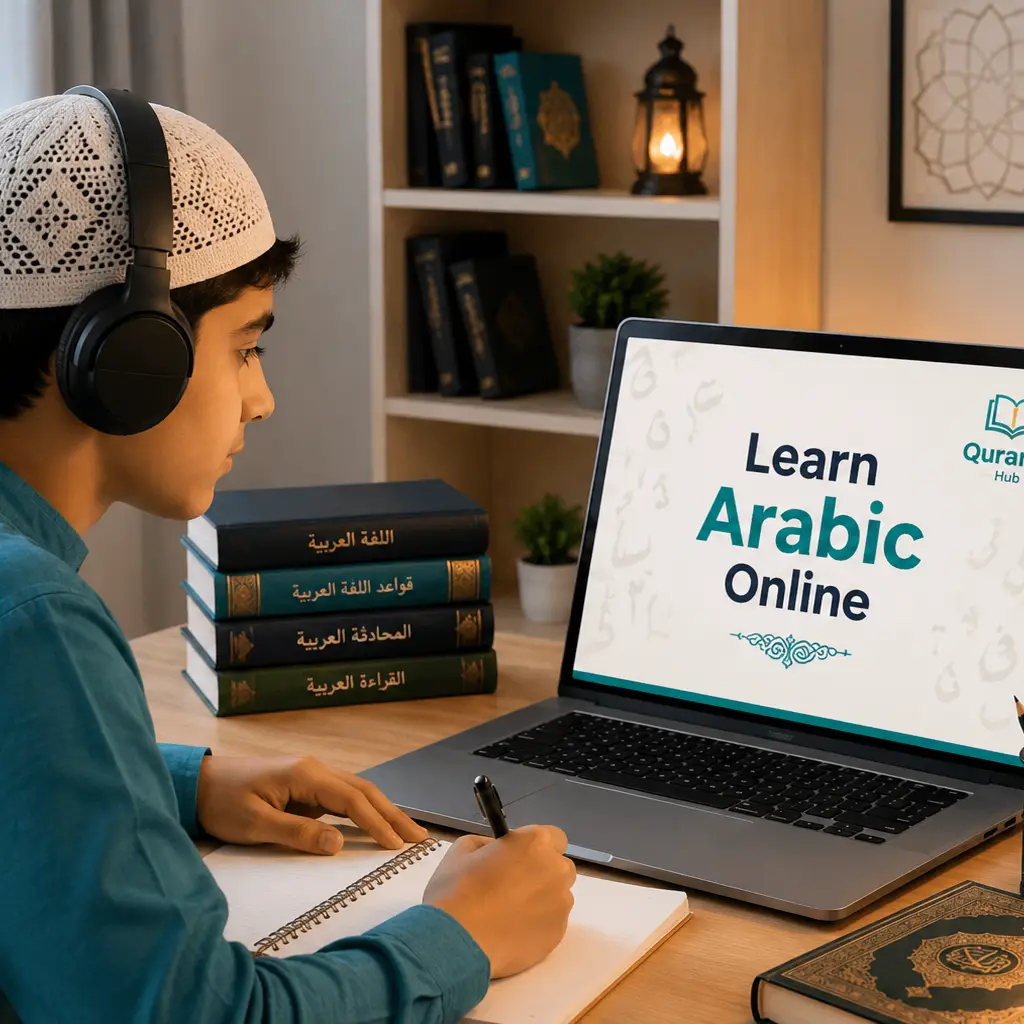
Boy wearing a headset attending a live online Quran class on his laptop, with his tutor visible on screen and the QuranlyHub logo

Online Quran Classes in Bangladesh

Short answer: Online Quran classes in Bangladesh give families in Dhaka, Chittagong, Sylhet and beyond access to live, one-on-one Ijazah-certified tutors across Noorani Qaida, Tajweed, Hifz, Tafseer and Quranic Arabic, scheduled around Bangladesh Standard Time with a free trial before any payment.

Bangladesh is home to one of the largest Muslim populations in the world – roughly 90% of its more than 170 million people, making it the fourth-largest Muslim-majority nation globally. Even with mosques and maktabs in nearly every neighbourhood, finding a specific tutor gender, teaching pace or evening time slot can still mean a wait, especially outside the biggest cities. Online Quran classes remove that limit entirely – a tutor matched to your family, on a schedule built around Dhaka time, not the other way round.

Book Your Free Trial in Bangladesh

One-to-one · Ijazah-certified tutors · No card required

Bangladesh’s Muslim Community: A Brief Picture

With around 150 million Muslims, Bangladesh has one of the largest Muslim populations of any country on earth, concentrated across Dhaka, Chittagong, Sylhet, Khulna and Rajshahi. Religious education is woven deeply into daily life through mosques, maktabs and madrasas – but a residential or fixed-timetable local option doesn’t always fit a working parent’s schedule, a specific tutor preference, or a child who needs a slower or faster pace than the rest of a group class.

Why Families in Bangladesh Are Choosing Online Quran Classes

A large local Muslim community doesn’t always translate into an easy match: a well-regarded maktab might mean a long wait, a rigid group timetable, or simply no female teacher available for a daughter. Moving online removes the postcode problem completely – a family in Sylhet or a family in Dhaka gets the exact same access to a certified tutor, chosen by teaching style and specialism rather than by whoever happens to be nearby.

  • One-to-one, not group classes: full tutor attention every session.
  • Ijazah-certified tutors: a verified chain of transmission behind their own recitation.
  • Flexible scheduling: evenings, weekends, or a mix, around Bangladesh Standard Time.
  • A genuine free trial: a real class with the actual tutor, not a sales call.

Female Quran Teacher in Bangladesh

A female tutor for a daughter, or for a mother learning as an adult, is available as standard for families in Bangladesh, with no separate waiting list and no extra charge. All seven courses can be booked one-to-one with a female tutor, at whatever pace suits the student.

Tajweed Classes in Bangladesh

Most students in Bangladesh can already read Arabic script – what’s often missing is live correction. Our Tajweed course gives one-to-one feedback on makharij and elongation rules that a shared maktab class rarely has time for.

Hifz Course in Bangladesh

Families in Bangladesh don’t need a residential madrasa for Hifz. Our online Hifz course runs the same sabaq, sabqi and manzil revision cycle a residential programme would, one-on-one, timed around school rather than replacing it.

Tafseer and Quranic Arabic for Students in Bangladesh

Beyond recitation, our Tafseer classes cover meaning and context verse by verse, referencing Ibn Kathir and Al-Jalalayn, in Bengali, Urdu or English. Quranic Arabic teaches the grammar and vocabulary to understand the text directly, for students ready to move beyond translation.

Quran Classes in Dhaka, Chittagong and Sylhet

Because every class is delivered live over video, city no longer limits which tutor a family is matched with. Families searching for an online quran academy in dhaka get the same pricing, certified-tutor matching and free trial as families in chittagong or sylhet – useful for Sylhet in particular, given how many families there have close ties to relatives in the UK.

Pricing: What You Actually Pay

Every standard course – Noorani Qaida, Tajweed, Advanced Tajweed, Hifz, Tafseer and Quranic Arabic – is priced the same, with flexible schedules to fit around a Bangladesh work and school week:

PlanClasses / MonthSchedulePrice
Weekend Plan8 classesSat & Sun$30/month
3 Days a Week12 classesAny 3 weekdays$35/month
5 Days a Week20 classesMon to Fri$45/month

All plans include a free trial class, weekly progress updates, and a dedicated Ijazah-certified tutor. Enrolling siblings? Every additional child in the same family gets a 10% discount. See the full pricing page for the Alim & Aalimah scholar track.

All 7 Courses, One Platform

Whichever course your family starts with, the same tutor-matching and free trial process applies across all seven, for every age from Noorani Qaida beginners to the Alim & Aalimah scholar track:

Noorani Qaida course

Beginner

Noorani Qaida

Start from the very first letter with a structured, one-on-one Qaida foundation.

Learn More
Quran Reading with Tajweed course

Intermediate

Quran Reading with Tajweed

Recite the Quran correctly, one-on-one with an Ijazah-certified tutor.

Learn More
Advanced Tajweed course

Advanced

Advanced Tajweed

Refine recitation further with advanced Tajweed rules and correction.

Learn More
Hifz (Quran Memorization) course

Advanced

Hifz (Quran Memorization)

Structured daily revision (sabaq, sabqi, manzil) built around your pace.

Learn More
Tafseer course

Intermediate

Tafseer

Understand the meaning of the Quran directly with a tutor, in Bengali, Urdu or English.

Learn More
Quranic Arabic course

Beginner

Quranic Arabic

Understand the Quran’s own language directly, not just recite it.

Learn More
Alim & Aalimah Course course

Scholar Track

Alim & Aalimah Course

A structured path to becoming a certified Islamic scholar: Quran, Fiqh, Hadith and Arabic.

Learn More

Book Your Free Trial Class

See for yourself before you commit to a plan. Book a free trial class with an Ijazah-certified tutor, matched to your child’s or your own age, level and preferred schedule.

Frequently Asked Questions

Is a female Quran teacher available in Bangladesh?

Yes. You can request a female tutor for daughters or for women’s classes at no extra cost when you book your free trial – no waitlist.

Can my child join a Hifz course in Bangladesh online?

Yes. An online Hifz course follows the same sabaq-sabqi-manzil revision structure as an in-person programme, with a dedicated Ijazah-certified Hifz tutor tracking memorisation one-to-one.

What times work for Bangladesh Standard Time?

Classes are scheduled around BST, including evening and weekend slots, so lessons fit around school and work rather than the other way round.

Are Tafseer classes taught in Bengali?

Yes – tutors can teach Tafseer in Bengali, Urdu or English, matched to whichever a student understands best.

Is this available outside Dhaka, in cities like Chittagong or Sylhet?

Yes – every class runs live over video, so location anywhere in Bangladesh makes no difference to tutor matching or pricing.

How much does an online Quran class cost in Bangladesh?

Plans start from $30/month for 8 classes (weekends only), up to $45/month for 20 classes (Monday to Friday), 30 minutes each. A 10% discount applies for additional siblings.

Is there a free trial before I have to pay?

Yes, every course starts with a free trial class with a real tutor, no card required.

Boy wearing a headset attending a live online Quran class on his laptop, with his tutor visible on screen and the QuranlyHub logo

Best Online Quran Classes in Qatar: Academy, Tajweed, Hifz & Tafseer Courses Explained

Short answer: The best online Quran academy for families in Qatar delivers live, one-on-one classes with Ijazah-certified tutors – Tajweed, Hifz, Tafseer, Noorani Qaida and Quranic Arabic – scheduled around Doha time, with a female tutor option and a free trial before you pay. QuranlyHub runs exactly this, from $30/month.

Doha’s expat and local Muslim community has no shortage of weekend Islamic schools and mosque classes, but most run as shared group sessions on a fixed timetable. Families searching for a quran academy in qatar that actually fits a working week – and gives a child or adult a tutor’s full attention – usually end up looking online instead. Here’s what to check, course by course.

Book a Free Trial Class in Qatar

One-to-one · Ijazah-certified tutors · No card required

What to Look for in an Online Quran Academy in Qatar

  • Live, one-on-one classes – not a recorded course or a shared group session.
  • Ijazah-certified tutors – a verified chain of transmission, not just a claimed qualification.
  • A genuine free trial – a real class with the actual tutor before you commit to a plan.
  • Scheduling around Doha time – evening and weekend slots that fit a Qatar work or school week.
  • A female tutor option – available on request, at no extra cost.

Online Tajweed Classes in Qatar

Most students in Qatar already read Arabic script by the time they look for Tajweed – what they actually need is correction. Our Tajweed course gives live, one-to-one feedback on makharij and elongation rules a group class rarely has time for.

Online Hifz Classes in Qatar

Our online Hifz course runs the sabaq-sabqi-manzil revision cycle one-on-one with a dedicated Hafiz tutor, timed around Qatar school hours rather than replacing them.

Online Tafseer Classes in Qatar

Our Tafseer classes go beyond recitation into meaning and context, drawing on Ibn Kathir and Al-Jalalayn, in English or Urdu depending on what a student actually follows best.

Noorani Qaida and Quranic Arabic in Qatar

Complete beginners start with Noorani Qaida – letters, joining rules and basic Tajweed. Once reading is fluent, Quranic Arabic teaches the vocabulary and grammar to understand the text directly.

Online Quran Academy Fees in Qatar

One-to-one, 30 minutes per session: $30/month for 8 classes (2 a week), or $40/month for 16 classes (4 a week). A 10% family discount applies for more than one enrolment, and there’s no registration fee. Every plan starts with a free trial class. See the full pricing breakdown.

Best Online Quran Academy Options by City in Qatar

Every class runs live over video, so your area no longer limits which tutor you’re matched with – but here’s how it applies across Qatar.

Online Quran Academy in Doha

Families searching for an online quran academy in doha get the same pricing, certified-tutor matching and free trial as anywhere else in Qatar. See our full Doha Quran classes guide.

Al Rayyan and Al Wakrah

The same applies outside Doha – see our guides for Al Rayyan and Al Wakrah, where local tutor options for a specific gender or pace are often even thinner.

Scheduling Around Qatar’s Work Week and Prayer Times

Doha runs on a Sunday-to-Thursday work and school week, with Friday and Saturday as the weekend – the opposite pattern to much of the West. This matters for scheduling: a family moving from a Friday-Saturday-off country needs a tutor who already works around the Gulf week rather than offering only Saturday-Sunday slots. QuranlyHub tutors keep availability across the full week, including Friday and Saturday, specifically because so many Gulf-based families need it.

Daily prayer times also shape when a class actually happens. Many Qatar families prefer scheduling around Maghrib or after Isha, once the day’s prayers and any evening commitments are settled, rather than squeezing a lesson in during Asr or right before Maghrib when timing gets tight. Because tutors offer slots from early morning through late evening Arabia Standard Time (AST), a family can pick a recurring time that sits comfortably between prayers rather than working around one fixed classroom slot.

Qatar’s school calendar adds another layer: the academic year typically runs with a long summer break and shorter breaks around winter and Eid, and attendance at local weekend Islamic schools often pauses entirely during these periods. Online one-on-one classes do not have to follow that calendar – a family can keep a consistent weekly rhythm through school holidays, or move up to the 16-class plan during a break to make faster progress on Hifz or Tajweed while the usual school workload is lighter.

For families who travel during Qatar’s summer heat months, when many residents leave the country for extended periods, classes continue over video from wherever the family is, as long as the time zone difference is manageable – tutors are used to adjusting a regular slot temporarily rather than pausing the course altogether.

How to Enrol

  1. Message us on WhatsApp with your (or your child’s) current level and preferred days.
  2. Take a free trial class – no payment, no obligation.
  3. Confirm your plan and start regular weekly classes.

Frequently Asked Questions

What should I look for in an online Quran academy in Qatar?

Live one-on-one classes, an Ijazah-certified tutor, a genuine free trial, and scheduling that fits Doha time.

Which is the best online Quran academy in Qatar?

One offering all seven core courses one-on-one with a free trial before payment – QuranlyHub runs on exactly this model.

Can I learn Hifz Quran online in Qatar?

Yes – the sabaq-sabqi-manzil cycle runs one-on-one with a dedicated Hafiz tutor, the same structure a residential programme would use.

Do you offer online Tajweed classes in Qatar?

Yes – live, one-to-one correction of makharij and elongation rules.

Is a female Quran teacher available in Qatar?

Yes, as a standard option at no extra cost.

Are online Quran classes available in Doha, Al Rayyan and Al Wakrah specifically?

Yes – coverage is the same across all of Qatar since classes run live over video.

How much does an online Quran academy cost in Qatar?

$30/month for 8 classes, or $40/month for 16 classes, one-on-one, 30 minutes each.

Is there a free trial before I have to pay?

Yes – every course starts with a free trial class with a real tutor.

Boy wearing a headset attending a live online Quran class on his laptop, with his tutor visible on screen and the QuranlyHub logo

Best Online Quran Classes in the UAE: Academy, Tajweed, Hifz & Tafseer Courses Explained

Short answer: The best online Quran academy for families in the UAE offers live, one-on-one classes – not pre-recorded video – with Ijazah-certified tutors covering Tajweed, Hifz, Tafseer, Noorani Qaida and Quranic Arabic, scheduled around Gulf time, with a female tutor option and a free trial before you pay. QuranlyHub runs exactly this model, from AED 110/month.

Families across Dubai, Abu Dhabi, Sharjah and the rest of the UAE searching for a quran academy online usually run into the same problem: plenty of options claim to teach Quran online, but far fewer actually deliver live, one-on-one sessions with a genuinely certified tutor rather than a recorded course or a crowded group class. Here’s what to actually look for, course by course, plus real AED pricing.

Book a Free Trial Class in the UAE

One-to-one · Ijazah-certified tutors · No card required

What to Look for in an Online Quran Academy in the UAE

  • Live, one-on-one classes – not a recorded course or a group of six-plus students sharing one tutor.
  • Ijazah-certified tutors – a verified chain of transmission behind their own recitation, not just a self-declared qualification.
  • A genuine free trial – an actual class with the real tutor, not a sales call.
  • Scheduling around Gulf time – evening and weekend slots that fit a UAE work or school week.
  • A female tutor option – available on request, not as a special favour or extra charge.

Online Tajweed Classes in the UAE

Most students in the UAE can already read Arabic script – what a dedicated Tajweed course adds is correction: live, one-to-one feedback on makharij, elongation and stopping rules that a self-taught reader or a childhood group class usually misses. See our Tajweed course page for the full curriculum.

Online Hifz Classes in the UAE

Hifz is a long-term commitment best matched to a dedicated Hafiz tutor running the sabaq-sabqi-manzil revision cycle consistently – not a rotating roster of teachers. Our online Hifz course keeps the same tutor throughout, tracked session by session, timed around UAE school hours.

Online Tafseer Classes in the UAE

Understanding what the Quran actually means is a separate skill from reciting it correctly. Our Tafseer classes cover meaning and context verse by verse, drawing on Ibn Kathir and Al-Jalalayn, in English or Urdu depending on what a student actually understands best.

Noorani Qaida and Quranic Arabic in the UAE

For complete beginners, Noorani Qaida is the starting point – Arabic letters, joining rules and basic Tajweed before real Quran reading begins. Once reading is fluent, many students move into Quranic Arabic to understand the text directly, without relying on translation.

Online Quran Academy Fees in the UAE

Classes are one-to-one, 30 minutes per session, on a flexible monthly plan: AED 110/month for 8 classes (2 a week), or AED 150/month for 16 classes (4 a week). A 10% family discount applies for more than one enrolment, and there’s no registration fee. Every plan starts with a free trial class. See the full pricing breakdown for every course.

Best Online Quran Academy Options by City in the UAE

Because every class runs live over video, your city no longer limits which tutor you’re matched with – but here’s how it applies across the Emirates.

Online Quran Academy in Dubai

Families searching for an online quran academy in dubai get the same AED pricing, certified-tutor matching and free trial as anywhere else in the UAE, without depending on which local teachers happen to have evening slots free. See our full Dubai Quran classes guide.

Online Quran Academy in Abu Dhabi, Sharjah and Al Ain

The same applies across Abu Dhabi, Sharjah and Al Ain – a one-to-one tutor matched to your schedule rather than a fixed-timing local class.

Ajman, Ras Al Khaimah, Fujairah and Umm Al Quwain

Smaller emirates often have the thinnest local options for a specific tutor gender or teaching pace – exactly where online makes the biggest practical difference. See our guides for Ajman, Ras Al Khaimah, Fujairah and Umm Al Quwain.

How to Enrol

  1. Message us on WhatsApp with your (or your child’s) current level and preferred days.
  2. Take a free trial class – no payment, no obligation.
  3. Confirm your plan and start regular weekly classes.

Frequently Asked Questions

What should I look for in an online Quran academy in the UAE?

Live one-on-one classes (not recorded or group), an Ijazah-certified tutor, a genuine free trial, and scheduling that actually fits Gulf time zones.

Which is the best online Quran academy in the UAE?

Look for one offering all seven core courses – Noorani Qaida through Tafseer and Quranic Arabic – one-on-one, with a free trial before you pay. QuranlyHub runs on exactly this model.

Can I learn Hifz Quran online in the UAE?

Yes – a structured sabaq-sabqi-manzil cycle runs the same way online as a residential programme, one-on-one with a dedicated Hafiz tutor.

Do you offer online Tajweed classes in the UAE?

Yes – live, one-to-one correction of makharij, elongation and stopping rules, matched to your current level.

Is a female Quran teacher available in the UAE?

Yes, as a standard option at no extra cost – just mention your preference when booking your free trial.

Are online Quran classes available in Dubai, Abu Dhabi and Sharjah specifically?

Yes – every emirate is covered, since classes run live over video rather than depending on local tutor availability.

How much does an online Quran academy cost in the UAE?

AED 110/month for 8 classes, or AED 150/month for 16 classes, one-on-one, 30 minutes each.

Is there a free trial before I have to pay?

Yes – every course starts with a free trial class with a real tutor, no card required.

Boy wearing a headset attending a live online Quran class on his laptop, with his tutor visible on screen and the QuranlyHub logo

Alim & Aalimah Course in Pakistan: Become a Certified Islamic Scholar Online

Short answer: The Alim & Aalimah course in Pakistan is a structured, multi-year scholar track covering Quran, Fiqh, Hadith and Arabic, delivered one-on-one online with Ijazah-certified tutors – a full alternative to attending a physical madrasa. From PKR 13,500/month, with a free trial first.

Becoming an Alim or Aalimah has traditionally meant years at a residential madrasa. For students in Pakistan who can’t commit to that – working adults, women balancing family responsibilities, or anyone outside a city with a strong madrasa nearby – the online Alim & Aalimah course covers the same core curriculum, one-on-one, without relocating anywhere.

Book a Free Alim & Aalimah Trial

One-to-one · Ijazah-certified tutors · No card required

What the Curriculum Covers

  • Quran: Tajweed, Tafseer and (for those choosing it) Hifz, integrated into the wider scholar track.
  • Fiqh: Islamic jurisprudence – the practical rulings that guide daily worship and life.
  • Hadith: the sayings and practice of the Prophet ﷺ, studied with proper chains of narration and context.
  • Arabic: grammar and vocabulary at a level that supports independent study of classical texts.

A Real Option for Women in Pakistan

The Aalimah track specifically opens a path that many women in Pakistan otherwise can’t access – a residential madrasa often isn’t realistic alongside family responsibilities or without relocating cities. Studying one-on-one from home, on a schedule that fits around your life rather than a fixed institutional timetable, removes that barrier entirely, with female tutors available throughout.

How Long Does It Take?

A traditional Alim/Aalimah programme typically runs several years full-time. Online, at a pace built around your existing commitments, it usually takes longer than a full-time residential programme but fits around work, family or other study in a way a residential option can’t.

Alim & Aalimah Fees in Pakistan (PKR)

Given the depth of the scholar track, sessions run 40 minutes: PKR 13,500/month for 16 classes (4 a week). A 10% family discount applies for more than one enrolment, and there’s no registration fee. Every plan starts with a free trial class.

How to Enrol

  1. Message us on WhatsApp with your current Quran and Arabic level.
  2. Take a free trial class to discuss the curriculum and meet a tutor.
  3. Begin your scholar track on a schedule built around your life.

What the First Year of Study Actually Looks Like

“Several years” can feel like an abstract number until you know what actually happens along the way. The early part of the Alim/Aalimah track is deliberately foundation-heavy – most new students underestimate how much groundwork in Arabic grammar is needed before Fiqh and Hadith texts can be studied directly rather than through translation, and a good tutor will not rush past that stage just to get to more advanced-sounding material.

In practice, early sessions tend to focus on three things running in parallel: building Arabic grammar to the point where classical texts stop feeling like a wall of unfamiliar words, starting foundational Fiqh with the rulings most relevant to daily worship, and introducing Hadith study alongside an understanding of why chains of narration matter – not just what a hadith says, but how its authenticity is established. Quran study (Tajweed, Tafseer, and Hifz for those who choose it) runs throughout rather than being front-loaded or left for later.

A common mistake at this stage is trying to move faster than the Arabic foundation allows – pushing ahead into more advanced Fiqh or Hadith texts before grammar is solid enough to read them without constant translation. It feels like progress in the short term, but it usually means relying on translation longer than necessary and re-learning grammar gaps later. A tutor who knows the track well will hold a student at the foundation stage slightly longer than feels comfortable, specifically to avoid that trade-off – which is one of the clearer differences between a strong and a weak tutor on this particular course.

This is also where the one-on-one structure matters most, compared to a classroom madrasa setting: pacing is set entirely by how fast your own Arabic and comprehension are actually developing, not by a fixed term schedule shared with a group of other students at different levels. A student who needs an extra few months on grammar before moving into Hadith texts simply gets that time, without falling behind a class or being pushed ahead of their own readiness.

Explore Our Other Courses

Frequently Asked Questions

Is this course open to women?

Yes – the Aalimah track is a core part of this course, with female tutors available throughout.

Do I need prior Quran or Arabic knowledge to start?

Basic Quran reading is expected; Arabic grammar and deeper study are built up as part of the course itself.

How is this different from just taking Tafseer or Hifz separately?

Alim & Aalimah is a full structured scholar track covering Fiqh and Hadith alongside Quranic studies – broader and more formal than a single course.

Can I study this part-time alongside work or university?

Yes – scheduling is one-on-one and built entirely around your availability.

How much does the Alim & Aalimah course cost in Pakistan?

PKR 13,500/month for 16 classes, 40 minutes each, one-on-one.

Is there a free trial before I commit?

Yes, every course starts with a free trial class.

Is Quran study (Tajweed, Tafseer, Hifz) taught separately or alongside Fiqh and Hadith?

Quranic studies run throughout the track in parallel with Fiqh and Hadith, rather than being completed first or left until later.

What’s the biggest mistake students make early in this course?

Trying to move into advanced Fiqh or Hadith texts before Arabic grammar is solid enough to read them without constant translation – a good tutor will hold you at the foundation stage long enough to avoid that.

Can I pause the Alim & Aalimah course if life gets busy?

Yes – scheduling is one-on-one, so sessions can be paused and resumed without losing your place in the curriculum.

Boy wearing a headset attending a live online Quran class on his laptop, with his tutor visible on screen and the QuranlyHub logo

Quranic Arabic Course in Pakistan: Understand the Quran Without a Translator

Short answer: The Quranic Arabic course in Pakistan teaches the vocabulary and grammar needed to understand the Quran directly in its own language, without relying on a translator or Tafseer session every time. One-on-one, from PKR 3,500/month, with a free trial first.

There’s a real difference between being told what a verse means and being able to work it out yourself from the Arabic words on the page. Quranic Arabic is built for exactly that gap – not conversational Arabic, not Modern Standard Arabic, but specifically the vocabulary, grammar patterns and sentence structures that appear again and again across the Quran, taught in an order that gets you reading with comprehension as fast as possible.

Book a Free Quranic Arabic Trial

One-to-one · Ijazah-certified tutors · No card required

What You’ll Actually Be Able to Do

  • Recognise the Quran’s most frequent words: a relatively small vocabulary set covers the majority of the text.
  • Understand basic sentence structure: how Arabic verbs, nouns and particles combine to form meaning.
  • Spot root patterns: recognising how one three-letter root generates dozens of related words.
  • Read simple verses independently: working out meaning directly, without opening a translation first.

Not the Same as a University Arabic Degree

This course isn’t trying to make you fluent in spoken Arabic or prepare you for an Arabic literature degree – it’s deliberately narrower and more practical than that, focused entirely on what actually appears in the Quran. That focus is exactly why students see results faster than a general Arabic-language course would give them.

Who This Suits

Anyone who already reads the Quran reasonably fluently and wants to stop relying entirely on translations – university students, working adults, and older teenagers who’ve finished Tajweed and want the next challenge.

Quranic Arabic Fees in Pakistan (PKR)

One-on-one, 30 minutes per session: PKR 3,500/month for 8 classes, or PKR 5,500/month for 16 classes. A 10% family discount applies for more than one enrolment. Every plan starts with a free trial class.

How to Enrol

  1. Message us on WhatsApp with your current Quran reading level.
  2. Take a free trial class to see the teaching approach firsthand.
  3. Start weekly sessions and begin building vocabulary and grammar systematically.

How Progress Actually Works, and Why Apps Alone Rarely Get You There

Most students who try to pick up Quranic Arabic on their own start with a vocabulary app or a word-list PDF, memorise a few hundred words, and then hit the same wall: they can recognise individual words in a list but still can’t follow a verse when those same words appear inside real Quranic sentence structure. That gap, between recognising a word and understanding it in context, is where a tutor-led course earns its place over a self-study tool.

Progress here isn’t just a growing vocabulary count. A tutor works through how words change shape depending on their grammatical role – the same three-letter root producing a noun, a verb, and a description depending on a prefix or a vowel pattern – and checks, verse by verse, whether you can actually reconstruct meaning rather than recall a flashcard. That checking is the part an app can’t do: it can quiz you on an isolated word, but it can’t listen to your attempt at parsing a full ayah and correct the specific point where your understanding broke down.

Common mistakes at this stage tend to repeat themselves across students:

  • Treating every word as a fixed unit instead of recognising the root pattern underneath it, which means re-memorising words that are actually variations of something already learned.
  • Translating word-by-word in Arabic word order rather than following Arabic sentence structure, which often produces a meaning close to right but subtly off.
  • Relying on memorised translations of familiar verses instead of actually parsing the Arabic, which can mask gaps until an unfamiliar verse exposes them.

A tutor catches these early precisely because they’re listening to your reasoning out loud, not just checking a final answer, and can redirect you back to the root pattern or sentence structure in the moment, rather than letting a wrong habit repeat across dozens of self-study sessions before it’s noticed.

On timeline: this course is deliberately paced to build recognition gradually, since the most frequent words and patterns in the Quran repeat constantly – once a core set of root patterns clicks, a surprising number of previously unfamiliar verses start to open up at once. That’s usually the clearest sign of real progress, more telling than any vocabulary count: the moment an untranslated verse you haven’t studied before starts making sense on its own, without reaching for a translation first.

Explore Our Other Courses

Frequently Asked Questions

Do I need any prior Arabic knowledge?

No formal Arabic knowledge is needed, but you should already be able to read the Quran reasonably fluently.

Is this the same as learning to speak Arabic?

No – it’s focused specifically on Quranic vocabulary and grammar, not conversational Arabic.

How long until I can understand basic verses on my own?

Many students start recognising common patterns within a few months of consistent weekly classes.

Is a female tutor available?

Yes, at no extra cost.

How much does Quranic Arabic cost in Pakistan?

PKR 3,500/month for 8 classes, or PKR 5,500/month for 16 classes, one-on-one.

Is there a free trial before I pay?

Yes, every course starts with a free trial class.

I’ve tried a Quranic vocabulary app before – how is this different?

An app can quiz you on isolated words, but it can’t check whether you can actually parse a full verse or catch the point where your understanding of root patterns breaks down – that needs a tutor listening in real time.

Will I be tested on grammar rules, or just vocabulary?

Both – vocabulary alone isn’t enough to understand real verses, so grammar patterns and sentence structure are taught alongside word recognition from early on.

What does real progress look like, if it’s not just a growing word count?

The clearest sign is being able to work out the meaning of a verse you haven’t studied before, using root patterns and structure you’ve already learned, rather than recalling a memorised translation.

Boy wearing a headset attending a live online Quran class on his laptop, with his tutor visible on screen and the QuranlyHub logo

Online Tafseer Classes in Pakistan for Adults: Understand the Quran’s Meaning

Short answer: Online Tafseer classes in Pakistan help adults move beyond recitation into actually understanding what the Quran means, verse by verse, one-on-one with a tutor who can teach in English or Urdu, referencing Ibn Kathir and Al-Jalalayn. From PKR 3,500/month, with a free trial first.

A huge number of adults in Pakistan can recite the Quran fluently and still couldn’t tell you what most of it actually says – recitation and understanding were simply taught as separate things growing up. Tafseer closes that gap directly: instead of more recitation practice, it’s a tutor walking you through the meaning, context and reasoning behind each verse, in whichever language you actually think in.

Book a Free Tafseer Trial Class

One-to-one · Ijazah-certified tutors · No card required

What a Tafseer Class Actually Looks Like

Rather than working straight through the whole Quran, most adult students pick a starting point that matters to them – short, frequently-recited surahs like Al-Fatiha, Al-Kahf or Yaseen, or a topic they’re curious about. The tutor explains the verse’s meaning, the context it was revealed in, and how classical scholars like Ibn Kathir have understood it, then opens it up for your own questions – something a Friday khutbah or a YouTube video can’t do.

English or Urdu – Whichever You Actually Understand Best

Plenty of adults in Pakistan are more comfortable following a detailed explanation in English than in Urdu, especially after years of English-medium education – and that option is available here, alongside Urdu, matched to whichever you’ll genuinely retain more from. If you specifically want a Tafseer course centred on Urdu explanation and well-known Urdu commentators, see our dedicated Urdu Tafseer guide.

Who This Course Suits

Mainly adults who already read the Quran comfortably and want the meaning to go with it – working professionals with limited time, university students, and parents who want to be able to actually answer their children’s questions about what a verse means, not just how to recite it.

Tafseer Fees in Pakistan (PKR)

One-on-one, 30 minutes per session: PKR 3,500/month for 8 classes, or PKR 5,500/month for 16 classes. A 10% family discount applies for more than one enrolment. Every plan starts with a free trial class.

How to Enrol

  1. Message us on WhatsApp and tell us which surah or topic interests you, and your preferred language.
  2. Take a free trial class to meet your tutor and judge the teaching style.
  3. Start weekly sessions at your own pace.

Common Misunderstandings Tafseer Corrects

Most adults who’ve recited the Quran for years without formal Tafseer carry a handful of the same misunderstandings, usually picked up from a half-remembered khutbah, a forwarded WhatsApp message, or a short clip taken out of context. A tutor-led class corrects these directly, in conversation, rather than leaving them to accumulate.

  • Reading a verse in isolation: taking a single ayah’s meaning without the verses immediately before and after it, which can change or even reverse the apparent meaning.
  • Missing the context of revelation: not knowing why or when a verse was revealed, which is often essential to understanding who it addresses and how broadly it applies.
  • Confusing a scholar’s opinion with the only opinion: classical commentators sometimes differ, and a good Tafseer class presents that range honestly rather than picking one view and presenting it as the sole interpretation.
  • Conflating Tafseer with personal opinion: treating a verse’s meaning as open to any interpretation that feels right, rather than grounded in the tools – language, context, and established scholarship – that Tafseer actually uses.

Progress in a Tafseer class looks different from progress in a recitation course, because there’s no new letter or rule to master – instead, your tutor is listening for whether you can explain a verse’s meaning back in your own words, accurately, not just repeat what was said. Being able to answer a follow-up question about a verse, or explain it to someone else – a child, a spouse, a friend who asked what a verse means – is usually a clearer sign of real understanding than simply having sat through the explanation.

This is also the clearest contrast with a Friday khutbah or a YouTube explainer: both are one-directional. A khutbah covers one topic for a general audience and moves on; a video can’t answer the specific question your own reading actually raised. In a live Tafseer session, if a verse’s reasoning doesn’t make sense to you, or a translation feels off, you ask immediately and the tutor adjusts the explanation until it does, rather than you being left to sit with a half-understood point until the next khutbah covers something else entirely.

Explore Our Other Courses

Frequently Asked Questions

Do I need to be an advanced reciter to start Tafseer?

No – Tafseer is about meaning, not recitation skill. As long as you can read comfortably, you can start.

Can classes be taught in English instead of Urdu?

Yes – many adult students in Pakistan prefer English explanation, and tutors can teach in either.

Which tafsir do tutors reference?

Primarily Ibn Kathir and Al-Jalalayn, explained in accessible language rather than academic Arabic.

Can I choose which surah to start with?

Yes – many students start with a specific surah they recite often, like Al-Kahf or Yaseen, rather than going in order.

How much does Tafseer cost in Pakistan?

PKR 3,500/month for 8 classes, or PKR 5,500/month for 16 classes, one-on-one.

Is there a free trial before I pay?

Yes, every course starts with a free trial class.

What if I disagree with a particular scholar’s explanation of a verse?

Tutors present the range of views classical commentators hold where it exists, rather than insisting on only one reading, and you’re welcome to ask about differing opinions.

How do I know if I’m actually understanding the meaning, rather than just following along?

Your tutor will ask you to explain a verse back in your own words or answer follow-up questions on it – being able to do that, rather than simply having heard the explanation, is the real marker of progress.

Boy wearing a headset attending a live online Quran class on his laptop, with his tutor visible on screen and the QuranlyHub logo

Online Hifz Course in Pakistan: Memorize the Quran at Your Child’s Pace

Short answer: Online Hifz classes in Pakistan let your child memorise the Quran one-on-one with a dedicated Hafiz tutor, following the same sabaq-sabqi-manzil revision structure as a residential madrasa, but timed around school instead of replacing it. From PKR 13,500/month, 40-minute sessions, free trial first.

Hifz is the biggest commitment on this list, and Pakistani families usually face the same dilemma: a residential Hifz madrasa gives structure but means boarding a child away from home for years, while a local part-time class often means sharing one teacher’s attention across a dozen students. Online Hifz splits the difference – the same structured, tracked revision cycle a madrasa uses, but one-on-one, from home, around school hours rather than instead of them.

Book a Free Hifz Trial Class

One-to-one · Ijazah-certified Hafiz tutors · No card required

How Hifz Actually Works: Sabaq, Sabqi, Manzil

  • Sabaq: the new portion memorised in that day’s session.
  • Sabqi: recent portions being reinforced, revised daily until firmly retained.
  • Manzil: older, already-memorised portions revised on rotation so nothing fades over time.

This three-part cycle is exactly what a residential Hifz programme runs – we simply run it live over video, one student at a time, tracked session by session so both you and the tutor can see real progress.

Home-Based Hifz vs a Residential Madrasa

A residential Hifz madrasa in Pakistan typically means a child boards away from home for 2-4 years, often pausing regular schooling entirely. Online Hifz keeps your child at home, attending regular school, with Hifz sessions scheduled around that timetable rather than the other way round – slower for some students, but without the trade-off of years away from family and formal education.

Do You Need Tajweed First?

Ideally yes – memorising with incorrect Tajweed means memorising the mistakes too. Most Hifz students either complete our Tajweed course first or run it alongside Hifz in the early months.

Hifz Fees in Pakistan (PKR)

Hifz runs on a 40-minute session (longer than our standard 30-minute courses, given the revision load): PKR 13,500/month for 16 classes (4 a week). A 10% family discount applies for more than one enrolment, and there’s no registration fee. Every plan starts with a free trial class.

How to Enrol

  1. Message us on WhatsApp with your child’s current Quran reading level.
  2. Take a free trial class so the Hafiz tutor can assess readiness and starting point.
  3. Begin the sabaq-sabqi-manzil cycle on a schedule built around school.

What the First Few Months of Hifz Actually Look Like

The early months of Hifz are where most of the habits that determine long-term success – good or bad – get set. A child’s first few juz are usually the slowest relative to effort, simply because the sabaq-sabqi-manzil cycle itself is new, and both the pace of new memorisation and the discipline of daily revision take time to settle into a routine.

The single most common mistake at this stage is prioritising sabaq (new memorisation) over sabqi and manzil (revision) – it feels like progress to keep adding new verses, but memorisation that isn’t revised on schedule fades quietly, and a student can end up with a much larger “memorised” portion than they can actually recite reliably months later. A tutor tracking the cycle properly will slow down new memorisation, not speed it up, the moment revision starts slipping – which can feel counterintuitive to a parent watching for visible progress, but is exactly what protects everything already memorised.

Real progress in Hifz isn’t best measured by how many pages have been newly memorised – it’s measured by how reliably a student can recite manzil portions, cold, without prompting, weeks or months after first memorising them. A tutor who only reports “we’re on juz 4 now” without being able to say how solid juz 1 still is isn’t tracking the part that actually matters long-term.

This is also where correct Tajweed from the start pays off directly: a mistake memorised alongside a verse becomes far harder to unlearn once it’s locked into months of repetition, which is the whole reason most students either complete basic Tajweed first or run it alongside Hifz in these early months rather than afterward.

Explore Our Other Courses

Frequently Asked Questions

Does my child need to finish Tajweed before starting Hifz?

Ideally yes, or run it alongside Hifz – memorising with correct Tajweed from the start avoids relearning mistakes later.

How long does full Hifz take online?

It varies widely by student and weekly hours, typically 3-6 years at a steady pace – your tutor will give a realistic estimate after the trial class.

Will online Hifz replace a residential madrasa entirely?

It offers the same structured revision cycle without boarding away from home, letting your child continue regular schooling alongside it.

Is a female Hafiza tutor available for my daughter?

Yes, at no extra cost – mention your preference when booking.

How much does Hifz cost in Pakistan?

PKR 13,500/month for 16 classes, 40 minutes each, one-on-one.

Is there a free trial before I commit?

Yes – every course, including Hifz, starts with a free trial class.

What if my child needs to pause for exams or holidays?

Just message us on WhatsApp – schedules can be paused and resumed without losing your enrolment.

How can I tell if my child’s Hifz progress is actually solid, not just fast?

Ask how reliably older, already-memorised portions (manzil) are recited without prompting, not just how many new pages have been added – that’s the real indicator of lasting memorisation.

What happens if revision starts slipping behind new memorisation?

A good tutor slows down new sabaq rather than pushing ahead, to protect what’s already been memorised before it fades.

Does my child get homework between sessions?

Yes – sabqi revision is usually practised between sessions so the tutor can check retention at the start of the next class, not just teach new material.

Boy wearing a headset attending a live online Quran class on his laptop, with his tutor visible on screen and the QuranlyHub logo

Advanced Tajweed Course in Pakistan: Master Makharij and Sifaat

Short answer: The Advanced Tajweed course in Pakistan is for students who already recite correctly and want to master the finer rules – makharij precision, sifaat (letter characteristics), and the subtleties that separate accurate recitation from truly refined recitation. One-on-one, from PKR 3,500/month, with a free trial first.

Basic Tajweed gets recitation correct. Advanced Tajweed gets it precise – the difference between pronouncing a letter roughly right and pronouncing it exactly as it should be articulated, with every characteristic (qalqalah, hams, jahr, shiddah and more) properly applied. It’s the course most Hifz students in Pakistan take before or alongside memorisation, because uncorrected small habits get memorised right along with the verse.

Book a Free Advanced Tajweed Trial

One-to-one · Ijazah-certified tutors · No card required

What This Course Covers That Basic Tajweed Doesn’t

  • Sifaat-ul-Huroof: the full set of letter characteristics – not just where a letter comes from, but how it should sound.
  • Makharij precision: distinguishing near-identical articulation points that basic courses often gloss over.
  • Advanced madd rules: less common elongation cases beyond the basics.
  • Waqf and Ibtida in depth: where a stop is technically correct versus where it’s simply common practice.
  • Recitation refinement: smoothing rhythm and flow without losing rule accuracy.

Who This Course Is For

This isn’t a starting point – it assumes you can already recite with correct basic Tajweed. It suits Hifz students refining their memorisation, anyone preparing to lead prayer (imamah), or simply a reciter who wants their Quran reading to sound the way a trained hafiz’s does, not just technically correct but genuinely polished.

Advanced Tajweed Fees in Pakistan (PKR)

One-on-one, 30 minutes per session: PKR 3,500/month for 8 classes, or PKR 5,500/month for 16 classes. A 10% family discount applies for more than one enrolment. Every plan starts with a free trial class, no card required.

How to Enrol

  1. Message us on WhatsApp and mention you’ve already completed basic Tajweed.
  2. Take a free trial class so the tutor can assess your current level.
  3. Start your plan and begin refining, session by session.

Common Mistakes at This Level, and How a Tutor Corrects Them

At advanced level, mistakes stop being obvious. Nobody mispronounces a letter completely wrong by this stage – the errors that remain are small enough that most listeners, even fairly literate ones, won’t catch them. That’s exactly why they survive years of regular recitation uncorrected: they’re subtle, consistent, and nobody around you is trained to hear them.

  • Qalqalah that fades under speed: the bounce on letters like qaf and dal is often done properly when reciting slowly, then quietly dropped once recitation speeds up to a natural pace.
  • Inconsistent ghunnah duration: the nasal hold on noon and meem rules can vary session to session rather than staying a fixed, measured length.
  • Blurred heavy and light letters: tafkheem and tarqeeq distinctions often get less precise as reading speed increases, even when they’re correct in slow practice.
  • Sifaat that slip under natural pace: hams versus jahr, or shiddah versus rikhwah, are usually fine in isolated letter drills but blend together once you’re reading full verses at a normal pace.

A tutor catches these by listening to the same passage recited more than once, at different speeds, and stopping you the moment a characteristic slips – not waiting until you’ve finished the page to give general feedback. That immediate correction, repeated over several sessions, is what actually fixes a habit; hearing “good, but work on your qalqalah” once a week rarely does.

Progress at this level isn’t measured by moving through new material the way it is in basic Tajweed – most sessions revisit the same core surahs or passages, with the tutor tracking which specific sifaat and makharij have become consistent and which still need attention. A realistic expectation: students who arrive with genuinely correct basic Tajweed usually see their most obvious habits addressed within the first several weeks of consistent sessions, while the deeper, automatic-under-speed corrections – the kind that let you recite naturally for a full rakah without concentrating on every letter – take longer and keep improving well past that point, the same way they would under any traditional, in-person training.

This is also where the gap with self-study widens. A recitation app can flag a dropped madd by timing, and recording yourself against a reciter you admire can catch the obvious slips. Neither can hear the difference between a qalqalah that’s slightly too soft and one that’s correct, or tell you mid-verse that your jahr just turned into a half-hams – that distinction needs a trained ear, live, with the chance to repeat the same word immediately until it’s right. It’s also why this course stays one-on-one rather than group-based: there’s no “average” level of correctness to teach to, only your own specific set of habits.

Explore Our Other Courses

Frequently Asked Questions

Do I need to finish basic Tajweed first?

Yes – this course assumes correct basic recitation already and builds precision on top of it.

Is this the same as Hifz?

No. Advanced Tajweed refines how you recite; Hifz is memorisation. Many students do both together.

Can this help someone preparing to lead prayer?

Yes – refined makharij and sifaat are exactly what imamah preparation focuses on.

Is a female tutor available?

Yes, at no extra cost.

How much does Advanced Tajweed cost in Pakistan?

PKR 3,500/month for 8 classes, or PKR 5,500/month for 16 classes, one-on-one.

Is there a free trial before I pay?

Yes, every course starts with a free trial class.

How is progress actually measured in Advanced Tajweed, since there’s no new book to move through?

Your tutor tracks which specific sifaat and makharij have become consistent across sessions, rather than measuring progress by new material covered.

What if my tutor finds mistakes I didn’t know I had, even though I thought my Tajweed was already good?

That’s common and expected at this level – most students arrive with solid basic Tajweed and discover subtle habits, like qalqalah fading under speed, that only a trained ear catches.

Will the same tutor stay with me throughout the course?

Yes – continuity with one tutor who knows your specific habits is part of how corrections stick session to session.

Boy wearing a headset attending a live online Quran class on his laptop, with his tutor visible on screen and the QuranlyHub logo

Online Tajweed Classes in Pakistan: Fix Your Recitation With a Certified Tutor

Short answer: Online Tajweed classes in Pakistan correct the specific mistakes a self-taught or group-class reciter usually carries – wrong makharij, skipped elongations, rushed stops – through live, one-on-one correction with an Ijazah-certified tutor. Plans start from PKR 3,500/month, with a free trial first.

Most people in Pakistan learn to read the Quran as children and never formally revisit it – which means small mistakes picked up early (a rushed madd, a swallowed letter, a stop in the wrong place) just stay uncorrected for years. An online Tajweed course isn’t about starting from scratch; for most adults it’s about finally having someone listen closely enough to catch what a busy childhood class never had time to fix.

Book a Free Tajweed Trial Class

One-to-one · Ijazah-certified tutors · No card required

Mistakes This Course Actually Catches

  • Makharij errors: letters pronounced from the wrong point in the mouth or throat, often unnoticed for years.
  • Rushed or skipped madd: elongations cut short, changing the meaning or rhythm of a verse.
  • Ghunnah (nasalization): noon and meem sounds either missed entirely or over-emphasized.
  • Incorrect waqf (stopping): stopping mid-phrase in a way that changes or obscures the meaning.
  • Qalqalah and heavy/light letters: the bounce and weight rules that most self-taught readers skip.

Why a Live Tutor Catches What an App Can’t

Recitation apps can flag obvious timing errors, but they can’t hear the difference between a letter pronounced from slightly the wrong point in the mouth and a correct one – that takes a trained human ear, live, in real time, with the chance to repeat a verse immediately until it’s right. That’s the entire value of a one-on-one Tajweed class over a self-study app or a recorded course.

Who Should Join

This course fits three kinds of students equally well: children who’ve just finished Noorani Qaida and are ready to apply it to actual Quran reading, adults who learned as kids and want their recitation properly checked, and anyone re-reading the Quran after years away and wanting to be sure they’re getting it right this time.

Tajweed Class Fees in Pakistan (PKR)

One-on-one, 30 minutes per session: PKR 3,500/month for 8 classes (2 a week), or PKR 5,500/month for 16 classes (4 a week). A 10% family discount applies for more than one enrolment, and there’s no registration fee. Every plan starts with a free trial class.

How to Enrol

  1. Message us on WhatsApp with your current reading level and preferred days.
  2. Take a free trial class so the tutor can hear where your recitation actually stands.
  3. Start weekly classes on a plan matched to your pace.

After Tajweed: Going Further

Once basic Tajweed rules are solid, students often move on to our Advanced Tajweed course for finer makharij and sifaat work, or begin Hifz now that recitation is accurate.

How You Can Tell a Mistake Is Actually Fixed, Not Just Corrected Once

Being told “that’s wrong, try again” and getting it right the next attempt isn’t the same as a mistake being fixed – it just means you can do it once, under direct attention. A habit carried for years, like a rushed madd or a swallowed letter, tends to quietly return the moment you’re reciting naturally again rather than concentrating hard on that one point. A tutor who’s actually tracking progress will deliberately come back to the same correction across several sessions, not just move on once you’ve got it right a single time.

This is a useful way to judge the difference between a strong and a weak tutor on this particular course. A weak tutor corrects a mistake, hears it done right once, and moves to the next verse – it looks like progress in the moment, but the same error often resurfaces a few sessions later, unaddressed because it was considered “done.” A strong tutor notes the correction, deliberately listens for it again in later sessions without being asked, and treats a mistake as fixed only once it holds up consistently at normal reading speed, not just in a slow, careful repeat.

Real progress, then, is better measured by what happens when you’re not thinking about a specific rule anymore – whether a previously rushed madd stays correct while you’re focused on something else in the verse, not just when you’re consciously holding it. That’s also why one-on-one correction matters more here than in a group class: a group setting can tell you a rule in general, but it can’t track your specific recurring habit across sessions the way an individual tutor can.

Most students notice this shift happening gradually rather than all at once – a mistake that needed correcting every session eventually needs it only occasionally, then not at all, usually without a single dramatic “breakthrough” session to point to.

Explore Our Other Courses

Frequently Asked Questions

Do I need to know Noorani Qaida before starting Tajweed?

Yes, ideally – Tajweed applies rules to reading you can already do. If you can’t yet read Arabic letters fluently, we’ll start you on Qaida first.

Can adults join, or is this only for children?

Most of our Tajweed students in Pakistan are actually adults correcting recitation they learned informally as kids.

How is this different from a mosque Tajweed class?

It’s one-on-one rather than a group, so every mistake gets caught and corrected in the same session, not lost in a crowd.

Is a female tutor available?

Yes, at no extra cost – mention your preference when booking your free trial.

How much do Tajweed classes cost in Pakistan?

PKR 3,500/month for 8 classes, or PKR 5,500/month for 16 classes, one-on-one, 30 minutes each.

Is there a free trial before I pay?

Yes – every course starts with a free trial class with a real tutor.

What happens after I finish this course?

Most students move on to Advanced Tajweed for finer detail, or begin Hifz now that their recitation is accurate.

What if I started Tajweed somewhere else and want to continue here?

Your free trial class is used to assess exactly where your recitation currently stands, so you pick up at the right point rather than starting over.

Boy wearing a headset attending a live online Quran class on his laptop, with his tutor visible on screen and the QuranlyHub logo

Noorani Qaida Classes for Kids in Pakistan: Where Every Quran Student Starts

Short answer: Noorani Qaida is the very first step for any Quran student in Pakistan, teaching correct pronunciation of Arabic letters and basic Tajweed rules before a child (or adult) moves on to reading the Quran itself. QuranlyHub runs it one-on-one, live over video, with a female teacher option and a free trial before you pay – from PKR 3,500/month.

Almost every parent in Pakistan asks the same question at some point: where does my child actually start? Not with the Quran itself – with Noorani Qaida, the foundation book that teaches the shape and sound of every Arabic letter, how letters join together, and the basic Tajweed rules that make recitation correct rather than just approximate. Skip it, and a child ends up reading Quran with mistakes that are hard to unlearn later. QuranlyHub runs Noorani Qaida the same way a good local tutor would, just delivered live over video, one-on-one, with your child getting the tutor’s full attention every session.

Book a Free Noorani Qaida Trial Class

One-to-one · Ijazah-certified tutors · No card required

Is My Child Ready to Start Noorani Qaida?

Most families in Pakistan start Noorani Qaida somewhere between ages 4 and 7, though there is no strict cut-off in either direction – plenty of older children and adults start from zero too, especially converts or anyone who missed this step growing up. The real readiness marker isn’t age, it’s attention span: if a child can sit and follow a 30-minute activity, they can start. Tutors adjust pace constantly, so a slower starter isn’t held to the same timeline as a quick one.

What’s Actually Covered in the Course

  • The Arabic alphabet: shape, sound and how each letter changes depending on its position in a word.
  • Joined letters (Murakkabat): reading letters together as words, not just in isolation.
  • Basic Tajweed rules: madd (elongation), noon and meem rules, and correct makharij (articulation points) from day one.
  • Harakat and Tanween: the short vowel marks that change how a letter sounds.
  • Fluency building: moving from spelling out each letter to reading smoothly, in preparation for the Quran itself.

Why Families in Pakistan Are Choosing Online Over a Local Class

Pakistan has no shortage of mosque-based Qaida classes, but most run as group sessions – ten or more children with one teacher, moving at whatever pace suits the middle of the group. A child who needs a bit longer on a letter gets left behind; a quicker child gets bored waiting. Online, one-on-one changes that completely: the entire session is your child’s, the pace is set by them, and there’s no commute to a mosque or academy after a full school day.

Female Teacher for Daughters

A female tutor is available as standard for daughters, at no extra cost, with no separate waiting list – just mention your preference when you book your free trial.

Noorani Qaida Fees in Pakistan (PKR)

One-on-one, 30 minutes per session: PKR 3,500/month for 8 classes (2 a week), or PKR 5,500/month for 16 classes (4 a week). A 10% family discount applies for more than one child, and there’s no registration fee. Every plan starts with a free trial. See the full pricing breakdown for every course.

How to Enrol – 3 Simple Steps

  1. Message us on WhatsApp with your child’s age and your preferred days.
  2. Meet the tutor in a free trial class – no payment, no obligation.
  3. Confirm a plan and start regular weekly classes.

After Qaida: What Comes Next

Once Qaida is complete, most students move straight into Quran reading with Tajweed, and many families combine it with Quran Tafseer in Urdu once reading is fluent – see our Noorani Qaida and Tafseer in Urdu guide for that full pathway.

Common Mistakes Kids Make at This Stage, and How a Tutor Catches Them

A handful of mistakes show up in almost every Noorani Qaida student, and catching them early is the entire point of one-on-one attention. Mixing up letters that look visually similar but differ by a single dot (like beh, teh and theh) is one of the most common – in a group class of ten children, this kind of mix-up can go unnoticed for weeks, simply because the teacher’s attention is spread across the whole room rather than on one child’s specific pattern of mistakes.

Another frequent issue is rushing through joined letters (murakkabat) before the individual letter sounds are fully secure – a child can appear to be reading fluently while actually guessing at letter combinations based on shape rather than genuinely sounding them out. A tutor working one-on-one will notice this quickly, because they’re the only person listening to that specific child in that specific session, and can slow the pace back down before the habit sets in.

A strong Qaida tutor also treats pace as individual rather than fixed – moving to the next lesson only once the current one is genuinely secure, not on a set weekly schedule regardless of readiness. A weaker tutor, often by necessity in a group setting, moves the whole class forward together, which means some children progress with shaky foundations simply because the group did. This difference compounds: a child who moves on from Qaida with uncertain letter recognition carries that uncertainty straight into Quran reading, where mistakes are far harder to notice and correct.

This is also why parents are encouraged to sit in occasionally, especially early on – not to supervise the tutor, but to see directly which letters or sounds still need practice between sessions, rather than relying only on a general “doing well” update.

Explore Our Other Courses

Frequently Asked Questions

Is Noorani Qaida only for young children?

No. Most students are between 4 and 7, but older children, teenagers and adults – including converts starting from zero – join just as often. Pace is set individually either way.

How long does the Noorani Qaida course take?

It varies by student, but most children complete it in 4-8 months at 4 classes a week. Adults often move faster.

Is a female teacher available for my daughter?

Yes, at no extra cost – just mention it when booking your free trial.

What happens after Noorani Qaida is finished?

Students move on to Quran reading with Tajweed, and can add Tafseer once reading is fluent.

How much does Noorani Qaida cost in Pakistan?

PKR 3,500/month for 8 classes, or PKR 5,500/month for 16 classes, one-on-one, 30 minutes each. A 10% discount applies for additional siblings.

Is there a free trial before I pay?

Yes – every course starts with a free trial class with a real tutor, no card required.

How do I enrol my child?

Message us on WhatsApp with your child’s age and preferred days, meet the tutor in a free trial, then confirm your plan.

Can I sit in on my child’s Noorani Qaida sessions?

Yes – many parents sit in, especially early on, to see directly which letters or sounds need extra practice between classes.